
Few kitchen tasks are as universally required—and as commonly mishandled—as shredding an onion. Whether you're building a sofrito base, crafting a pico de gallo, or layering flavor into a curry, the texture and consistency of your onion can make or break a dish. A poorly chopped onion introduces uneven cooking, inconsistent flavor bursts, and unappealing mouthfeel. Yet many home cooks resort to haphazard dicing or avoid raw onion altogether due to irritation, inefficiency, or fear of injury. The solution lies not in avoiding onions, but in mastering the precise technique of fine shredding: a method that delivers uniformity, speed, safety, and maximum aromatic release without sacrificing control.
True fine shredding goes beyond rough chopping. It produces thin, even strips—typically 1–2 millimeters wide—that cook uniformly, integrate seamlessly into dishes, and offer a delicate bite when used raw. Achieving this consistently requires understanding onion anatomy, selecting the right tools, employing proper hand positioning, and applying efficient cutting patterns. When executed correctly, the entire process—from peeling to finished shred—should take under two minutes with minimal tear production and zero risk to fingertips.
Definition & Overview
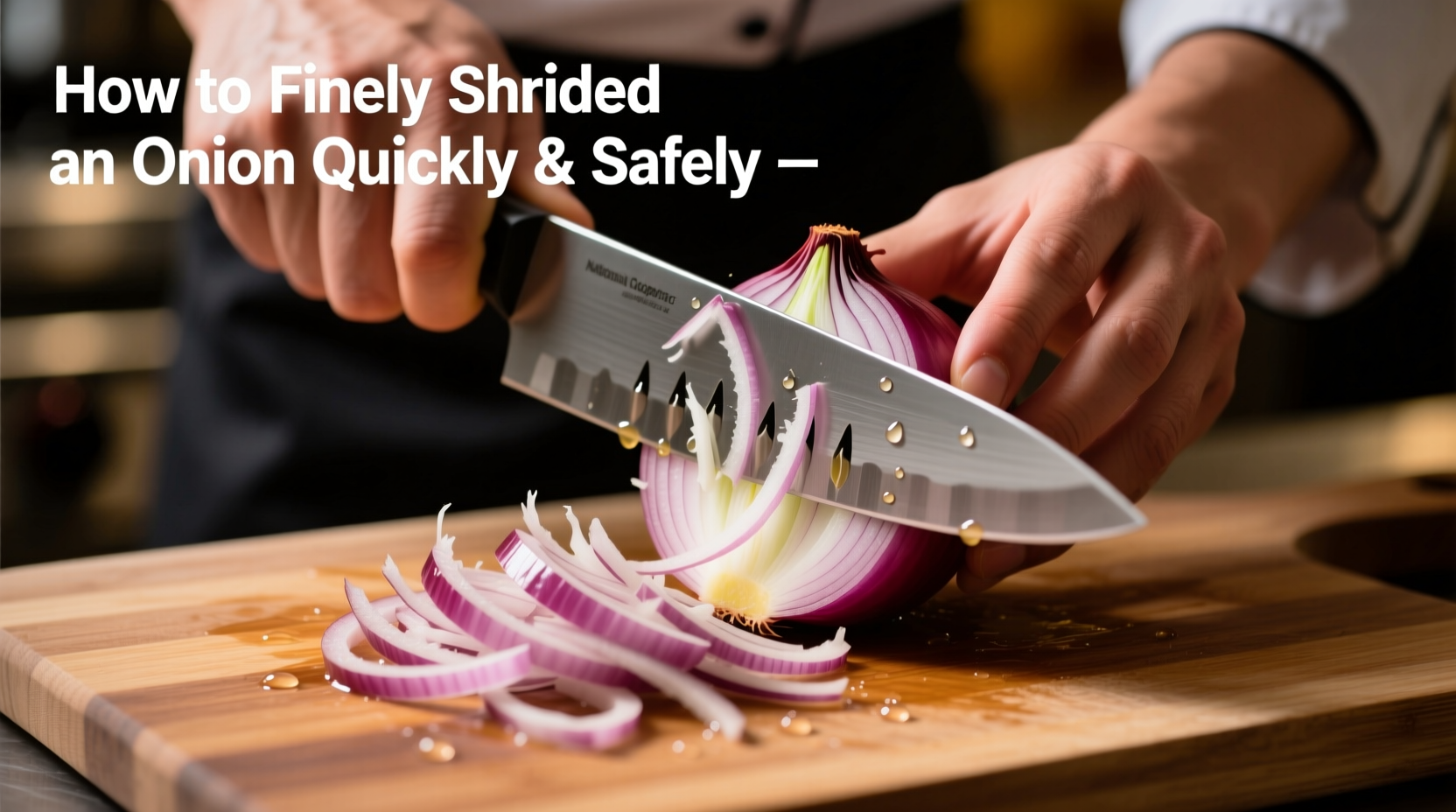
To \"finely shred\" an onion means to cut it into very narrow, uniform strips using a sharp chef’s knife and controlled slicing motions. Unlike coarse dicing or rough mincing, fine shredding preserves the onion’s cellular integrity just enough to prevent mushiness while ensuring rapid flavor dispersion during cooking or a clean, crisp texture when served raw.
This technique is rooted in classical French cuisine, where the mirepoix (a mix of onions, carrots, and celery) relies on evenly sized pieces for balanced flavor development. However, fine shredding diverges from traditional mirepoix cuts by emphasizing length and thinness over cubes. It aligns more closely with the julienne principle but applies specifically to spherical alliums like yellow, white, red, or sweet onions.
The goal is not merely aesthetic; it's functional. Thin, consistent shreds increase surface area, accelerating caramelization and softening during sautéing. In raw applications—such as salads, salsas, or ceviche—they provide a subtle presence without overwhelming crunch or pungency. Done properly, fine shredding transforms one of the most polarizing ingredients into a harmonious component of any recipe.
Key Characteristics of a Properly Shredded Onion
- Width: Strips should measure between 1 and 2 mm—thin enough to melt into sauces, yet distinct when raw.
- Length: Retains natural curvature from the onion layers, typically 1.5 to 3 inches long depending on onion size.
- Uniformity: All pieces must be nearly identical in thickness to ensure even cooking.
- Texture: Crisp when raw, tender when cooked; no bruising or clumping.
- Flavor Release: Maximizes sulfur compound dispersion for robust aroma and taste integration.
- Safety: Achieved without slipping, rocking, or compromising hand stability.
Essential Tools for Success
While knives vary in brand and style, certain features are non-negotiable for safe, efficient shredding:
- Chef’s Knife (8–10 inches): Full tang, balanced weight, and a sharp, slightly curved blade allow for smooth rocking motion.
- Sharpness: A honed edge reduces resistance, minimizing slippage and effort. Dull blades crush fibers instead of slicing them.
- Cutting Board: Stable, non-slip surface—preferably wood or high-density plastic—with raised edges to contain juices.
- Bowl of Cold Water (Optional): Soaking shredded onion briefly tames pungency and firms texture for raw use.
Pro Tip: Never use a serrated knife or mezzaluna for fine shredding. These tools compress rather than slice, releasing excess juice and creating uneven textures.
Step-by-Step Guide to Finely Shredding an Onion
The following method assumes standard kitchen safety practices and uses a single medium-sized onion (about 3 inches in diameter). Total time: approximately 90 seconds.
Step 1: Prepare Your Workspace
Place a damp towel under your cutting board to prevent movement. Fill a bowl with ice water if preparing raw onion for immediate use. Have a waste container nearby for skins and root ends.
Step 2: Trim and Halve the Onion
Lay the onion on its side. Using a sharp chef’s knife, slice off the stem end (top), removing about ¼ inch. Do not cut off the root end yet—it anchors the layers during slicing. Flip the onion upright and cut vertically through the equator, dividing it into two equal halves from pole to pole. This maintains fiber alignment along the growth axis, which is essential for clean shredding.
Step 3: Remove the Skin and Root Cap
Peel back the papery skin from each half, discarding it. Gently trim away the small knob of root tissue at the base, taking care not to separate the layers. The intact root end until now has kept the onion cohesive; removing it now allows separation while preserving structure.
Step 4: Create Guiding Cuts
Place one half flat-side down on the board, with the cut face facing downward and the root-to-stem axis horizontal. Make one vertical cut from top to bottom, directly through the center of the hemisphere. You now have two quarters. Take one quarter and rotate it so the curved outer edge faces away from you, and the newly cut inner edge rests flat on the board.
Step 5: Execute the Shredding Motion
Grip the knife handle firmly, placing your index finger and thumb on the blade’s spine near the heel for control. Tuck your free hand into a claw shape, curling fingertips inward and using knuckles as a guide against the blade’s side. Position the knife tip lightly touching the board.
Starting at the stem end, make thin, parallel vertical slices moving toward the root end, keeping each cut about 1–2 mm apart. Apply gentle forward pressure, allowing the curve of the blade to rock slightly with each descent. Stop slicing about ¼ inch before reaching the root end to maintain structural integrity during the next phase.
Step 6: Separate Into Fine Shreds
Once the vertical cuts are complete, reposition the onion quarter so the freshly sliced side faces upward. Hold the top gently with your non-knife hand and use the knife tip to nudge the bundle apart. The strips will naturally fall into individual shreds. Repeat with remaining quarters.
Step 7: Final Separation and Rinsing (If Needed)
Transfer all shreds to a bowl. For raw applications requiring milder flavor—like tacos or salads—soak in ice water for 5–10 minutes, then drain and pat dry. This removes volatile sulfur compounds responsible for harshness and tears, resulting in sweeter, crisper onion.
Safety Note: Always cut away from your body and keep your workspace well-lit. If your knife slips, it should move into open space, not toward your hands.
Variants & Types of Onion Cuts
Not every dish demands fine shredding. Understanding alternative cuts helps determine when shredding is optimal.
| Cut Type | Dimensions | Best Used In | Differentiation from Fine Shred |
|---|---|---|---|
| Julienne | 2x2x40mm sticks | Stir-fries, garnishes | Straighter, longer, often blanched; less common for onions |
| Dice (Fine) | 3–5mm cubes | Soups, stews, mirepoix | Cubed vs. strip-cut; better for slow-cooked bases |
| Mince | <2mm irregular bits | Sauces, dressings, fillings | Smaller, more fragmented; releases more liquid |
| Chiffonade (for scallions) | Thin ribbons | Garnishes, salads | Applies only to tubular greens, not bulb onions |
| Fine Shred | 1–2mm wide x 1–3” long | Salsas, quick sautés, relishes, fajitas | Optimal balance of texture, speed, and flavor release |
Comparison with Similar Ingredients
Onions are frequently substituted or confused with related alliums. While interchangeable in some contexts, their structural differences affect shredding outcomes.
| Ingredient | Texture When Shredded | Flavor Profile | Shredding Suitability |
|---|---|---|---|
| Yellow Onion | Firm, layered, holds shape | Pungent when raw, sweet when cooked | Excellent – ideal for most savory dishes |
| Red Onion | Crisp, vibrant rings | Sharper bite, mildly bitter | Very good – best raw; color fades when cooked |
| White Onion | Tender, moist flesh | Clean, sharp, slightly acidic | Good – common in Mexican cuisine |
| Shallot | Delicate, fibrous | Subtle garlic-onion blend | Fair – better minced than shredded |
| Scallion (Green Onion) | Juicy, hollow stems | Mild, grassy | Good – shred only green parts; white portion diced |
\"The difference between a home cook and a trained line cook often comes down to how they treat the onion. Uniformity isn't perfectionism—it's predictability. One bad chop can throw off timing, seasoning, and texture across an entire dish.\" — Chef Elena Ruiz, Culinary Instructor, Institute of American Kitchens
Practical Tips & FAQs
Why do my eyes burn when I cut onions?
When onion cells are ruptured, enzymes convert sulfoxides into sulfenic acid, which rapidly changes into a volatile gas called syn-propanethial-S-oxide. This gas reacts with moisture in your eyes to form mild sulfuric acid, triggering tears. To minimize exposure:
- Use a sharp knife to reduce cell damage.
- Cut near a vent or open window.
- Chill the onion for 15–20 minutes before cutting—cold slows enzyme activity.
- Avoid cutting near your face; position the board at chest level if possible.
Can I use a food processor to shred onions?
Technically yes, but with significant trade-offs. Processors tend to over-process, turning onions into mush within seconds. Even with pulse settings, achieving true fine shredding—not mincing—is difficult. Additionally, processors release far more juice and aroma, increasing pungency and reducing shelf life. Reserve mechanical shredding for large batches where precision matters less, such as stock-making or bulk soups.
How long do shredded onions last?
Stored in an airtight container in the refrigerator, finely shredded onions keep for 3–4 days. After that, moisture loss and oxidation degrade texture and flavor. For longer storage, freeze in single-use portions for up to 3 months—though thawed onions will be too soft for raw use and are best reserved for cooking.
Is there a way to shred onions without a knife?
While graters or mandolines can produce thin strips, they compromise safety and quality. Box graters crush fibers and create wet, clumped shreds. Mandolines require extreme caution and still yield inconsistent results due to onion curvature. A sharp knife remains the safest, most effective tool.
What dishes benefit most from finely shredded onion?
Recipes that demand rapid incorporation or textural finesse include:
- Fajitas and stir-fries (quick sear without burning)
- Pico de gallo and fresh salsas (clean bite, even distribution)
- Curries and tomato sauces (melt-in base layer)
- Egg salads and tuna salads (no overpowering chunks)
- Marinades and rubs (even flavor adhesion)
How much onion does one medium bulb yield when shredded?
A single medium onion (about 8 oz / 225g) yields approximately 1 cup (150g) of finely shredded onion after trimming and peeling. Adjust recipes accordingly when scaling up or substituting pre-cut varieties.
Efficiency Hack: Practice the \"two-onion rotation.\" While one onion cooks, prepare the next. With proper technique, you can shred a second onion faster than the first cools, maintaining workflow in busy kitchens.
Summary & Key Takeaways
Finely shredding an onion is not just a prep task—it's a foundational culinary skill that enhances both safety and dish quality. By understanding the structure of the onion and applying precise knife work, cooks gain control over flavor, texture, and timing. The key elements are:
- Knife Choice: An 8–10 inch chef’s knife with a sharp, curved blade enables smooth, controlled cuts.
- Technique: Vertical slicing along the grain, guided by a claw-hand grip, ensures uniform 1–2 mm shreds.
- Safety: Anchoring the onion via partial root retention prevents slipping and protects fingers.
- Functionality: Fine shreds integrate seamlessly into dishes, whether raw or cooked, offering superior consistency over dicing or mincing.
- Efficiency: Once mastered, the full process takes under two minutes per onion.
Unlike mechanical alternatives, hand-shredding preserves the integrity of the onion while minimizing irritant release. It adapts to any variety—yellow, red, white—and outperforms substitutes in most savory applications. Mastery of this technique separates rushed preparation from intentional cooking.
Ready to elevate your daily prep? Practice this method with three onions tonight. Time yourself. Refine your grip. Within a week, fine shredding will become instinctive—transforming a dreaded chore into a moment of precision and calm in the kitchen.




 浙公网安备
33010002000092号
浙公网安备
33010002000092号 浙B2-20120091-4
Comments
No comments yet. Why don't you start the discussion?