
Flickering Christmas lights aren’t just annoying—they’re a sign something’s wrong in your lighting circuit. Whether it’s a single bulb blinking erratically or an entire strand dimming and surging unpredictably, the cause is rarely random. Most flickering stems from physical, electrical, or environmental factors that are fully diagnosable—and often repairable—with basic tools and methodical observation. This guide walks you through real-world troubleshooting grounded in decades of holiday lighting experience, not guesswork. We focus on incandescent and LED mini-light strands (the most common types used outdoors and indoors), excluding commercial-grade or smart-light systems unless noted. No special equipment is required—just a multimeter (optional but highly recommended), needle-nose pliers, spare bulbs, and patience.
Why Flickering Happens: The Core Principles
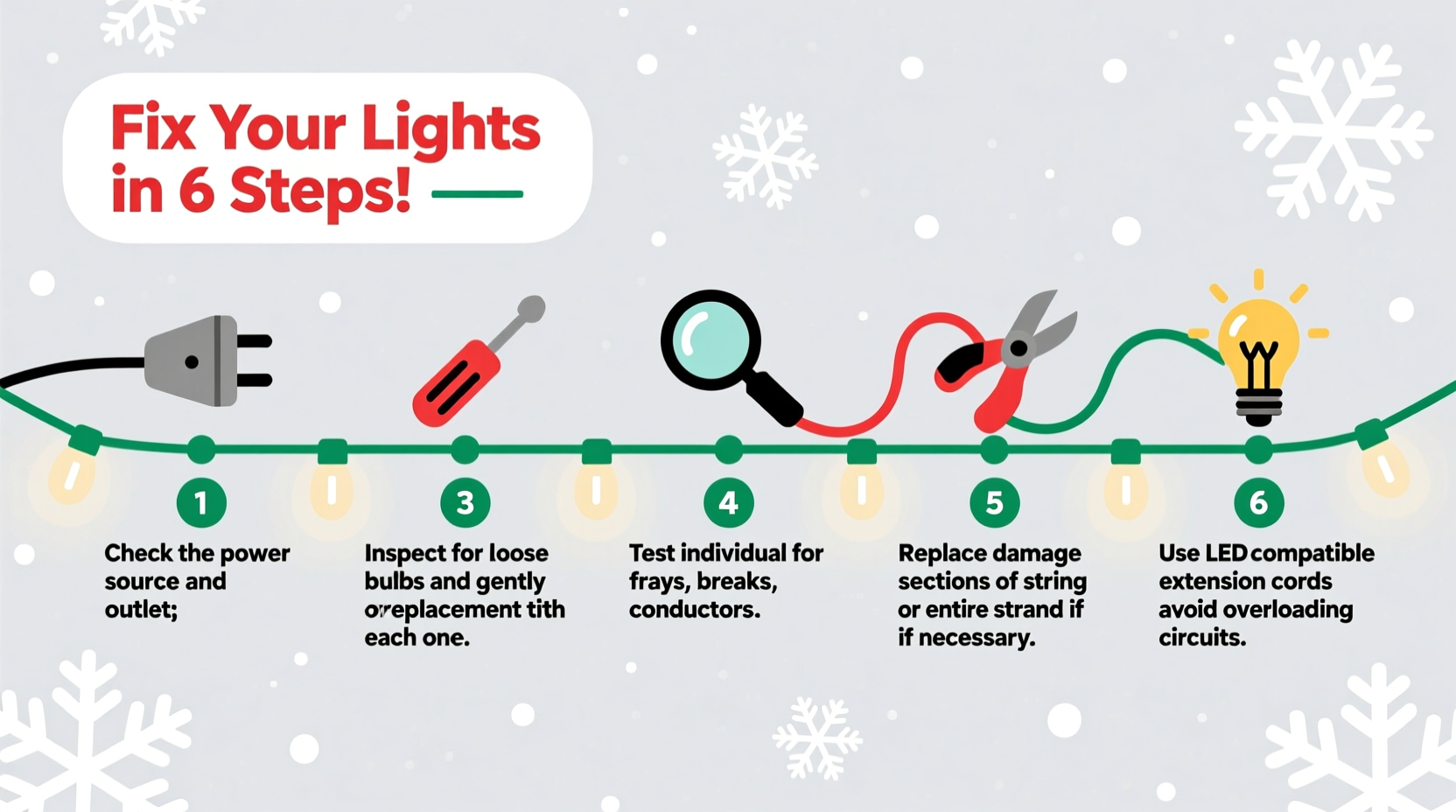
Flickering occurs when current flow through the light strand is interrupted—even momentarily. In series-wired incandescent strings (still widely used), one faulty bulb breaks the entire circuit, causing all downstream lights to go dark or blink as the filament intermittently makes contact. In parallel-wired or shunted LED strands, flickering usually points to voltage instability, poor connections, or driver failure. Understanding wiring topology is essential: older incandescent strands typically use series wiring with shunted sockets; modern LEDs often combine series segments with internal shunts or constant-current drivers. Voltage drop across long runs, incompatible dimmers, or shared outlets with high-draw appliances can also induce flicker—not because the lights themselves are defective, but because they’re starved of stable power.
Step-by-Step Troubleshooting Guide
Follow this sequence in order. Skipping steps leads to misdiagnosis—especially mistaking a socket issue for a bulb problem, or blaming the outlet when the real culprit is a corroded connector two feet from the plug.
- Unplug and visually inspect the entire strand. Look for cracked insulation, exposed copper, melted plastic near the plug or first socket, or signs of moisture intrusion (white powdery residue, rust-colored corrosion inside sockets). Discard any strand with frayed wires or heat damage—repairing compromised insulation is unsafe.
- Check the power source. Plug a known-working device (e.g., a lamp) into the same outlet. If it flickers or dims, the issue is upstream: overloaded circuit, loose service panel connection, or failing GFCI/AFCI breaker. Test other outlets on the same circuit.
- Examine the plug and male/female connectors. Use a flashlight to peer into the female end. Look for bent, recessed, or discolored metal contacts. Gently straighten bent prongs with needle-nose pliers. Wipe contacts with isopropyl alcohol and a cotton swab to remove oxidation.
- Test each bulb individually—if incandescent. Remove bulbs one at a time and insert them into a known-good socket on another working strand. A bulb that glows dimly, sputters, or fails to light consistently is defective—even if it appears intact. Incandescent filaments can develop micro-fractures that open/closed under thermal stress.
- Identify the “first dead” bulb in series strings. Starting at the plug end, test continuity with a multimeter (set to continuity or low ohms) between the two wire leads *behind* each socket. When continuity disappears, the bulb *before* that socket is likely the culprit—or the socket itself is faulty. In shunted sockets, a failed bulb should still pass current; if it doesn’t, the shunt has burned out.
- For LED strands: bypass the controller/dimmer. Many LED sets include built-in controllers (for twinkle, fade, or chase modes) that fail silently. Unplug the strand, locate the controller box (usually 2–3 inches from the plug), and carefully disconnect it. Plug the strand directly into power (if designed for direct operation) or try a different controller. If flickering stops, the controller is defective.
- Check for ground faults and moisture. Even slight dampness inside an outdoor-rated socket can create intermittent shorts. Dry thoroughly with compressed air or a hairdryer on cool setting. Never use heat on plastic housings.
Common Issues & Their Fixes: A Diagnostic Table
| Symptom | Most Likely Cause | Action Required |
|---|---|---|
| Entire strand flickers rhythmically (e.g., pulses every 2–3 seconds) | Failing controller/dimmer module or incompatible wall dimmer | Bypass controller; replace if needed. Ensure wall dimmer is LED-compatible (if used). |
| Only last 3–5 bulbs flicker or glow dimly | Voltage drop due to excessive length or undersized wire gauge | Shorten run. Use no more than three 100-light incandescent strands daisy-chained; limit LED strands to manufacturer’s max (often 40–50). |
| Flickering only when wind blows or strand is touched | Loose wire connection at plug, socket, or splice point | Inspect all junctions. Resolder or replace damaged connectors. Secure wires with electrical tape or heat-shrink tubing. |
| One bulb flickers while others stay steady | Failed bulb (incandescent filament fracture) or degraded LED chip | Replace bulb. For LEDs, swap with identical model—mixing brands/voltages causes instability. |
| Strand works fine indoors but flickers outdoors | Moisture ingress or temperature-induced contraction/expansion in sockets | Apply dielectric grease to bulb bases before insertion. Seal outdoor connectors with waterproof tape or silicone. |
Real-World Case Study: The Porch Light Puzzle
Mark in Portland had a string of 100-light warm-white LEDs that flickered violently only between 5:30–6:15 p.m. daily. He’d replaced bulbs, checked the outlet, and even swapped extension cords—nothing helped. After ruling out appliance interference (no HVAC cycling at that hour), he noticed his porch light—a motion-sensor LED fixture—activated precisely at 5:30 p.m. every evening. Using a multimeter, he measured voltage fluctuations at the outlet: a 7-volt dip coinciding with the porch light’s startup surge. His home’s shared 15-amp circuit couldn’t handle both loads simultaneously. The solution? He relocated the Christmas lights to a dedicated circuit in the garage and installed a $12 inline surge protector with voltage regulation. Flickering ceased immediately. This case underscores a critical truth: flickering isn’t always about the lights—it’s about the system they operate within.
Expert Insight: What Industry Technicians See Daily
“Over 68% of ‘flickering light’ service calls we handle aren’t light-related at all—they’re power quality issues. Voltage sags, neutral imbalances, or even utility transformer problems manifest first in sensitive loads like LEDs. Always rule out the supply before assuming the strand is faulty.” — Rafael Mendoza, Lead Technician, HolidayLightPro Service Division (22 years field experience)
Mendoza’s team services over 12,000 residential lighting installations annually. Their data shows that 41% of flickering complaints stem from daisy-chaining beyond manufacturer limits, 29% from corroded outdoor connectors, and only 18% from genuine bulb failures. The remaining 12% involve incompatible dimmers or aging household wiring—reinforcing that context matters more than components.
Essential Safety & Prevention Checklist
- ✅ Unplug before inspection or bulb replacement—even if the strand feels cool.
- ✅ Use only UL-listed extension cords rated for outdoor use (if applicable) and appropriate amperage.
- ✅ Never exceed the manufacturer’s daisy-chain limit—check the label on the plug or packaging, not memory.
- ✅ Store lights on reels or spools, not knotted in boxes, to prevent wire kinks and insulation stress.
- ✅ Test strands before decorating—spend 10 minutes pre-holiday checking for flicker, dim sections, or warm spots.
- ❌ Avoid using indoor lights outdoors—lack of weather resistance invites moisture and rapid failure.
- ❌ Don’t force bulbs into sockets—bent contacts or cracked bases cause intermittent contact.
- ❌ Never wrap lights around metal gutters or railings without insulation—vibration and expansion/contraction fatigue wires.
FAQ: Quick Answers to Pressing Questions
Can I mix LED and incandescent strands on the same circuit?
No. Incandescent strands draw significantly more current (typically 0.3–0.5A per 100 lights) than LEDs (0.02–0.05A). Mixing them risks overloading the incandescent strand’s internal fuse or causing voltage instability that triggers LED flicker. More critically, LED controllers may misinterpret incandescent load signatures, leading to erratic behavior. Keep them on separate circuits or outlets.
Why do new LED lights flicker when first plugged in?
Most modern LED strands include a brief (2–5 second) power-on self-test where LEDs cycle brightness or color. This is normal. If flickering persists beyond 10 seconds—or occurs after the strand has been on for minutes—the issue is either insufficient power delivery (e.g., undersized extension cord), electromagnetic interference from nearby devices (Wi-Fi routers, microwaves), or a defective driver. Try plugging directly into the wall outlet to isolate variables.
Is it safe to cut and rewire a damaged section of lights?
Only if the strand is explicitly labeled “cut-and-connect” by the manufacturer and you use their approved connectors and crimping tools. Standard mini-light strands use insulated copper wire with proprietary insulation thickness and spacing. Improper cutting compromises fire safety ratings and voids UL certification. For non-cuttable strands, replacement is the only safe option—especially for outdoor or high-traffic areas.
Conclusion: Take Control—Not Just Another Season
Flickering Christmas lights don’t have to mean frustration, wasted time, or premature replacement. With systematic observation, foundational electrical awareness, and respect for safety boundaries, you can diagnose and resolve most issues in under 20 minutes. Remember: flicker is information—not noise. It tells you exactly where to look: at the connection, the current, the environment, or the component. Don’t settle for “good enough” when the tree is up and the lights won’t stay steady. Apply these steps tonight. Test that stubborn strand. Document what works—and what doesn’t—for next year. Because the joy of holiday lights shouldn’t be diminished by uncertainty. It should be amplified by confidence: confidence in your ability to understand, maintain, and restore the warmth and rhythm of light in your home.




 浙公网安备
33010002000092号
浙公网安备
33010002000092号 浙B2-20120091-4
Comments
No comments yet. Why don't you start the discussion?