
Fairy lights bring warmth, charm, and a magical glow to any space. Whether draped over a bed frame, wrapped around a mirror, or hung across a patio, they elevate ambiance with minimal effort. But when it’s time to pack them away—or pull them out again—their delicate wires often turn into a frustrating knot of loops, twists, and snarls. Untangling them by hand can take minutes, even hours, depending on the severity. There is, however, a remarkably simple solution that takes less than 90 seconds and uses an item most households already have: a cardboard paper towel roll.
This method isn’t just fast—it’s reliable, repeatable, and prevents future tangles if used during storage. Forget expensive organizers or complicated wrapping techniques. The paper towel roll method leverages physics, tension control, and smart coiling to keep your lights neat and ready for next season. What was once a seasonal chore becomes a quick, satisfying task.
The Science Behind the Tangle
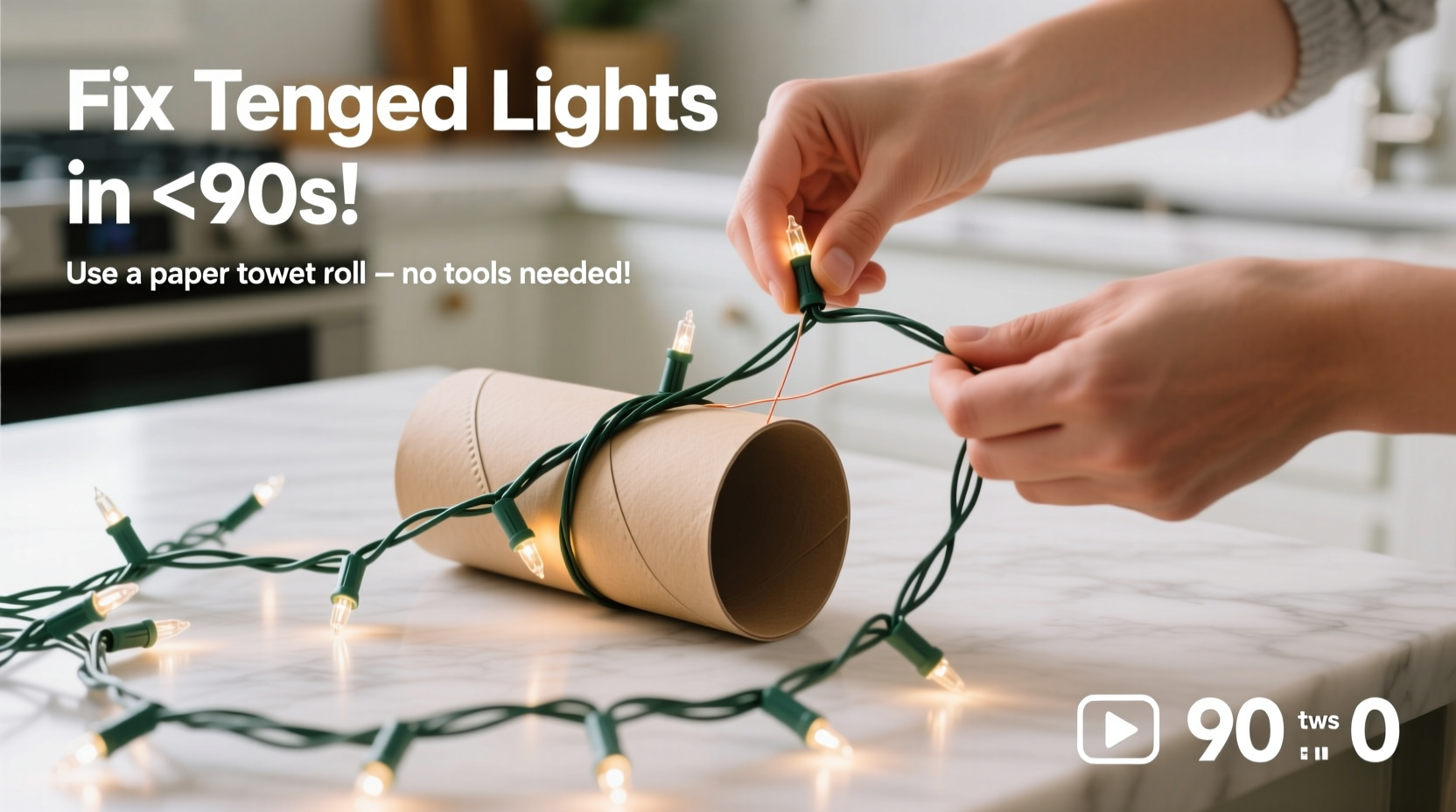
To understand why this method works so well, it helps to understand how tangles form in the first place. Fairy lights are prone to tangling due to their length, flexibility, and the way they’re typically stored—loosely bunched or thrown into a box. When wires move freely without structure, small twists compound into larger knots through a phenomenon known as “spontaneous knotting.” Studies in polymer physics have shown that even in short periods of motion, long flexible strands naturally form complex entanglements.
Fairy lights amplify this problem because they combine multiple elements: thin copper wiring, evenly spaced bulbs, and often battery packs or plugs at one end. These fixed points create resistance, making untangling harder once knots set in. Traditional methods—like pulling gently from both ends or trying to pick apart loops with fingers—often make things worse by tightening existing knots or creating new ones.
The paper towel roll method interrupts this cycle by providing a rigid core around which the wire can be evenly wound. This ensures consistent tension, prevents crossing loops, and keeps the strand organized from start to finish.
Step-by-Step Guide: The 90-Second Fix
Follow these steps precisely to eliminate tangles efficiently and prepare your lights for hassle-free storage in the future.
- Gather your materials: You’ll need your tangled fairy lights and one empty cardboard paper towel roll. Ensure the roll is clean and dry, with no residue or tears that could snag the wire.
- Locate the plug or power source: Identify the end with the battery pack or electrical plug. This will be your starting point. Never begin from the middle or the far end.
- Insert the plug into the center of the roll: Push the plug about halfway through the cardboard tube so it’s secured but still accessible. If using battery-powered lights, make sure the switch is off.
- Begin winding slowly: Hold the roll in one hand and use the other to guide the wire. Wrap the lights around the roll in a single direction, keeping each loop snug but not tight. Do not overlap or cross wires.
- Maintain steady tension: As you wind, apply gentle, even pressure. Let the cardboard core absorb any slack. If you encounter a small knot, pause and gently work it loose with your fingers before continuing.
- Secure the final section: Once all the wire is wrapped, use a rubber band, twist tie, or adhesive tab to hold the last loop in place. Avoid metal clips that could damage insulation.
- Store upright or flat: Place the roll in a drawer, shelf, or storage bin where it won’t be crushed. Ideally, store vertically like a record to prevent compression.
This entire process should take between 60 and 90 seconds once practiced. More importantly, it transforms the act of untangling into proactive maintenance, reducing future headaches.
Why Cardboard Works Better Than Alternatives
You might wonder why a humble paper towel roll outperforms plastic reels, foam spools, or dedicated light-wrapping tools. The answer lies in material properties and design simplicity.
Cardboard offers just enough rigidity to support the coil while remaining lightweight and non-abrasive. Unlike plastic, it doesn’t generate static that attracts dust or cause micro-scratches on delicate wire coatings. Its hollow center allows the plug to pass through, anchoring the start point securely. And because it’s cylindrical, it encourages smooth, uniform winding without corners or edges where wires can catch.
Additionally, cardboard is free, eco-friendly, and widely available. Most people discard these rolls without realizing their secondary utility. By repurposing them, you save money and reduce waste—all while solving a common household annoyance.
| Storage Method | Time Required | Tangle Prevention | Cost | Eco-Friendliness |
|---|---|---|---|---|
| Paper Towel Roll | 60–90 sec | High | Free (reused) | High |
| Plastic Reel | 2–3 min | Medium | $8–$15 | Low |
| Hand-Bundled (No Tool) | 5+ min | Low | Free | Medium |
| Foam Spool | 90–120 sec | Medium-High | $5–$10 | Low-Medium |
The data shows that the paper towel roll method is not only the fastest but also the most cost-effective and environmentally responsible option. While specialized tools exist, they rarely offer enough advantage to justify their expense or footprint.
Real Example: A Holiday Saver
Sarah from Portland had grown dreading December. Every year, she’d pull out her favorite string of warm-white fairy lights—meant for her living room mantel—only to find them hopelessly knotted after being stuffed into a holiday bin. One particularly bad tangle took her 20 minutes to undo, leaving her frustrated before the season had even begun.
Last November, she tried the paper towel roll method on a whim after seeing it mentioned in a home organizing forum. She started with her smallest set—just 15 feet—and followed the steps exactly. To her surprise, the lights unwound cleanly as she wrapped them, with only two minor snags that resolved instantly. The whole process took 78 seconds.
Encouraged, she repeated the method with four additional sets. Now, every string is stored on its own labeled roll, stacked neatly in a basket under the stairs. This past December, she retrieved the first roll, unwound the lights in seconds, and hung them without a single knot. “It’s changed how I think about holiday prep,” she said. “What used to be a chore now feels effortless.”
Expert Insight: Preventative Care Matters
“Most people treat fairy lights as disposable decor, but with proper handling, they can last five years or more. The key is eliminating stress points—especially tangles. A simple cardboard roll does more for longevity than any high-end storage case.” — Daniel Ruiz, Electrical Safety & Home Decor Specialist
Ruiz, who consults for several lighting manufacturers, emphasizes that repeated bending, kinking, and pulling on tangled wires accelerates wear on internal conductors. Over time, this leads to flickering, dead sections, or complete failure. Proper coiling reduces mechanical fatigue, preserving both function and safety.
Tips for Long-Term Success
To get the most out of this method, incorporate these best practices into your routine:
- Label each roll: Use masking tape and a marker to note light color, length, and intended location (e.g., “White, 20ft – Bedroom”).
- Avoid extreme temperatures: Store rolls in a climate-controlled area. Heat can warp cardboard; moisture can weaken it.
- Inspect before storing: Check for frayed wires, cracked bulbs, or corroded connectors. Repair or retire damaged sets promptly.
- Don’t overwind: If the wire doesn’t fit comfortably on one roll, split it across two. Overcrowding causes pressure and increases friction.
- Use soft ties: Rubber bands work, but fabric strips or silicone bands are gentler on insulation over time.
Checklist: Mastering the Paper Towel Roll Method
Keep this checklist handy for your next lighting session:
- ✅ Locate the plug or battery pack
- ✅ Insert plug through the center of the cardboard roll
- ✅ Begin winding from the plug end
- ✅ Keep loops parallel and non-overlapping
- ✅ Gently untie any small knots as you go
- ✅ Secure the end with a soft tie
- ✅ Label the roll for easy identification
- ✅ Store in a cool, dry, upright position
Following this checklist ensures consistency and minimizes errors, especially during busy seasons.
Frequently Asked Questions
Can this method work with LED strip lights?
Not directly. LED strips are usually rigid or semi-flexible and require flat rolling or accordion folding. However, the principle of using a core for even tension applies—consider a larger-diameter PVC pipe or a custom-cut foam roller instead.
What if my lights are already severely tangled?
Start by laying the lights flat on a carpeted floor or table. Locate the plug and gently fan out the nearest loops. Work outward slowly, using your fingers to isolate and reverse knots. Once partially loosened, transfer to the paper towel roll to finish the job and prevent recurrence.
Is there a risk of damaging the bulbs during winding?
Only if excessive force is applied. Wind slowly and avoid yanking. If bulbs are tightly spaced, wrap with extra care, ensuring each bulb passes smoothly over the previous loop. For fragile vintage-style bulbs, consider slightly wider spacing by hand-coiling loosely after the initial wrap.
Conclusion: Turn Frustration Into Flow
Fixing tangled fairy lights shouldn’t feel like solving a puzzle. With the paper towel roll method, you reclaim time, reduce stress, and extend the life of your decor. It’s a small change with outsized returns—a testament to how simple solutions often outperform complex ones.
Next time you unbox a knotted string of lights, don’t reach for scissors or resignation. Grab a cardboard roll, follow the steps, and watch chaos transform into order in under 90 seconds. Then, store it properly so next year’s setup is just as smooth.




 浙公网安备
33010002000092号
浙公网安备
33010002000092号 浙B2-20120091-4
Comments
No comments yet. Why don't you start the discussion?