
LED net lights are a favorite for holiday displays, patios, and indoor ambiance. Their grid-like design spreads light evenly, creating a magical glow across walls, trees, or ceilings. But when they come out of storage knotted like a sailor’s worst nightmare, many people reach for the scissors. Cutting wires might seem like a quick fix—but it risks breaking entire circuits, reducing brightness, or rendering the strand useless.
The good news: with patience and the right technique, you can untangle even the most stubborn knot without damaging a single bulb or wire. This guide walks you through a systematic approach, backed by electricians and decorators who deal with hundreds of strands each season. Whether you're preparing for Christmas, a wedding, or a backyard party, these methods will save your lights—and your sanity.
Why cutting wires is never the solution
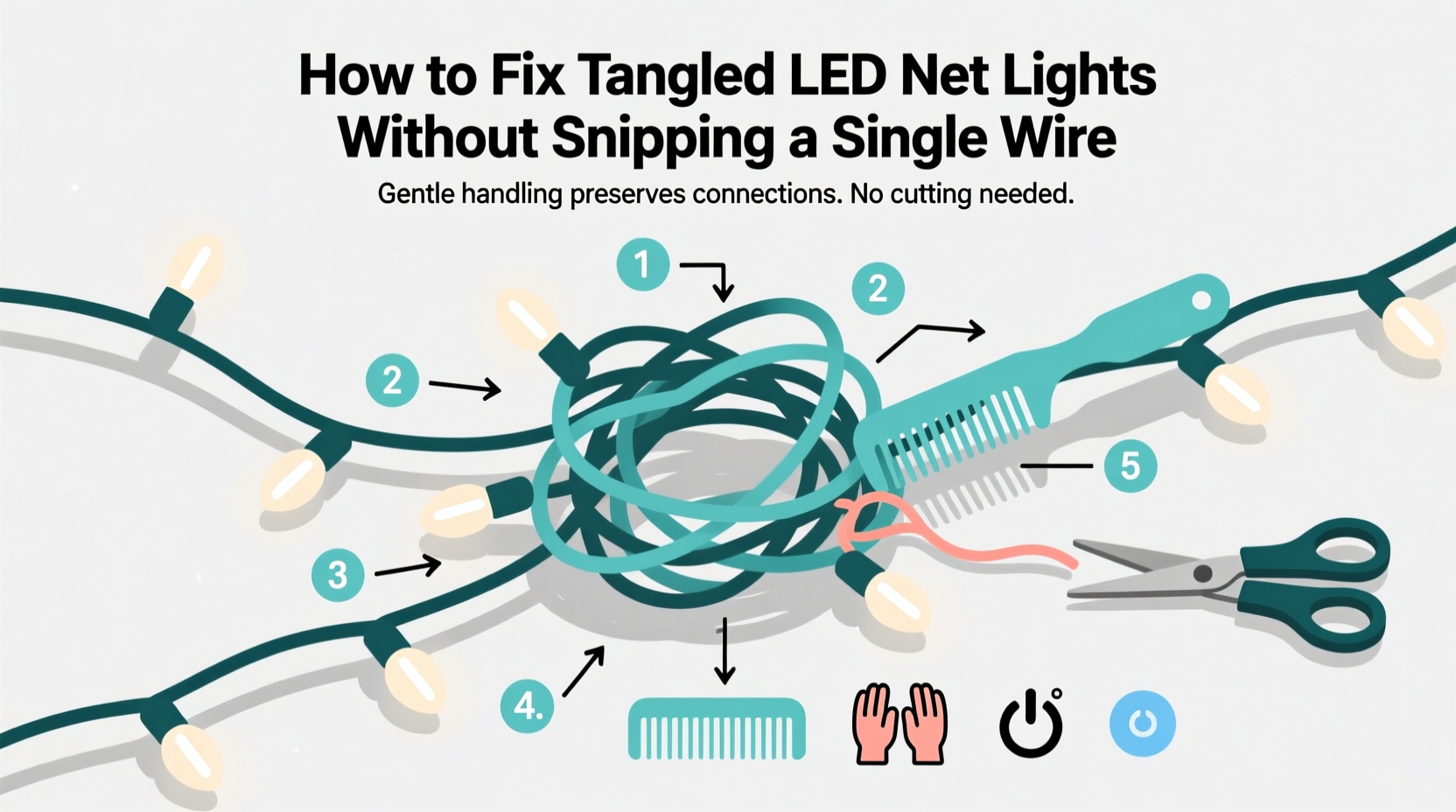
LED net lights operate on low-voltage DC current, typically in series-parallel configurations. Each bulb receives power through interconnected pathways. Severing one wire may not just disable one bulb—it can interrupt an entire segment. Even if the strand still lights up after a cut, you risk:
- Reduced lifespan due to uneven current distribution
- Increased heat at connection points near the break
- Difficulty matching replacement sections later
- Voiding manufacturer warranties
Moreover, most modern LED strings are sealed and non-modular. Unlike older incandescent sets where individual bulbs could be replaced, LEDs are often soldered directly into the circuit. Once cut, repair requires advanced tools and skills beyond typical household capabilities.
“Every wire in an LED net light serves a purpose. Snipping may solve a tangle temporarily, but it creates long-term failure points.” — Marcus Lin, Residential Lighting Technician, 12+ years experience
A step-by-step method to untangle LED net lights safely
Untangling isn’t about force—it’s about structure, observation, and gentle manipulation. Follow this timeline-tested process used by professional installers during high-volume seasonal setups.
- Prepare your workspace: Lay down a clean, flat surface—like a carpeted floor, bed, or large table. Avoid windy areas or static-prone surfaces (e.g., plastic). Ensure good lighting so you can see fine threads and junctions clearly.
- Unplug and inspect: Never work on plugged-in lights. Check for visible damage—cracked sockets, exposed copper, or melted insulation. If found, isolate that section mentally; handle it last.
- Identify entry and exit points: Locate the male plug (power end) and female connector (daisy-chain end). Hold the male plug in your non-dominant hand. This becomes your anchor point.
- Spread the net gently: Using both hands, slowly fan out the tangled mass. Do not pull hard. Let gravity help. The goal is to transition from a compact ball into a loose web.
- Find the outermost loops: Look for loops of wire that aren’t wrapped around other wires. These are your starting points. Gently lift and slide them over any obstructions—bulbs, nodes, or thicker junctions.
- Work from edge to center: As you free outer tangles, move inward. Use your fingers to “walk” along the wire path, teasing apart knots millimeter by millimeter. Think of it like untying shoelaces—small, deliberate movements prevent new snags.
- Use a seam ripper or dental pick (optional): For tight knots where fingers can’t reach, a thin, blunt-tipped tool helps separate wires without piercing insulation. Never use sharp blades.
- Test periodically: Once the majority of tangles are gone, plug in the strand briefly (on a dry surface) to ensure continuity. A working light means your efforts haven’t damaged internal connections.
Proven techniques from decorators and electricians
Seasonal lighting crews face dozens of tangled nets every year. Over time, they’ve refined strategies that minimize effort and maximize success rates.
Technique 1: The \"Roll-and-Peel\" Method
Instead of pulling wires apart, roll the tangled section between your palms like a dough cylinder. Rotate it slowly while applying slight outward pressure. This motion naturally loosens intertwined loops without stress on joints. Once rolled open, peel layers away like an onion.
Technique 2: Gravity-Assisted Unknotting
Hold the plug end and let the rest of the strand dangle vertically. Shake gently side-to-side—not up and down—to encourage knots to slide downward and unravel under their own weight. Works especially well with lightweight string types.
Technique 3: Segment Isolation
If the entire net is hopelessly knotted, divide it visually into quadrants. Focus on one 6x6 inch area at a time. Untangle completely before moving to the next. This prevents scattered progress and keeps frustration low.
“We once had a 10-foot net light pulled from attic storage—looked like a bird’s nest. Took 45 minutes using the roll-and-peel method. Came out perfect, all 250 bulbs lit.” — Dana Reyes, Holiday Lighting Crew Lead, Portland, OR
Do’s and Don’ts of handling tangled LED net lights
| Do’s | Don’ts |
|---|---|
| Work on a soft, non-abrasive surface | Place lights on rough concrete or gravel |
| Keep both ends secured during untangling | Let ends flap freely—causes re-tangling |
| Use fingers or dull tools to separate wires | Use scissors, box cutters, or pliers |
| Untangle in natural or bright white light | Work under dim or colored lighting |
| Store lights coiled loosely with tissue paper | Stuff into small boxes or crush under heavy items |
| Label connectors before storage | Assume you’ll remember which end is which |
Real example: Recovering a decade-old heirloom strand
Sarah M., a homeowner in Vermont, inherited a set of white LED net lights from her mother. Used every Christmas since 2013, they were stored in a cardboard box tucked inside a wool blanket. When she retrieved them in November 2023, the 8x12 foot net was fused into a dense core—some wires appeared welded together by time and pressure.
She resisted cutting, instead following the step-by-step method outlined here. She began by anchoring the plug to her coffee table, then spent two 20-minute sessions over two days carefully rolling and peeling knots. On the third day, she used a dental pick to dislodge a critical junction near the center. After 70 minutes total effort, the net lay flat again. She tested it—every bulb illuminated.
“I cried when they turned on,” she said. “It wasn’t just the lights. It was the memory. I couldn’t have lived with myself if I’d cut them.”
Checklist: How to prevent future tangles
Prevention is easier than correction. After successfully untangling your lights, follow this checklist before storing them again:
- ✅ Clean dust and debris with a dry microfiber cloth
- ✅ Let lights air-dry fully if cleaned with damp wipe
- ✅ Attach labels to both plug and connector ends
- ✅ Wrap loosely around a piece of stiff cardboard (e.g., 12x18 inch sheet)
- ✅ Place tissue paper or fabric between coils to reduce friction
- ✅ Store in a breathable cotton bag—not plastic, which traps moisture
- ✅ Keep in a temperature-stable location (avoid attics or garages)
Alternatively, use a rotating light winder—a handheld device that coils string lights evenly. Many models include built-in storage compartments and tension control to prevent kinks.
Frequently asked questions
Can I untangle LED net lights while they’re plugged in?
No. Always unplug before handling. Not only is it a safety hazard, but manipulating live wires increases the risk of short circuits, especially if insulation is already worn.
What if a wire is already broken or cut?
If the damage is minor and isolated, some LED nets allow bypassing dead sections using jumper wires—but this requires electrical knowledge. For most users, it’s safer to retire the strand and replace it. Consider the cost of replacement versus potential fire hazards from DIY repairs.
How long should untangling take?
For moderate tangles, expect 20–40 minutes. Severe cases may take 60–90 minutes, especially for large nets (100+ sq ft). Break the task into sessions. Rushing leads to mistakes and accidental cuts.
Final thoughts: Patience pays off
Fixing tangled LED net lights without snipping a wire isn’t magic—it’s mindfulness. Each twist holds a path, and every knot has an origin point. By approaching the task systematically, you preserve not just the functionality of the lights, but also their emotional value and longevity.
Modern LED strands can last 30,000 to 50,000 hours with proper care. That’s over ten years of nightly use. Protecting them from avoidable damage—like unnecessary cuts—is one of the simplest ways to reduce waste, save money, and maintain the charm of your favorite displays.




 浙公网安备
33010002000092号
浙公网安备
33010002000092号 浙B2-20120091-4
Comments
No comments yet. Why don't you start the discussion?