
Dining chairs are among the most used pieces of furniture in a home, yet they rarely receive the maintenance attention they deserve. Over time, repeated use, shifting weight, and minor impacts can loosen joints, especially in wooden or knock-down style chairs. The result? A persistent wobble that’s not only annoying but potentially unsafe. While many turn to screwdrivers or wood glue for repairs, what if you don’t have tools on hand—or worse, you’re staying in a rental where modifications aren’t allowed?
The good news is that a wobbly chair doesn’t always require hardware fixes. With clever positioning, everyday materials, and an understanding of structural stability, you can stabilize your dining chair quickly and quietly—no tools, no glue, no damage. This guide walks through practical, proven methods that homeowners, renters, and even guests can use to restore comfort and confidence to their seating.
Understanding Why Chairs Wobble
A wobbly chair typically results from one of three issues: loose joints, uneven legs, or floor irregularities. In traditional wooden chairs, mortise-and-tenon joints can loosen over time due to humidity changes or stress. Modern flat-pack furniture often uses cam locks or dowels that shift with use. Metal chairs may develop play in welded connections or leg brackets.
However, not all wobbling indicates structural failure. Sometimes, the problem isn’t the chair at all—it’s the floor. Uneven tiles, warped hardwood, or carpet bunching under one leg can mimic instability. Before attempting any fix, determine whether the issue lies with the chair or the surface.
“Most chair wobbles are actually caused by floor inconsistencies rather than broken joints. Always test on multiple surfaces first.” — Daniel Meeks, Furniture Restoration Specialist
To diagnose the source:
- Place the chair on a known flat, hard surface (like a tile or concrete floor).
- Gently rock the chair forward/backward and side-to-side.
- If it still wobbles, the chair itself has a stability issue. If it sits solid, the original floor was the culprit.
Once you’ve confirmed the chair is the problem, proceed with non-invasive stabilization techniques.
Immediate Fixes Using Household Items
You don’t need a toolbox to stabilize a shaky chair. Common items found in kitchens, drawers, or junk cabinets can provide temporary or even long-term support.
1. Coin or Card Shim Under the Leg
If one leg is shorter or slightly lifted, inserting a thin shim beneath it can level the chair instantly. Coins work exceptionally well because they’re rigid and won’t compress.
- Identify which leg lifts when pressure is applied.
- Slide a coin (dime, penny, or nickel) under the base of that leg.
- Test the chair. Add another coin if needed.
For carpeted floors, folded cardboard or a thick playing card can serve the same purpose. The key is rigidity—soft materials like foam or cloth will compress and fail over time.
2. Rubber Band Tension Trick
For chairs with visible leg splay—where the legs angle outward—a rubber band can act as a tension brace. This method works best on four-legged chairs with open frames.
Wrap a wide rubber band (or several looped together) tightly around the legs just below the seat. Position it where the legs begin to diverge. The band pulls inward, counteracting the outward force that causes wobble.
For added grip, use a rubber-coated elastic strap from office supplies or a hair tie with texture. Replace bands every few months as they degrade.
3. Fabric or Towel Padding for Joint Compression
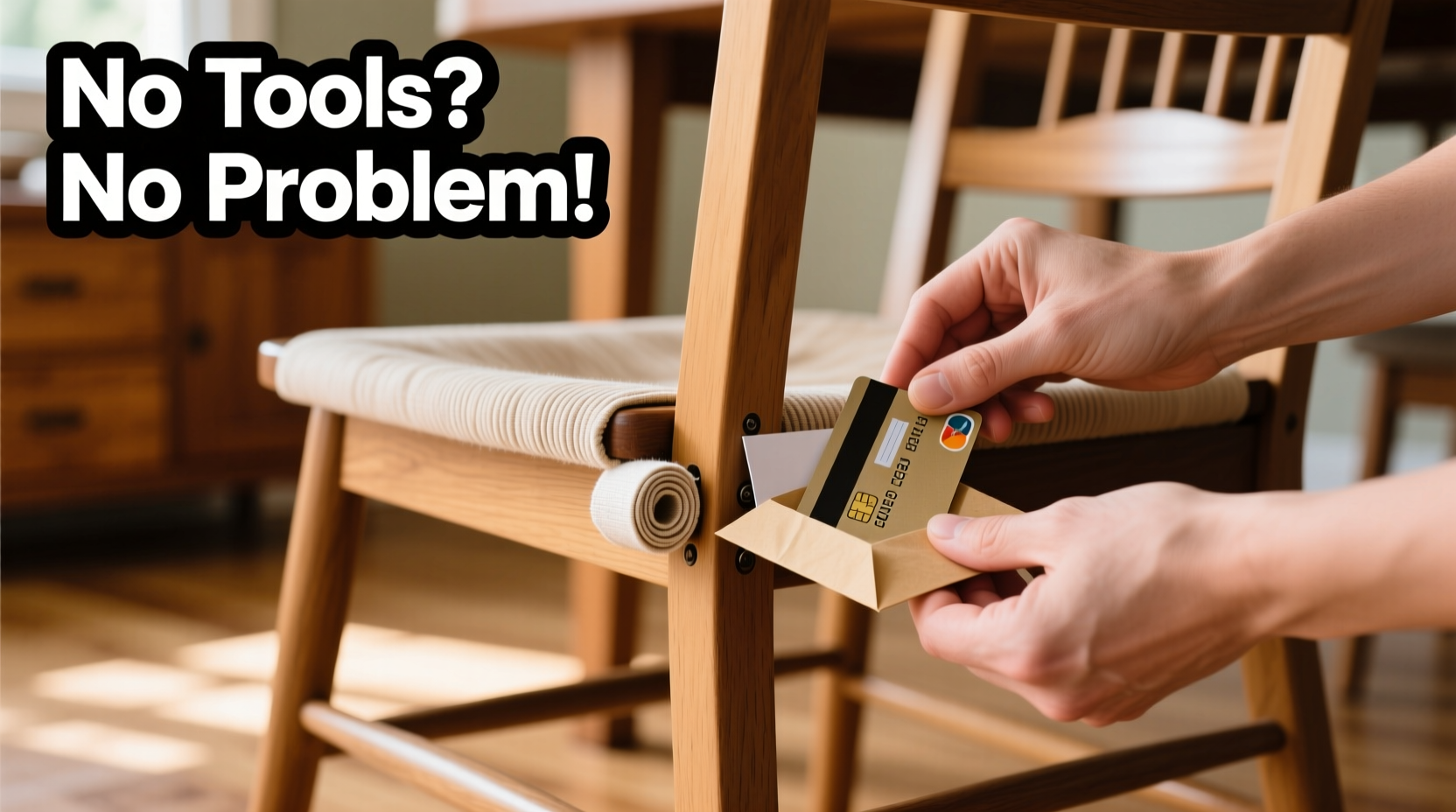
If the wobble comes from a loose joint near the seat, stuffing fabric into the gap can reduce movement. Cotton rags, strips of denim, or rolled-up socks work well.
Carefully insert a small piece of dense fabric into the space between the leg and the seat frame. Don’t force it—gentle compression is enough. The fabric acts as a cushion that dampens vibration and fills microscopic gaps.
This method is ideal for rentals or antique chairs where appearance must be preserved.
Structural Stabilization Without Adhesives
While shims and padding help with minor instability, deeper wobble often stems from internal joint play. These techniques address motion at the source—without touching a screwdriver.
Weight-Based Frame Locking
Gravity can be used to your advantage. Placing a small but heavy object inside the chair frame can dampen vibrations and reduce perceived wobble.
For chairs with hollow legs or open undersides, position a bag of dried beans, a small sandbag, or even a wrapped brick beneath the seat. Center it over the main joint intersection. The added mass reduces resonance and makes small movements less noticeable.
This technique is especially effective on lightweight modern chairs made of plastic or tubular metal.
Seat Pressure Reinforcement
Sometimes, the joint only loosens when weight is applied off-center. You can simulate constant reinforcement by adjusting how the chair is used.
Place a firm cushion or folded blanket directly on the seat. When someone sits, the padding distributes weight more evenly across all four legs, minimizing torque on weak joints. Memory foam cushions are particularly effective because they conform and maintain contact even during movement.
The Cross-Tape Method (Non-Damaging)
Although this involves tape, it’s removable and leaves no residue if done correctly. Use painter’s tape or masking tape—never duct tape, which can peel finishes.
Cut two 12-inch strips and place them diagonally across the underside of the chair, forming an “X” between opposite legs. Attach only to the wood or frame, avoiding upholstery. The tape resists lateral movement and mimics a diagonal brace.
Replace monthly or sooner if peeling occurs. This is a favorite among event planners who need quick fixes for folding chairs.
Do’s and Don’ts: What Works and What Doesn’t
| Do | Don't |
|---|---|
| Test the chair on multiple surfaces before assuming it's broken | Assume all wobble means a broken joint |
| Use rigid shims like coins or plastic cards | Use soft foam or paper that compresses over time |
| Apply tension with rubber bands or tape on leg frames | Wrap bands around delicate finishes that could scratch |
| Add weight under the seat to reduce vibration | Glue or nail anything in a rental unit without permission |
| Rotate chairs regularly to distribute wear evenly | Ignore small wobbles—they often worsen over time |
Real-World Example: The Dinner Party Save
Sarah hosted a weekly Sunday dinner for her extended family. One of her favorite vintage wooden chairs had developed a noticeable wobble after being moved frequently. With guests arriving in an hour and no tools in the house, she needed a fast solution.
She tested the chair on her kitchen tile—still wobbly. She noticed the front right leg lifted slightly. From her junk drawer, she pulled out two stacked pennies and taped them together with Scotch tape. She slid the makeshift shim under the short leg. Then, remembering the joint near the seat felt loose, she took a small dish towel, rolled it tightly, and tucked it into the gap between the leg and frame.
When her nephew sat on the chair later that evening, he commented on how “solid” it felt. Sarah never mentioned the fix—and kept the kit of coins and tape in her drawer ever since.
Step-by-Step: No-Tools Chair Stabilization Plan
Follow this sequence to systematically eliminate wobble without tools or glue:
- Diagnose the Source: Test the chair on a flat, hard surface. Determine if the issue is the floor or the chair.
- Locate the Lifted Leg: Rock the chair gently. Note which leg lifts or where movement feels loose.
- Level the Legs: Apply a rigid shim (coin, cardboard, plastic) under the shorter leg until all four touch the ground.
- Stiffen the Frame: Wrap a rubber band around the legs below the seat to add inward tension.
- Reinforce Joints: Insert a tightly rolled fabric strip into any visible joint gap near the seat.
- Dampen Movement: Place a small weighted item (bean bag, wrapped book) under the seat to reduce vibration.
- Test and Adjust: Sit on the chair carefully. Repeat steps as needed until stability is restored.
This process takes less than ten minutes and can extend the life of a chair significantly—even if permanent repair isn’t possible.
Frequently Asked Questions
Can I permanently fix a wobbly chair without glue or tools?
True permanence usually requires mechanical fasteners or adhesive. However, the methods described can provide long-term stability—especially when combined and maintained. Regular checks and replacements (e.g., new rubber bands, refreshed shims) keep the fix effective for months or even years.
Will these methods damage my chair or floor?
No. All techniques use non-abrasive, removable materials. Shims sit beneath legs without scratching, tapes are low-residue, and fabrics don’t mar wood. Always avoid adhesives or sharp objects that could leave marks.
Are these fixes safe for antique or valuable chairs?
Yes—these are preferred for antiques because they preserve original craftsmanship. Conservators often use reversible methods like fabric packing and tension bands to avoid altering historical pieces. If in doubt, consult a restoration expert before applying any material.
Final Thoughts: Stability Starts with Observation
A wobbly dining chair doesn’t have to mean a trip to the hardware store or a call to the landlord. Often, the simplest solutions are the most effective. By observing how the chair behaves, identifying the point of instability, and using common household items creatively, you can restore balance and safety in minutes.
These techniques empower you to act immediately—whether you're preparing for guests, working from your dining table, or simply want to enjoy a meal without constant rocking. Best of all, they respect the integrity of the furniture and your living space.




 浙公网安备
33010002000092号
浙公网安备
33010002000092号 浙B2-20120091-4
Comments
No comments yet. Why don't you start the discussion?