
Folding a fitted sheet has long been considered one of the great domestic challenges—right up there with parallel parking and assembling flat-pack furniture. The elastic corners twist, the fabric bunches, and what should be a neat rectangle ends up looking like a crumpled laundry grenade. But it doesn’t have to be that way. With the right technique, folding a fitted sheet can become a quick, almost meditative task that takes less than a minute. No more tossing it into the linen closet in defeat. This guide reveals a proven method that transforms chaos into order, using nothing but your hands and a few deliberate folds.
The Science Behind the Struggle
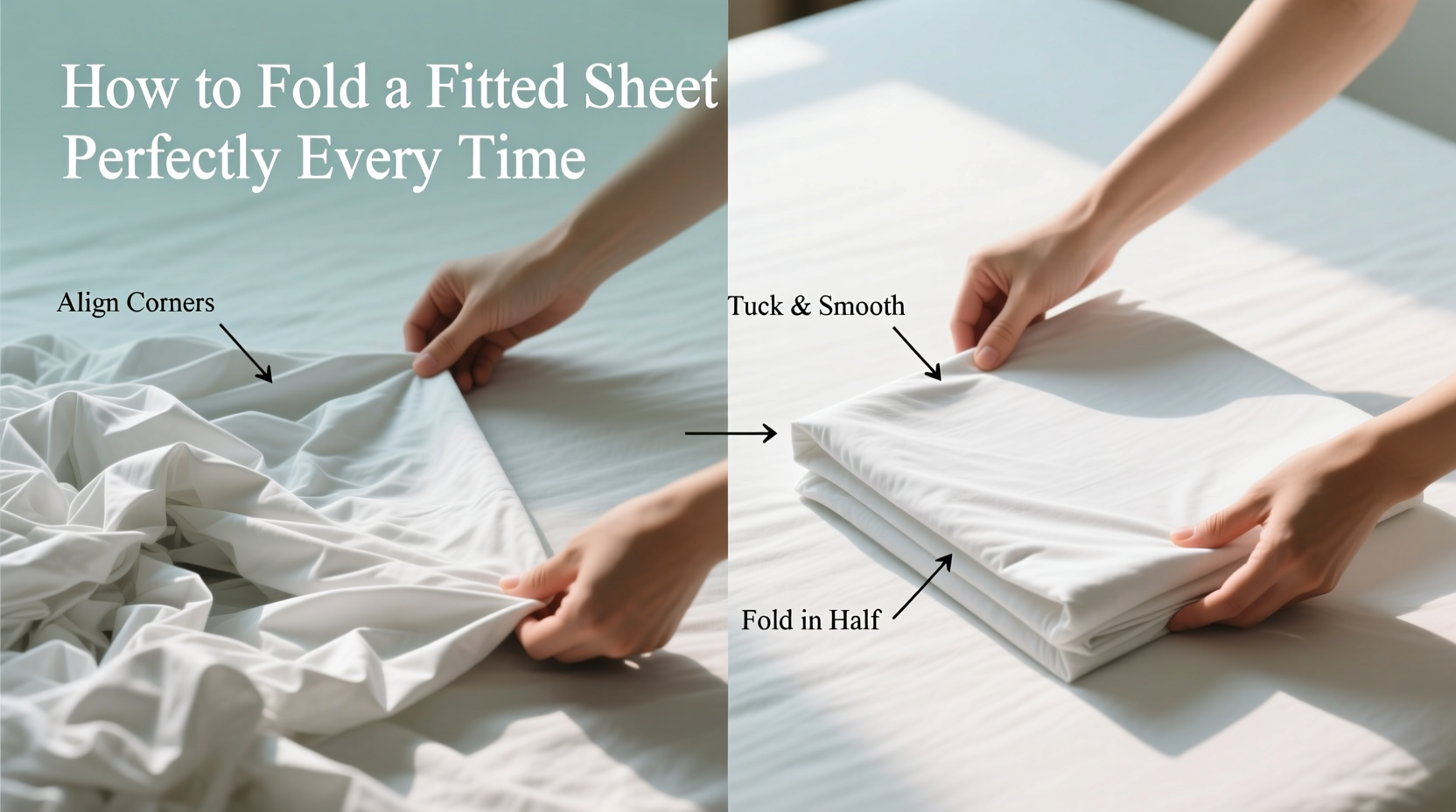
The difficulty with fitted sheets lies in their design. Unlike flat sheets, which are rectangles with straight edges, fitted sheets have elasticized corners meant to stretch over a mattress. This very feature—the elasticity—makes them unstable when unfolded. Without fixed corners or clean lines, they resist symmetry, leading most people to ball them up or give up entirely.
Marie Kondo, renowned organizing consultant and author of *The Life-Changing Magic of Tidying Up*, addresses this issue directly:
“Folding is not just about saving space—it’s about respect for your belongings. When you fold a sheet properly, you’re acknowledging its purpose and preserving its form.” — Marie Kondo, Organizing Consultant
She emphasizes that improper folding leads to cluttered storage, wrinkled linens, and a subconscious sense of disorder. The solution isn’t more storage bins or deeper shelves—it’s mastering the technique.
A Step-by-Step Guide to Perfect Folding
The following method breaks down the process into manageable, repeatable steps. Practice once or twice, and soon you’ll be able to fold a fitted sheet without even thinking about it. This approach works regardless of sheet size—twin, queen, king—and fabric type, from cotton percale to microfiber blends.
- Hold the sheet by two adjacent corners (elastic side out): Start by grasping two neighboring corners of the fitted sheet—one in each hand. Make sure the elastic edges are facing outward, not tucked inward. These will be the top two corners of your future folded rectangle.
- Turn one corner inside out and tuck it over the other: Take one of the corners in your hand and flip it inside out so it completely envelops the other corner. Now both corners are nested together, elastic sides hidden within. This creates a clean, stable edge.
- Repeat with the remaining two corners: Move to the opposite end of the sheet. Locate the two remaining corners and repeat the tucking process: flip one inside out and slide it over the other. You now have two sets of joined corners, with all elastic concealed.
- Lay the sheet flat on a surface (or hold it taut): Place the sheet on a bed, table, or countertop. Smooth it out gently so it lies as flat as possible. The tucked corners should now form two clean ends, with the body of the sheet forming a long rectangle.
- Fold lengthwise once or twice: Bring one long edge toward the center, then bring the opposite edge over it. Depending on the width of the sheet, you may need only one fold or two to achieve a balanced shape.
- Fold crosswise into a compact rectangle: Starting from one end, fold the sheet in thirds or quarters—whichever yields a neat, stackable square. Keep folds crisp by smoothing each layer before proceeding.
- Store immediately or place atop matching flat sheet: For best results, store the folded fitted sheet with its corresponding flat sheet and pillowcases. This keeps sets together and maintains organization.
Do’s and Don’ts of Fitted Sheet Folding
Mistakes often stem from small missteps—grabbing the wrong corners, rushing the tuck, or folding too early. The table below outlines common errors and how to avoid them.
| Do’s | Don’ts |
|---|---|
| Always start with elastic side out – Ensures proper nesting of corners. | Don’t grab opposite corners first – This creates diagonal tension and misalignment. |
| Smooth the fabric before final folds – Prevents bulges and uneven stacks. | Don’t fold while holding the sheet loosely – Leads to crooked edges and wasted effort. |
| Pair fitted and flat sheets immediately after folding – Saves time during bedding changes. | Don’t shove the sheet into the closet un-folded – Encourages wrinkles and disorganization. |
| Practice the tuck-and-nest move slowly at first – Muscle memory develops quickly with repetition. | Don’t skip the corner-tucking step – It’s the foundation of a clean fold. |
Real-Life Example: From Chaos to Calm
Sarah, a working mother of three in Portland, Oregon, used to dread laundry day—not because of the volume, but because of the linen closet. “Every time I pulled out a fitted sheet, it was tangled with another one, or half-unfolded, or just balled up,” she recalls. “I’d waste five minutes trying to find the corners, and by then I just didn’t care.”
After watching a short tutorial based on this method, she tried it once with a queen-sized cotton sheet. “It took me maybe 90 seconds, but when I finished, it was actually rectangular. I couldn’t believe it.” She repeated the process with her other sets and stacked them neatly with their matching flat sheets. “Now my closet looks like something out of a catalog. And I don’t stress about changing beds anymore.”
This transformation wasn’t due to new products or extra time—it came from applying a consistent, logical system. Sarah now teaches the method to her teenage daughters, calling it “one of the few useful life skills I’ve actually passed down.”
Expert Tips for Long-Term Success
Mastering the fold is just the beginning. To maintain consistency and make the process effortless over time, consider these expert-backed strategies:
- Fold immediately after drying: Warm sheets are more pliable and less likely to crease deeply. Folding while slightly warm also helps release residual wrinkles.
- Use the “bundling” method for storage: Place the folded fitted sheet on top of its matching flat sheet, then wrap both around the pillowcases. This keeps complete sets together and simplifies bedtime routines.
- Label if necessary: For households with multiple bed sizes, attach small fabric labels or use colored tags to distinguish sets at a glance.
- Teach others in the household: Share the technique with family members or roommates. Uniformity prevents one person from undoing the system.
Checklist: Fold a Fitted Sheet Like a Pro
Keep this checklist handy until the process becomes second nature:
- ✅ Grab two adjacent corners, elastic side out
- ✅ Tuck one corner inside the other
- ✅ Repeat with the opposite two corners
- ✅ Lay sheet flat on a surface
- ✅ Smooth out wrinkles
- ✅ Fold lengthwise into a narrow strip
- ✅ Fold crosswise into a compact rectangle
- ✅ Store with matching bedding set
Frequently Asked Questions
Can this method work with oversized or extra-deep fitted sheets?
Absolutely. The depth of the pocket doesn’t change the geometry of the corners. As long as you correctly pair adjacent corners and tuck them neatly, the folding sequence holds true regardless of sheet thickness or size.
What if my sheet still comes out lumpy?
Lumpiness usually results from incomplete corner tucking or failing to smooth the fabric before folding. Double-check that both sets of corners are fully nested and that the sheet lies flat before making any folds. If needed, refold one section at a time to isolate the issue.
Is it worth folding fitted sheets this way if I’m in a hurry?
Yes—especially because a well-folded sheet saves time later. A crumpled sheet takes longer to unfold and re-smooth when making a bed. The initial investment of 60–90 seconds pays off in efficiency and reduced frustration down the line.
Making Order Out of Chaos
Folding a fitted sheet perfectly isn’t about perfectionism—it’s about control. In a world full of unpredictable variables, being able to consistently create order from what seems like disorder is empowering. This skill doesn’t require special tools, expensive organizers, or hours of practice. It requires attention, patience, and a willingness to try a better way.
Once mastered, the technique becomes automatic. You’ll reach for the fitted sheet without hesitation, knowing exactly what to do. Your linen closet will reflect that confidence—neat rows of uniform bundles, ready for use. More than just a household trick, this is a small act of mindfulness, a quiet victory in the daily pursuit of simplicity.




 浙公网安备
33010002000092号
浙公网安备
33010002000092号 浙B2-20120091-4
Comments
No comments yet. Why don't you start the discussion?