
Folding clothes might seem like a mundane chore, but when done the right way, it transforms cluttered drawers into neatly organized spaces that maximize every inch. For those living in compact apartments, dorm rooms, or simply dealing with limited wardrobe space, mastering professional folding techniques is not just convenient—it’s essential. The right folds can double your drawer capacity, keep garments wrinkle-free, and make daily dressing faster and more efficient.
Unlike tossing clothes haphazardly into a drawer, strategic folding creates stability, uniformity, and accessibility. Whether you're packing for travel or reorganizing your closet after a seasonal shift, these methods apply universally. What separates amateurs from pros isn’t speed—it’s precision, consistency, and understanding how fabric behaves under compression.
The KonMari Fold: The Foundation of Space-Saving Success
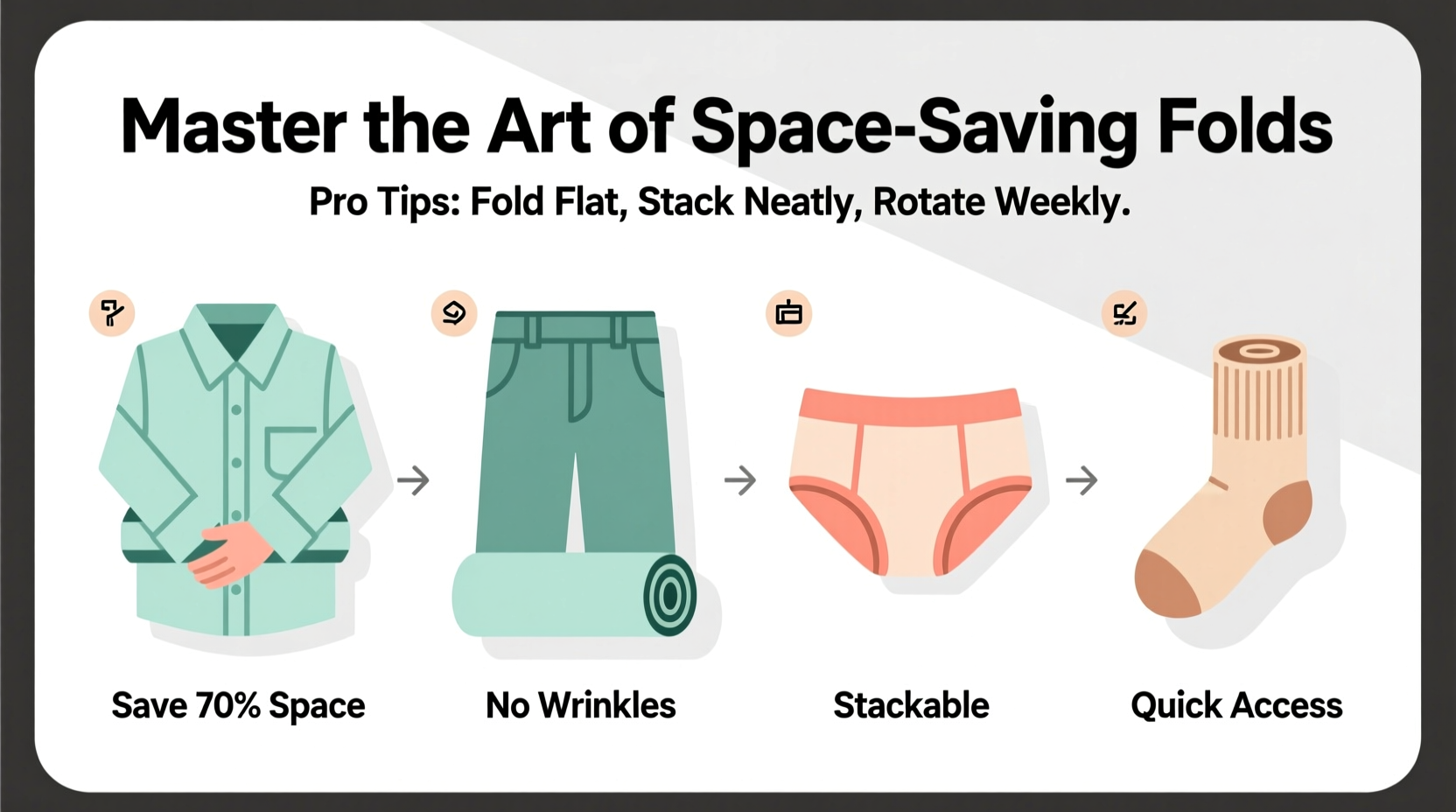
Popularized by organizing expert Marie Kondo, the KonMari folding method revolutionized how people store clothing. Instead of stacking items flat, this technique emphasizes vertical folding so each piece stands upright, visible at a glance. This eliminates the need to rummage through piles, reducing wear on garments and saving time.
The core principle? Fold clothes into compact rectangles that can stand on their own. This works exceptionally well for t-shirts, sweaters, pajamas, and casual wear.
Step-by-step: KonMari fold for a standard t-shirt
- Lay the shirt flat on a clean surface, face up.
- Fold one side inward about one-third of the way, aligning the edge toward the center.
- Repeat with the opposite side so both folds meet neatly in the middle.
- Fold the bottom up about one-third, creating a clean horizontal line across the shirt.
- Fold the top down to meet the bottom fold, enclosing any remaining collar or shoulder area.
- Flip the folded rectangle over so the smooth side faces forward.
This final product stands vertically in a drawer, allowing you to see every shirt without disturbing others. It also prevents slumping and maintains shape over time.
Clothing-Specific Folding Techniques
Not all garments respond well to the same fold. Tailoring your approach based on fabric weight, structure, and usage ensures longevity and optimal space use.
Folding Button-Down Shirts Without Wrinkles
Dress shirts require care to avoid creasing critical areas like collars and cuffs. While hanging is ideal, folding becomes necessary during travel or drawer storage.
- Lay the shirt face-down, smoothing out sleeves and shoulders.
- Bring one side of the shirt across the back, folding along the shoulder seam.
- Cross the opposite side over the first, overlapping slightly to form a straight edge.
- Fold the bottom third upward, then fold the top third down to create a compact rectangle.
- Store vertically or stack flat if unavoidable.
This method minimizes friction between buttons and fabric, reducing snags and shine marks.
Maximizing Sweater Storage
Heavy knits should never be hung long-term—they stretch out of shape. Folding preserves drape and elasticity.
- Fold sleeves inward first to create a clean rectangle.
- Fold the sweater in half vertically if needed for width control.
- Fold the bottom up two-thirds, then fold the top down over it.
- Store flat or upright depending on drawer depth.
Underwear and Socks: Roll, Don’t Fold
Small items take disproportionate space when folded traditionally. Rolling saves room and keeps pairs together.
- Lay socks flat, one on top of the other.
- Roll tightly from toe to cuff.
- Secure with a rubber band or place in a small compartment.
For underwear, especially briefs or boxers, roll from the waistband down. Thongs and bikini cuts benefit from being rolled individually to avoid tangling.
Do’s and Don’ts of Drawer Organization
A well-folded garment loses its advantage if stored incorrectly. These guidelines ensure your efforts last.
| Do | Don't |
|---|---|
| Group similar items (e.g., all t-shirts together) | Mix heavy and lightweight fabrics in the same stack |
| Use drawer dividers or small boxes for categories | Overfill drawers to the point of resistance |
| Fold heavier items at the bottom of stacks | Fold damp clothes—this encourages mildew and odors |
| Rotate seasonal items quarterly | Ignore signs of overcrowding or misshapen folds |
| Label compartments for quick identification | Store jeans or denim folded sharply at the knees—this creates permanent creases |
“Efficient folding starts with intention. Every fold should serve a purpose: visibility, protection, or compression.” — Lena Torres, Professional Organizer & Author of *The Minimal Closet*
Real-Life Example: Transforming a Studio Apartment Wardrobe
Sophie, a graphic designer living in a 450-square-foot studio in Brooklyn, struggled with overflowing drawers and constant laundry cycles. Her衣柜 (wardrobe) consisted of three shallow drawers meant for linens, now repurposed for clothes. After attending a home organization workshop, she applied professional folding techniques to her space.
She began by sorting garments by frequency of use and category. Using the KonMari method, she folded 30 t-shirts into standing rectangles, fitting them into a single drawer previously occupied by half that number. She rolled her eight pairs of socks and placed them in a recycled glass jar as a decorative organizer. Delicate blouses were folded with acid-free tissue and stored flat beneath sweaters.
The result? One full drawer was freed up for accessories. Dressing time dropped from seven minutes to under two. More importantly, her clothes stayed fresher longer because they weren’t crushed or tangled.
Sophie’s experience underscores a universal truth: smart folding isn’t about perfection—it’s about function meeting simplicity.
Advanced Tips for Maximizing Small Spaces
Beyond basic folding, several advanced strategies amplify storage efficiency.
Use Shelf Dividers or DIY Boxes
Repurpose shoeboxes, gift boxes, or purchase modular drawer inserts. These keep folded sections upright and prevent leaning. Cover cardboard containers with wrapping paper or contact paper for a polished look.
Stack Strategically
Place heavier, less-used items at the base—like jeans or sweatshirts—and lighter, frequently worn pieces on top. Avoid stacks taller than the drawer height; instability leads to collapse and frustration.
Color-Code for Visual Efficiency
Arrange folded clothes in rainbow order or by outfit type. This makes coordination easier and turns your drawer into a functional display. Neutral tones on one end, brights on the other, or workwear separated from loungewear—all enhance usability.
Seasonal Rotation System
Every three months, swap out off-season clothing. Store off-season items in vacuum-sealed bags under the bed or on high shelves. Not only does this free up prime drawer real estate, but it also protects fabrics from dust and sunlight exposure.
Checklist: Fold Like a Pro in 7 Steps
Follow this actionable checklist to transform your drawer organization today:
- Empty completely: Remove all contents and wipe down the drawer interior.
- Sort by category: Group tops, bottoms, underwear, sleepwear, etc.
- Edit ruthlessly: Donate or discard items not worn in the past six months.
- Select folding method: Apply KonMari for casual wear, rolling for smalls, flat folding for delicates.
- Create zones: Assign sections using dividers or mental boundaries.
- Fold uniformly: Ensure all pieces are the same height and width for neat stacking.
- Maintain weekly: Reset folds every laundry cycle to preserve order.
Frequently Asked Questions
Can I use these folding methods for travel packing?
Absolutely. The KonMari fold and rolling techniques are widely used by frequent travelers. Vertical folding allows you to see all options in your suitcase, while rolled clothes fit snugly into gaps, minimizing empty space and shifting during transit.
Will folding damage my clothes over time?
Not if done correctly. Natural fibers like cotton and wool tolerate folding well. Avoid sharp creases on structured garments like blazers—those are better hung. For delicate silks, fold loosely and buffer with tissue paper to prevent stress on seams.
What if I don’t have drawer dividers?
You don’t need specialized tools. Use small baskets, cosmetic cases, or even folded cardboard to create compartments. The goal is separation, not perfection. Repurpose what you already own before investing in organizers.
Final Thoughts: Mastery Begins with a Single Fold
Learning how to fold clothes like a pro isn’t about achieving Instagram-worthy drawers overnight. It’s about building habits that support clarity, efficiency, and respect for your belongings. Each precise fold is a small act of mindfulness—an investment in daily ease.
In small living spaces, every inch counts. By adopting these proven techniques, you reclaim not just physical space, but mental calm. No more digging for a missing sock or untangling a pile of sweaters. Just open a drawer, see exactly what you need, and go.
Start tonight. Pull out one drawer. Fold ten items properly. Notice the difference. Then do it again tomorrow. Consistency beats intensity when it comes to organization. And soon, you won’t just fold clothes—you’ll command your space.




 浙公网安备
33010002000092号
浙公网安备
33010002000092号 浙B2-20120091-4
Comments
No comments yet. Why don't you start the discussion?