
Opening your drawer to neatly stacked, visible clothing that stays in place throughout the week is more than just satisfying—it’s transformative. The KonMari method, developed by organizing consultant Marie Kondo, isn’t just about tidying up; it’s about creating a relationship with your belongings that sparks joy. A cornerstone of this philosophy is folding clothes vertically so each piece stands on its own, like files in a filing cabinet. This technique saves space, reduces wrinkles, and makes every item instantly accessible. What many don’t realize is that once mastered, this system can be applied quickly—without sacrificing precision or results.
The Philosophy Behind Vertical Folding
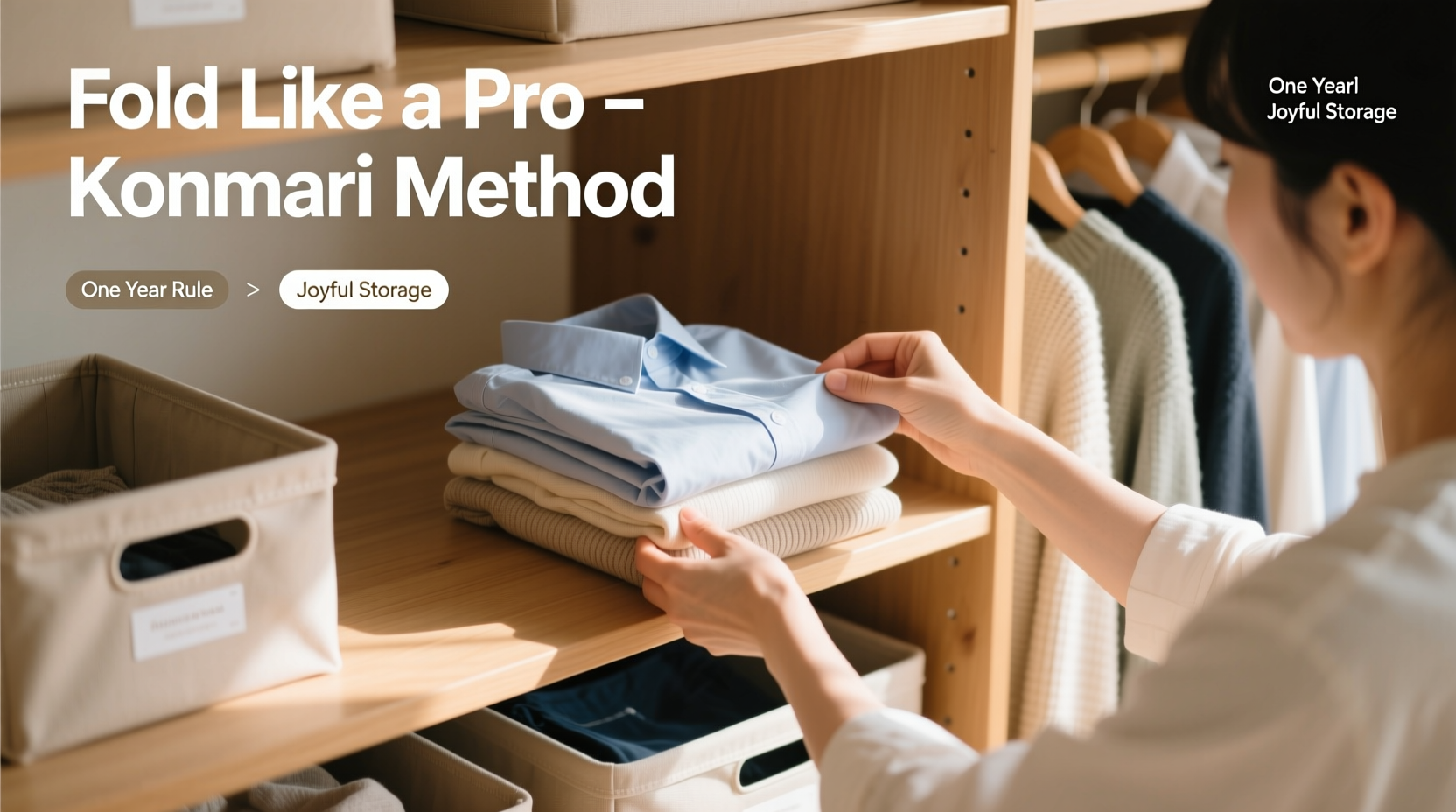
Before diving into the mechanics, it's important to understand why the KonMari method emphasizes vertical folding over traditional stacking. When clothes are folded flat and piled on top of one another, only the top item is visible. The rest get buried, forgotten, and often unworn. This leads to inefficient use of wardrobe space and decision fatigue when getting dressed.
Marie Kondo observed that people tend to pull from what they can see. By folding garments vertically, you create a “display” effect. Each shirt, pair of socks, or underwear is upright, visible, and easy to remove without disturbing the others. This not only maximizes drawer space but also encourages mindful consumption—because you can clearly see what you own, you’re less likely to buy duplicates.
“The goal is not just a tidy room. It’s to arrange your belongings so they support the life you want to lead.” — Marie Kondo
This mindset shift—from hoarding out of habit to curating with intention—is what sets KonMari apart from other organizational systems.
Step-by-Step Guide: Mastering the KonMari Fold in Minutes
The key to folding like a pro is consistency and repetition. Once you’ve practiced the basic rectangle fold, you’ll be able to apply it to nearly every category of clothing. Below is a streamlined process designed for speed and precision.
- Gather all similar items: Pull out all shirts, pants, or undergarments from your closet and drawers. Sort them by type and lay them on a clean, flat surface.
- Declutter first: Hold each item and ask, “Does this spark joy?” If not, set it aside for donation or recycling. This step ensures you're only organizing what truly matters to you.
- Use a folding board (optional): While not required, a KonMari folding board helps achieve uniform size and shape across multiple garments, especially useful for t-shirts and button-downs.
- Apply the rectangle fold: This is the core technique used for most clothing.
The Universal Rectangle Fold
This method works for t-shirts, blouses, pajamas, and lightweight sweaters:
- Lay the garment face-up on a flat surface.
- Fold one side toward the center, aligning the sleeve edge with the middle of the chest area.
- Repeat with the opposite side so both sleeves now meet in the center.
- Fold the bottom third upward, tucking any excess fabric neatly.
- Fold the top third down to complete a compact rectangle.
- Stand the fold upright, with the smoothest side facing forward.
Clothing-Specific Folding Techniques
Not all garments respond to the standard rectangle fold. Here’s how to adapt the method for different types of clothing while maintaining speed and consistency.
T-Shirts & Casual Tops
Use the universal rectangle fold. For thicker fabrics like hoodies, press gently after folding to remove air pockets and ensure stability when standing.
Button-Down Shirts
To prevent collar creasing and maintain structure:
- Button the top two buttons.
- Lay face-down, then fold each side inward at a slight angle (about 30 degrees) to preserve the shoulder line.
- Fold the bottom up, then the top down.
- Rotate and store vertically with the collar facing up.
Pants & Jeans
Avoid rolling or bunching. Instead:
- Lay flat, legs aligned.
- Fold lengthwise if wide-legged; otherwise, keep as-is.
- Fold in thirds from the bottom up—first ankles, then knees, finally waistband.
- Store upright in drawers or stack horizontally in shallow bins.
Socks & Underwear
These small items benefit most from visibility:
- Socks: Lay flat, heel-to-toe. Fold the toe end up about one-third, then fold again so the heel sits neatly on top.
- Underwear: Fold briefs or boxers into a small square. For bras, nest the cups and fold straps inward to form a stable base.
Do’s and Don’ts of KonMari Folding
| Do | Don’t |
|---|---|
| Fold all like-items at once to build rhythm | Fold one sock at a time across multiple loads |
| Store folded clothes vertically in drawers | Stack folded clothes horizontally like pancakes |
| Use drawer dividers to maintain sections | Let categories mix (e.g., t-shirts with pajamas) |
| Label sections if sharing space with others | Overfill drawers—this causes collapse and mess |
| Reassess folds monthly for efficiency | Ignore items that consistently fall over—refold or resize |
Real-Life Example: Transforming a Chaotic Drawer
Sarah, a busy marketing executive and mother of two, struggled with a bedroom drawer that spilled over every morning. Her kids would rummage through her clothes looking for hair ties or misplaced toys. She spent an average of 12 minutes per day searching for matching socks or a clean blouse.
After dedicating one Sunday morning to the KonMari method, Sarah pulled everything out, kept only what sparked joy (donating nearly 40% of her wardrobe), and folded the remainder using the vertical technique. She used small cardboard dividers to separate categories: work blouses, casual tees, workout tanks, and sleepwear.
Within a week, she noticed a dramatic change. Mornings became smoother—she could see every option at a glance. Her children stopped digging because the drawer stayed neat. Most surprisingly, she started wearing pieces she’d forgotten she owned, simply because they were now visible.
“It’s not just about folding,” Sarah said. “It’s about respecting my space and my time. I get dressed faster and feel more put together—even on chaotic days.”
Checklist: Quick KonMari Folding Routine
Follow this checklist to streamline your folding process and maintain momentum:
- ☐ Clear a flat workspace (bed or table)
- ☐ Empty one drawer or closet section at a time
- ☐ Sort items by category (not by color or season)
- ☐ Hold each item and decide: Does it spark joy?
- ☐ Keep only what brings value or happiness
- ☐ Begin folding using the rectangle method
- ☐ Store vertically, facing forward, in designated zones
- ☐ Repeat for next category until entire wardrobe is complete
- ☐ Re-evaluate monthly for adjustments
FAQ: Common Questions About KonMari Folding
Can I use the KonMari method for bulky items like sweaters?
Yes, but with caution. Heavy knits may sag or stretch if stored upright long-term. Fold them using the rectangle method, but store in shallow drawers or on shelves. Avoid hanging, as this can distort the shoulders. For delicate woolens, consider placing tissue paper between folds to maintain shape.
How do I prevent folded clothes from falling over?
Ensure each fold is tight and rectangular. Overly loose folds lack structural integrity. Use drawer organizers or acrylic dividers to create compartments. If items still topple, reduce the number per stack—ideally no more than 8–10 folded garments in a single column.
Is it worth folding clothes this way if I live alone or don’t care about organization?
Absolutely. Even minimalists benefit from clarity and ease. The KonMari method reduces decision fatigue and laundry pile-ups. You’ll spend less time hunting for clothes and more time doing what matters. Plus, a tidy space often leads to a clearer mind—regardless of lifestyle.
Maximizing Speed Without Sacrificing Quality
The misconception that KonMari folding is time-consuming stems from trying to perfect every fold on the first attempt. In reality, efficiency comes with repetition. Here’s how to fold like a pro—fast:
- Create a folding station: Dedicate a corner with good lighting and enough surface area. Keep hangers, labels, and dividers nearby.
- Batch-fold by type: Fold all t-shirts, then all pants, etc. Repetition builds speed.
- Pre-sort during laundry: As you transfer clothes from washer to dryer, group them by folding category. This saves time later.
- Teach household members: Show family members the method once. Uniformity prevents re-folding and maintains order.
- Invest 30 minutes weekly: Instead of spending hours quarterly, maintain freshness with short, consistent sessions.
“Tidying is not a one-time chore. It’s a continuous practice of aligning your environment with your values.” — Marie Kondo
Conclusion: Turn Folding Into a Ritual That Sparks Joy
Folding clothes using the KonMari method isn’t about perfection—it’s about intention. When you take the time to fold deliberately, you’re not just organizing fabric; you’re honoring the role your clothing plays in your daily life. And with practice, this ritual becomes quick, almost meditative, transforming a mundane chore into a moment of mindfulness.
You don’t need special tools or hours of free time. Start with one drawer. Fold ten items correctly. See how it feels to open a space where everything has its place and purpose. From there, expand gradually. The cumulative effect is profound: less stress, better choices, and a wardrobe that reflects who you are—not who you used to be.




 浙公网安备
33010002000092号
浙公网安备
33010002000092号 浙B2-20120091-4
Comments
No comments yet. Why don't you start the discussion?