
Folding fitted sheets has long been considered one of the most frustrating household tasks. Unlike flat sheets or pillowcases, their elastic edges resist neat folding, often resulting in lumpy bundles that don’t fit well on shelves. But mastering this skill isn’t just about tidiness—it’s about efficiency, space-saving, and maintaining the longevity of your linens. A properly folded fitted sheet lies flat, resists creasing, and stacks cleanly alongside its matching set. With the right technique, anyone can transform this chore from a source of frustration into a quick, satisfying routine.
The Problem with Fitted Sheets
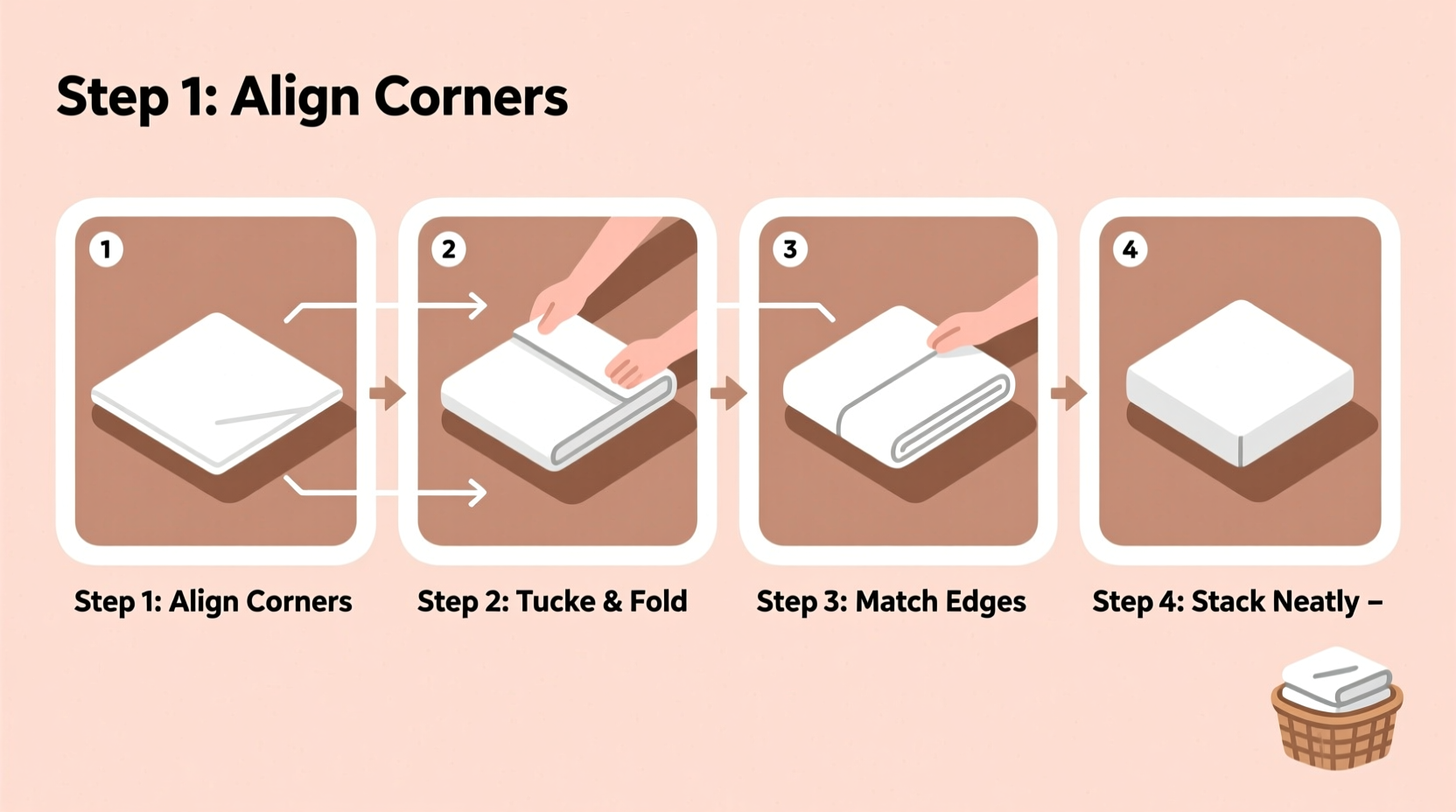
Fitted sheets are designed for function—snug corners, stretchy fabric, and deep pockets ensure they stay in place on mattresses. However, these same features make them difficult to fold uniformly. Most people attempt to fold them like flat sheets, only to end up with an uneven bundle that unravels when stored. Over time, poorly folded sheets develop permanent creases, take up more space than necessary, and contribute to cluttered linen closets.
The root issue lies in the structure: four elasticized corners pull outward, resisting symmetry. Without addressing the geometry of the sheet first, any folding effort is doomed to collapse. The solution? Work with the design, not against it. Begin by aligning the corners and smoothing out the tension before transitioning into traditional folding patterns.
Step-by-Step Guide to Folding Fitted Sheets Neatly
The following method transforms a rumpled fitted sheet into a compact rectangle that stacks seamlessly with other linens. This technique works for all sizes—twin, full, queen, and king—and requires no special tools. Practice may be needed at first, but once mastered, the process takes less than two minutes.
- Hold the sheet by two adjacent corners. Pick up the fitted sheet by grabbing the top two corners—one in each hand. These should be corners from the same short edge of the sheet (the side that goes over the head of the bed).
- Turn one corner inside out. While holding both corners, tuck one hand (and its corner) inside the other, so the right side of the fabric faces inward. This begins to hide the elastic and smooths the surface.
- Match the third corner to the second. Still holding the first two corners together, reach down with your free hand and grab the corner diagonally opposite the tucked one. Pull it over and tuck it inside the second corner, ensuring all right sides of the fabric face inward.
- Secure all four corners together. Now, locate the fourth corner—the remaining elasticized edge—and tuck it into the bundle so all four corners are nested inside one another. At this point, the sheet should resemble a loose pouch with all elastic hidden and the outer surface smooth.
- Lay the sheet flat and smooth it out. Place the bundled sheet on a flat surface such as a bed or table. Gently press down to flatten the fabric, working out any air pockets or wrinkles.
- Fold lengthwise into thirds. Fold one long edge toward the center, then bring the opposite edge over it, creating a long rectangle. This mimics a business-letter fold and reduces width.
- Fold crosswise into a compact square. Starting from one end, fold the sheet in half, then in half again—or into thirds if preferred—until you have a tidy, rectangular or square shape.
- Store with matching set. Pair the folded fitted sheet with its corresponding flat sheet and pillowcases. Tuck the flat sheet around the bundle to keep everything together.
This method ensures that the elastic remains compressed and protected, minimizing stress on the seams. It also creates a uniform shape ideal for vertical stacking in drawers or shelves.
Common Mistakes to Avoid
Even with clear instructions, many people fall into habits that undermine their efforts. Recognizing these pitfalls can help refine your technique and produce consistently neat results.
| Mistake | Why It’s a Problem | Better Approach |
|---|---|---|
| Folding while standing or in the air | Prevents proper smoothing and alignment | Use a flat surface like a bed or table |
| Not nesting all four corners | Leaves bulk and exposed elastic | Ensure all corners are tucked inside each other |
| Rushing the final folds | Creates uneven edges and instability | Fold deliberately and press flat between steps |
| Storing damp sheets | Causes mildew and weakens fibers | Always fold completely dry linens |
| Folding too tightly | Stretches elastic and distorts shape | Fold snugly but without tension |
Expert Insight: Why Proper Folding Matters
Textile care experts emphasize that how you store your linens directly impacts their lifespan. Improper folding can lead to weakened elastic, faded fabric, and unnecessary wear.
“Folding fitted sheets correctly isn’t just about appearance—it’s fabric preservation. When elastic is constantly twisted or overstretched in storage, it loses its grip. Neat folding keeps tension balanced and extends usability by years.” — Dr. Lena Patel, Home Textiles Researcher, Institute of Fabric Care
Dr. Patel notes that hospitals and high-end hotels use similar techniques to maintain inventory. In commercial laundries, standardized folding reduces labor time and ensures consistency across thousands of linens weekly. Adopting professional methods at home brings those same benefits on a smaller scale.
Real Example: From Chaos to Order
Sarah M., a mother of three in Portland, Oregon, used to dread laundry day. Her linen closet was a jumble of mismatched sheets stuffed into baskets. “I’d spend ten minutes just trying to find the right fitted sheet,” she recalls. After watching a tutorial based on this method, she practiced twice and got it right. Within a week, she had reorganized her entire collection.
“Now I fold them right out of the dryer. My kids even started doing it themselves. The best part? Everything fits in half the space, and I haven’t lost a single sheet since.” Sarah now stores sets in labeled bins, with fitted sheets folded neatly beneath flat ones—a system that’s lasted over a year without issues.
Checklist: Mastering Fitted Sheet Folding
Follow this checklist every time to ensure consistent results:
- ✅ Wash and dry the sheet completely before folding
- ✅ Choose a large, flat surface (bed, table, countertop)
- ✅ Hold two adjacent corners of the short edge
- ✅ Tuck one corner inside the other to invert the seam
- ✅ Attach the third corner by tucking it into the second
- ✅ Secure the fourth corner to complete the bundle
- ✅ Lay flat and smooth out wrinkles
- ✅ Fold lengthwise into thirds
- ✅ Fold crosswise into a compact rectangle
- ✅ Store with matching flat sheet and pillowcases
Repeat this process with each new load. After a few attempts, the motions become muscle memory, turning a once-dreaded task into a seamless part of your routine.
FAQ
Can I fold a king-size fitted sheet the same way?
Absolutely. The method works regardless of size. King sheets may require a larger surface area to smooth out, but the folding sequence remains identical. You might need two hands to manage the extra fabric during the final folds, but the corner-nesting principle applies universally.
What if my fitted sheet has deep pockets or extra elastic?
Sheets with deep pockets or added stretch (like those for mattress toppers) follow the same folding logic. The key is ensuring all four corners are fully nested. If the fabric bunches, gently redistribute it before making the final folds. Some users find it helpful to partially fold the sides inward before bundling corners to reduce excess material.
Should I iron fitted sheets before folding?
Ironing is optional and generally unnecessary for cotton blends used in most fitted sheets. High heat can degrade elastic over time. If wrinkles persist, try removing sheets from the dryer slightly early and folding them while warm and pliable. For linen or wrinkle-prone fabrics, a light steam can help, but avoid direct contact with elastic edges.
Alternative Methods Worth Trying
While the corner-tucking method is the most reliable, some people prefer alternative approaches based on dexterity or space constraints.
The Roll Method: After nesting the corners and flattening the sheet, roll it tightly from one end to the other. This minimizes creases and is ideal for travel or compact storage. Rolled sheets can be placed upright in bins like files.
The Burrito Fold: Similar to rolling a tortilla, this involves folding the sides inward, then rolling from one end while tucking as you go. It’s faster but less precise for long-term stacking.
The Triangle Fold: More common in Europe, this method folds the sheet diagonally into a triangle, then continues folding into a smaller triangle. It looks elegant but uses more space than rectangular folding.
Each variation has merits, but for consistent stacking and maximum shelf efficiency, the standard tuck-and-fold method remains superior.
Conclusion
Folding fitted sheets neatly is a practical life skill that pays dividends in organization, space management, and fabric care. Once seen as an unsolvable puzzle, the process becomes straightforward with the right approach. By aligning corners, concealing elastic, and folding with intention, you turn chaos into order—one sheet at a time.




 浙公网安备
33010002000092号
浙公网安备
33010002000092号 浙B2-20120091-4
Comments
No comments yet. Why don't you start the discussion?