
Folding laundry is one of those household tasks that never ends. Just when you think you’re caught up, another basket appears. Many people abandon folding altogether, tossing clothes into drawers in a haphazard pile. But clutter breeds stress, and disorganization makes mornings harder. The KonMari Method, developed by organizing consultant Marie Kondo, offers a solution: folding clothes vertically so they stand upright like files in a drawer. This not only saves space but also makes every item visible at a glance.
Yet many who try the method give up because it feels too slow at first. The key isn’t just learning how to fold—it’s learning how to fold *efficiently* while maintaining motivation. With the right approach, the KonMari technique can actually make laundry faster over time. It reduces decision fatigue, eliminates rummaging, and cuts down on refolding or reorganizing later. This guide breaks down exactly how to implement the method quickly and sustainably—without burning out.
Why the KonMari Fold Works (and Why Speed Matters)
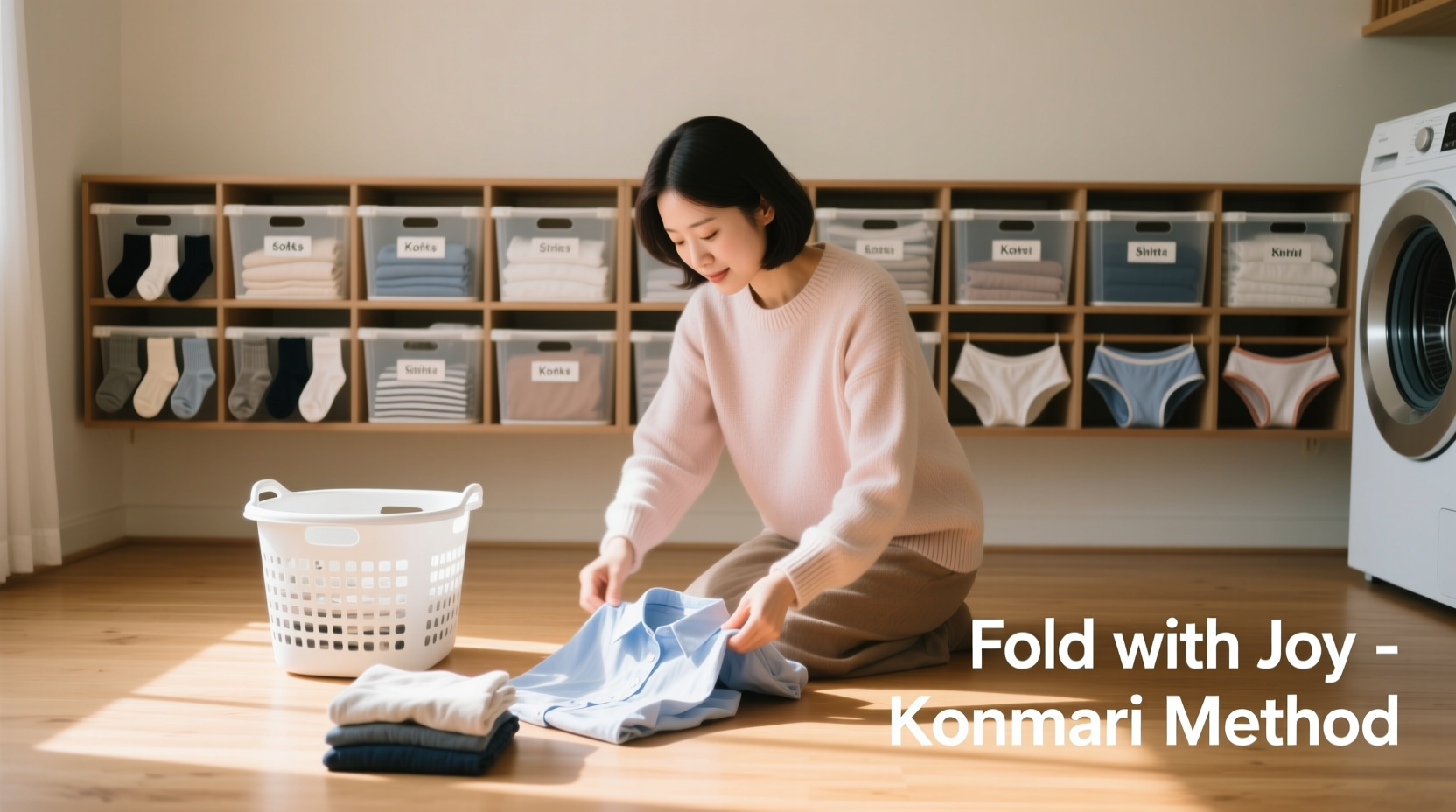
The KonMari fold is designed for visibility and accessibility. Instead of stacking clothes flat, which hides items underneath, garments are folded into compact rectangles that stand upright. This allows you to see every shirt, sock, or sweater at once. No more pulling out five t-shirts to find the gray one. You simply slide one out, take what you need, and the rest remain neatly in place.
But speed is often the missing piece. People assume this method takes longer than traditional folding. In reality, once mastered, it can be faster because it reduces the number of steps needed later—no digging, no re-folding misshapen piles, no drawer avalanches. The initial investment pays off in long-term efficiency.
“Folding clothes properly isn’t about perfection. It’s about creating a system that respects your time and energy.” — Marie Kondo, The Life-Changing Magic of Tidying Up
The challenge lies in the transition. If you attempt to fold an entire week’s laundry using KonMari for the first time, fatigue sets in by the third sock. Momentum stalls. That’s why pacing, preparation, and process optimization are essential.
Step-by-Step: A Faster KonMari Folding Workflow
To fold laundry efficiently using the KonMari method, treat it like an assembly line—not a marathon. Break the task into phases and optimize each stage. Follow this timeline to maintain speed and consistency.
- Sort by category, not load: Don’t fold mixed loads. Separate everything into categories—t-shirts, underwear, socks, pants, etc.—before you begin. This prevents switching techniques mid-flow.
- Gather supplies: Clear a large, flat surface (bed or table). Keep a ruler or folding board nearby if desired. Have matching hangers ready for any items needing them.
- Pre-flatten garments: Lay each item face-down and smooth out wrinkles. This reduces adjustments during folding and speeds up the final shape.
- Use consistent dimensions: Aim for folds that are roughly 3 inches wide and 4–5 inches tall—ideal for standing upright in drawers.
- Batch-fold by type: Fold all t-shirts together, then all shorts, then all pajamas. Muscle memory builds quickly, cutting individual fold time by up to 40%.
- Store immediately: Place folded items directly into their designated drawer or shelf. Avoid intermediate piles.
Mastering the Core KonMari Folds (With Speed Shortcuts)
Not all folds are created equal. Some take practice, but once internalized, they become second nature. Below are the three most common garment types and how to fold them efficiently.
T-Shirts (The Foundation Fold)
This is the most replicated KonMari technique. Done correctly, it takes under 15 seconds.
- Lay the shirt face-down, smoothing shoulders and sides.
- Fold one side inward about one-third of the way, aligning the sleeve edge with the center back seam.
- Repeat on the other side.
- Fold the bottom up about two inches to create a base.
- Fold the top down, tucking it into the base pocket formed in step 4.
The result is a tight rectangle that stands on its own. For speed, use the “sliding hand” technique: after folding both sides in, grip the top and bottom edges and slide your hands toward the center to compress the fabric before the final fold.
Socks (The Burrito Roll)
Instead of balling or loose folding, roll socks tightly to preserve elasticity and prevent loss.
- Place one sock on top of the other, heel-to-heel.
- Roll tightly from the toe end toward the cuffs.
- Fold the cuffs over the roll to secure.
They stand upright in a drawer and stay paired. Bonus: this method works for underwear and tank tops too.
Pants (The Rectangle Stack)
Avoid bulky folds. Focus on uniformity.
- Lay pants flat, legs aligned.
- Fold in half lengthwise, creasing at the inner seam.
- Fold one leg up about one-third, then the other over it.
- Flip so the smoother side faces out.
For jeans or heavier fabrics, skip the final flip to reduce bulk. The goal is stability, not perfection.
Do’s and Don’ts of Fast KonMari Folding
| Do’s | Don’ts |
|---|---|
| Do fold similar items in batches to build rhythm. | Don’t mix folding styles within a drawer (e.g., some vertical, some stacked). |
| Do store folded clothes in shallow drawers for easy access. | Don’t overcrowd drawers—items should stand freely without leaning. |
| Do label drawer dividers for quick identification. | Don’t fold still-damp towels—they’ll mildew; dry completely first. |
| Do spend 10 minutes weekly maintaining order (realign fallen items). | Don’t skip sorting—mixing categories kills efficiency. |
Real Example: How Sarah Cut Her Folding Time in Half
Sarah, a working mother of two, used to dread laundry day. She’d accumulate three baskets over the week, then spend Sunday afternoon folding while watching TV. Even then, things rarely got put away. Drawers were messy, and finding clothes took time.
She decided to try the KonMari method but stopped after folding six shirts—“It’s too slow,” she thought. Then she revisited the process with a new mindset: treat folding like a timed task, not a chore.
She began sorting clothes by category as soon as the dryer stopped. She cleared her bed and laid out all t-shirts together. Using a YouTube tutorial as a guide, she practiced the fold 10 times until it felt natural. By the 11th shirt, she was folding in under 12 seconds.
She applied the same logic to socks and pajamas. Within three weeks, her average folding time dropped from 70 minutes per load to 32. More importantly, her kids started putting their own clothes away because “it’s easier to see everything.”
“I used to hate folding,” Sarah said. “Now I do it right after the dryer buzzes. It takes less time than making coffee.”
Checklist: Optimize Your KonMari Folding Routine
- ☐ Sort laundry by garment type before folding
- ☐ Clear a large, flat surface near the drying area
- ☐ Fold in batches (all t-shirts, then all shorts, etc.)
- ☐ Use consistent fold dimensions for visual harmony
- ☐ Store items immediately in designated drawers
- ☐ Maintain fold alignment with weekly 5-minute touch-ups
- ☐ Teach household members the same technique for consistency
- ☐ Replace deep drawers with shallow organizers if needed
FAQ: Common Questions About Fast KonMari Folding
Can I use the KonMari method for thick sweaters?
Yes, but with modifications. Heavy knits shouldn’t be folded too tightly, as this strains fibers. Instead, fold them into broad rectangles and store in a single layer. Consider rolling chunky cardigans to prevent shoulder bumps.
What if my family won’t adopt the method?
Start with your own drawer. When others see how fast you find clothes, they may follow. Offer to fold their section using the method—many convert after experiencing the ease. Consistency is contagious.
Does this really save time in the long run?
Absolutely. One study of home organization habits found that households using vertical folding systems reduced clothing retrieval time by 63%. Less searching, fewer refolds, and less clutter mean net time savings—even if folding takes slightly longer upfront.
Conclusion: Make Folding Effortless, Not Endless
The KonMari method isn’t about spending more time on laundry. It’s about spending time *once* to save time forever after. The secret to folding faster isn’t rushing—it’s building a repeatable, rhythmic process that minimizes friction and maximizes flow.
By batching tasks, mastering core folds, and setting up your space for success, you turn a dreaded chore into a five-minute daily habit. Momentum isn’t lost when the work feels meaningful and the results are visible. Every upright fold becomes a small win—a quiet signal that your space respects your time.




 浙公网安备
33010002000092号
浙公网安备
33010002000092号 浙B2-20120091-4
Comments
No comments yet. Why don't you start the discussion?