
Making decisions is part of daily life, yet many people hesitate, overthink, or delay action due to fear of failure, uncertainty, or perfectionism. The ability to decide with clarity and act decisively isn’t an innate trait—it’s a skill that can be developed. This guide offers a structured, realistic approach to building confidence in your choices and moving forward with purpose. Whether you're facing career changes, personal goals, or everyday crossroads, the principles here will help you cut through hesitation and take meaningful steps.
Understand the Psychology of Decision-Making
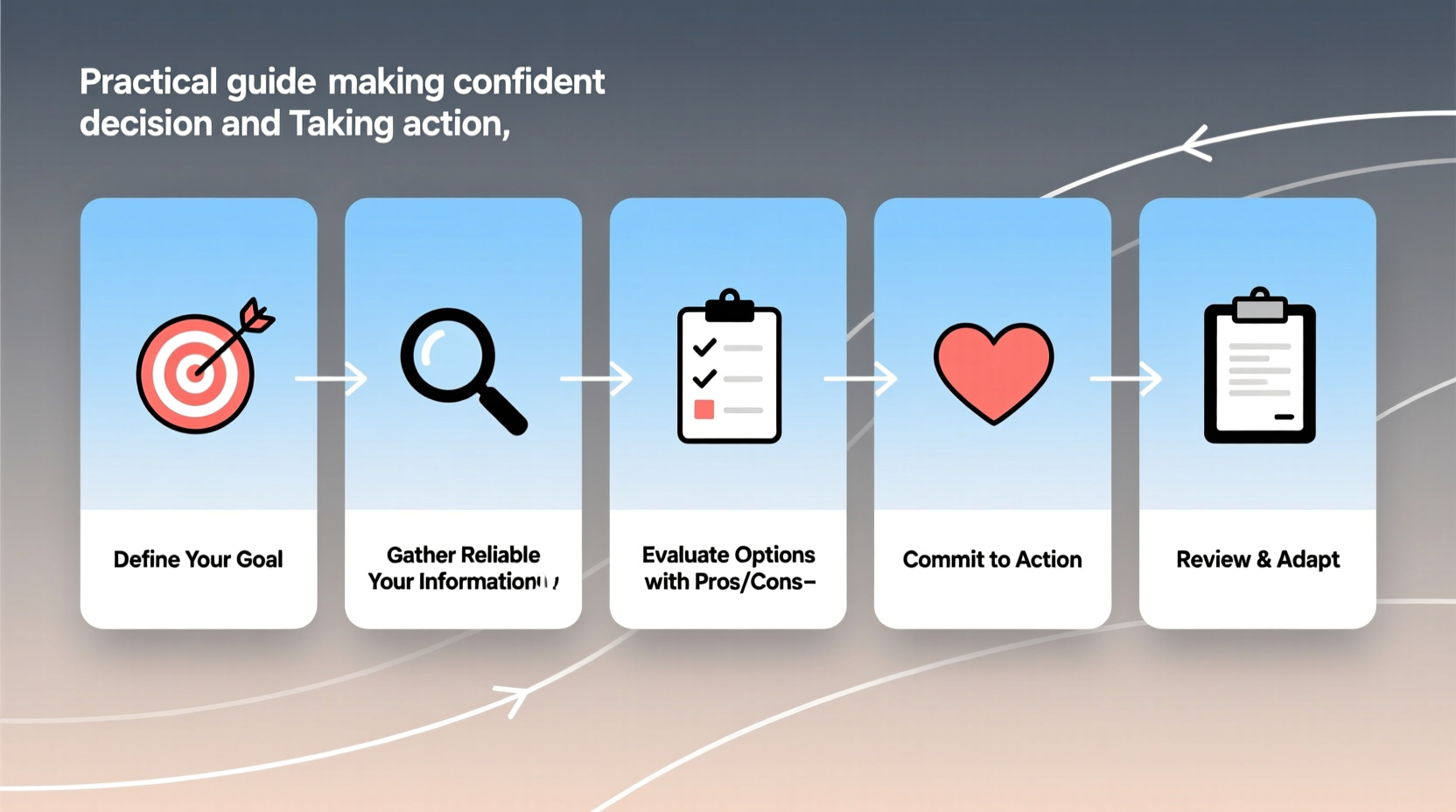
Every decision begins with perception. How we interpret information, assess risk, and anticipate outcomes shapes our willingness to act. Cognitive biases—like loss aversion, confirmation bias, and analysis paralysis—often distort judgment. Recognizing these patterns is the first step toward clearer thinking.
For instance, loss aversion causes us to fear losses more than we value equivalent gains. This leads to inaction: staying in a stable but unfulfilling job because quitting feels too risky. Similarly, confirmation bias makes us seek information that supports our existing beliefs, narrowing our perspective.
Confidence doesn’t come from having all the answers. It comes from trusting your process—even when outcomes are uncertain. A sound decision-making framework reduces anxiety and increases momentum.
A Step-by-Step Framework for Confident Decisions
Follow this five-stage process to make thoughtful, timely decisions without getting trapped in indecision.
- Clarify the Objective: Define what success looks like. Is it financial security? Personal growth? Peace of mind? Be specific.
- Gather Relevant Information: Collect data, consult trusted sources, and identify key variables. Avoid information overload—focus on what truly impacts the outcome.
- Evaluate Options with a Pro-Con Lens: List alternatives and their consequences. Use weighted scoring if needed (e.g., rate each option 1–5 on criteria like feasibility, impact, and alignment).
- Set a Decision Deadline: Impose time limits. Even imperfect decisions made on time are often better than perfect ones delayed indefinitely.
- Act and Adjust: Take the first step. Monitor results and refine as you go. Action generates feedback; feedback improves future decisions.
This method prevents endless deliberation and creates forward motion. It also builds self-trust: each completed cycle reinforces your ability to navigate complexity.
Common Barriers and How to Overcome Them
Several internal and external factors hinder decisive action. Below is a summary of frequent obstacles and practical countermeasures.
| Barrier | Why It Holds You Back | How to Move Forward |
|---|---|---|
| Fear of failure | Paralyzes action; equates mistakes with personal inadequacy | Reframe failure as learning. Ask: “What’s the cost of not trying?” |
| Perfectionism | Demands ideal conditions that rarely exist | Adopt the 70% rule: If you’re 70% sure, act and adjust as you go. |
| Overthinking | Creates false complexity; drains energy | Limit research time. Set a timer for 30 minutes of focused input, then decide. |
| External pressure | Others’ opinions override your intuition | Separate advice from obligation. You own the outcome. |
“Decisiveness is a muscle. The more you use it, the stronger it gets.” — Dr. Lena Torres, Behavioral Psychologist
Real Example: From Hesitation to Action
Consider Maria, a marketing manager who wanted to start her own consultancy. For two years, she researched business models, saved money, and attended courses—but never launched. She feared losing income, client rejection, and being unprepared.
After applying the decision framework, she clarified her goal: to work with sustainable brands using ethical marketing. She listed three service offerings, set a launch date within 30 days, and committed to acquiring one paying client in the first month. She didn’t wait for a website or perfect branding—she started with a simple email and LinkedIn post.
Within six weeks, she had three clients. Her initial offer wasn’t flawless, but feedback helped her refine it quickly. By acting early, she gained real-world insight no amount of planning could provide. Today, her consultancy is profitable, and she credits her progress to one principle: “Action precedes clarity.”
Checklist: Building Confidence Through Action
Use this checklist weekly to strengthen your decision-making habits:
- ☑ Identify one decision you’ve been avoiding and define its core question.
- ☑ Limit input gathering to 3 reliable sources or 45 minutes max.
- ☑ Write down two possible actions and their likely outcomes.
- ☑ Choose one and commit to executing it within 48 hours.
- ☑ After acting, reflect: What worked? What would I adjust next time?
- ☑ Celebrate the effort, not just the result.
Consistency matters more than scale. Small decisions made confidently compound into greater self-assurance over time.
Frequently Asked Questions
What if I make the wrong decision?
No decision is final. Most choices are reversible or adjustable. The real cost lies in prolonged indecision, which stalls growth. Mistakes provide data. Treat them as course corrections, not failures.
How do I trust my gut when I’m unsure?
Your intuition is shaped by experience, even when you can’t articulate it. To test it, ask: “Does this choice align with my values and long-term vision?” If yes, proceed cautiously but deliberately. Pair instinct with a small action step to validate your sense.
How can I stay consistent when motivation fades?
Motivation fluctuates. Systems don’t. Build routines around decision-making: schedule reflection time, use templates for evaluating options, and track past decisions to see patterns. Reviewing your history reinforces confidence in your judgment.
Take Action Before You Feel Ready
Confidence isn’t the prerequisite for action—it’s the result of it. Waiting until you feel certain means waiting indefinitely. Progress favors those who choose, act, learn, and repeat. Every decision, even the flawed ones, sharpens your judgment and expands your capacity for future challenges.
The most effective people aren’t those with perfect foresight. They’re the ones who move despite doubt, iterate based on feedback, and treat decisions as experiments rather than verdicts. Start where you are. Use what you have. Do what you can.




 浙公网安备
33010002000092号
浙公网安备
33010002000092号 浙B2-20120091-4
Comments
No comments yet. Why don't you start the discussion?