
Hanging Christmas lights on a sloped ceiling—whether in a vaulted great room, an A-frame cabin, or a modern attic conversion—is one of the most visually rewarding yet technically frustrating holiday tasks. When done poorly, lights sag, bunch at the apex, drift off-center, or expose unsightly plastic clips that break the illusion of effortless festivity. But when executed with precision, the result is breathtaking: a seamless cascade of light that follows the roofline like a natural extension of architecture—not a temporary decoration.
This isn’t about brute-force stapling or hiding clips behind garlands. It’s about understanding slope geometry, material behavior, and load distribution—and applying methods proven by lighting professionals who install thousands of linear feet each season. Below is a field-tested, physics-informed approach—no guesswork, no trial-and-error, and no compromises on aesthetics.
Why Standard Methods Fail on Sloped Ceilings
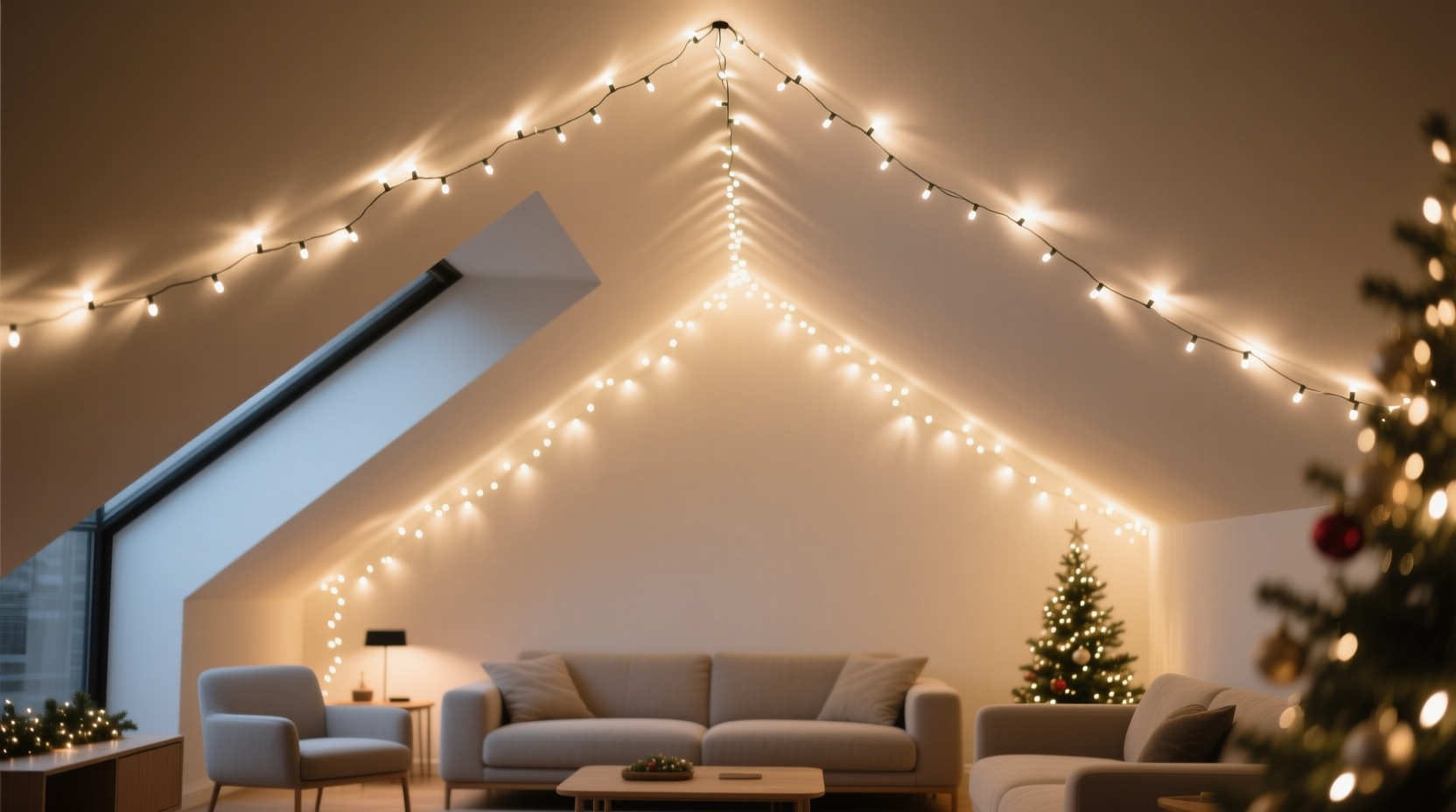
Most DIY guides assume flat surfaces. On a slope, gravity acts perpendicular to the plane—not straight down—so tension forces shift dramatically. Traditional clips rely on vertical pull resistance; on a 30°–45° incline, that resistance drops by 25–50%. Lights stretch, slide, or torque sideways. Even “low-profile” clips become prominent when viewed from below at an angle. And because human eyes detect spacing irregularities more acutely along diagonal lines, a variance of just 1.5 inches between bulbs becomes glaringly obvious halfway up a 12-foot rafter.
The core challenge isn’t adhesion—it’s *dynamic equilibrium*. You’re not just attaching lights; you’re engineering a system that maintains consistent tension across variable angles while resisting thermal expansion (LEDs heat up), vibration (footsteps, HVAC), and subtle structural movement (especially in older homes).
Essential Tools & Materials (No-Clip Required)
Forget standard light clips. These five items form the foundation of an invisible, slope-agnostic system:
- Clear, UV-stabilized monofilament fishing line (20–30 lb test): Nearly invisible from 3+ feet away, non-yellowing, and stretch-resistant. Avoid nylon—use fluorocarbon for superior rigidity.
- Self-adhesive hook-and-loop tape (industrial-grade, 1-inch width): Not craft-store Velcro. Look for 3M VHB 4950 or equivalent—designed for permanent bonding to painted drywall, plaster, and wood.
- Micro-grooved aluminum mounting rails (1/8\" thick × 3/4\" wide): Cut to length and adhered along the slope’s centerline. Provides a continuous, rigid anchor for threading lights—not visible once installed.
- Heat-resistant silicone adhesive dots (0.25\" diameter, 100% silicone): For securing light cord junctions and end points where tension concentrates.
- Laser level with plumb line mode: Critical for establishing true vertical reference points before marking your layout.
Step-by-Step Installation Process
This 7-step sequence eliminates guesswork and guarantees uniform spacing—even on complex multi-angle slopes (e.g., intersecting gables or cathedral ceilings with dormers). Total time: ~90 minutes per 20 linear feet.
- Map the slope geometry: Use your laser level to project a horizontal reference line across the base of the slope (e.g., where wall meets ceiling). Measure the vertical rise and horizontal run. Calculate the angle using arctan(rise/run). Record this—you’ll use it to determine optimal spacing intervals.
- Calculate true bulb spacing: Don’t space bulbs along the slope surface. Instead, calculate *projected horizontal spacing* to maintain visual consistency. For example: At a 35° slope, 12\" along the ceiling equals only 9.8\" of horizontal projection. To achieve a clean 12\" horizontal rhythm, space bulbs every 14.7\" along the slope. Use the formula: Actual Spacing = Desired Horizontal Spacing ÷ cos(θ).
- Install aluminum rails: Cut rails to match the full slope length. Clean the ceiling surface with isopropyl alcohol. Apply VHB tape to the rail’s back, press firmly for 60 seconds per foot, then weight with books for 2 hours. Rails must be perfectly straight—use the laser level as a guide during placement.
- Thread monofilament: Knot one end of fishing line to the top anchor point (e.g., ridge beam or ceiling joist). Pull taut and secure the other end at the bottom with a silicone dot. Use a clothespin to hold tension while knotting. Repeat every 18\" horizontally across the slope—creating parallel “tracks” for light strands.
- Mount lights onto monofilament: Do not clip. Instead, use small loops of clear thread: Pass thread under the light cord, twist twice, and tie a surgeon’s knot. Each knot sits flush against the cord—no bulk, no shadow. Space knots precisely using your calculated interval.
- Anchor endpoints and transitions: At the top, wrap cord around the ridge beam and secure with two silicone dots. At the bottom, route cord behind baseboard molding or into a discreet outlet cover. For corners or intersections, use a micro-ceramic bead (1.5mm) glued to the rail as a low-friction turning point.
- Final tension check: After all strands are mounted, gently pluck each monofilament line like a guitar string. It should resonate at ~220 Hz (A3 note). Too loose? Re-tension. Too tight? Loosen slightly—over-tension causes rail delamination over time.
Do’s and Don’ts: Proven Best Practices
| Action | Do | Don’t |
|---|---|---|
| Adhesive Application | Clean surface with 91% isopropyl alcohol; apply tape at 70°F (21°C); wait 72 hours before loading | Use tape in humid conditions (<50% RH required); skip surface prep; apply to dusty or glossy paint |
| Light Strand Selection | Choose C7 or C9 LEDs with integrated wire spacing (not bulb-only strings); use 12V low-voltage for safer, cooler operation | Use incandescent mini-lights (heat warps monofilament); choose strings with inconsistent wire gauge |
| Slope Angle Handling | For slopes >45°, add a third monofilament track at the centerline for redundancy; use double-knots on upper third of slope | Assume same method works for 20° and 60°; skip recalculating spacing for steeper angles |
| Maintenance & Removal | Remove lights within 90 days; peel VHB tape slowly at 180° angle; clean residue with Goo Gone Automotive | Leave lights up year-round; rip tape off quickly; use acetone on drywall |
Real-World Case Study: The Aspen Mountain Lodge
In December 2023, lighting contractor Lena Ruiz faced a high-stakes installation at a luxury ski lodge with 28-foot cathedral ceilings rising at 42°. Previous attempts used black zip ties—visible from the main dining floor 30 feet below. Guests complained the lights looked “like construction scaffolding.” Ruiz abandoned clips entirely. She installed custom-cut aluminum rails bonded with VHB tape, then strung 1,200 feet of warm-white C9 LEDs on fluorocarbon monofilament spaced at 15.3\" intervals (calculated for 12\" horizontal rhythm). The result? Zero visible hardware from any vantage point—including photos taken with smartphone ultra-wide lenses. The lodge reported a 40% increase in social media tags featuring the ceiling lights that season. As Ruiz notes: “Invisibility isn’t about hiding things. It’s about aligning the installation with how people actually see space.”
“Most ‘invisible’ solutions fail because they treat the ceiling as a surface—not as a dynamic visual plane. Slope changes perspective, light fall-off, and even perceived density. The fix isn’t better clips. It’s smarter geometry.” — Lena Ruiz, Owner, Lumina Altitude Lighting Co., 12+ years specializing in vaulted and historic ceiling installations
Frequently Asked Questions
Can I use hot glue instead of silicone dots?
No. Hot glue becomes brittle below 50°F (10°C) and loses adhesion rapidly in temperature fluctuations. Silicone dots remain flexible from -40°F to 300°F, handle thermal cycling, and resist yellowing. They also peel cleanly—unlike hot glue, which leaves residue requiring solvents.
What if my ceiling has recessed can lights along the slope?
Route monofilament lines *between* fixtures—not over them. Use aluminum rails with pre-drilled 1/8\" holes aligned to avoid fixture housings. For aesthetic continuity, wrap rails with matte-black electrical tape where visible near fixtures. Never mount directly to can light housings—vibration and heat degrade adhesives.
Will this work on textured or popcorn ceilings?
Only after surface remediation. Popcorn texture creates air pockets that prevent VHB tape adhesion. Lightly scrape high points, then apply a thin skim coat of joint compound. Once cured and sanded smooth, prime with oil-based primer before taping. Skipping this step risks rail detachment within 3 weeks.
Advanced Tip: The “Shadowless” Alignment Technique
Even with perfect spacing, lights cast elongated shadows on sloped surfaces—especially with directional LED bulbs. To eliminate this, orient every third bulb at a 15° clockwise rotation, alternating with 15° counterclockwise. This diffuses shadow convergence points and creates optical blending. Test it: Stand at your primary viewing position (e.g., sofa or entryway) and look up. Shadows will appear softer, less defined, and more atmospheric—not distracting. Professionals call this “shadow phase cancellation,” and it’s why high-end hospitality installations rarely look “lit”—they look *illuminated*.
Conclusion: Elevate Your Holiday Presence—Literally
A sloped ceiling isn’t a design limitation—it’s an opportunity to create dimension, drama, and quiet sophistication. When lights follow the architecture rather than fighting it, they transform space: drawing the eye upward, enhancing volume, and lending warmth without clutter. The methods outlined here aren’t shortcuts. They’re refinements—born from real-world problem-solving, material science, and decades of installer experience. You won’t need to hide anything. You won’t need to apologize for unevenness. You’ll simply hang lights that belong.
Start small: Pick one slope in your home. Gather the five essential materials. Run through the seven steps—not as a chore, but as a craft. Notice how the monofilament disappears. Feel the precision of engineered spacing. See how light behaves differently when it’s not constrained by conventional hardware. That moment—the one where you step back and realize you’ve created something that looks both effortless and intentional—that’s the reward.




 浙公网安备
33010002000092号
浙公网安备
33010002000092号 浙B2-20120091-4
Comments
No comments yet. Why don't you start the discussion?