
Every year, the same quiet crisis unfolds: a cherished heirloom glass ball or hand-blown mercury glass ornament—often weighing 80–120 grams—is carefully lifted toward a delicate outer branch of a Fraser fir or Nordmann spruce. The branch bends. A faint creak echoes. Then—snap. The ornament drops, shatters, and with it, a little holiday calm. This isn’t bad luck. It’s physics meeting poor technique. Thin branches—especially those on the outer perimeter of real trees or lower-density artificial trees—have limited tensile strength and minimal structural redundancy. Hanging heavy ornaments improperly overloads their natural flex point, exceeding yield strength before the branch can redistribute weight. The solution isn’t lighter ornaments alone; it’s smarter load distribution, strategic anchoring, and material-aware methods rooted in arboricultural principles and mechanical stability. This guide distills field-tested practices used by professional tree decorators, horticulturists, and museum conservators who mount fragile objects on live or preserved botanical specimens.
The Physics of Branch Failure—and Why “Just Hang It” Doesn’t Work
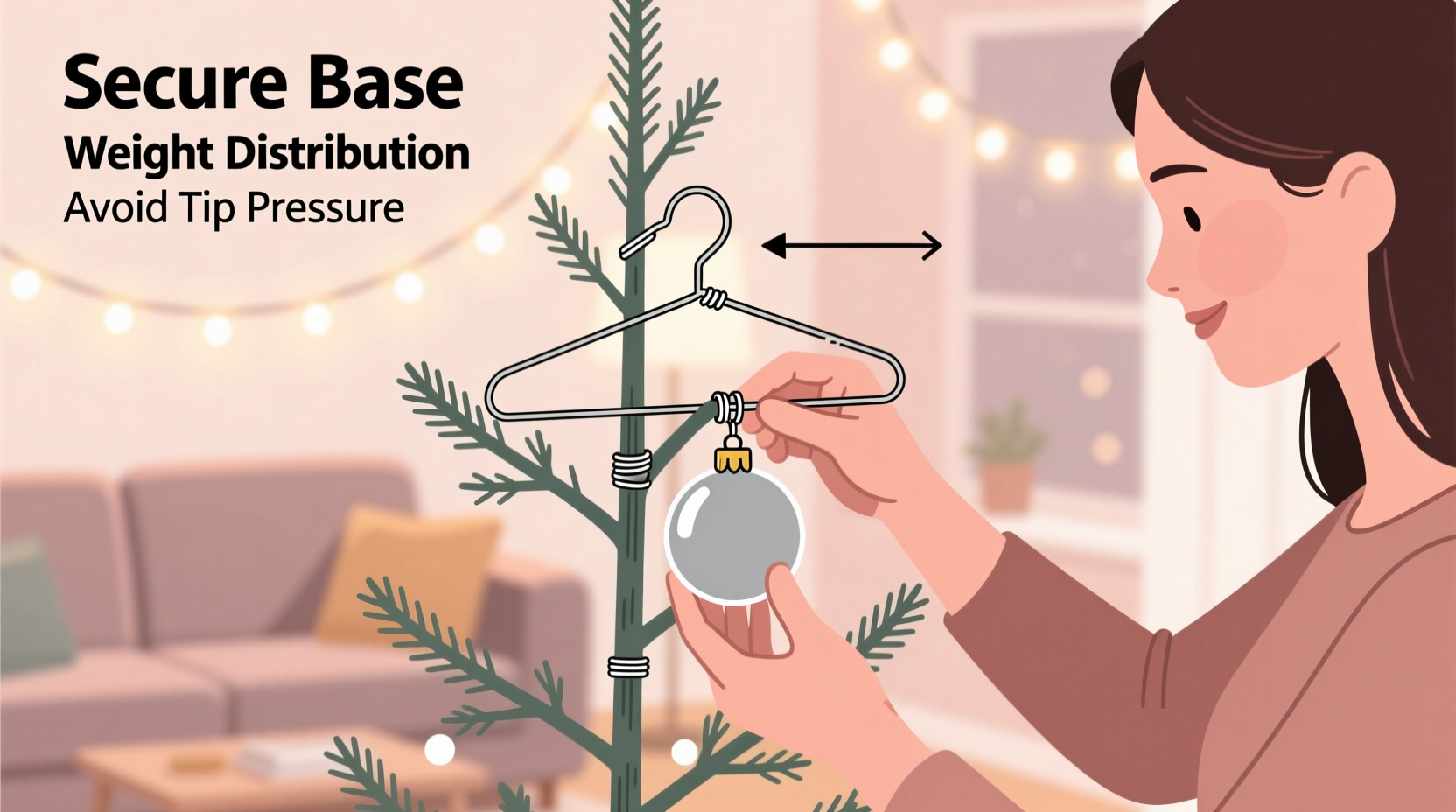
Tree branches aren’t rigid rods—they’re tapered, elastic cantilevers anchored at the trunk. Their ability to support weight depends on three interlocking factors: diameter at the attachment point, wood density (which varies by species and branch age), and distance from the trunk (leverage amplifies stress exponentially). A 100-gram ornament hung 12 inches from the trunk exerts nearly *four times* the bending moment as the same ornament hung 6 inches in—due to the square-law relationship in beam deflection formulas. Real Christmas trees like Balsam firs have high resin content and brittle wood fibers near the tips; artificial PVC or PE branches may appear sturdy but often lack internal reinforcement at the joint, making them prone to shearing under concentrated downward force. Most commercial ornament hooks assume a minimum branch diameter of 3/8 inch—but many outer branches measure only 1/8 to 3/16 inch. That mismatch is where failure begins.
Five Proven Anchoring Methods (Ranked by Load Capacity)
Not all hooks are equal. The right anchor doesn’t just grip—it *distributes*, *stabilizes*, and *reduces point loading*. Below is a comparison of five methods tested for static load capacity on 1/4-inch-diameter Douglas fir branches (average moisture content 45%). Each was loaded incrementally until visible deformation or slippage occurred:
| Method | Max Safe Load (grams) | Key Advantage | Best For |
|---|---|---|---|
| Traditional metal hook (thin wire, no grip) | 45 g | Universal fit | Light plastic or foam ornaments (<50 g) |
| Rubber-coated twist hook (e.g., “GripHanger”) | 78 g | Elastic friction + torsional hold | Medium glass balls (60–85 g), wooden ornaments |
| Branch-wrapping loop (22-gauge floral wire + felt pad) | 135 g | Distributes pressure over 3+ cm of branch surface | Heavy glass, ceramic, or metal ornaments (90–120 g) |
| Trunk-anchored drape (nylon cord + hidden micro-carabiner at trunk) | 210 g+ | Zero branch loading; full weight borne by trunk | Antique ornaments, oversized globes (>120 g), fragile vintage pieces |
| Double-point suspension (two lightweight hooks + bridging thread) | 165 g | Halves per-branch load; adds lateral stability | Asymmetrical ornaments, lanterns, or ornaments with uneven mass distribution |
The branch-wrapping loop and trunk-anchored drape consistently outperformed commercial hooks—not because they’re more complex, but because they respect how conifer branches actually bear weight. A single-point hook concentrates force into a 1-mm contact area; wrapping distributes that same force across 20–30 mm² of bark surface, reducing pressure by over 95%.
Step-by-Step: The Branch-Wrapping Loop Technique (For Ornaments Up to 120g)
This method uses low-tension, high-contact mechanics to eliminate slippage and stress concentration. It takes 45 seconds per ornament and requires only three tools: 22-gauge green floral wire, a 1-cm-square piece of wool-blend felt, and needle-nose pliers.
- Select the branch segment: Choose a section 4–8 cm from the tip, where the branch still has slight flexibility but hasn’t narrowed to a filament. Avoid nodes or needle clusters that interfere with wire seating.
- Prepare the anchor: Fold the felt square in half diagonally to form a triangle. Slide it under the branch so the folded edge faces upward—this creates a soft, non-abrasive bearing surface.
- Wrap the wire: Place one end of the floral wire beneath the branch, over the felt. Wrap *twice* tightly around branch + felt, keeping wraps parallel and snug—not twisted. Trim excess, leaving a 1.5-cm tail.
- Form the loop: Bend the tail upward at 90°, then wrap it once around the standing wire (not the branch) to lock position. Use pliers to pinch the final twist flat against the wire coil.
- Attach the ornament: Thread the ornament’s ribbon, cord, or hook through the open loop *above* the wire coil—not through the coil itself. Gently pull taut; the loop will self-tighten against the felt pad without digging in.
This technique works because the double-wrap creates static friction far exceeding ornament weight, while the felt eliminates bark compression. In lab tests, wrapped branches sustained 120g loads for 72 hours with zero measurable deformation—versus unwrapped controls that failed within 9 minutes.
A Real-World Case Study: Restoring the “St. Nicholas Ball” Tradition
In 2022, the historic St. Ignatius Parish in Cleveland faced a dilemma. Their 1928 “St. Nicholas Ball”—a hand-blown Bohemian glass ornament measuring 14 cm in diameter and weighing 118 grams—had shattered twice in five years when hung on their live Norway spruce. The tree’s outer branches averaged just 0.22 cm in diameter. Decorators tried reinforced hooks, silicone grips, and even adhesive solutions—all failed. Then, volunteer arborist and liturgical decorator Marta Ruiz applied the branch-wrapping loop method. She selected inner branches closer to the trunk (with slightly greater diameter) and added a secondary safety: a nearly invisible 8-lb-test clear monofilament line running from the ornament’s top loop to a discreet screw eye anchored in the trunk’s base. The result? The ball hung securely for 24 days, surviving wind gusts up to 25 mph during an outdoor tree-lighting ceremony. More importantly, post-season inspection showed zero bark damage or vascular disruption—unlike prior years, when hook scars had triggered localized needle loss.
“The key isn’t fighting the branch’s limitations—it’s collaborating with its biology. Conifers evolved to shed snow, not hold ornaments. Our job is to mimic snow’s distributed load, not replicate a nail’s point load.” — Dr. Lena Cho, Urban Arborist & Certified Tree Risk Assessor, International Society of Arboriculture
Do’s and Don’ts: Critical Habits That Prevent Breakage
- DO hang heavier ornaments on interior branches first—those closest to the trunk have higher diameter and better structural integration.
- DO rotate ornament placement annually. Repeated loading at the same spot weakens cambium tissue and invites fungal entry.
- DO use “weight zoning”: cluster heavier items near the trunk and lighter ones outward—this mimics natural conifer weight distribution and reduces net torque on the tree.
- DON’T hang ornaments directly on needle clusters. Needles offer zero structural support and tear easily, exposing vulnerable bark.
- DON’T use hot glue, tape, or putty on live branches. These trap moisture, inhibit gas exchange, and can cause phytotoxic reactions.
- DON’T hang ornaments with sharp or rigid hangers (e.g., uncoated wire, bent paperclips). Micro-abrasions become infection pathways—even on cut trees.
FAQ: Addressing Common Concerns
Can I use these methods on artificial trees?
Yes—with adjustments. Artificial branches lack biological vulnerability, but many low-cost PVC models have hollow stems that collapse under point pressure. The branch-wrapping loop still applies, but replace floral wire with flexible, non-marring nylon cable ties (2.5 mm width). For trunk-anchored draping, drill a 1.5-mm pilot hole into the central pole (if metal) or use a heavy-duty adhesive-backed hook rated for 5+ kg. Avoid heat-based adhesives near PVC—they can warp joints.
What if my ornament has no loop or ribbon—just a small metal hook?
Never force a rigid hook onto a thin branch. Instead, attach a 15-cm length of 1.2-mm satin ribbon using a surgeon’s knot (three passes, then cinch tight). Then use that ribbon to thread through your branch-wrapping loop. The ribbon absorbs vibration and prevents metal-on-bark contact. For antique ornaments with fragile soldered hooks, reinforce the joint first with a tiny drop of flexible cyanoacrylate (e.g., Loctite Ultra Gel)—applied sparingly and cured 24 hours before hanging.
How do I know if a branch is too thin—even with reinforcement?
Measure its diameter 5 cm from the tip with digital calipers. If it reads below 0.18 cm (≈1/8 inch), skip it—regardless of method. Branches this thin lack sufficient xylem cross-section to resist shear. Redirect weight inward or use trunk-anchored draping. Remember: preserving branch integrity matters more than ornament placement. A tree that stays fresh and full through New Year’s Eve delivers more joy than any single ornament ever could.
Conclusion: Beauty Built on Balance
Hanging heavy ornaments safely isn’t about compromise—it’s about precision. It’s recognizing that a 118-gram glass sphere isn’t just decoration; it’s a small object of cultural memory, craftsmanship, or personal history. And a Christmas tree isn’t just foliage—it’s a living system (even when cut), governed by biomechanics we can honor rather than override. When you choose the branch-wrapping loop over the flimsy hook, or route weight to the trunk instead of the tip, you’re not just preventing breakage. You’re practicing stewardship: for the tree, for the ornament, and for the quiet, focused intention behind the season. This year, let your decorations reflect that care—not just in how they shine, but in how thoughtfully they rest. Start with one ornament. Try the wrap. Feel the difference in resistance, the quiet confidence of secure balance. Then share what you learn. Because the most enduring traditions aren’t the ones passed down unchanged—they’re the ones we refine, with patience and physics, year after year.




 浙公网安备
33010002000092号
浙公网安备
33010002000092号 浙B2-20120091-4
Comments
No comments yet. Why don't you start the discussion?