
Hanging decorative or functional lighting on a vaulted ceiling presents unique challenges. The soaring angles make access difficult, and traditional methods—like stacking ladders or renting scaffolding—can be dangerous, costly, or impractical for homeowners. Yet, beautifully lit ceilings enhance ambiance, highlight architecture, and improve functionality in spaces like great rooms, foyers, and cathedral-ceilinged dining areas.
The good news: you don’t need professional rigging gear or a team of installers to get the job done safely. With the right tools, techniques, and a bit of ingenuity, it’s entirely possible to hang string lights, fairy lights, or lightweight fixtures securely—without stepping onto an unstable platform or risking a fall from height.
Why safety matters when working at height
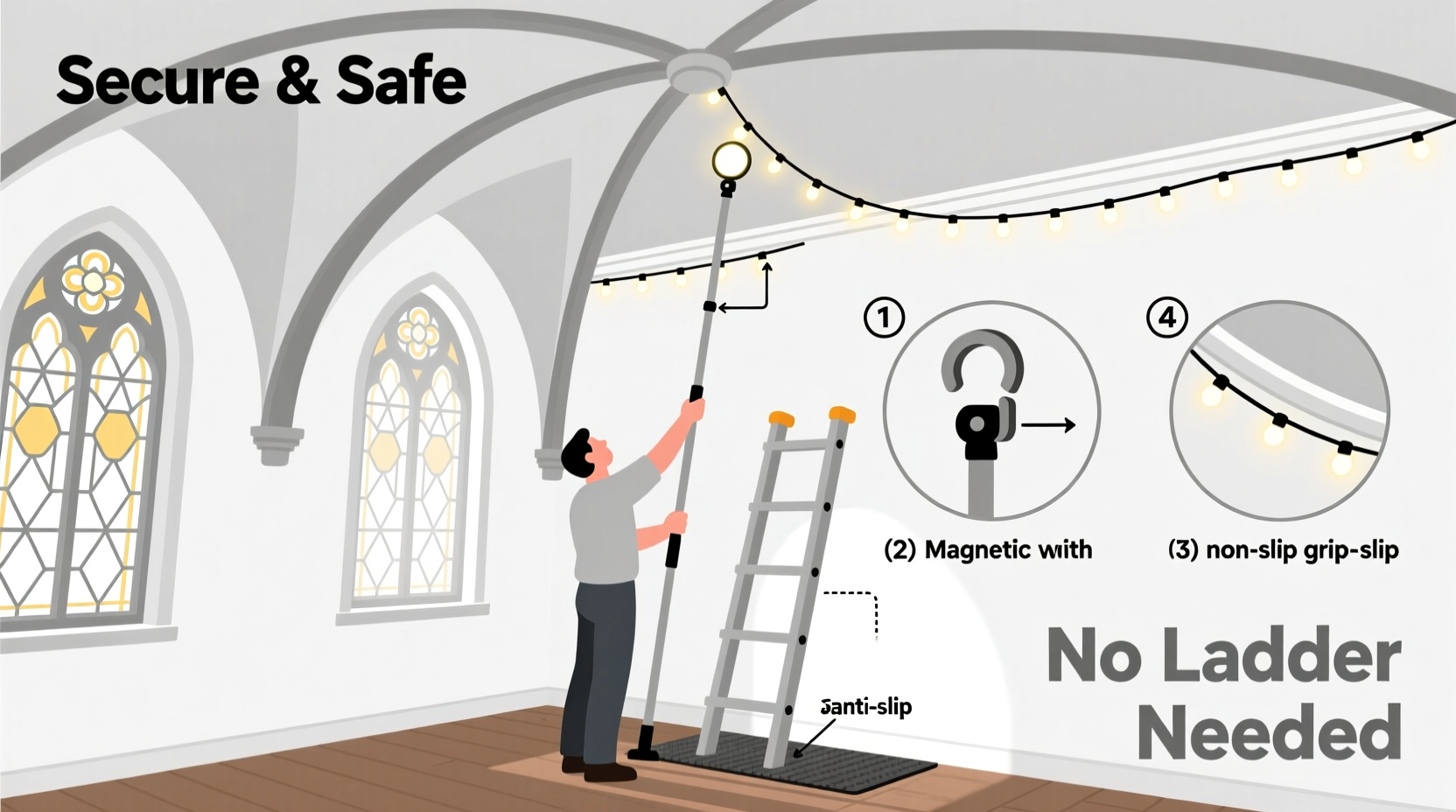
Falls from ladders account for over 500,000 injuries annually in the U.S., according to the Centers for Disease Control and Prevention (CDC). Working on vaulted ceilings often requires prolonged balance on elevated surfaces, increasing risk significantly. Even experienced DIYers can misstep due to fatigue, uneven flooring, or shifting weight while handling materials overhead.
“People underestimate how quickly a simple task turns dangerous,” says Mark Delaney, a certified safety trainer with the National Association of Home Builders.
“A momentary lapse in focus while reaching upward can lead to serious injury. Whenever possible, eliminate the need to climb by using reach tools and remote-installation methods.”
This principle forms the foundation of modern home improvement best practices: reduce exposure to fall hazards through smarter planning and equipment.
Essential tools and materials for no-scaffold installation
To hang lights without scaffolding, you’ll rely on extension, precision, and secure fastening—all from ground level. Below is a curated list of tools that make the process safer and more efficient:
- Telescoping pole (10–20 ft): Look for models with rotating heads and clamp attachments designed for hanging items.
- Heavy-duty fishing line or nylon cord (20–50 lb test): Nearly invisible and strong enough to support lightweight strings.
- Removable adhesive hooks (rated for ceiling use): Options like 3M Command Ceiling Hooks hold up to 4.5 lbs and leave no residue.
- Tape measure and laser pointer (optional): For precise spacing and alignment.
- String lights or LED strips: Choose lightweight, low-heat options; avoid heavy incandescent strands.
- Utility blade or scissors: For trimming cords or lines cleanly.
- Assistant (recommended): A second person helps manage tension and positioning.
Step-by-step method: Hanging string lights using the fishing line & pole technique
This proven method allows full control from floor level, minimizing climbing and maximizing accuracy. It works best for evenly spaced runs along the peak or across the slope of a vaulted ceiling.
- Plan your layout on the ground. Unroll the lights and trace the intended path on the floor. Measure intervals between connection points—typically every 18–24 inches for stability.
- Attach adhesive hooks at anchor points. Clean each surface with rubbing alcohol first. Press firmly for 30 seconds per hook. Let cure for one hour before loading.
- Cut a length of fishing line about 3x the height to the ceiling. Tie one end into a secure loop around the base of your telescoping pole.
- Thread the free end through the first hook. Extend the pole slowly until the line engages the hook. Gently pull the line taut from below to guide it through.
- Create a slipknot or lasso around the light strand. Lower the loop end to attach to the first bulb socket or wire housing. Pull gently to cinch and lift the light into position.
- Repeat for each interval. Use your assistant to maintain even tension as you advance along the run.
- Secure ends at outlets or anchor zones. Use clips or additional hooks near walls or beams to prevent sagging.
- Test illumination before finalizing. Plug in temporarily to check coverage and adjust spacing if needed.
This method reduces physical strain and eliminates repeated ladder ascents. Once mastered, most users complete a 20-foot run in under 45 minutes.
Alternative strategies for different ceiling types and light styles
Vaulted ceilings vary widely—some are steeply pitched wood-trussed, others feature drywall with recessed beams. Your approach should adapt accordingly.
| Ceiling Type | Recommended Method | Avoid |
|---|---|---|
| Wood Beamed (Exposed Rafters) | Use small zip ties or braided fishing line wrapped directly around beams | Drilling unless necessary; may damage finish |
| Drywall with Smooth Surface | Command Ceiling Hooks + fishing line suspension | Nails or screws without anchors—risk of cracking |
| High-Pitched Angle (>60°) | Pole-mounted gripper tool to place and clip lights | Ladder work—increased instability |
| With Existing Track or Wiring | Tap into junction boxes using plug-in adapters and daisy-chain wires | Overloading circuits; always check wattage limits |
For LED strip lights, consider magnetic mounting rails if your ceiling contains metal framing. Alternatively, apply double-sided VHB tape (industrial grade) to the back of flexible strips—this holds securely on clean, smooth surfaces and can be removed later with dental floss and heat.
Real-world example: Lighting a family room for the holidays
Karen M., a homeowner in Asheville, NC, wanted to decorate her two-story living room with warm white string lights for Christmas. The vaulted ceiling rises 22 feet at its peak, making ladder access both intimidating and logistically difficult due to furniture arrangement.
She opted for the fishing-line-and-pole method using a $35 adjustable painter’s pole and 30-lb-test braided fishing line. She placed six Command Ceiling Hooks along the ridge line, spaced evenly. With her son assisting, she threaded the line through each hook and used a lasso knot to hoist and secure sections of 25-light strand. Total time: 50 minutes. No climbing required.
“I was nervous at first,” Karen said, “but once we got the rhythm down, it felt almost fun. And I didn’t have to worry about falling or damaging the wood beams.”
Safety checklist: Do’s and don’ts for high-altitude installations
Before starting any project involving overhead work, review this essential safety checklist.
- ✅ Test adhesive strength of hooks on a small area first
- ✅ Ensure all electrical cords are rated for indoor use and undamaged
- ✅ Confirm circuit load capacity before plugging in multiple strands
- ✅ Use non-conductive tools (fiberglass poles, plastic clips)
- ✅ Work with a partner to assist with tension and coordination
- ❌ Never stand on the top two steps of any ladder
- ❌ Avoid using nails, staples, or screws without proper anchoring
- ❌ Don’t overload outlets or use damaged extension cords
- ❌ Skip the job in poor lighting or when fatigued
When to consider professional help
While many lighting tasks can be handled independently, certain situations warrant hiring a licensed electrician or handyman with high-reach experience:
- You’re installing permanent fixtures (e.g., chandeliers, recessed downlights).
- Wiring must be hardwired into the home’s electrical system.
- The space exceeds 25 feet in height or has complex geometry.
- You have mobility limitations or fear of heights.
Professionals often use motorized scissor lifts or rope-access systems—but they also carry insurance and follow OSHA-compliant protocols. For one-time projects, the cost ($150–$400) may be worth eliminating personal risk.
Frequently asked questions
Can I reuse adhesive ceiling hooks after removing them?
No, the adhesive backing loses integrity once detached. However, replacement tabs are available from manufacturers like 3M. Always use fresh adhesive for each application to ensure holding power.
Will fishing line damage my ceiling paint or finish?
Not if installed correctly. Braided nylon fishing line has minimal contact area and exerts very little pressure when properly tensioned. Avoid dragging the line across the surface during setup. If concerned, test in an inconspicuous area first.
What’s the maximum weight I can hang using these methods?
Adhesive ceiling hooks typically support 3–4.5 lbs each. Fishing line rated at 30 lbs can theoretically hold much more, but the limiting factor is usually the attachment point. For loads exceeding 5 lbs total, consider structural mounting via joist screws (requires drilling) or consult a pro.
Final thoughts: Smart solutions beat risky shortcuts
Hanging lights on a vaulted ceiling doesn’t require heroics. In fact, the safest and most effective methods are often the simplest—leveraging physics, patience, and purpose-built tools instead of brute force or improvisation. By eliminating the need for scaffolding and reducing reliance on ladders, you protect not just your body, but also your home’s finishes and your peace of mind.
Whether you're preparing for a holiday, enhancing ambient lighting, or accenting architectural details, the techniques outlined here offer a repeatable, reliable framework. Start small, test your setup, and scale up with confidence.




 浙公网安备
33010002000092号
浙公网安备
33010002000092号 浙B2-20120091-4
Comments
No comments yet. Why don't you start the discussion?