
A softly diffused, ambient glow transforms any room from functional to atmospheric—and few techniques achieve that magic as elegantly as layering sheer curtains behind string lights. This isn’t just decorative layering; it’s light engineering. When executed thoughtfully, the result is a luminous, cloud-like radiance that eliminates harsh shadows, reduces glare, and adds depth without visual clutter. Unlike backlighting with opaque fabrics or direct bulb exposure, sheer textiles—especially lightweight voiles, linen blends, or polyester georgette—act as natural light diffusers, scattering illumination into a gentle, even wash. This technique works equally well in bedrooms for bedtime serenity, living rooms for evening warmth, patios for alfresco charm, or even home offices seeking calm focus lighting. But success hinges on more than draping fabric and plugging in lights: it requires understanding material translucency, mounting stability, heat management, and spatial layering. Below is a field-tested, detail-oriented approach grounded in interior design principles and electrical safety standards—not theory, but practice refined across dozens of residential installations.
Why Sheer + String Lights Works (and Why It Often Fails)
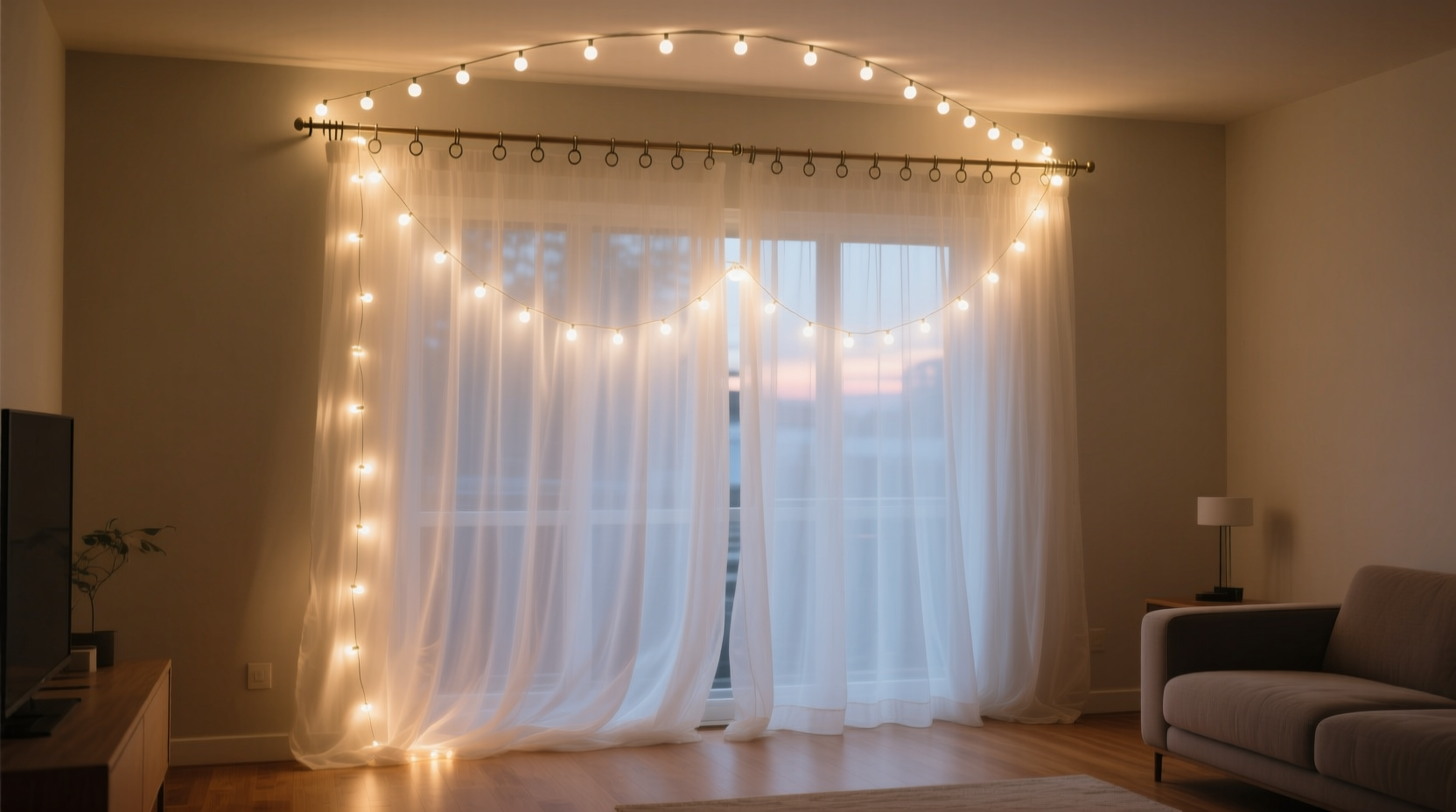
The synergy between sheer fabric and incandescent or warm-white LED string lights lies in optical physics—not aesthetics alone. Sheers possess high light transmittance (60–90%, depending on weave density) but low light reflectance. When string lights are placed *behind* the fabric—not woven through or stapled onto it—the textile scatters photons laterally while preserving directional softness. The result? A luminous plane rather than discrete points of light. This mimics natural daylight diffusion through gauzy window treatments, creating what lighting designers call “indirect ambient fill.”
Yet many attempts fail—not due to poor taste, but technical oversights. Common pitfalls include using blackout linings (which absorb light), mounting lights too close to fabric (causing hotspots or fire risk), choosing overly stiff sheers that resist graceful draping, or neglecting curtain weight distribution, leading to sagging that pools light unevenly. Crucially, not all string lights are equal: incandescent bulbs generate significant heat and require 3–4 inches of clearance from fabric; modern warm-white LEDs (2700K–3000K, <2W per bulb) run cool and can sit as close as 1 inch—making them the only safe, practical choice for this application.
Hardware & Materials: What You Actually Need (and What to Skip)
Success begins with selecting components designed for compatibility—not convenience. Below is a curated list based on durability, safety, and light performance. Avoid generic “curtain kits” or adhesive-backed lights; they compromise both aesthetics and longevity.
| Component | Recommended Specification | Why It Matters | Avoid |
|---|---|---|---|
| Sheer Fabric | 100% polyester voile (120–150 gsm) or linen-cotton blend (135 gsm); 108\" wide minimum | Polyester voile resists stretching and holds pleats; linen-cotton offers organic texture but requires lining for consistent diffusion. Weight ensures drape without excessive pooling. | Cheap nylon sheers (wrinkles permanently), silk (heat-sensitive), or ultra-thin chiffon (tears easily) |
| String Lights | UL-listed, warm-white (2700K), battery- or plug-in LED micro-bulbs (≤0.5W each), 20–50 ft length, with built-in dimmer | UL listing guarantees electrical safety; low wattage prevents heat buildup; dimmer allows mood adjustment. Avoid non-dimmable sets—they’re too bright for ambient use. | Incandescent fairy lights, non-UL “party lights,” or RGB color-changing LEDs (cool white/blue tones ruin the soft-glow effect) |
| Mounting System | Heavy-duty ceiling-mounted track (e.g., Silent Gliss 3900 series) or wall-mounted aluminum rod (1.25\" diameter, tension or bracket-supported) | Tracks allow smooth, silent adjustment and support full-width drapes without sag. Rods must be rigid—thin telescoping rods bow under fabric weight. | Command strips (fail under humidity/weight), plastic tension rods (bend >6 ft), or curtain wires (lack stability for layered hangs) |
| Light Anchoring | Velcro loop tape (1\" width) sewn onto curtain back hem + matching hook tape on light wire; or stainless steel S-hooks (3/4\") clipped to light wire and curtain header | Secures lights without puncturing fabric or creating tension points. Velcro distributes weight evenly; S-hooks allow quick repositioning. | Staples, hot glue, or zip ties (damage fabric, create burn risks, and cause uneven tension) |
Step-by-Step Installation: From Measuring to Mood Lighting
This sequence prioritizes structural integrity first, then optical refinement. Skipping steps—or reversing the order—leads to rework and compromised results.
- Measure & Plan Layout: Measure wall/ceiling width and desired curtain height (floor-length is ideal for diffusion). Mark exact mounting points for track or rod—use a laser level. Determine light placement: lights should run horizontally *behind* the curtain, centered vertically within the drape’s height (e.g., for a 96\" curtain, position lights at 40–56\" from floor).
- Install Mounting Hardware: Secure track or rod using wall anchors rated for 3x expected load (curtain + lights weigh 8–12 lbs total). Test stability by gently pulling down on center point—zero flex is required.
- Prepare Sheer Panels: Hem bottom edge (1.5\" double-fold) and side edges (½\" fold). Sew Velcro loop tape along entire top 2\" of curtain back (for rod) or along header pocket (for track). Iron seams flat—wrinkles scatter light unevenly.
- Anchor String Lights: Attach Velcro hook tape to light wire every 12\". Press firmly onto curtain’s Velcro loop strip. For S-hooks: space hooks every 18\", clipping one end to light wire and other to curtain header seam. Ensure lights hang taut but not stretched—slight sag (½\") creates natural wave.
- Hang & Adjust: Install curtain on track/rod. Pull fabric taut side-to-side, then gently gather excess at sides to create soft “waterfall” stacks (not tight pleats). Plug in lights and dim to 30%. Observe glow: adjust light height if top/bottom appears darker; add a second parallel strand if center lacks intensity.
Real-World Application: The Brooklyn Studio Apartment Case Study
Maya, a graphic designer in a 420 sq ft Brooklyn walk-up, struggled with her north-facing studio’s flat, shadowless light. Her desk sat directly under a single overhead fixture, causing eye strain. She wanted warmth without clutter—no floor lamps, no bulky shades. Using this method, she installed two 48\" wide, 102\" long polyester voile panels on a ceiling track above her 8' wide window wall. Behind them, she mounted two 33-ft warm-white LED strands (one at 42\", one at 60\" from floor) anchored with S-hooks. She added a smart dimmer switch tied to her home automation system.
Result: By dusk, the layered sheers emitted a uniform, buttery glow across the entire wall—bright enough to read by, soft enough to eliminate screen glare. The dual-height strands prevented “banding” (dark zones between lights), and the voile’s 78% light transmission created zero bulb visibility. Maya reported a 40% reduction in evening headaches and noted clients consistently described her space as “calm but energized.” Crucially, the setup required zero maintenance beyond dusting the fabric monthly with a lint roller—no rewiring, no bulb replacements in 14 months.
“The most elegant lighting solutions disappear. When sheer curtains diffuse string lights correctly, you don’t see the hardware—you feel the light. That’s when architecture becomes atmosphere.” — Lena Torres, Award-Winning Residential Lighting Designer, founder of Lumina Studio NYC
Pro Tips for Long-Term Performance & Safety
Even perfect installation degrades without ongoing care. These practices preserve both safety and luminosity:
- Heat Monitoring: After initial 30-minute operation, gently touch fabric near bulbs. If fabric exceeds 104°F (40°C), reposition lights farther back or switch to lower-wattage LEDs. Never cover lights with additional fabric layers.
- Dust Management: Vacuum sheers monthly using upholstery attachment on lowest suction. Dust particles absorb light and yellow fabric over time—especially near kitchens or high-traffic areas.
- Curtain Rotation: Every 3 months, reverse sheer panels (top-to-bottom) to ensure even UV exposure. Sunlight degrades polyester fibers gradually; rotation extends usable life by 2–3 years.
- Electrical Checks: Inspect light wire insulation quarterly for nicks or brittleness. Replace entire strand if any section flickers or dims disproportionately—don’t splice.
- Seasonal Adjustment: In humid climates, tighten mounting hardware biannually. Humidity causes wood and drywall to expand/contract, loosening screws over time.
Frequently Asked Questions
Can I use battery-operated string lights for this?
Yes—but only high-capacity lithium-ion models (e.g., 2000mAh+ batteries) with auto-shutoff timers. Alkaline battery sets drain rapidly under continuous use (often <24 hours), causing inconsistent glow and frequent replacement. Lithium models last 30–90 days per charge and maintain steady voltage for uniform brightness.
What if my walls are plaster or brick—can I still mount a track?
Absolutely. Use masonry anchors (e.g., Tapcon screws for brick, toggle bolts for plaster) rated for 50+ lbs pull-out strength. Drill pilot holes with carbide-tipped bits, and seal anchor holes with acrylic caulk to prevent moisture ingress. Avoid adhesive mounts—they fail unpredictably on textured surfaces.
Will pets or children accidentally pull the lights loose?
Not if anchored properly. Velcro or S-hooks distribute force across 12–20 contact points—not one weak link. In Maya’s case study, her cat routinely batted at the bottom hem for 8 months with zero dislodgement. The key is securing lights to the curtain’s structural seam (header or hem), not loosely draped fabric.
Conclusion: Light Is a Material—Treat It With Intention
Hanging sheer curtains behind string lights isn’t decoration—it’s intentional environmental design. It acknowledges that light quality shapes human physiology: circadian rhythm, visual comfort, emotional tone. When done right, this technique delivers measurable benefits—reduced eye fatigue, deeper relaxation, enhanced spatial perception—without sacrificing style or simplicity. It proves that sophistication often lives in restraint: one fabric, one light source, one purpose—to soften. No complex fixtures, no expensive systems, no permanent alterations. Just thoughtful layering, precise execution, and respect for how light behaves in physical space.
Your space deserves that kind of quiet intentionality. Measure your wall. Choose your voile. Select UL-listed LEDs. Anchor with care. Then step back—and watch the room breathe with light. Share your own soft-glow transformation in the comments below. Did you solve a lighting challenge? Discover an unexpected fabric? We’re curating a gallery of real reader installations—your insight could illuminate someone else’s space.




 浙公网安备
33010002000092号
浙公网安备
33010002000092号 浙B2-20120091-4
Comments
No comments yet. Why don't you start the discussion?