
Every year, the space beneath the Christmas tree transforms from a festive focal point into a logistical puzzle: tangled ribbons, mismatched wrapping paper scraps, lopsided stacks of presents, and that one box that’s clearly too big for its spot. The visual chaos doesn’t just undermine holiday cheer—it adds stress during what should be a joyful, unhurried season. Yet most advice stops at “wrap neatly” or “stack in order of size.” That misses the real opportunity: treating the tree skirt not as storage to conceal, but as a curated design zone where function and aesthetics coexist seamlessly. Stylish baskets and boxes aren’t just containers—they’re intentional design tools that organize, elevate, and quietly solve the problem of gift clutter before it begins.
Why Traditional Gift Stacking Fails (and What Works Instead)
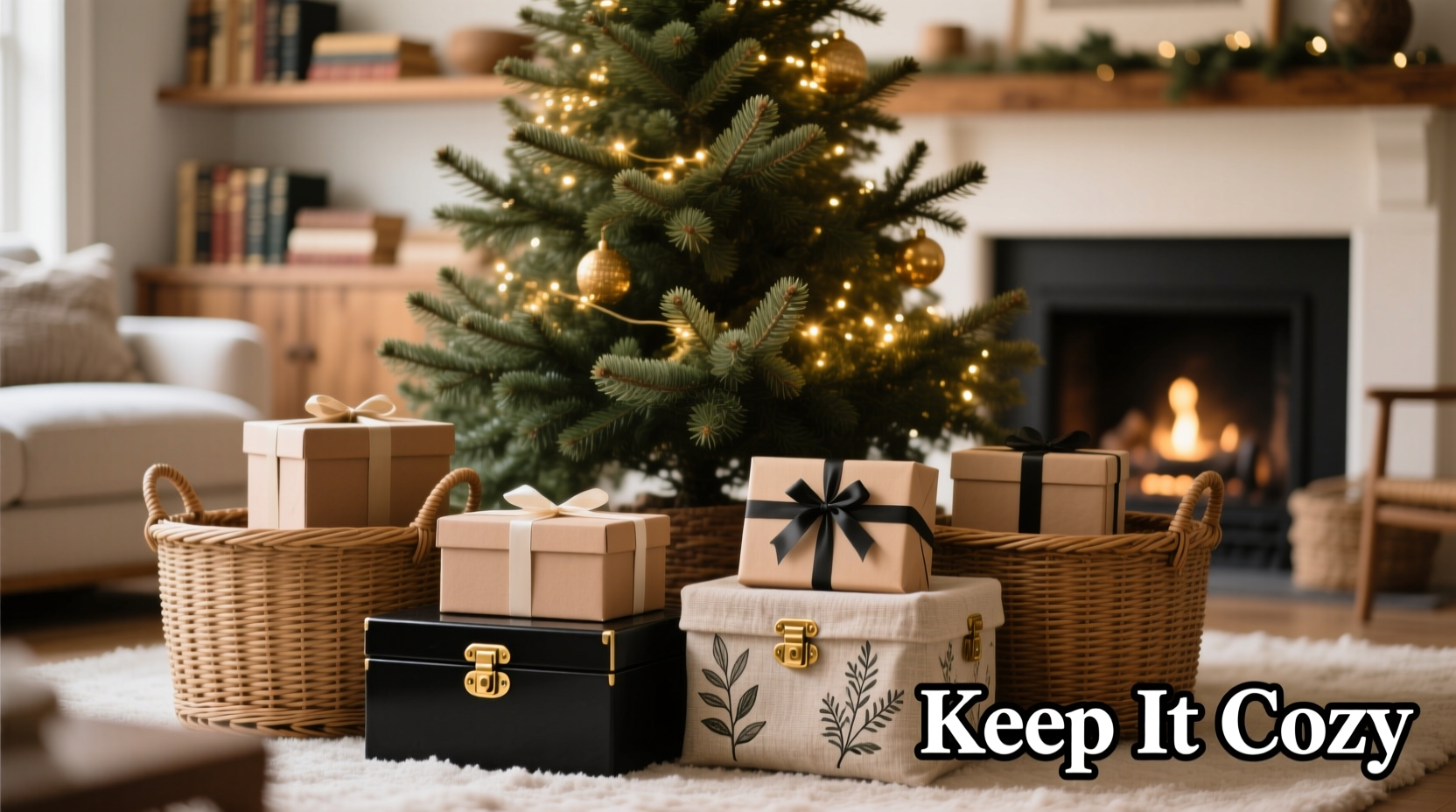
Stacking gifts haphazardly under the tree creates three persistent issues: visual fragmentation (clashing patterns, inconsistent heights, exposed tape), physical instability (toppling towers, crushed corners), and psychological overwhelm (the sense that “there’s too much to manage”). A 2023 National Retail Federation survey found that 68% of holiday shoppers reported feeling stressed by last-minute gift organization—especially around presentation and spatial planning. The solution isn’t fewer gifts; it’s smarter containment.
Baskets and boxes succeed where loose stacking fails because they provide consistent silhouettes, unified textures, and built-in boundaries. Unlike individual wrapped parcels—which vary wildly in shape, weight, and surface finish—well-chosen containers impose visual rhythm. A woven seagrass basket anchors the base with organic texture; a set of matte-finish linen-covered boxes introduces quiet sophistication; a vintage-style wooden crate adds rustic warmth. Each option absorbs visual noise while preserving gifting intent. Crucially, they also protect gifts from accidental kicks, pet curiosity, or children’s early-morning reconnaissance missions.
Selecting the Right Baskets and Boxes: Form, Function, and Festive Fit
Not all baskets and boxes are created equal—and selecting the wrong ones can introduce new problems (e.g., flimsy walls that collapse, rough interiors that scratch delicate packaging, or oversized dimensions that dwarf your tree). Prioritize structure, material integrity, and seasonal harmony over trend-driven aesthetics alone.
| Container Type | Ideal For | Key Considerations | Avoid If… |
|---|---|---|---|
| Woven Seagrass or Water Hyacinth Baskets | Families with pets/kids; rustic, coastal, or Scandinavian decor; storing multiple smaller gifts | Natural fibers breathe well; sturdy when tightly woven; age beautifully with use | You need full opacity—light gaps between weaves may reveal gift shapes or colors underneath |
| Linen-Covered Rigid Boxes (with lift-off lids) | Formal living rooms; minimalist or neutral palettes; gifting high-end items like jewelry or books | Smooth, matte surfaces photograph well; lids stay put; interiors often lined with soft fabric | Your gifts have irregular shapes (e.g., bottles, plush toys) that won’t sit flat inside a rigid square |
| Vintage-Inspired Wooden Crates (unfinished or whitewashed) | Large trees (7+ ft); farmhouse or industrial spaces; grouping themed gifts (e.g., “cozy night in” kits) | Deep storage capacity; stackable; naturally hides wrapping paper edges | You lack floor space—crates add significant footprint and shouldn’t extend beyond the tree’s drip line |
| Felted Wool or Felt-Blend Totes (with reinforced bases) | Small apartments; modern or boho interiors; gifts requiring gentle handling (e.g., ceramics, candles) | Soft exterior protects tree stand and flooring; folds flat for off-season storage; no sharp edges | You need vertical stacking—felt totes compress under weight and lose shape when piled |
| Metal-Lidded Tin Boxes (vintage or reproduction) | Collectible or nostalgic themes; storing non-perishable consumables (cookies, teas, chocolates) | Airtight seals preserve contents; retro charm; highly durable | You’re storing electronics or battery-powered items—metal can interfere with signals or cause condensation |
Pro tip: Limit your palette to *two* dominant container materials and *one* accent color (e.g., natural seagrass + charcoal linen boxes + terracotta ribbon accents). This restraint prevents visual competition and lets the tree remain the centerpiece.
A Real Example: How the Chen Family Transformed Their Tree Zone in 90 Minutes
The Chens live in a 900-square-foot downtown loft with an 8-foot flocked tree positioned directly in front of their large-format sofa. Last year, their “gift zone” was a chaotic mound of 27 individually wrapped packages—some taped with duct tape, others spilling glitter onto the hardwood. Guests tripped twice. Their toddler pulled a ribbon and unraveled three presents before breakfast.
This December, they invested $89 in supplies: four 16\"x12\"x8\" linen boxes (in oatmeal), two medium seagrass baskets (lined with removable ivory cotton dust bags), and one shallow wooden crate (24\"x16\"x5\"). They sorted gifts by recipient *before* wrapping: children’s toys went into the baskets (easy to lift and carry), adult gifts into the linen boxes (for clean unboxing), and shared experience gifts (a board game, gourmet popcorn kit, concert tickets) into the crate. They added eucalyptus sprigs tucked into basket handles and tied simple twine bows on box lids—no glue, no fuss.
Result? A cohesive, grounded base that looked intentionally styled—not staged. Guests complimented the “calm elegance.” Most importantly, the Chens spent zero time reorganizing on Christmas Eve. As Maya Chen told us: “It wasn’t about hiding the gifts. It was about honoring them—giving each one a proper ‘home’ before it was opened.”
Step-by-Step: Building Your Clutter-Free Gift Zone (Under 2 Hours)
- Assess & Sort (20 minutes): Gather all wrapped gifts. Group by recipient, then by size/shape. Discard torn wrapping paper, excess tape, and broken ribbons immediately.
- Measure & Map (15 minutes): Measure the diameter of your tree’s base (at floor level) and the height from floor to lowest branch. Sketch a simple diagram: mark where baskets/boxes will sit—ideally in a staggered semi-circle, not a straight line.
- Select & Prep Containers (25 minutes): Choose containers per your table guidelines. Line baskets with reusable fabric liners (cotton muslin works well). Place small silica gel packets inside boxes storing paper-based gifts (like cards or vouchers) to prevent humidity warping.
- Load Strategically (30 minutes): Place heaviest, sturdiest items (books, games, candles) at the bottom of baskets/boxes. Nest lighter items (scarves, socks, small toys) on top. Leave 1–2 inches of headroom in each container to avoid lid pressure or overflow.
- Style & Secure (10 minutes): Tuck greenery stems into basket weaves or box corners. Tie identical ribbons or twine bows on all box lids. Place one small pinecone or dried orange slice in each basket for textural contrast. Use museum wax dots under basket corners to prevent sliding on hardwood or tile.
“Clutter isn’t caused by too many things—it’s caused by too few places for things to belong. A thoughtfully chosen basket isn’t hiding clutter; it’s completing a sentence the tree began.” — Elena Ruiz, Spatial Designer and Author of Domestic Harmony: Designing Calm Into Everyday Life
Common Pitfalls—and How to Avoid Them
Even with good intentions, small missteps can unravel the entire effort. Here’s what seasoned holiday stylists consistently flag:
- Overfilling containers: When baskets bulge or box lids won’t close fully, you reintroduce visual tension. Fill only to 80% capacity—even if it means using one more small container.
- Mixing incompatible materials: Placing a glossy acrylic box next to a raw jute basket creates tonal dissonance. Stick to complementary finishes: matte with matte, natural with natural, textured with textured.
- Ignoring scale relative to the tree: A 24-inch crate looks balanced under an 8-foot tree—but overwhelming under a 4.5-foot tabletop tree. Rule of thumb: Container height should be no more than 1/6 the tree’s total height.
- Forgetting accessibility: If Grandma needs to retrieve her gift without bending deeply, place her container at knee height—not buried behind taller ones. Rotate placement daily if needed.
- Skipping the “test lift”: Before final placement, lift each loaded container. If it feels unstable, uneven, or strains your wrist, redistribute weight or choose a different vessel.
FAQ: Practical Questions Answered
Can I reuse these baskets and boxes next year—or even for non-holiday storage?
Absolutely. High-quality seagrass baskets last 10+ years with light dusting; linen boxes retain shape for 5–7 seasons if stored flat and away from direct sun. After the holidays, repurpose them: baskets become toy caddies in kids’ rooms, linen boxes store off-season scarves or craft supplies, and crates hold firewood or gardening tools. Just wipe interiors with a dry microfiber cloth before storing empty.
What if I’m gifting something fragile—like glassware or electronics—can I still use baskets?
Yes—with precautions. Line the basket base with crumpled acid-free tissue or recycled kraft paper. Nest the item upright (never on its side) and surround it with shredded recycled paper or biodegradable packing peanuts. Top with a lightweight fabric napkin or folded tea towel—not plastic wrap—to absorb minor vibration. Avoid placing heavy items atop fragile ones, even in separate containers.
How do I handle oddly shaped gifts—like a ukulele or a giant stuffed animal?
Embrace the shape rather than fight it. A ukulele fits perfectly lengthwise in a long, low wooden crate—drape a scarf over the neck for softness and visual flow. Oversized plush toys belong in a deep, wide basket (minimum 18\" diameter); tuck their limbs inward and cover loosely with a faux-fur throw blanket. The goal isn’t invisibility—it’s graceful integration.
Conclusion: Your Tree Deserves Intention—Not Just Inventory
Hiding gift clutter isn’t about deception. It’s about respect—for your space, your time, and the meaning behind each present. When you choose a basket not just for capacity but for texture, or select a box not just for size but for how its lid lifts with quiet dignity, you shift the narrative from “managing stuff” to “honoring significance.” You create breathing room for wonder instead of worry. You give your guests a moment of calm before the unwrapping begins—not a visual scramble to decipher what belongs where.
Start small this season: pick one container type, measure your tree base, and commit to sorting gifts by recipient *before* wrapping. Notice how much lighter the process feels—not physically, but emotionally. That ease is the first gift you give yourself. And once you’ve experienced the serenity of a tree base that looks like it belongs in a design magazine—not a storage closet—you’ll never go back to haphazard stacking again.




 浙公网安备
33010002000092号
浙公网安备
33010002000092号 浙B2-20120091-4
Comments
No comments yet. Why don't you start the discussion?