
In outdoor landscape design, the integration of lighting can dramatically enhance ambiance, safety, and visual interest. Many designers and homeowners seek discreet ways to conceal wiring and control units—especially when working with natural elements like trees. Hollow tree trunks offer a tempting hiding spot for light controllers due to their organic appearance and central placement in gardens or yards. However, improper installation risks trapping heat, restricting airflow, and damaging both electronics and the tree itself. When done correctly, this method becomes an elegant, nearly invisible solution that preserves both function and form.
The key lies in understanding thermal dynamics, moisture management, and safe electrical practices within confined natural enclosures. This guide provides a comprehensive approach to installing light controllers in hollow tree trunks while maintaining proper ventilation, preventing overheating, and ensuring long-term reliability.
Why Use Hollow Tree Trunks for Controller Concealment?
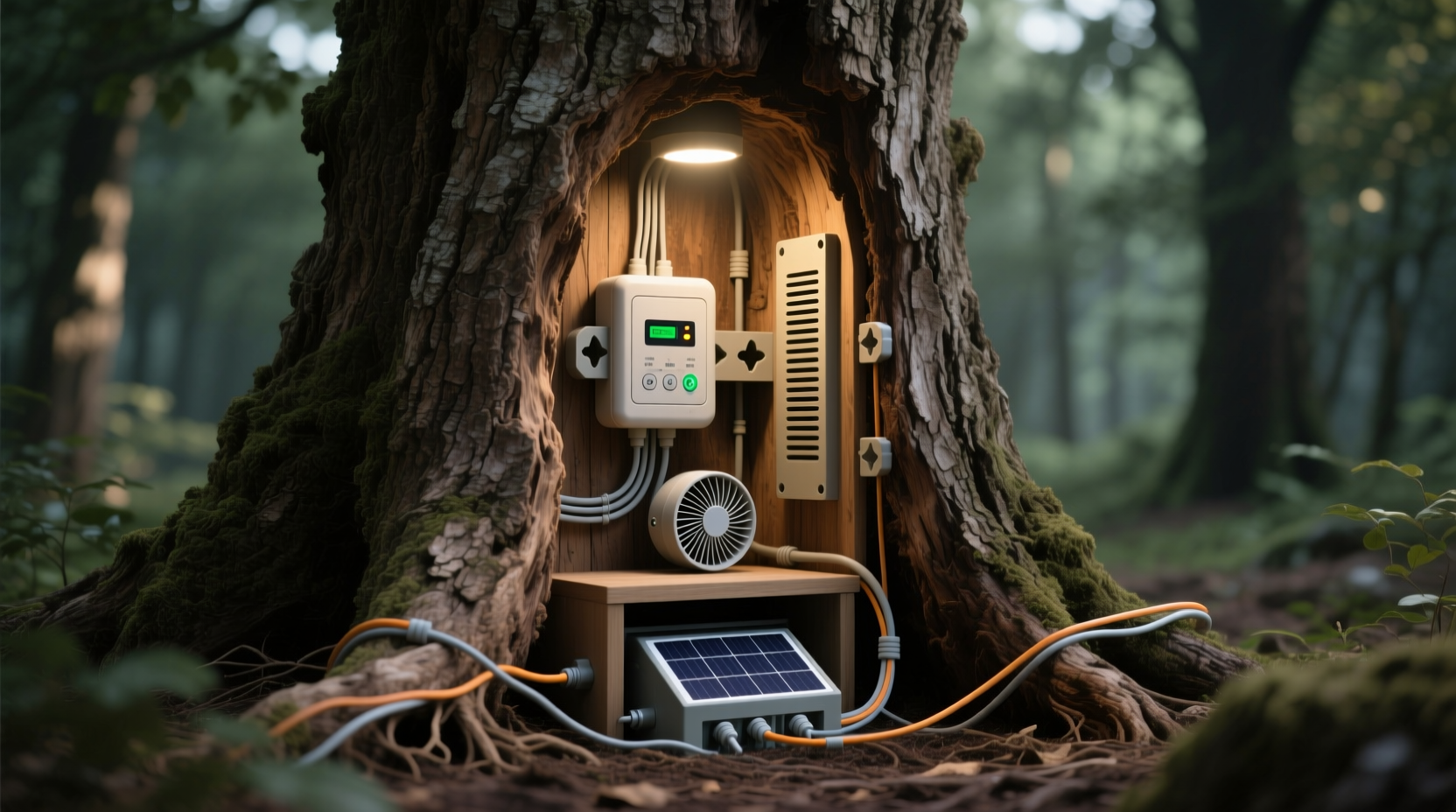
Hollow tree trunks are increasingly popular as hidden enclosures for low-voltage lighting systems, timers, transformers, and smart controllers. Their appeal is multifaceted:
- Aesthetic blending: They eliminate visible boxes and wires, preserving the natural look of the landscape.
- Central positioning: Trees often sit at focal points, making them ideal hubs for distributed lighting networks.
- Protection from elements: A sturdy trunk offers shelter from rain, UV exposure, and accidental impact.
- Security: Hidden components are less vulnerable to tampering or theft.
Despite these benefits, the internal environment of a hollow trunk presents unique challenges: limited air circulation, potential moisture buildup, fluctuating temperatures, and biological activity (like insects or fungi). Installing electronic equipment here without planning can lead to premature failure, fire hazards, or harm to the host tree.
Thermal Management: Preventing Overheating in Confined Spaces
Electronic controllers generate heat during operation, especially under continuous load or high ambient temperatures. In enclosed spaces like hollow trunks, this heat can accumulate rapidly, leading to component degradation or even thermal shutdown. According to the IEEE Guide for Electrical Equipment Thermal Evaluation, every 10°C rise above rated operating temperature can halve the lifespan of electronic components.
To mitigate this risk, consider the following principles:
- Choose low-heat electronics: Opt for energy-efficient LED-compatible controllers with passive cooling designs. Avoid units that require active fans, which are prone to dust clogging and mechanical failure in outdoor settings.
- Maintain clearance around devices: Leave at least 2–3 inches (5–7.5 cm) of open space on all sides of the controller to allow convective airflow.
- Use thermally conductive mounting: Attach the controller to a metal backplate anchored to the outer wall of the trunk. This transfers heat outward, using the tree’s mass as a rudimentary heatsink.
- Monitor temperature remotely: Install a wireless temperature sensor inside the cavity to alert you if internal temps exceed 40°C (104°F).
“Enclosing electronics in natural structures demands extra caution. Heat buildup is silent but destructive—it can degrade insulation, warp circuit boards, and trigger short circuits.” — Dr. Alan Reeves, Electrical Systems Engineer, Outdoor Lighting Institute
Step-by-Step Installation Process
Follow this sequence to safely install a light controller inside a hollow tree trunk while preserving airflow and minimizing risks.
- Assess the tree’s condition: Confirm the trunk is stable, dry, and free of active decay. Consult an arborist if unsure about structural integrity.
- Select a suitable entry point: Choose a side-facing opening away from direct sun exposure. Ideally, position it 12–18 inches above ground level to reduce moisture ingress.
- Install a ventilation sleeve: Drill two 1-inch (2.5 cm) diameter holes—one near the top, one near the bottom—on opposite sides of the trunk. Insert plastic or metal ventilation tubes angled downward to prevent rain entry while enabling convection currents.
- Mount the controller externally but conceal it internally: Use a weatherproof enclosure mounted just inside the cavity, secured to a non-load-bearing bracket. Ensure cables enter through grommet-sealed knockouts at the base.
- Route wiring properly: Feed low-voltage cables through buried conduit from lights to the trunk. Keep high-voltage input lines separate and protected with junction boxes outside the tree.
- Test before sealing: Power up the system and monitor for 30 minutes. Check for unusual warmth, flickering, or voltage drops.
- Add breathable shielding: Cover the opening with a perforated metal grille or louvered vent cover painted to match bark texture. Avoid solid caps or foam seals.
Do’s and Don’ts: Best Practices Summary
| Do | Don’t |
|---|---|
| Use sealed, outdoor-rated enclosures (IP65 or higher) | Place bare circuit boards directly in the cavity |
| Ensure top-to-bottom ventilation for natural convection | Block airflow with insulation or foam padding |
| Inspect annually for pests, moisture, or corrosion | Forget about the unit after installation |
| Ground all electrical components properly | Run extension cords or temporary power solutions permanently |
| Use drip loops on all cable entries | Allow water to pool near connections |
Mini Case Study: The Oak Grove Project
In a residential garden in Asheville, North Carolina, a landscape designer was tasked with illuminating a circular grove of mature white oaks without disrupting the serene, woodland aesthetic. Each tree had a naturally formed hollow at its base, varying in depth from 18 to 30 inches. The client wanted individual dimming control per tree, requiring ten separate low-voltage controllers.
Rather than use ground-level enclosures, the team opted to house each controller within its respective tree. They installed aluminum backplates anchored to the inner walls, mounted IP67-rated smart controllers with passive cooling, and added dual ventilation ports with insect mesh. Cables were routed underground and entered via drip loops at the base. Perforated bronze grille covers, custom-aged to resemble bark, concealed the openings.
After one year of monitoring, internal temperatures remained within 5°C of ambient levels, even during summer peaks. No moisture accumulation or insect intrusion was detected. The client reported flawless performance and praised the invisible integration. An arborist inspection confirmed no adverse effects on tree health.
Checklist: Safe Installation in Hollow Trunks
Before completing your installation, verify the following:
- ☐ Tree has been inspected for structural stability and rot
- ☐ Controller is rated for outdoor/enclosed use (IP65 minimum)
- ☐ Ventilation ports are installed at top and bottom for convection
- ☐ All wiring uses UV-resistant, direct-burial-rated cable where exposed
- ☐ Drip loops are formed before any entry point
- ☐ Enclosure is mounted securely with non-corrosive hardware
- ☐ Temperature sensor or remote monitoring is in place (optional but recommended)
- ☐ Vent covers are insect-proof but airflow-permissive (mesh ≤ 1 mm)
- ☐ System has been tested under full load for at least 30 minutes
- ☐ Inspection schedule established (minimum annual check)
Frequently Asked Questions
Can I use a regular indoor controller in a tree trunk?
No. Indoor controllers lack protection against moisture, dust, and temperature swings. Always use outdoor-rated, sealed enclosures designed for damp or wet locations. Look for IP65 or NEMA 3R/4X ratings.
Won’t drilling holes hurt the tree?
Small-diameter ventilation holes (under 1.5 inches) in already-hollow trunks typically do not harm healthy trees. The cambium layer is no longer active in deadwood sections. However, avoid drilling into living tissue or creating large cavities. When in doubt, consult a certified arborist.
How do I prevent animals from nesting in the trunk with my equipment?
Install fine stainless steel mesh over ventilation openings and access points. Avoid glue or sealants that could trap moisture. Consider adding ultrasonic deterrents rated for outdoor use if pest activity is common in your area.
Conclusion: Balancing Innovation with Safety
Hiding light controllers in hollow tree trunks is more than a clever trick—it’s a thoughtful fusion of technology and nature. When executed with attention to airflow, heat dissipation, and ecological sensitivity, it delivers clean, unobtrusive lighting that enhances rather than interrupts the landscape. The success of such installations hinges not on hiding the hardware completely, but on integrating it responsibly.
Every decision—from choosing the right enclosure to designing passive ventilation—contributes to a system that lasts, performs, and respects its environment. As outdoor living spaces become extensions of our homes, the demand for seamless, intelligent lighting will only grow. By mastering techniques like these, you position yourself at the forefront of sustainable, aesthetically conscious design.




 浙公网安备
33010002000092号
浙公网安备
33010002000092号 浙B2-20120091-4
Comments
No comments yet. Why don't you start the discussion?