
Every holiday season, millions of households wrestle with the same visual dilemma: how to keep Christmas tree lighting tidy and festive while maintaining electrical safety. Tucking power strips and extension cords beneath a tree skirt seems like an elegant solution—until you consider heat buildup, restricted airflow, and the real risk of thermal failure. This isn’t just about aesthetics; it’s about preventing a preventable hazard. According to the U.S. Fire Administration, electrical distribution and lighting equipment account for an estimated 27% of home Christmas tree fires—and improper cord management is a leading contributing factor. This article delivers field-tested, code-aligned strategies that balance visual harmony with engineering rigor. No shortcuts. No assumptions. Just actionable, safety-validated approaches grounded in NEC (National Electrical Code) guidelines, UL certification standards, and real-world troubleshooting from electricians who’ve responded to post-holiday fire investigations.
Why “Hidden” Doesn’t Mean “Ignored”: The Overheating Reality
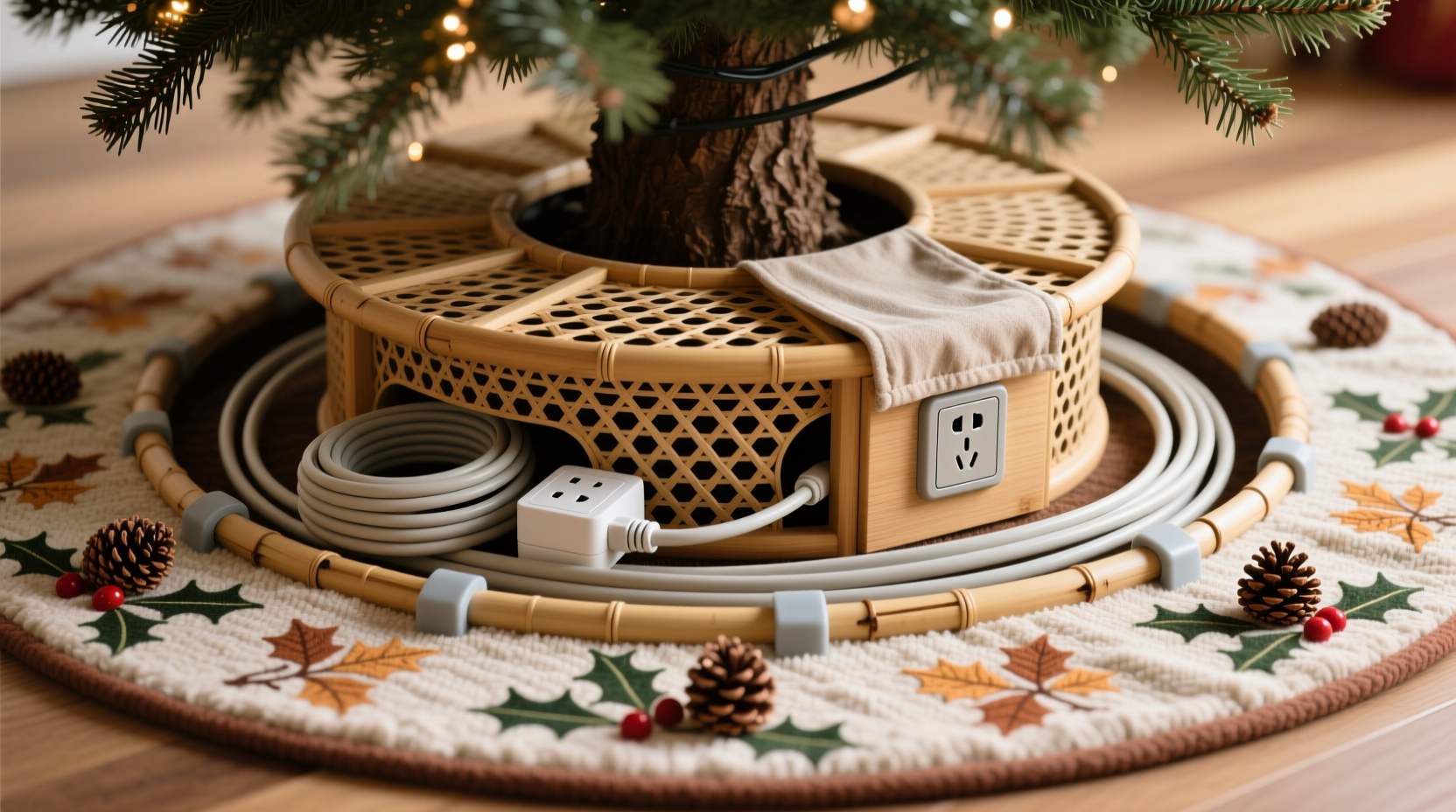
Power strips generate heat—not dramatically under light loads, but consistently and cumulatively. A standard 15-amp, 1875-watt strip operating at 80% capacity (1500W) can reach surface temperatures of 65–75°C (149–167°F) in confined, low-airflow conditions. When buried under fabric, insulation, pine needles, or plush skirt material—even loosely draped—the natural convection cooling path is severed. Heat becomes trapped, accelerating insulation degradation on both the power strip housing and connected cords. Over time, this compromises dielectric strength, increases resistance at plug connections, and raises the risk of arcing or thermal runaway. Worse, many consumers unknowingly daisy-chain multiple power strips or overload single outlets with high-wattage LED stringers, vintage incandescent sets, or even mini-heaters near the tree base—all amplifying thermal stress.
“Cord concealment is one of the top three non-compliant practices we document during holiday fire origin investigations. It’s not the device itself—it’s the environment we create around it.” — Captain Marcus R. Delgado, NFPA Certified Fire Investigator & Lead Electrical Safety Advisor, National Fire Protection Association
Safety-First Setup Checklist
- ✅ Verify all power strips are UL 1363 certified *and* explicitly rated for continuous load (not just intermittent use)
- ✅ Confirm total connected wattage stays below 80% of the strip’s rated capacity (e.g., ≤1200W on a 15A/1875W strip)
- ✅ Use only cords rated for indoor use with 16 AWG minimum gauge (thicker wire = lower resistance = less heat)
- ✅ Keep all connections elevated off carpet/floor by ≥1 inch using non-combustible spacers (ceramic tile, metal standoffs, or UL-listed cord organizers)
- ✅ Install a GFCI-protected outlet or use a GFCI-protected power strip—mandatory for any setup near moisture-prone areas (real trees, humid rooms)
- ✅ Test ground-fault and overload protection monthly during the season—not just once at setup
Step-by-Step: Building a Thermally Safe, Visually Seamless Base
- Calculate Your Load Precisely: List every light string, ornament warmer, or sound module. Add their wattages (check labels or manufacturer specs—don’t estimate). For LED strings, assume 4–7W per 100 bulbs; for older incandescents, 20–40W per 100. Total must stay ≤80% of your strip’s rating.
- Select the Right Power Strip: Choose one with spaced-out outlets (no clustered sockets), built-in thermal cutoff (auto-shutoff above 90°C), and external ventilation grilles—not sealed plastic housings. Avoid “surge-only” strips; they lack robust internal circuitry for sustained load.
- Elevate and Isolate: Place the power strip on a non-flammable platform: a 4×4-inch ceramic tile, a UL-listed aluminum cord management tray, or a small stainless-steel shelf bracket mounted to the tree stand. Ensure ≥½ inch clearance on all sides—including underneath—for passive airflow.
- Route Cords Strategically: Feed cords *upward* from the strip into the tree trunk base—not downward under the skirt. Use cord clips attached to the stand or trunk to hold them vertically. This prevents kinking, reduces friction heat, and keeps the hottest component (the strip) exposed.
- Install the Skirt Last—With Intention: Drape the skirt so its inner hem rests *just above* the elevated power strip—not covering it. Leave a visible 1–2 inch gap between skirt fabric and the strip’s top surface. If using a layered skirt, ensure the bottom layer is breathable (linen, cotton canvas) and the top layer is loosely gathered—not taut or compressed.
- Monitor Weekly: Feel the strip housing each Sunday. If it’s too hot to hold comfortably (>50°C / 122°F), unplug immediately, reduce load, and re-evaluate placement.
Do’s and Don’ts: A Thermal Safety Comparison Table
| Action | Do | Don’t |
|---|---|---|
| Power Strip Placement | On a raised, non-combustible platform with ≥½\" side/bottom clearance | Directly on carpet, under rug padding, or nestled into tree stand foam |
| Cord Management | Vertical routing clipped to stand/trunk; no coiling or bundling beneath skirt | Tightly wound cords taped under skirt or wrapped around tree base |
| Skirt Material | Breathable natural fibers (cotton, linen, burlap); loose drape with visible gap | Synthetic fleece, polyester velvet, or quilted layers pressed flush against strip |
| Load Verification | Measured with a Kill-A-Watt meter; updated if adding new lights | Assumed safe because “it’s LED” or “only two strings” |
| Maintenance | Weekly tactile check + GFCI test button press | Set-and-forget until New Year’s Eve |
Real-World Example: The Johnson Family’s Near-Miss Intervention
The Johnsons purchased a popular “all-in-one” holiday power hub marketed for tree bases—featuring four outlets, surge protection, and a fabric-wrapped housing designed to blend under skirts. They loaded it with five LED stringers (totaling 1380W), a rotating tree stand motor, and a battery-powered ornament speaker. After three days, the fabric housing began emitting a faint, acrid odor. Their 10-year-old noticed the skirt felt warm near the base and pointed it out. Upon inspection, the power hub’s surface temperature measured 82°C—well beyond safe limits—with visible warping around the outlet slots. They unplugged everything, contacted the manufacturer, and discovered the unit lacked UL 1363 certification for continuous load and had no thermal cutoff. Replaced with a UL 1363-certified strip on a ceramic tile platform—wattage reduced to 1120W—the setup ran cool and silent for 42 days. Their takeaway? Marketing claims don’t override physics. When in doubt, measure temperature and verify certifications—not just branding.
Frequently Asked Questions
Can I use a surge protector power strip labeled “for holiday use” under a tree skirt?
Not safely—unless it explicitly states “UL 1363 certified for continuous operation” *and* includes thermal cutoff, spaced outlets, and ventilation design. Many “holiday-rated” strips only meet UL 1449 (surge-only) standards and lack thermal management. Always check the fine print on the label or spec sheet—not the box copy.
Is it safer to run cords up the back of the tree instead of hiding them under the skirt?
Yes—significantly safer. Vertical routing minimizes contact points, maximizes airflow, and eliminates compression heat from fabric weight. Use clear adhesive cord clips every 12 inches along the trunk, and route the final connection to a wall outlet behind the tree. This also reduces tripping hazards and makes troubleshooting faster.
What’s the safest alternative if I absolutely need a hidden look?
Use a purpose-built, ventilated tree base enclosure: a 3D-printed or metal-mesh housing (available from specialty electrical suppliers) that mounts to the stand and features passive cooling vents, integrated cord routing channels, and a removable top panel for access. These maintain full airflow while providing visual containment—unlike fabric skirts, which act as thermal blankets.
Conclusion: Beauty Built on Safety, Not Compromise
Hiding cords under a tree skirt shouldn’t require choosing between aesthetics and accountability. With precise load calculation, thermally intelligent hardware selection, intentional elevation, and disciplined monitoring, you can achieve both elegance and engineering integrity. This isn’t about adding complexity—it’s about replacing guesswork with verification, marketing hype with measurement, and tradition with thoughtful adaptation. Every holiday season brings new lighting technologies, but the laws of thermodynamics remain constant. Respect them, and your tree will shine brightly—not dangerously. Start this year by auditing your current setup: pull back the skirt, feel the strip, check the label, and measure the wattage. Then make one intentional improvement—whether it’s swapping a daisy-chained strip for a certified single unit, adding a ceramic tile riser, or switching to vertical cord routing. Small changes, grounded in evidence, compound into meaningful safety. Your home, your family, and your peace of mind deserve nothing less than rigor disguised as routine.




 浙公网安备
33010002000092号
浙公网安备
33010002000092号 浙B2-20120091-4
Comments
No comments yet. Why don't you start the discussion?