
Every holiday season, the same challenge emerges: a tangle of extension cords, overloaded outlets, and unsightly power strips snaking across baseboards, peeking from under furniture, or dangling mid-wall. When you’re stringing lights on mantels, bookshelves, stair railings, window frames, and ceiling beams—all indoors—the electrical infrastructure quickly becomes as visible as the decorations themselves. But visibility isn’t just an aesthetic issue. Exposed power strips pose real safety concerns: overheating from overloading, accidental disconnection, tripping hazards, and increased fire risk—especially when draped near flammable materials like dried pine garlands or fabric drapery. The solution isn’t fewer lights or less cheer. It’s smarter, safer, and more intentional power management. This guide distills field-tested strategies used by professional holiday installers, certified electricians, and interior stylists who regularly manage 20+ light strings in residential spaces—without sacrificing safety, accessibility, or style.
Why Hiding Power Strips Matters Beyond Aesthetics
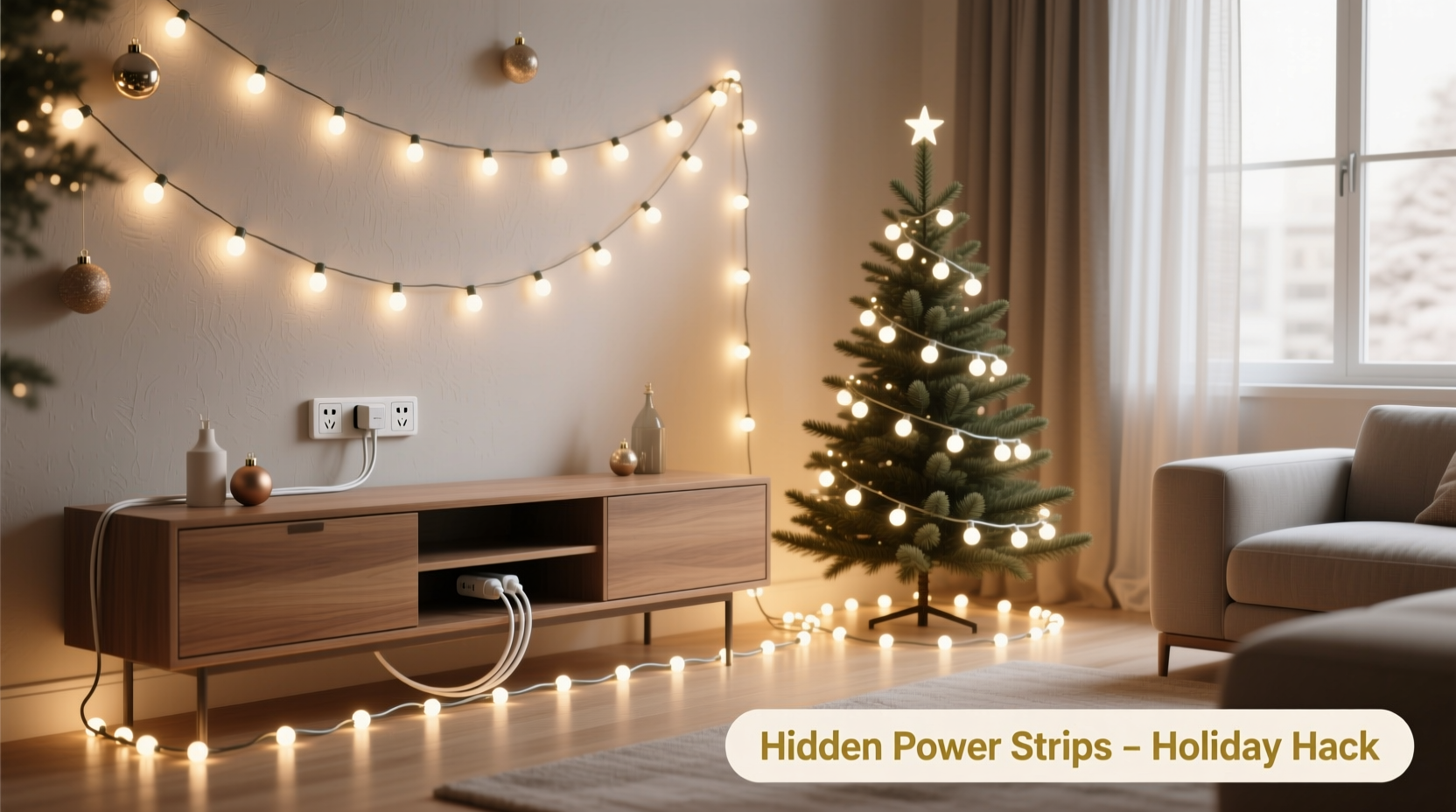
Hiding power strips isn’t about cosmetic perfection—it’s rooted in electrical safety standards and human behavior. According to the National Fire Protection Association (NFPA), over 700 home fires each year are attributed to decorative lighting, with improper power distribution cited as a top contributing factor. Most incidents occur not from faulty bulbs or wiring, but from daisy-chained extensions, concealed power strips buried under rugs or inside cabinets, and thermal buildup caused by inadequate ventilation. UL (Underwriters Laboratories) explicitly prohibits covering power strips with insulation, fabric, or carpet—even temporarily—because heat dissipation is compromised. Yet many well-intentioned homeowners tuck strips behind sofas or inside entertainment centers without realizing they’ve created a latent hazard. Equally important is accessibility: hidden strips become difficult to reset during outages, inspect for damage, or unplug before bed—a critical habit for reducing overnight fire risk. Prioritizing concealment *with* ventilation, load monitoring, and quick access transforms a potential liability into a seamless part of your holiday setup.
Five Safe & Effective Concealment Methods (Ranked by Safety + Practicality)
Not all hiding methods are created equal. Below are five approaches evaluated against three non-negotiable criteria: (1) continuous airflow around the unit, (2) immediate physical access for unplugging or resetting, and (3) adherence to UL 1363 safety standards for relocatable power taps. Each method includes implementation notes, ideal use cases, and common pitfalls.
- Wall-Mounted Raceway Enclosures with Ventilation Slots
Hardwired or adhesive-backed plastic raceways (e.g., Wiremold® or Legrand Wiremold Series) allow you to route cords *and* mount a power strip flush against the wall. Choose models with built-in ventilation slots and integrated cord covers. Mount at least 6 inches above baseboard level to prevent dust accumulation and allow bottom airflow. Ideal for mantels, stair landings, or long hallway runs where multiple strings originate from one zone. - Open-Front Entertainment Center Shelves with Strategic Placement
Use the open lower shelf of a media console—not the enclosed cabinet—to house a power strip. Position it at the back center, plug in lights through rear cable ports, and run cords upward along the back panel. Keep at least 2 inches of clearance on all sides. Avoid stacking AV equipment directly above; heat from receivers or game consoles compounds thermal stress. - Baseboard-Mounted Metal Junction Boxes (Non-Permanent)
UL-listed surface-mount junction boxes (e.g., Steel City® 4x4x2) can be secured to baseboards with removable double-sided tape or low-profile screws. Mount the power strip *inside* the box with the outlet faceplate removed, ensuring no internal components are obstructed. The metal housing dissipates heat more efficiently than plastic, and the open front maintains full access. Best for high-traffic areas like entryways or living room perimeters. - Furniture-Integrated Cord Management Trays
Slip a slim, ventilated cord management tray (like Belkin 12-Outlet Surge Protector Tray) beneath a sofa or sectional. Place it centered, not tucked fully underneath—leave a 1.5-inch gap at the front and sides. Use Velcro straps to secure cords vertically up the furniture leg, then horizontally along the frame to their destination. Never let the tray rest directly on carpet or padding. - Decorative Hollow Columns or Light Pole Conduits
For large-scale displays (e.g., a 10-ft faux-fir tree with 12+ light strings), build or purchase a hollow, ventilated column (wood, PVC, or metal mesh) that houses both the tree stand and a centrally located power strip. Drill ¼-inch ventilation holes every 4 inches vertically. Route all cords internally and exit through discreet grommets at the base. This method isolates heat, centralizes control, and doubles as structural support.
Load Management: The Hidden Foundation of Safe Concealment
You can conceal a power strip perfectly—but if it’s overloaded, safety is already compromised. Most standard 12-outlet power strips are rated for 15 amps (1,800 watts) at 120V. Yet a single 50-light incandescent string draws ~200W, while LED strings average 4–12W each. Overloading occurs silently: warm housings, buzzing sounds, or tripped breakers are late-stage warnings. Calculate total wattage *before* plugging anything in:
| Light Type | Per-String Wattage (Typical) | Max Strings per 15A Strip | Key Notes |
|---|---|---|---|
| Mini Incandescent (100-count) | 40–60W | 25–30 strings | High heat output; avoid near curtains or dry greenery |
| LED Mini Lights (100-count) | 4.5–7W | 200+ strings | Low heat; safest for dense or layered displays |
| Wide-Angle LED (C7/C9) | 12–25W | 60–120 strings | Check manufacturer specs—some draw significantly more |
| Fairy Lights (battery + AC hybrid) | 2–5W | 300+ strings | Verify AC adapter rating; don’t overload adapter + strip |
Always derate by 20%: for a 15A/1,800W strip, limit continuous load to 1,440W. Use a plug-in watt meter (like the Kill A Watt P4400) to verify actual draw—not just label ratings. And never daisy-chain power strips. As electrician Marcus Bell explains:
“Daisy-chaining creates impedance mismatches and turns the first strip into a bottleneck. You’re not adding capacity—you’re adding failure points. If you need more outlets, use a single, higher-capacity strip rated for commercial use, or consult an electrician about adding a dedicated circuit.” — Marcus Bell, Master Electrician & Holiday Lighting Safety Advisor, NFPA Certified
A Real-World Example: The 3-Story Victorian Living Room
Sarah K., a historic home renovator in Portland, faced a complex indoor lighting challenge: her 1892 Victorian had ornate woodwork, narrow doorways, and only four working outlets on the first floor. She planned to illuminate a 9-ft tree, fireplace mantel, staircase banister, two bay windows, and a suspended ceiling garland—totaling 17 light strings (14 LED, 3 incandescent). Her initial setup used three daisy-chained strips hidden behind the sofa, under the rug, and inside a closed cabinet. Within 48 hours, the cabinet-mounted strip tripped repeatedly, and the rug-covered unit emitted a faint burning odor.
She revised her approach using three principles: centralized distribution, vertical cord routing, and passive cooling. She installed a ventilated raceway along the baseboard from the nearest outlet to the fireplace (12 ft), mounted a 15A metal-jacketed power strip inside it, and ran all mantel and tree cords upward through decorative brass conduit clips. For the stairs, she used a baseboard-mounted junction box at the landing, feeding strings downward to the banister and upward to the ceiling garland. All incandescent strings were limited to two per circuit and placed away from flammable surfaces. Total setup time: 3.5 hours. Zero trips, zero heat issues, and zero visible hardware—just lights.
Essential Pre-Installation Checklist
- ✅ Verify all power strips are UL 1363–listed and have built-in circuit breakers (not just fuses)
- ✅ Test each outlet with a receptacle tester before plugging in lights
- ✅ Measure total wattage of all connected strings—and stay below 80% of strip’s rated capacity
- ✅ Confirm at least 2 inches of unobstructed space surrounds the entire unit on all sides
- ✅ Label each cord at both ends (e.g., “Mantel – Left,” “Tree – Top Ring”) using masking tape and a fine-tip marker
- ✅ Install GFCI protection on the circuit—or use a GFCI-protected power strip for added safety
- ✅ Set a recurring phone reminder to unplug all indoor lights before sleeping or leaving home for >4 hours
FAQ
Can I use a surge protector instead of a basic power strip for concealment?
Yes—and it’s strongly recommended. Surge protectors add critical voltage-clamping circuitry that absorbs spikes from HVAC cycling or lightning-induced surges. However, not all “surge protectors” offer true protection: look for a UL 1449 listing, a clamping voltage under 400V, and a joule rating of at least 1,000 (2,000+ preferred for whole-display setups). Avoid power strips labeled only as “protected” without published specs.
Is it safe to mount a power strip inside a wooden shelf unit?
Only if the shelf is open-front, made of non-combustible material (or sealed hardwood), and provides ≥2 inches of clearance on all sides—including above. Never mount inside enclosed cabinets, particleboard enclosures, or near heat-generating devices like amplifiers. Wood conducts heat poorly; trapped air becomes an insulator, not a radiator.
What’s the safest way to hide cords running across a hardwood floor?
Use low-profile, ventilated cord covers designed for foot traffic (e.g., Z-Bar® Floor Cord Protector). These have rigid, slotted tops that allow airflow while protecting cords from abrasion and crushing. Secure with painter’s tape—not duct tape—to avoid residue. Never use rugs, runners, or thresholds to cover cords: they create tripping hazards and trap heat.
Conclusion
Hiding power strips isn’t about erasing electricity from your holiday experience—it’s about integrating it thoughtfully, safely, and respectfully into your home’s rhythm. The most beautiful displays aren’t those with the most lights, but those where every element serves function *and* feeling: warmth without risk, magic without compromise, abundance without chaos. When you choose ventilation over concealment, calculation over assumption, and accessibility over invisibility, you do more than tidy up cords—you honor the quiet work of safety that makes celebration possible. Start small: pick one method from this guide, audit your current setup with a watt meter, and replace one daisy chain this year. Then share what you learn. Your neighbor scrolling for solutions at midnight? Your cousin setting up their first apartment tree? Your future self, unclipping lights in January without finding a melted outlet? They’ll thank you for the clarity, the care, and the confidence to light up the season—responsibly.




 浙公网安备
33010002000092号
浙公网安备
33010002000092号 浙B2-20120091-4
Comments
No comments yet. Why don't you start the discussion?