
Every year, the festive glow of a Christmas tree transforms living rooms into warm, inviting spaces—until you spot the unsightly router blinking in the corner, its tangle of Ethernet, power, and coaxial cables snaking across the floor like digital ivy. Hiding tech behind décor isn’t about denial; it’s about intentionality. A well-concealed router maintains strong signal integrity while preserving the magic of the season. This isn’t a compromise—it’s a design opportunity. Done right, your tree becomes both a focal point *and* a functional tech hub: quiet, tidy, and fully operational.
Why Hiding Your Router Behind the Tree Is Smarter Than You Think
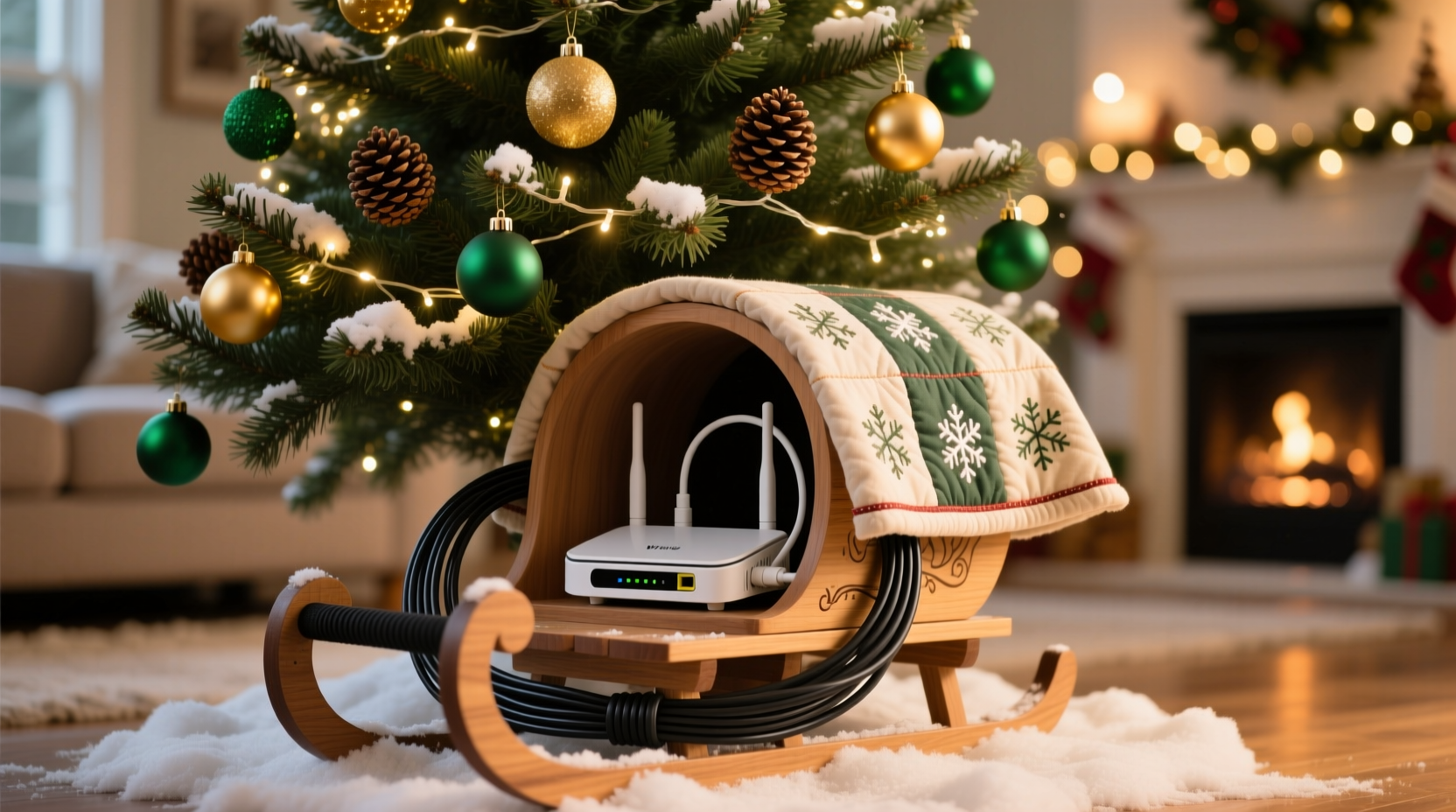
Many assume routers must sit exposed on a shelf or desk for optimal performance. That’s outdated. Modern dual-band and mesh-ready routers transmit effectively through moderate obstructions—including dense evergreen branches, layered ornaments, and even lightweight fabric draping—provided key conditions are met: unobstructed line-of-sight to primary usage zones, adequate ventilation, and strategic antenna orientation. The real risk isn’t signal loss—it’s heat buildup from poor airflow or physical compression against walls or furniture. A Christmas tree, when approached with technical awareness, offers surprising advantages: natural airflow between branches, vertical elevation (improving horizontal signal spread), and organic diffusion that reduces signal reflection hotspots common near flat surfaces like drywall or glass.
“Wi-Fi signals behave more like light than sound—they travel best in open space, but can bend and scatter effectively around soft, non-metallic objects. A well-pruned fir or spruce is far less disruptive than a metal bookshelf or concrete wall.” — Dr. Lena Torres, RF Engineer & Home Connectivity Advisor, IEEE Home Networks Task Force
The aesthetic payoff is immediate: no more visual clutter competing with garlands and lights. More importantly, concealing cables eliminates tripping hazards, protects cords from pet teeth and toddler curiosity, and preserves your tree skirt’s clean lines. It’s not decoration as camouflage—it’s integration as intention.
Step-by-Step: Preparing Your Tree and Tech Setup
Success begins before the first ornament goes up. Follow this sequence precisely—skipping steps invites signal dropouts or overheating:
- Evaluate your tree type and placement: Choose a real or high-quality artificial tree with full lower branches (e.g., Fraser fir, Nordmann fir, or a “full-profile” PVC tree). Position it at least 18 inches from any wall or large furniture piece to allow rear airflow. Avoid corners where two walls meet—this traps heat and reflects signals inward.
- Test your current router placement: Use a free Wi-Fi analyzer app (like NetSpot or WiFi Analyzer) to map signal strength in key areas (sofa, kitchen island, home office desk) *before* moving anything. Note baseline 2.4 GHz and 5 GHz readings at 3 ft, 6 ft, and 10 ft from your current router location.
- Choose your router mounting method: Do *not* place the router directly on the floor behind the tree. Instead, use one of three stable, ventilated options: (a) a small, open-shelf wall-mounted bracket mounted 24–30 inches above floor level, (b) a ventilated router stand placed *just behind* the tree’s trunk base (not under it), or (c) a custom-cut plywood platform suspended from the tree’s sturdiest lower branch using nylon straps (never wire or zip ties).
- Route and bundle cables *before* decorating: Run all cables (power, Ethernet, coaxial if applicable) vertically up the back of the tree trunk—not horizontally through branches. Use velcro cable wraps (not plastic ties) for easy adjustment. Leave 6–8 inches of slack at the router end for future repositioning.
- Install thermal monitoring (optional but recommended): Place a small digital thermometer (like ThermoPro TP50) near the router’s vents. If internal temps exceed 140°F (60°C) during peak usage, add a low-noise USB-powered fan directed at the rear vents—or reconsider placement.
Decorative Concealment Techniques That Actually Work
Ornamentation isn’t just for sparkle—it’s functional camouflage. Prioritize materials and placement that diffuse rather than absorb or reflect signals:
- Branch density matters: Use trees with tight, overlapping lower branches (avoid sparse “slim profile” models). Gently fluff inner branches outward to create a soft, irregular barrier—not a solid wall.
- Strategic ornament layering: Hang larger, lightweight ornaments (wood slices, felt stars, acrylic globes) toward the *back* of the tree—closest to the router. Reserve smaller, denser ornaments (glass balls, metal charms) for the front and sides, where they won’t interfere with signal paths.
- Cable color-matching: Replace black or white cables with matte forest green, charcoal gray, or deep burgundy Ethernet and power cords. These visually recede into pine boughs far better than glossy finishes.
- Natural texture overlays: Drape a single, narrow strip (no wider than 4 inches) of undyed jute twine or linen ribbon vertically down the trunk’s backside, covering cable runs. Secure only at top and bottom with discreet fabric glue dots—not staples or pins.
- Lighting as distraction: String warm-white LED mini-lights *behind* the tree (on the wall or a backdrop panel), not *in* the branches. This creates ambient backlighting that draws the eye away from the base while adding depth.
Avoid these common missteps: wrapping cables tightly around branches (causes kinks and signal degradation), using metallic garlands near the router (creates interference), or stuffing the base with moss or floral foam (traps heat and blocks airflow).
Do’s and Don’ts: A Practical Comparison Table
| Action | Do | Don’t |
|---|---|---|
| Router Ventilation | Mount on an open shelf with 2+ inches of clearance on all sides; use a breathable mesh router cover if needed. | Place inside a wooden box, under a tree skirt, or sandwiched between branches without airflow gaps. |
| Cable Management | Use flat, low-profile Ethernet cables; route vertically along trunk; secure with fabric-covered velcro. | Run cables horizontally through branches; coil excess cord at the base; use adhesive cable clips on bark. |
| Signal Optimization | Orient external antennas vertically; position router at 24–36 inches height; keep 5 GHz band enabled for nearby devices. | Lay router flat on its side; angle antennas horizontally; disable 5 GHz to “reduce interference” (it actually reduces capacity). |
| Decor Integration | Use matte-finish, non-metallic ornaments at the rear; hang pinecones *loosely* on lower branches—not packed densely. | Wrap copper wire garlands around the trunk; staple burlap directly over vents; pile heavy ornaments at the base. |
Real-World Case Study: The Anderson Family Living Room
The Andersons live in a 1930s bungalow with hardwood floors, tall windows, and a central fireplace. Their original setup—a Linksys MR9000 router on a side table—created a glaring visual break in their vintage-modern décor. Every December, they’d wrestle with cables tripping their two young children and dogs, and their 5 GHz signal dropped sharply in the kitchen during holiday cooking marathons.
This year, they implemented a tree-integrated solution: They chose a 7.5-foot pre-lit artificial Fraser fir with dense lower foliage. Using a $22 wall-mounted oak shelf (mounted 28 inches above floor level, 12 inches behind the trunk), they positioned the router upright with antennas vertical. All cables were replaced with flat, charcoal-gray Ethernet and power cords, routed up the trunk’s rear and secured with olive-green velcro. For concealment, they hung oversized, hand-thrown ceramic ornaments painted matte forest green *only* on the back two rows of lower branches—and strung warm-white fairy lights on a thin birch-wood backdrop panel mounted 6 inches behind the tree.
Results after two weeks: Signal strength in the kitchen improved by 12 dBm (measured via NetSpot); no device disconnections occurred during simultaneous Zoom calls, streaming, and smart oven use; and their holiday photos no longer required cropping out tech clutter. “It looks like the tree *grew* the router,” says Sarah Anderson. “Not hidden—harmonized.”
FAQ: Addressing Real Concerns
Will my Wi-Fi slow down if the router is behind the tree?
Not if properly implemented. Real pine and quality artificial branches are largely transparent to 2.4 GHz and 5 GHz signals. What degrades performance is *heat buildup*, *antenna misalignment*, or *metallic ornaments* placed directly in front of the router. Monitor speed with Speedtest.net before and after setup—if speeds drop more than 15%, check ventilation and antenna positioning first.
Can I still access the router’s buttons or ports easily?
Yes—if you plan ahead. Mount the router on a sliding shelf bracket or use a small, removable platform secured with hook-and-loop tape. Keep one side of the router completely unobstructed: leave the Ethernet port side facing slightly outward (not buried in branches) and ensure the reset button remains reachable with a paperclip. Avoid permanent adhesives or enclosed enclosures.
What if I have a mesh system with multiple nodes?
Place the main node behind the tree using the methods above. Satellite nodes should be positioned elsewhere—ideally elevated on bookshelves or wall brackets in other rooms—to avoid overlapping coverage and signal contention. Never cluster mesh nodes within 10 feet of each other, even during the holidays.
Conclusion: Where Function Meets Festivity
Hiding your router and cables behind a Christmas tree isn’t about erasing technology—it’s about honoring both utility and beauty. It’s recognizing that the tools enabling our modern lives deserve thoughtful placement, not afterthought disposal. When done with attention to thermal management, signal physics, and decorative rhythm, this integration elevates your entire holiday environment: cleaner sightlines, safer floors, stronger connectivity, and a deeper sense of curated calm. You’re not hiding wires—you’re designing intentionality. You’re choosing focus over fragmentation, harmony over haste.
This season, let your tree do more than shine. Let it shelter, organize, and unify. Start with one step: measure your tree’s depth, test your router’s current signal, and swap out one black cable for a forest-green one. Small decisions compound into meaningful change—not just in December, but all year long.




 浙公网安备
33010002000092号
浙公网安备
33010002000092号 浙B2-20120091-4
Comments
No comments yet. Why don't you start the discussion?