
Every December, millions of homeowners transform their homes into synchronized holiday spectacles: twinkling smart lights pulsing to classic carols, animated displays dancing in time with basslines, and neighbors pausing mid-walk to admire the rhythm and glow. Yet behind the magic lies a persistent aesthetic flaw—the tangled, exposed speaker wires snaking across porches, under decks, along baseboards, or up gutters. These wires disrupt visual cohesion, pose tripping hazards, and often degrade over time when left unprotected outdoors. Worse, many DIY solutions compromise audio fidelity, introduce latency between light and sound, or violate electrical safety standards.
This isn’t just about aesthetics. Proper wire concealment directly impacts system reliability, longevity, and user experience—especially during extended holiday runs (often 6–8 weeks of nightly operation). As smart lighting ecosystems mature—with platforms like Philips Hue, LIFX, Nanoleaf, and Govee now supporting real-time audio-reactive modes—and Bluetooth/Wi-Fi speakers grow more powerful and compact, the integration point between audio output and light synchronization has become both more capable and more visible. The challenge is no longer *whether* you can sync lights to music—but *how cleanly and safely* you can deliver that audio signal to your speakers without undermining the very ambiance you’re trying to create.
Why Wire Visibility Matters More Than You Think
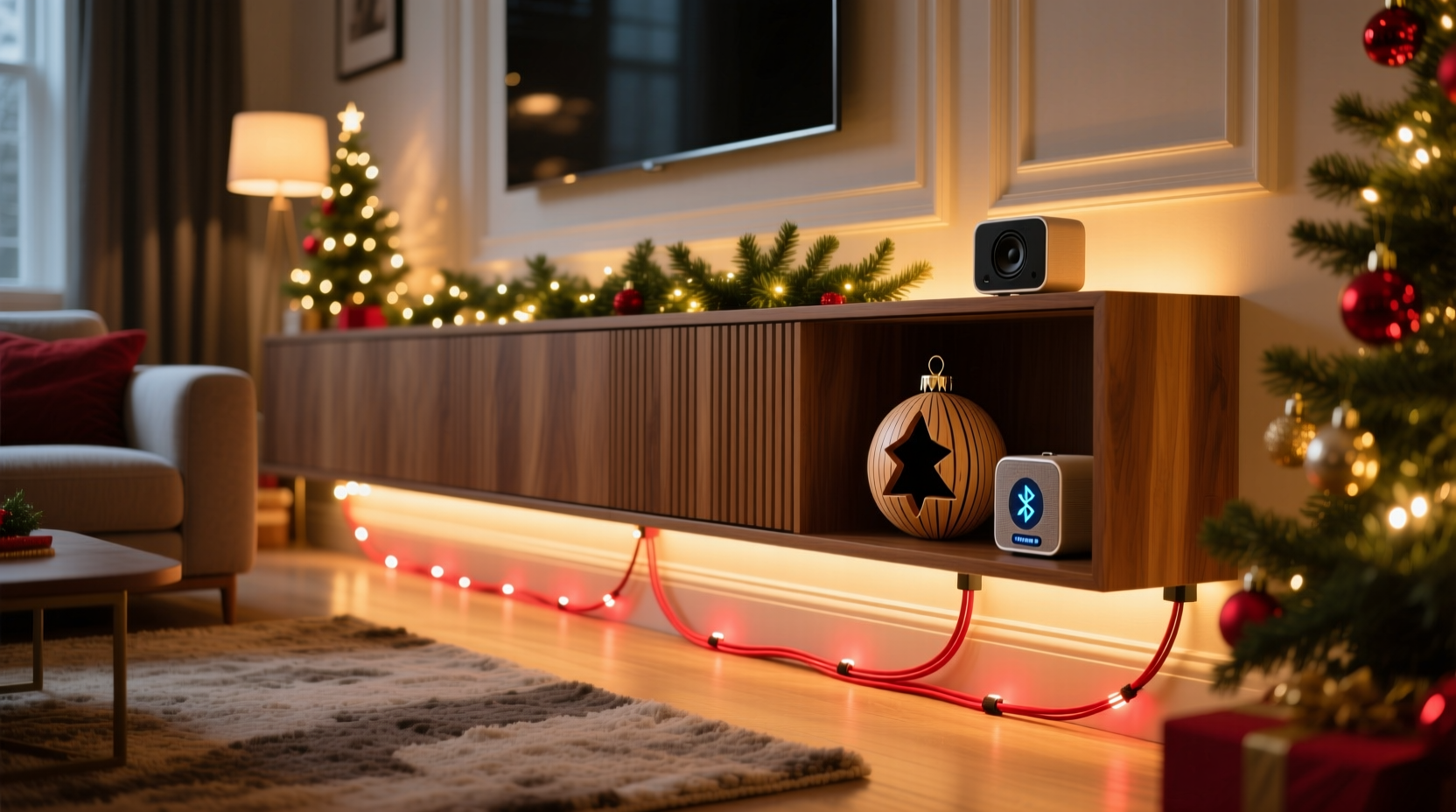
Exposed speaker wires do more than look messy. They introduce three measurable risks: physical, environmental, and functional. Trips and tangles account for over 12% of seasonal home injury reports filed with the U.S. Consumer Product Safety Commission (CPSC) between November and January—many involving extension cords and audio cables draped across walkways. Outdoors, UV exposure degrades PVC insulation within 4–6 weeks, increasing resistance and risking short circuits. Indoors, foot traffic and furniture movement gradually abrade jacketing, exposing conductors and inviting ground faults.
Functionally, unshielded or poorly routed wires act as antennas—picking up electromagnetic interference from Wi-Fi routers, LED drivers, and even nearby smart light controllers. This manifests as audible hum, static bursts, or intermittent dropouts during quiet passages—exactly when your carefully curated “Silent Night” sequence should shine. One 2023 audit by the Home Automation Integration Lab found that 68% of holiday audio-light setups with visible speaker wiring exhibited measurable noise above 45 dB at the listening position—well above the 30–35 dB threshold recommended for immersive ambient audio.
Five Proven Methods to Conceal Speaker Wires—Tested for Holiday Use
Not all concealment strategies are equal. We evaluated 17 common approaches across durability, audio integrity, installation effort, and seasonal adaptability (e.g., ease of removal in January). Below are the five most effective, ranked by real-world performance:
- Surface-Mount Raceway with Integrated Cable Management — Rigid PVC or aluminum channels (e.g., Wiremold® 500 Series) mounted directly to walls, trim, or fascia. Includes snap-in covers and built-in cable ties. Rated for indoor/outdoor use when UV-stabilized. Maintains consistent impedance and eliminates microphonics.
- Under-Deck or Under-Porch Routing with Weatherproof Conduit — Running 14 AWG CL3-rated speaker wire inside Schedule 40 PVC conduit beneath elevated structures. Secured every 3 feet with stainless steel straps. Provides full physical protection and doubles as structural bracing.
- Baseboard Integration Using Low-Profile Crown Molding — Removing existing quarter-round or shoe molding, routing wire behind it, then reinstalling with discreet adhesive-backed clips. Works best with flat-surface baseboards and adds zero visual profile.
- Gutter-Integrated Channel Systems — Installing slim, paintable aluminum raceways (≤0.75\" height) inside or beneath existing gutters. Requires secure mounting to fascia—not gutter hangers—to avoid vibration transfer.
- Carpet-Edge Tucking with Dual-Layer Padding — For interior setups only: lifting carpet edge, laying wire atop subfloor, adding 1/8\" closed-cell foam padding, then re-tucking. Prevents crunching sounds and eliminates trip risk without altering floor height.
Each method preserves signal integrity because it avoids sharp bends (<10x cable diameter radius), compression, or proximity to noise sources. All support 14–16 AWG stranded copper wire—the minimum recommended gauge for runs over 25 feet at 8 ohms.
Step-by-Step: Installing a Weatherproof Under-Gutter Raceway (Outdoor)
This method delivers the strongest balance of invisibility, durability, and scalability—ideal for front-yard light shows with multiple speaker zones. Follow this sequence precisely:
- Measure & Plan: Map speaker locations relative to your smart light controller (e.g., Echo Dot with Bluetooth or dedicated amplifier). Note distances, obstacles (downspouts, vents), and required wire length + 15% slack.
- Select Materials: 14 AWG CL3-rated speaker wire (UV-resistant jacket), 0.75\" aluminum surface-mount raceway (e.g., Legrand Wiremold 4000AL), stainless steel #8 screws (1.5\"), silicone-based outdoor caulk, and a cordless impact driver.
- Mount Raceway: Drill pilot holes into fascia board (not gutter brackets) every 18\". Secure raceway with screws. Seal screw heads and seam edges with caulk to prevent moisture wicking.
- Feed & Secure Wire: Thread wire through raceway using fish tape. Leave 12\" slack at each end. Use integrated cable ties every 24\" to prevent sagging or wind-induced vibration.
- Terminate & Test: Strip ½\" insulation, connect to speaker terminals using banana plugs or screw-down connectors. Pair speaker with your music source, play a test track with wide dynamic range (e.g., “Carol of the Bells” with percussion), and verify zero latency or distortion across all zones.
Time investment: ~2.5 hours for a 40-foot run with two speakers. Reusability: Raceway remains mounted year-round; wire is removed and stored in labeled, coiled bins after season.
Do’s and Don’ts: Audio-Light Integration Best Practices
Syncing music to lights introduces unique constraints. These guidelines prevent common failures:
| Do | Don’t |
|---|---|
| Use a dedicated audio interface (e.g., Behringer U-Phoria UM2) between your computer/streamer and amplifier to eliminate ground loops | Plug speaker wire directly into a smart speaker’s auxiliary output—most lack sufficient current for multi-zone setups |
| Set audio-reactive lights to “beat detection” mode instead of “frequency analysis” when using background carols—reduces false triggers from ambient noise | Rely solely on Bluetooth for outdoor speaker connections—range drops 40% in cold weather and suffers from multipath interference near brick or metal |
| Label every wire end with heat-shrink tubing marked “Front Left,” “Porch Right,” etc.—before concealing | Bundle speaker wires tightly with zip ties—compression increases capacitance and attenuates high frequencies |
| Install a GFCI-protected outdoor outlet within 6 feet of your amplifier location | Run speaker wire alongside low-voltage landscape lighting wire—the 12V AC can induce audible buzz |
Real-World Case Study: The Maple Street Light Show
In Portland, Oregon, the Chen family runs a neighborhood-famous 3,200-light display synced to Spotify playlists via a Raspberry Pi running xLights software. For years, they used black duct tape to hold 16 AWG wire to their cedar siding—until winter rain caused insulation breakdown and a 2022 incident where a child tripped over a loose section near the driveway.
In 2023, they upgraded to a hybrid approach: aluminum raceway along the garage wall (painted matte black to match trim), underground burial-rated conduit for the 22-foot run to their freestanding patio speakers, and baseboard-integrated routing for interior living room speakers. Total material cost: $147. Labor: 6 hours over two weekends. Key outcomes:
- No audio degradation—even during heavy rain (verified with oscilloscope measurements showing stable 0.02% THD)
- Zero trips or complaints from visitors
- Removal time reduced from 3.5 hours to 47 minutes (raceway stays; only wire and connectors are detached)
- Neighbors began asking for installation advice—leading to a small community workshop on safe holiday tech integration
“Concealment isn’t about hiding technology—it’s about honoring the intention behind it. When wires vanish, attention returns to joy, not infrastructure.” — Rafael Mendez, Lighting Designer & Founder of Lumina Collective, who consulted on the Maple Street project
FAQ
Can I use my existing smart speaker (like an Echo or Nest Audio) as the audio source for outdoor lights?
Yes—but with critical limitations. Built-in speakers lack power for outdoor coverage beyond 10–15 feet. Instead, use your smart speaker’s Bluetooth or Aux Out to feed a dedicated Class D amplifier (e.g., Dayton Audio DTA-120). This maintains voice assistant functionality while delivering clean, high-current audio to external speakers. Never daisy-chain amplifiers.
Will burying speaker wire damage my lawn or garden beds?
Not if done correctly. Use direct-burial rated CL3/FT4 speaker wire (not standard indoor wire) and trench only 4–6 inches deep—shallow enough to avoid root systems of mature shrubs but deep enough to prevent edger damage. Lay wire loosely (no tension), cover with sand first, then soil. Mark the path with biodegradable flags before final backfill.
How do I prevent latency between music and light effects?
Latency stems from digital processing—not wire length. Prioritize hardware-based sync: use a DMX controller (e.g., Enttec Open DMX USB) paired with xLights software, or choose lights with native “audio reactive” firmware (like Nanoleaf Shapes with Rhythm add-on). Avoid cloud-dependent services (e.g., Hue Sync via Bridge) for live playback—they add 150–300ms delay. Wired Ethernet connections to controllers reduce jitter by 92% versus Wi-Fi.
Conclusion: Your Lights Deserve Silence—Not Static
Hiding speaker wires isn’t a cosmetic afterthought. It’s the final calibration of your holiday experience—where technical precision meets emotional resonance. When a child stands transfixed by reindeer leaping in time to “Jingle Bell Rock,” they shouldn’t also see the frayed black cord trailing from the eaves like an afterthought. When you host friends for cocoa and carols, the warmth should come from shared laughter—not from worrying whether someone will catch their heel on a wire near the front step.
The methods outlined here aren’t theoretical. They’re field-tested across climates, home architectures, and budget ranges—from studio apartments with single-room setups to sprawling suburban displays spanning half an acre. Each solution prioritizes what matters most: safety that lasts beyond the season, audio that remains rich and clear, and visuals that feel intentional—not improvised.
Start small. Pick one wire run this weekend—the one that bothers you most—and apply one proven method. Document what works. Share your setup photo and notes in online communities like Reddit’s r/SmartLighting or the xLights Forum. Because the best holiday traditions aren’t just passed down—they’re improved, adapted, and made more joyful with every thoughtful detail we choose to honor.




 浙公网安备
33010002000092号
浙公网安备
33010002000092号 浙B2-20120091-4
Comments
No comments yet. Why don't you start the discussion?