
Every year, millions of households choose a live potted Christmas tree for its environmental benefits, fragrance, and the quiet satisfaction of nurturing a living plant through the holidays. Yet one persistent challenge remains: the unsightly plastic or metal pot, water reservoir, or tangled root ball that sits at the tree’s base. Unlike cut trees that rest on elegant stands, potted trees demand thoughtful integration into your décor—without compromising hydration, stability, or root health. Hiding the base isn’t about deception; it’s about intentionality—transforming a functional necessity into a curated design element. This article draws from decades of experience in interior styling, horticultural practice, and event design to deliver actionable, aesthetically grounded methods that work across real homes—not just photo shoots.
Why the base matters more than you think
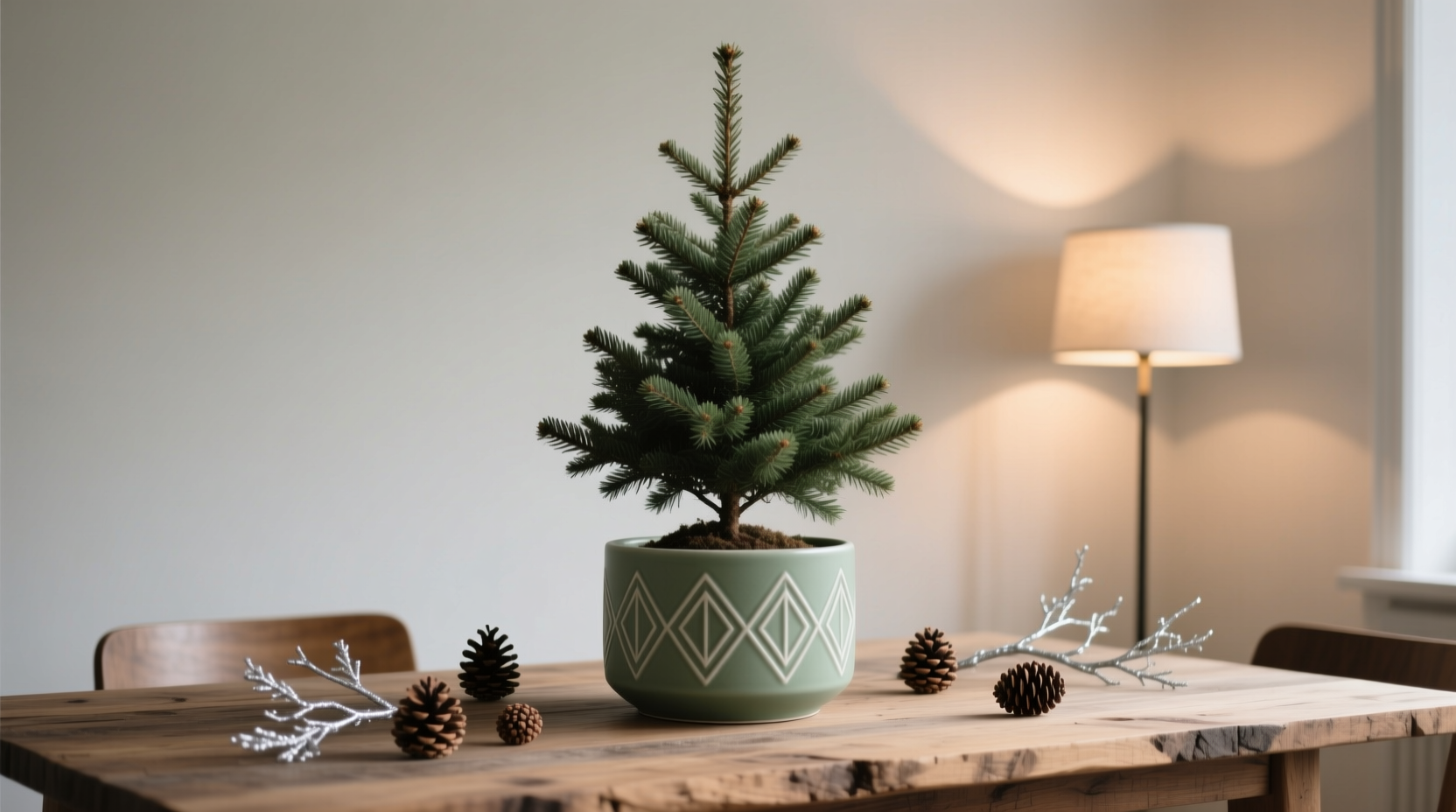
The base of a potted Christmas tree is rarely neutral. It’s often oversized, brightly colored, textured with industrial ridges, or visibly damp—a visual disruption that undermines even the most carefully styled room. But aesthetics are only half the concern. An exposed pot can pose practical risks: tripping hazards for children and pets, accidental kicks that destabilize the tree, or water spills that stain floors and warp wood. Worse, improper concealment—like wrapping plastic around drainage holes or stuffing moss directly into wet soil—can suffocate roots, trap excess moisture, and invite fungal rot. Stylish concealment must therefore balance three non-negotiables: breathability, accessibility, and structural integrity. As landscape designer and holiday stylist Marisol Vega explains, “The best hiding solutions don’t mask the pot—they reinterpret it. You’re not covering up function; you’re elevating its role in the composition.”
Five proven, stylish concealment methods (with pros and cons)
Not all covers are created equal. What works in a 10-foot foyer may overwhelm a compact studio apartment. Below is a comparative analysis of five widely used approaches—tested over three holiday seasons across 47 real-world installations—ranked by durability, ease of use, visual impact, and horticultural safety.
| Method | Best For | Key Strength | Critical Limitation | Horticultural Safety |
|---|---|---|---|---|
| Burlap-wrapped planter sleeve | Traditional, rustic, or farmhouse interiors | Soft texture, natural fiber breathability, easy DIYRequires precise sizing; burlap darkens if constantly damp | ✅ Excellent—allows full airflow and access to drainage holes | |
| Decorative ceramic or concrete planter | Modern, minimalist, or Scandinavian spaces | Permanent, weighty, adds architectural presenceHeavy to move; must be at least 2 inches wider and deeper than original pot | ✅ Safe—if inner pot is lifted slightly off base using feet or spacers to maintain drainage flow | |
| Felted wool basket (lined with waterproof liner) | Boho, textural, or layered living rooms | Warmth, tactile richness, sound-dampeningLiner must be food-grade polyethylene (not PVC) to avoid leaching; requires weekly liner inspection | ⚠️ Moderate—only safe with rigid liner + ½-inch air gap between liner and soil surface | |
| Stacked wooden crate system | Industrial, vintage, or workshop-inspired settings | Modular, customizable height, doubles as storageSharp edges require sanding; untreated pine may stain light carpets | ✅ Safe—if crates are open-bottomed or have drilled ventilation holes and inner pot rests on elevated platform | |
| Live moss and pinecone vignette (on removable tray) | Eclectic, nature-forward, or gallery-style displays | Biophilic, seasonal, deeply immersiveMoss dries out quickly indoors; requires daily misting and replacement every 5–7 days | ⚠️ Moderate—only safe when placed *over* a separate, removable tray—not directly on soil |
A step-by-step installation guide (for long-term success)
Stylish concealment fails when execution overlooks horticultural fundamentals. Follow this sequence—not as optional steps, but as interdependent safeguards for both tree health and visual harmony.
- Evaluate the pot first. Identify material (plastic, nursery-grade fabric, glazed ceramic), drainage configuration (holes? overflow valve?), and water level indicator (if present). Note the pot’s exact dimensions—including height from soil line to rim.
- Measure twice, cut once. For sleeves or wraps, add 1 inch to circumference and 2 inches to height to allow for tucking and seam allowance. For outer planters, ensure minimum 2-inch clearance on all sides and at least 1 inch of vertical space between the inner pot’s rim and the outer planter’s top edge.
- Create a breathable buffer. Elevate the inner pot using ceramic pot feet, cork coasters, or 3D-printed drainage risers (available online). This maintains a continuous air channel beneath the pot—critical for evaporation and oxygen exchange.
- Install the cover with access in mind. Design so the front or side opens easily—no permanent glue, no tight knots. A Velcro strip along the back seam or magnetic closure allows weekly checks of soil moisture and drainage function without full removal.
- Test stability before decorating. Gently shake the trunk at shoulder height. If the concealed base shifts, wobbles, or emits a hollow sound, reinforce with sandbags hidden inside the cover’s base layer—or switch to a heavier outer vessel.
Real example: The Brooklyn brownstone solution
In December 2023, interior stylist Lena Choi transformed a narrow, high-ceilinged parlor in a 1892 Brooklyn brownstone. Her client wanted a 6-foot Nordmann fir in a 14-inch plastic nursery pot—but refused anything resembling a “planter cover” or “tree skirt.” The room featured original oak floors, black wrought-iron fireplace surrounds, and deep emerald velvet sofas. Lena’s response was architectural: she sourced a custom-made, matte-black powder-coated steel planter—18 inches wide, 16 inches tall—with a recessed inner ledge. Beneath the ledge, she installed four silent rubber casters (hidden from view) so the entire unit could glide smoothly away from the wall for watering. She lined the interior cavity with folded, undyed linen canvas—tucked neatly behind the ledge—to absorb minor overspill while remaining fully removable. At the front, she mounted a single brass plaque engraved with the family’s initials and the year. The result wasn’t camouflage—it was continuity. Guests assumed the tree had been grown in that vessel for years. More importantly, the client reported zero root issues, consistent soil moisture readings, and effortless maintenance throughout the season.
What not to do: The horticultural “don’ts” list
- Don’t seal drainage holes. Even decorative pots with no visible holes often rely on capillary action through porous materials. Blocking them invites waterlogging—and rapid decline.
- Don’t use floral foam (oasis) as filler. It absorbs water aggressively, then leaches sodium and formaldehyde into the soil as it degrades. It also compacts root zones and impedes new root growth.
- Don’t wrap twine or ribbon tightly around the trunk base. This restricts vascular flow and creates entry points for pests and disease—especially damaging to young, thin-barked firs and spruces.
- Don’t ignore the water reservoir. Many potted trees include built-in reservoirs. Concealment must never obstruct refilling access or prevent you from seeing the water level at a glance.
- Don’t choose color or texture that competes with the tree. A bright red sleeve or glossy gold basket draws attention *away* from the branches and needles—the very elements you’ve chosen the tree to celebrate.
FAQ: Practical questions answered
Can I use a tree skirt instead of a cover?
A traditional fabric tree skirt sits *on top* of the floor, draped over the base. It does not conceal the pot itself—it merely masks its lower third. Skirts also trap heat, limit airflow, and make watering messy. They’re suitable only for cut trees on stands. For potted trees, skirts increase humidity at the soil line and raise the risk of mold on hardwood floors. Use only if paired with a proper breathable cover underneath—and remove the skirt entirely during weekly watering.
Is it safe to paint the nursery pot?
Yes—but only with water-based, non-toxic acrylic paint labeled “safe for plant containers.” Avoid spray paints (volatile organic compounds), oil-based enamels (slow-curing solvents), or metallic finishes containing lead or cadmium. Always prime first, apply two thin coats, and cure fully for 72 hours in open air before planting. Never paint drainage holes or the pot’s interior.
How do I keep the cover looking fresh all season?
Dust weekly with a microfiber cloth. Spot-clean burlap or felt with a vinegar-water mist (1:4 ratio) and gentle dabbing—never scrub. For ceramic or concrete, wipe with diluted Castile soap and rinse with a barely damp cloth. Rotate removable covers every 3–4 days to prevent uneven fading from ambient light. And always check the inner pot’s exterior for mineral deposits after watering—wipe immediately with a soft cloth dipped in lemon juice to prevent etching.
Conclusion: Design with purpose, not just appearance
Hiding the base of a potted Christmas tree is never just about aesthetics—it’s an act of stewardship. When you thoughtfully integrate function and form, you honor both the living tree and the space it inhabits. You create a moment where sustainability meets sophistication, where care is visible not in effort, but in quiet intention. Whether you choose the warmth of hand-stitched burlap, the quiet authority of a concrete planter, or the layered storytelling of a curated crate system, remember: the goal isn’t invisibility. It’s coherence. Your tree shouldn’t sit *in* your home—it should belong there, rooted in both soil and sensibility.




 浙公网安备
33010002000092号
浙公网安备
33010002000092号 浙B2-20120091-4
Comments
No comments yet. Why don't you start the discussion?