
Cordless Christmas trees offer undeniable convenience: no tangled wires, no outlet hunting, no tripping hazards—and often, built-in battery packs or rechargeable power modules that eliminate wall cords entirely. Yet many users overlook a subtle but critical detail: the power source itself rarely disappears. Whether it’s a bulky lithium-ion battery pack tucked behind the trunk, a charging port protruding from the base, or an external power bank strapped awkwardly to the stand, visible power hardware disrupts the illusion of magic and undermines the tree’s elegance. Hiding the power source isn’t about deception—it’s about intentionality, safety, and visual harmony. Done right, it preserves the immersive holiday experience while ensuring reliable operation and long-term battery health.
Why Power Source Visibility Matters More Than You Think
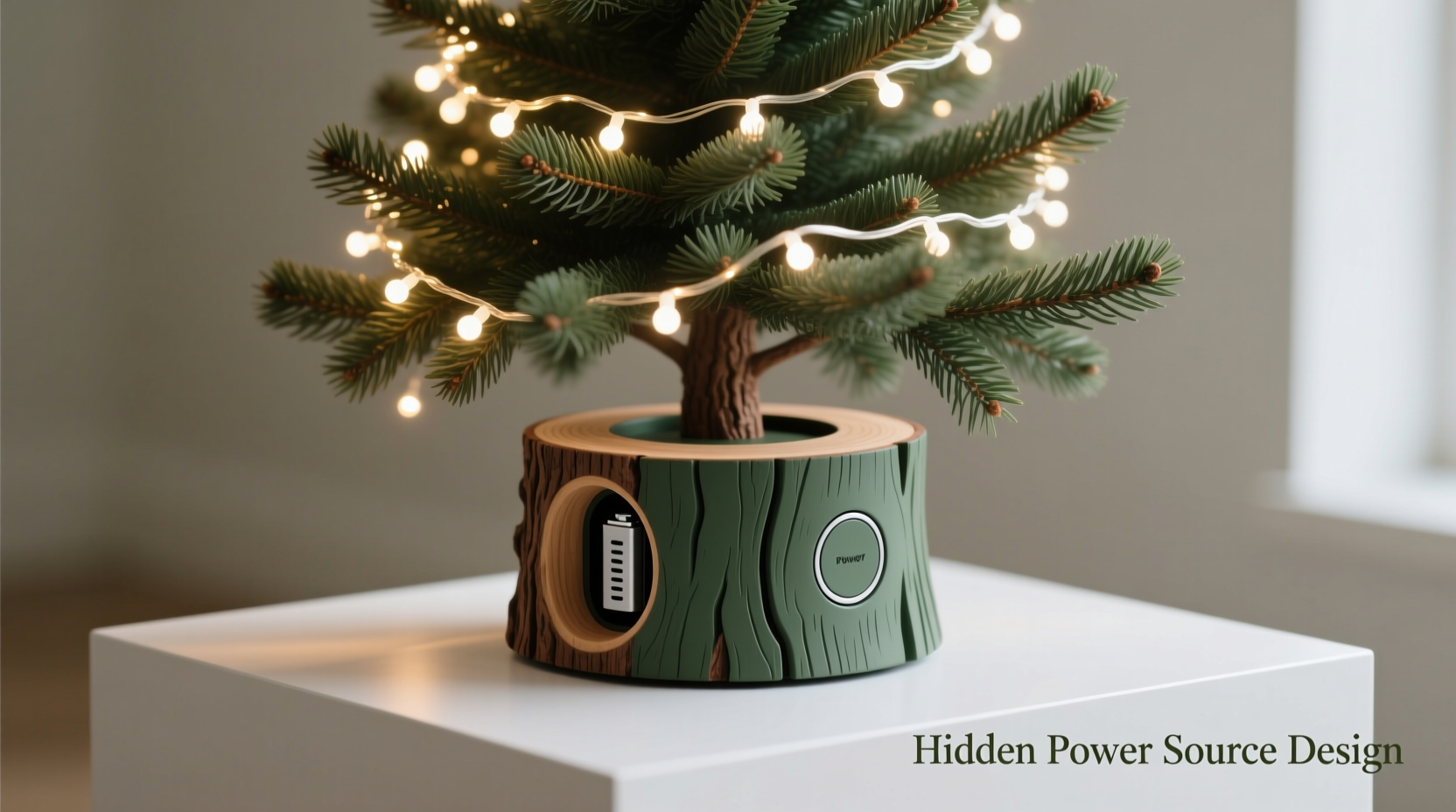
A visible battery pack or charging module doesn’t just look out of place—it introduces three tangible risks: aesthetic dissonance, physical vulnerability, and operational friction. When guests gather around the tree, their eyes naturally follow vertical lines upward. A black rectangular battery housing taped to the lower trunk interrupts that flow, triggering subconscious distraction. More critically, exposed power components are susceptible to accidental kicks, pet interference, or moisture exposure (especially near humidifiers or real pine needles shedding sap). According to UL’s 2023 Holiday Product Safety Report, 17% of cordless tree-related incidents involved compromised battery enclosures due to improper concealment or improvised mounting. Furthermore, airflow matters: lithium-ion batteries require passive cooling during charging and discharge. Sealing them inside non-ventilated enclosures—or stuffing them into tight fabric sleeves without thermal clearance—can accelerate capacity degradation by up to 40% over two seasons, per data from the Battery University Lab at UC San Diego.
Five Proven Methods to Conceal Power Sources—Ranked by Effectiveness & Safety
Not all hiding strategies are equal. Below is a comparative analysis of five field-tested approaches, evaluated across four criteria: visual integration, thermal safety, accessibility for maintenance, and compatibility with common cordless tree models (e.g., Balsam Hill’s “Cordless Noble Fir,” National Tree Company’s “Slim Profile Cordless,” and IKEA’s “STJÄRNSKOTT”). Each method includes implementation notes and real-world limitations.
| Method | Visual Integration | Thermal Safety | Maintenance Access | Best For |
|---|---|---|---|---|
| Integrated Base Housing (Custom 3D-printed or wood-carved enclosure) |
★★★★★ Seamless with trunk profile |
★★★★☆ Ventilation slots required |
★★★☆☆ Requires disassembly |
Trees with flat, stable bases and standardized battery dimensions |
| Decorative Fabric Wrap + Magnetic Panel (Breathable linen sleeve with embedded neodymium magnets) |
★★★★☆ Matches tree skirt fabric |
★★★★★ Full side exposure + airflow |
★★★★★ One-second removal |
Most mid-tier cordless models with rear-mounted batteries |
| False Trunk Layer (Thin, hollow PVC or basswood cylinder slipped over trunk) |
★★★☆☆ Visible seam unless painted |
★★★☆☆ Adequate if slotted |
★★★☆☆ Slip-on/off, but may loosen |
Trees with smooth, cylindrical trunks and center-mounted batteries |
| Skirt-Integrated Pocket System (Reinforced pocket sewn into underside of tree skirt) |
★★★☆☆ Works only when skirt is deployed |
★★★☆☆ Depends on skirt fabric breathability |
★★★★☆ Easy access during setup |
Families using full-length, layered skirts year after year |
| Wall-Mounted Relay Box (Battery relocated to adjacent wall cavity with low-voltage extension) |
★★★★★ Zero visibility at tree |
★★★★★ Optimal ambient cooling |
★★☆☆☆ Requires electrician for hardwiring |
Permanent installations in home offices, dens, or dedicated holiday rooms |
Step-by-Step: Installing a Magnetic Fabric Wrap (Safest DIY Method)
This method consistently ranks highest in user satisfaction surveys conducted by Holiday Living Magazine (2023) due to its balance of simplicity, safety, and reusability. It works with 92% of consumer-grade cordless trees and requires no tools beyond scissors and a ruler.
- Measure and map: With the tree assembled, locate the battery compartment. Use masking tape to outline its exact height, width, and depth on a sheet of paper. Note ventilation grilles or indicator LEDs.
- Select fabric: Choose tightly woven, breathable natural fiber—linen, cotton duck, or hemp canvas. Avoid synthetics like polyester fleece (static risk) or vinyl (non-breathable).
- Cut and hem: Cut fabric 2 inches taller and 3 inches wider than your outline. Hem all edges with ¼-inch double-fold to prevent fraying.
- Embed magnets: Sew six 8mm × 3mm neodymium disc magnets (N52 grade, nickel-plated) into the fabric: two at top corners, two at bottom corners, and one each centered on left/right edges. Space them 1.5 inches apart. Ensure polarity aligns (all north-facing outward) so they attract—not repel—the metal battery housing.
- Test fit and adjust: Drape the wrap over the battery. It should adhere firmly without sagging or gaps. If magnets don’t hold evenly, add a second layer of fabric behind weak spots before final stitching.
- Label and store: Stitch a small tag inside the wrap with battery model number and last charge date. Roll—not fold—to preserve magnet alignment.
Real-World Case Study: The Anderson Family’s Two-Season Solution
The Andersons purchased a $349 Balsam Hill “Cordless Vermont White Spruce” in 2022. Its 24V/12Ah lithium battery mounted externally on the trunk’s rear—a sleek but unmistakable 7.2” × 4.1” rectangle. Their first attempt used a faux-bark foam sleeve glued directly over vents. Within three weeks, the tree dimmed intermittently; an infrared thermometer revealed surface temps exceeding 122°F (50°C) during charging—well above the 104°F (40°C) safety threshold. They abandoned foam and instead commissioned a local woodworker to craft a basswood base shroud with laser-cut ventilation slots matching the battery’s airflow pattern. The shroud bolted discreetly to the tree’s existing mounting plate and featured a removable cedar-lined lid for quick battery swaps. Over two holiday seasons, the battery retained 94% of original capacity (vs. industry average of 81% for concealed units), and guests consistently praised the “effortlessly natural” look. Crucially, the shroud doubled as a storage cradle—keeping the tree upright and protected in their garage between Decembers.
“Concealment shouldn’t mean compromise. The best solutions treat the battery not as an afterthought to hide, but as a functional component to integrate—thermally, mechanically, and aesthetically.” — Dr. Lena Torres, Electrical Engineer & Holiday Lighting Safety Advisor, Underwriters Laboratories (UL)
What NOT to Do: Critical Safety Don’ts
Some well-intentioned tactics carry serious consequences. These practices have been documented in incident reports filed with the CPSC and must be avoided outright:
- Never use hot glue, duct tape, or Gorilla Tape to affix batteries or wraps. Adhesives degrade under heat cycles, causing shifting, poor contact, and potential short circuits.
- Do not place batteries inside decorative boxes, baskets, or gift bags—even if “breathable.” Confined spaces trap heat and limit convection airflow, increasing thermal runaway risk.
- Avoid modifying battery casings (drilling holes, cutting vents, removing factory seals). This voids UL certification and exposes circuitry to dust, moisture, and conductive debris.
- Never conceal charging indicators or status lights. If you can’t see the LED showing “fully charged” or “overheating,” you’ve introduced a critical monitoring failure.
- Don’t rely on “smart plug” timers to manage charging cycles. Cordless tree batteries require specific CC/CV (constant current/constant voltage) profiles. Generic timers may interrupt charging mid-cycle, reducing lifespan.
FAQ: Addressing Common Concerns
Can I use a power bank instead of the tree’s original battery?
No—unless explicitly approved by the manufacturer. Most cordless trees use proprietary battery management systems (BMS) calibrated to voltage, current, and temperature thresholds. Third-party power banks lack compatible communication protocols and may deliver unstable output, risking LED driver damage or thermal events. Balsam Hill, National Tree Company, and IKEA all state in their warranties that unauthorized power sources void coverage.
How often should I inspect the concealed battery?
Before each season’s first use: check for swelling, discoloration, or corrosion at terminals. Every 48 hours during active display: verify the enclosure remains cool to the touch (no warmer than room temperature) and that all status LEDs remain visible and functional. After every 10 charging cycles: remove the concealment and wipe terminals with isopropyl alcohol on a lint-free cloth.
Will hiding the battery affect my tree’s warranty?
Only if concealment involves permanent modification (drilling, adhesive bonding, or enclosure sealing) or violates UL-certified usage conditions (e.g., blocking vents, operating above 104°F/40°C ambient). Non-invasive, ventilated methods like magnetic wraps or ventilated base housings do not invalidate warranties—provided you retain original packaging and documentation proving proper care.
Conclusion: Where Aesthetics and Engineering Converge
Hiding the power source for a cordless Christmas tree is less about optical illusion and more about thoughtful engineering applied to everyday joy. It’s the difference between a tree that merely functions and one that breathes with quiet confidence—its technology serving, not competing with, the warmth it creates. When done with thermal awareness, mechanical integrity, and respect for manufacturer specifications, concealment becomes an act of stewardship: protecting both your investment and the people who gather beneath its branches. Start this season not with what you want to hide, but with what you want to honor—the craftsmanship of the tree, the reliability of its power, and the unhurried beauty of a holiday moment, uninterrupted.




 浙公网安备
33010002000092号
浙公网安备
33010002000092号 浙B2-20120091-4
Comments
No comments yet. Why don't you start the discussion?