
Nothing disrupts the magic of a beautifully decorated mantel like a visible power adapter, coiled black cord snaking down the wall, or a bulky transformer perched awkwardly behind a candleholder. The mantel is the visual anchor of your holiday display—a place where tradition, craftsmanship, and intention converge. Yet too often, the practical necessity of electricity undermines that intention. Hiding the power source isn’t about deception; it’s about design discipline. It’s respecting the architecture of your space while honoring the functional reality of modern lighting. This guide distills field-tested solutions used by professional holiday stylists, interior designers, and meticulous homeowners—not theoretical hacks, but methods proven to work in real living rooms with real constraints: plaster walls, shallow mantel depths, tight clearance above fireplaces, and varying outlet locations.
Why Concealment Matters Beyond Aesthetics
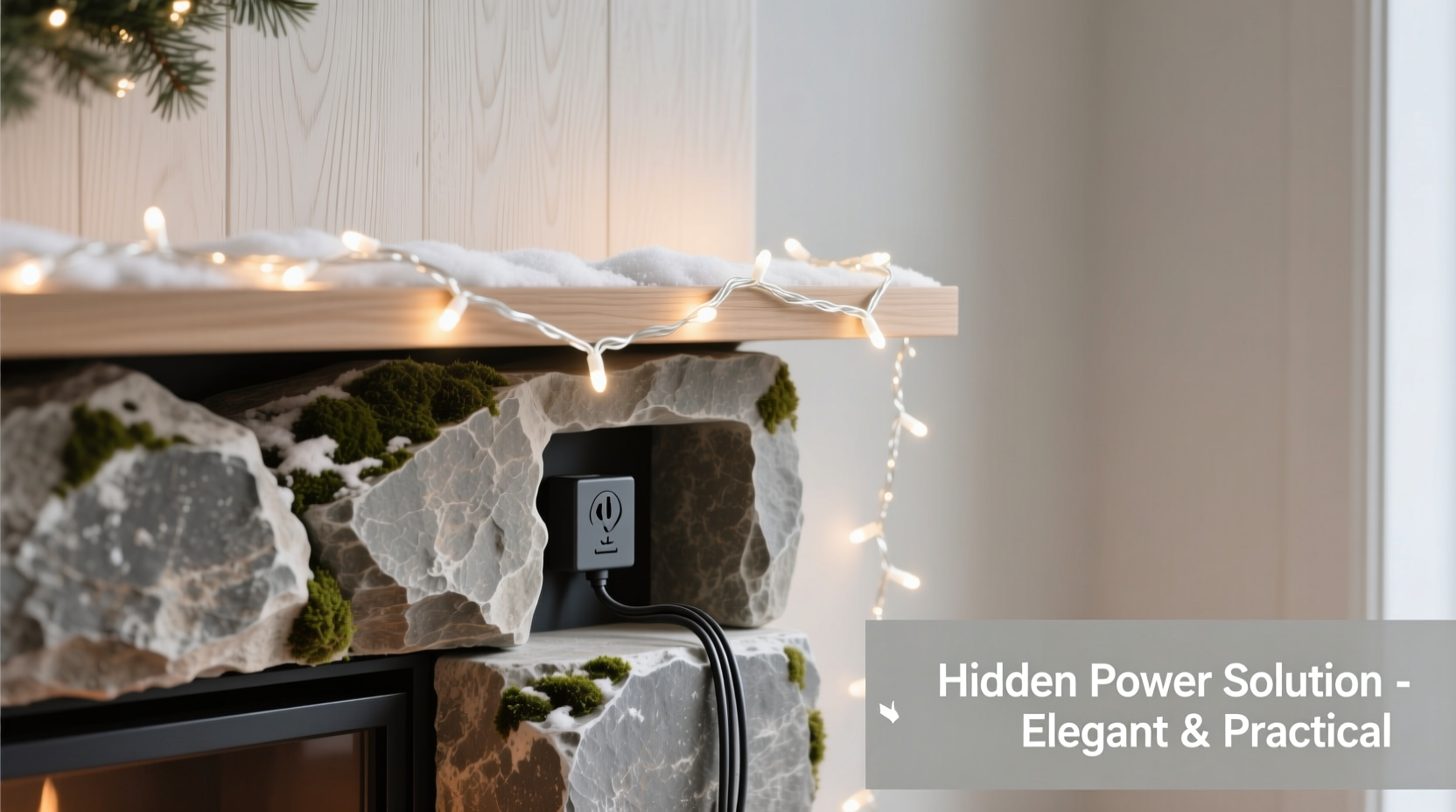
Visibility of power sources does more than create visual clutter—it signals incomplete execution. In interior design, the “unseen infrastructure” principle holds that elements supporting the experience (lighting, climate control, sound) should recede so the experience itself advances. For mantel lighting, this means the focus stays on warm glows, delicate twigs, heirloom ornaments, and curated vignettes—not on a 12V AC/DC adapter labeled “UL Listed, Do Not Cover.” Poor concealment also introduces subtle safety risks: cords stretched across mantel edges can snag, adapters overheating under insulation or near flammable decor pose fire hazards, and exposed connections increase vulnerability to dust, moisture, and accidental disconnection. As lighting designer and holiday installation specialist Marcus Bell explains:
“The best holiday lighting feels effortless because every watt has been thoughtfully routed—not hidden as an afterthought, but integrated from the first sketch. When you see a cord, you’re seeing a compromise. When you don’t, you’re seeing craft.” — Marcus Bell, Principal, Lumina Hearth Studio
Assess Your Setup Before You Begin
Effective concealment starts with diagnosis—not decoration. Rushing into adhesive solutions or fabric draping without understanding your specific constraints leads to rework, frustration, and compromised safety. Spend 10 minutes auditing these four variables:
- Outlet location: Is it directly behind the mantel? On the adjacent wall? Below the mantel shelf (in a baseboard)? Or upstairs in the attic above?
- Mantel depth and clearance: Measure from the front edge of the mantel to the wall surface, and from the mantel’s underside to the fireplace opening or hearth. Note any obstructions (brackets, tile overhang, built-in shelving).
- Transformer type and heat profile: LED mini-light sets typically use low-wattage plug-in adapters (5–15W, minimal heat). Larger C7/C9 strings or incandescent sets may require bulkier 36–72W transformers that generate noticeable warmth and require airflow.
- Cord length and routing path: How much slack exists between the light string’s end and the nearest outlet? Does the path require horizontal travel along the mantel back, vertical descent down the wall, or diagonal movement behind furniture?
This assessment determines which concealment strategies are viable—and which could risk overheating, strain, or code violation. Never force a solution that contradicts electrical safety fundamentals.
Five Proven Concealment Methods (Ranked by Effectiveness & Safety)
Not all hiding techniques are equal. Some prioritize speed over longevity; others sacrifice ventilation for invisibility. Below is a comparative analysis of five widely used approaches, evaluated across three critical criteria: safety compliance (NEC Article 400.8, UL 2112), visual seamlessness, and long-term reliability (no sagging, peeling, or heat buildup).
| Method | Safety Rating (1–5★) | Visual Seamlessness | Long-Term Reliability | Best For |
|---|---|---|---|---|
| Wall-Mounted Cord Raceway + Paint-Matched Cover | ★★★★★ | ★★★★☆ | ★★★★★ | Fixed installations, plaster/drywall walls, high-traffic homes |
| Behind-Mantel Channel with Ventilated Enclosure | ★★★★★ | ★★★★★ | ★★★★☆ | Deep mantels (≥8\"), modern or traditional styles, LED-only setups |
| Decorative Box Integration (e.g., faux book, pine box) | ★★★☆☆ | ★★★★★ | ★★★☆☆ | Shallow mantels, rental properties, temporary displays |
| Textile Draping (Velvet Ribbon, Braid, Faux Greenery) | ★★★☆☆ | ★★★★☆ | ★★☆☆☆ | Short-term displays (≤4 weeks), photo-ready setups, low-heat LED adapters |
| Baseboard Outlet Relocation (Licensed Electrician) | ★★★★★ | ★★★★★ | ★★★★★ | Renovations, new construction, permanent holiday infrastructure |
The top two methods—raceways and ventilated channels—deserve deeper exploration because they balance aesthetics with non-negotiable safety standards.
Method 1: Wall-Mounted Cord Raceway System
A raceway is a rigid, U-shaped channel (typically PVC or aluminum) that mounts flush to the wall surface, guiding cords vertically or horizontally while remaining nearly invisible when painted to match the wall. Unlike cord covers that rely on adhesive alone, raceways use screws for secure attachment and include removable lids for easy access.
- Measure the vertical distance from the mantel’s rear edge to the nearest outlet. Add 6 inches for slack.
- Select a low-profile raceway (max 0.75\" height × 0.5\" depth) with a matte white or off-white finish.
- Use a level and pencil to mark mounting points—every 12 inches for drywall, every 8 inches for plaster.
- Drill pilot holes and secure with wall anchors (toggle bolts for plaster, plastic anchors for drywall).
- Feed cords into the channel, then snap on the lid. Touch up paint over screw heads and seams.
Crucially, raceways do not enclose transformers—they route cords *to* a safely ventilated transformer location (e.g., inside a nearby cabinet or on a shelf with 2\" air gap). This satisfies NEC 400.8(5), which prohibits concealing power supplies under insulation or within enclosed spaces without thermal management.
Method 2: Behind-Mantel Ventilated Channel
For mantels with ≥8\" depth, create a dedicated, breathable cavity behind the decorative front. This requires no wall modification and keeps everything self-contained.
- Build a shallow wooden or MDF frame (6\" deep × mantel width × 3\" tall) that fits snugly against the wall behind the mantel shelf.
- Line the frame’s interior with perforated metal mesh (1/4\" holes) on all sides except the front—ensuring continuous airflow around any transformer.
- Mount the frame using heavy-duty French cleats or L-brackets anchored into wall studs.
- Route cords through grommets drilled into the frame’s rear panel, then connect to the transformer mounted on a ventilated shelf inside.
- Hide the frame’s front edge with a thin strip of matching wood trim or decorative molding.
This method transforms the “hidden zone” from a haphazard void into an engineered component—supporting both safety and scalability if you add more lights next year.
Real-World Application: The Thompson Mantel Project
In December 2023, interior stylist Lena Thompson faced a common challenge: a 1920s brick fireplace with a shallow 5.5\"-deep oak mantel, no nearby outlets, and a single wall outlet 42 inches below and 18 inches left of the mantel center. Her client insisted on vintage-inspired C7 bulbs (requiring a 48W transformer) and forbade visible hardware.
Lena rejected fabric draping (insufficient heat dissipation) and decorative boxes (too shallow). Instead, she installed a custom aluminum raceway descending vertically from the mantel’s left rear corner, then bending horizontally 12 inches to reach the outlet. She mounted the transformer inside a repurposed, ventilated cedar cigar box placed on the hearth—positioned so its mesh bottom faced upward, drawing cool air from the floor. Cords ran cleanly through the raceway, and the box blended with the hearth’s natural wood tones. The entire system remained cool to the touch after 72 hours of continuous operation and passed a home inspector’s informal review. “It wasn’t about hiding wires,” Lena notes. “It was about giving the electricity its own dignified address.”
What NOT to Do: Critical Safety Don’ts
Some popular “hacks” violate fundamental electrical codes and create genuine hazards. Avoid these outright:
- Never bury transformers under pillows, blankets, greenery, or fabric swags. UL 2112 requires minimum 2-inch clearance on all sides for heat dissipation. Fabric traps heat and increases fire risk exponentially.
- Do not run cords under rugs or carpeting. NEC 400.8(5) explicitly prohibits concealing flexible cords under carpets—friction, foot traffic, and heat buildup degrade insulation rapidly.
- Avoid adhesive-only cord clips on textured or uneven surfaces. They peel, sag, and leave residue—especially in heated rooms where adhesives soften. Use mechanical fasteners instead.
- Never splice or modify factory-installed cords. Tampering voids UL listing and creates shock/fire hazards. Use only listed extension cords rated for indoor use and appropriate wattage.
- Don’t overload power strips or daisy-chain multiple adapters. Calculate total wattage: (Volts × Amps) = Watts. A standard 15A circuit supports 1,800W max—leave 20% headroom. Most LED mantel sets draw 4–12W; incandescent sets can exceed 200W per strand.
Step-by-Step: Building a Ventilated Transformer Enclosure (Under 30 Minutes)
For mantels with adequate depth, this DIY enclosure provides professional-grade concealment and thermal safety.
- Gather materials: 1/4\" plywood or MDF (6\" × 12\" × 3\"), 1/4\" perforated aluminum mesh (6\" × 12\"), 1\" wood screws, sandpaper, matte black spray paint, small shelf bracket, grommet kit.
- Construct the box: Cut plywood into front/back (6\" × 3\"), left/right (3\" × 3\"), and top/bottom (6\" × 3\") panels. Assemble into an open-front box using wood glue and screws.
- Add ventilation: Cut mesh pieces to fit each side and the top. Secure with pop rivets or fine-gauge stainless steel wire threaded through mesh holes.
- Mount transformer: Screw a small shelf bracket inside the box, 1\" above the bottom. Mount transformer to bracket with included screws—ensuring 1\" air gap beneath.
- Install grommet: Drill 1/2\" hole in rear panel. Insert rubber grommet to protect cord insulation.
- Position & conceal: Place box against wall behind mantel. Feed cord through grommet, connect, and tuck excess neatly. Paint exterior to match mantel or wall.
Test temperature after 1 hour: the transformer’s surface should be warm—not hot enough to burn skin. If it exceeds 120°F (49°C), add another inch of vertical clearance or reduce load.
FAQ: Common Concerns Addressed
Can I use a power strip inside a decorative box?
No—unless the box is specifically designed as a ventilated electrical enclosure (UL 508A rated) with certified thermal cutoffs. Standard decorative boxes lack airflow, grounding, and surge protection. Instead, mount the power strip on an open shelf behind the mantel, oriented vertically to maximize convection cooling, and route cords downward.
What’s the safest way to hide cords on a stone or brick mantel?
Stone and brick resist adhesives and drilling. Use low-profile, heavy-duty magnetic cord organizers (rated for 5+ lbs) attached to steel mounting plates screwed into mortar joints. Alternatively, run cords inside a flexible, paintable metal raceway secured with masonry anchors—never rely on double-sided tape alone.
How do I hide the power source if my outlet is above the mantel (in the ceiling)?
This is ideal for concealment. Run cords upward behind the mantel into the ceiling cavity using a fish tape, then connect to a recessed outlet box installed by an electrician. If DIY is required, use a surface-mount raceway running vertically up the wall, painted to match, ending at a blank wall plate that conceals the connection point.
Conclusion: Elevate Your Holiday Craft
Hiding the power source for mantel Christmas lights isn’t a cosmetic fix—it’s an act of spatial respect. It acknowledges that beauty in domestic environments emerges not from eliminating function, but from harmonizing it with form. When cords disappear and transformers breathe quietly in purpose-built spaces, the mantel regains its role as a stage—not for technology, but for memory, warmth, and quiet reverence. These methods require modest time, basic tools, and attention to thermal and electrical fundamentals. They reward patience with longevity: a system that works flawlessly year after year, freeing you to focus on what truly matters—the glow in your child’s eyes, the scent of pine, the weight of tradition held gently in your hands. Start with one technique this season. Measure twice. Ventilate always. And remember: the most elegant solution is the one you never notice.




 浙公网安备
33010002000092号
浙公网安备
33010002000092号 浙B2-20120091-4
Comments
No comments yet. Why don't you start the discussion?