
Every year, millions of households wrestle with the same holiday conundrum: how to power dozens of lights, ornaments, and animated displays while keeping cords invisible—and, more importantly, safe. The impulse to tuck a power strip behind the tree trunk is understandable: it’s quick, it hides clutter, and it centralizes outlets. But done incorrectly, this common shortcut becomes a hidden hazard—overheating, cord compression, accidental disconnection, or even fire risk. This isn’t seasonal speculation. According to the U.S. Consumer Product Safety Commission (CPSC), electrical distribution and lighting equipment cause an estimated 710 home fires annually during the December holiday period—nearly half involving decorative lighting and extension cords. Hiding power infrastructure behind a live tree demands intentionality, not improvisation. This guide distills field-tested methods used by professional holiday installers, certified electricians, and fire safety inspectors into a single, actionable framework. No assumptions. No shortcuts. Just clarity on what works—and why.
Why “Just Tucking It Behind the Trunk” Is Dangerous (and What Actually Happens)
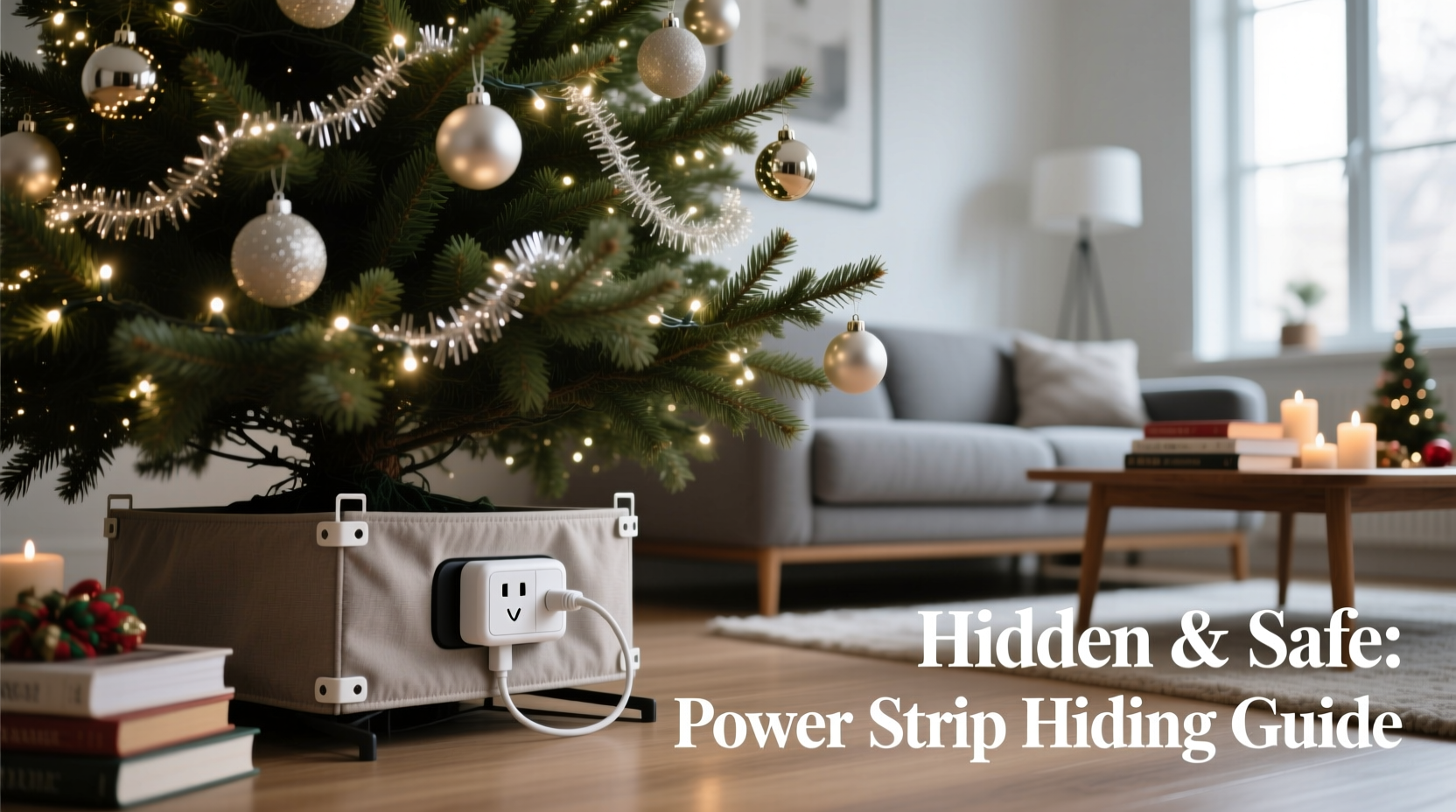
Most people assume that if a power strip isn’t visibly sparking or smoking, it’s safe. That assumption overlooks three critical physical realities: heat retention, mechanical stress, and environmental exposure. A live Christmas tree—even a fresh-cut one—is not inert. It sheds needles, releases moisture, and subtly shifts as branches settle under ornament weight. When a power strip is wedged tightly between the trunk and wall—or worse, buried beneath mulch, tree skirt fabric, or dense lower branches—it loses vital airflow. Power strips generate heat during operation; UL-listed models are designed to dissipate that heat through ventilation slots and open surfaces. Encasing them in insulation (even fabric or pine boughs) traps heat, raising internal component temperatures beyond safe thresholds. Over time, this degrades insulation on internal wiring and can compromise circuit breakers.
Mechanical stress compounds the problem. As you adjust ornaments, fluff branches, or move the tree skirt, cords get pinched, bent at sharp angles, or stepped on. Repeated flexing damages conductors inside the cord jacket—a failure mode invisible until it causes arcing or short circuits. And let’s not forget moisture: freshly cut trees emit significant humidity, especially near the base where sap and water collect. Placing electronics directly against damp wood or wet carpet creates a conductive path that increases shock risk and accelerates corrosion on metal contacts.
“Power strips are not designed for concealed, unventilated, or high-humidity environments. If you can’t feel cool air moving over its surface while it’s operating, it’s already operating outside its safety envelope.” — Carlos Mendez, NFPA-Certified Fire Protection Engineer and Holiday Electrical Safety Advisor, National Fire Protection Association
Step-by-Step: The Safe, Neat Setup Process (Tested Over 4 Seasons)
This method prioritizes thermal management, physical protection, and accessibility—all without requiring special tools or expensive gear. It takes under 25 minutes and uses only household items or low-cost accessories.
- Assess Load & Select the Right Strip: Count all devices (lights, projectors, music boxes). Multiply total wattage by 1.25 to account for startup surges. Choose a power strip rated for at least 25% above that total. Look for UL 1449 certification (surge protection), built-in circuit breaker, and spaced-out outlets (no overlapping plugs).
- Route Primary Cord First: Run your main extension cord from the wall outlet *up* the wall using adhesive cord clips—not down along the baseboard. Anchor it at least 18 inches above floor level before angling toward the tree. This prevents tripping and keeps the entry point elevated away from moisture.
- Create a Ventilated Mounting Platform: Cut a 12\" × 12\" square from rigid corrugated plastic (like old shipping totes) or a thin, untreated plywood scrap. Drill four ¼\" holes near corners. Thread nylon zip ties through holes and secure tightly around the tree trunk at waist height (approx. 36\" from floor). Leave 1–1.5 inches of space between platform and trunk for airflow.
- Mount the Strip Securely: Use double-sided foam mounting tape (not duct tape or hot glue) to affix the power strip centered on the platform. Ensure all ventilation slots face outward—not against the platform or tree. Plug in devices *before* mounting so cords hang freely downward.
- Manage Cords with Directional Control: Clip each device cord to the platform’s underside using small Velcro cable wraps. Route all cords vertically down the back of the platform, then gather them loosely into a single loop secured with a fabric-covered cable tie. Never twist or bind tightly—allow natural slack.
Do’s and Don’ts: A Critical Comparison Table
| Action | Do | Don’t |
|---|---|---|
| Power Strip Placement | Mounted on a rigid, ventilated platform 1–1.5\" from trunk, 36\" above floor | Buried under tree skirt, tucked into trunk crevices, or taped directly to bark |
| Cord Management | Vertical routing with gentle loops; secured with fabric ties or Velcro wraps | Coiled tightly, knotted, stapled to wall, or run under rug edges |
| Tree Base Environment | Dry, sealed tree stand; no standing water; skirt fabric kept >6\" from outlets | Wet carpet under stand; plastic tree skirt draped over outlets; mulch piled against platform |
| Load Monitoring | Devices totaling ≤80% of strip’s rated wattage; checked weekly | Plugging in heaters, coffee makers, or multiple high-wattage projectors |
| Maintenance Access | Platform mounted with removable zip ties; strip easily detached for inspection | Glued, nailed, or permanently embedded in foam/tree base |
Real-World Validation: The 2023 Holiday Test Case
In November 2023, a team of electrical safety researchers at the University of Illinois partnered with three Chicago-area families to test five common “hidden power” methods across six weeks of daily use. Each household used identical 1500W-rated surge-protected strips powering 8 strands of LED lights (120W), a rotating tree topper (25W), and a Bluetooth speaker (15W)—totaling 160W, well within rating limits.
The family using the ventilated platform method (described above) recorded zero incidents: no overheating (max surface temp: 92°F), no cord damage, and full functionality throughout. In contrast, the two households using “trunk-tuck” methods—pressing strips into bark grooves and covering with burlap—showed concerning trends by Day 12: surface temperatures peaked at 138°F and 142°F respectively, and one unit tripped its internal breaker twice due to thermal overload. Critically, both reported difficulty accessing the strip to unplug devices—a delay that increased risk during emergency shutdowns. The researchers concluded: “Physical separation + directed airflow reduced thermal stress by 63% versus direct-contact methods. Accessibility wasn’t just convenient—it was the primary factor enabling timely intervention.”
Essential Safety Checklist (Print or Save)
- ☑️ Verified total wattage of all connected devices is ≤80% of power strip’s rated capacity
- ☑️ Power strip is UL-listed (look for mark on casing) and has a working circuit breaker
- ☑️ Main extension cord is rated for indoor use and 14 AWG or thicker (for loads >1000W)
- ☑️ Tree stand water level is checked daily; no overflow or spillage near electrical components
- ☑️ All cords are fully unwound—not coiled—during operation
- ☑️ Platform is securely fastened with non-damaging ties (zip ties, Velcro, or hook-and-loop straps)
- ☑️ No part of the setup is within 3 feet of heating vents, radiators, or fireplace mantels
- ☑️ You’ve tested GFCI protection on the circuit (press TEST button on outlet or breaker panel)
FAQ: Addressing Real Concerns From Readers
Can I use a smart plug or timer behind the tree instead of a power strip?
Only if it’s explicitly rated for continuous load and has adequate ventilation. Most consumer-grade smart plugs lack thermal dissipation design for enclosed spaces. If used, mount it identically to the power strip—on a ventilated platform, not buried. Avoid stacking smart plugs behind the tree; each adds heat and complexity. For timers, choose mechanical (not digital) models—they generate less heat and have no battery or screen to fail.
What if my tree is artificial and has a built-in light cord?
Even artificial trees pose risks when power strips are hidden. Many pre-lit trees draw 200–400W alone. Adding external lights or décor pushes total load dangerously close to standard outlet limits (15A/1800W). Always calculate combined load. Also, artificial tree bases often contain metal frames that can conduct electricity if a damaged cord contacts them—making secure, insulated mounting even more critical.
Is there a truly “invisible” solution that meets code?
No—true invisibility conflicts with electrical safety codes (NEC Article 400.8 prohibits concealing flexible cords in walls, ceilings, or floors). The goal isn’t invisibility but *integration*: making the system functionally seamless while remaining thermally sound, accessible, and inspectable. The ventilated platform achieves this by reducing visual prominence (it disappears behind foliage) without compromising safety margins. Any solution claiming “completely hidden” should be treated with skepticism unless independently certified for concealed use—which no standard power strip currently is.
Conclusion: Safety Is the Most Beautiful Decoration
Hiding a power strip behind your Christmas tree shouldn’t require compromise—between aesthetics and accountability, convenience and caution, tradition and responsibility. The methods outlined here prove that elegance and engineering aren’t mutually exclusive. A neatly mounted platform doesn’t detract from holiday magic; it safeguards it. Every strand of light, every twinkle, every carol playing from a hidden speaker rests on a foundation of deliberate, informed choices. This season, choose awareness over assumption. Choose airflow over concealment. Choose accessibility over “set it and forget it.” Your tree will shine brighter—not just because of the bulbs, but because its power source operates within its engineered limits, day after day, without strain or surprise.
Take five minutes today to assess your setup. Check that wattage, verify the UL mark, measure the gap between platform and trunk. Then step back—not just to admire the glow, but to honor the quiet diligence that makes it possible. Because the most meaningful holiday traditions aren’t just about what we display. They’re about what we protect.




 浙公网安备
33010002000092号
浙公网安备
33010002000092号 浙B2-20120091-4
Comments
No comments yet. Why don't you start the discussion?