
Every year, the same quiet crisis unfolds: you’ve found the perfect gifts—the limited-edition board game your nephew has begged for, the vintage vinyl your partner mentioned once in passing, the ergonomic keyboard your teen needs but won’t admit to wanting—and now you must keep them hidden until December 25th. Not in a closet behind winter coats. Not under the bed beneath dusty shoeboxes. Not in the attic where humidity warps packaging and memory fades. You need concealment that withstands scrutiny—not from thieves, but from curious children, observant partners, or even your own forgetful self.
Decoy box concealment isn’t about illusionism or home renovation. It’s about behavioral design: leveraging how people scan, interpret, and interact with ordinary objects in domestic space. A well-placed decoy box doesn’t ask to be ignored—it invites casual dismissal. Its power lies not in secrecy, but in semantic saturation: it looks so much like what it’s *supposed* to be that the brain skips past it entirely. This method has been quietly refined by professional gift-hiders—from teachers who stash student appreciation gifts in classroom supply cabinets to retail managers who rotate seasonal inventory without tipping off staff—and validated by cognitive psychologists studying visual attention and object schema recognition.
The Psychology Behind Why Decoy Boxes Work
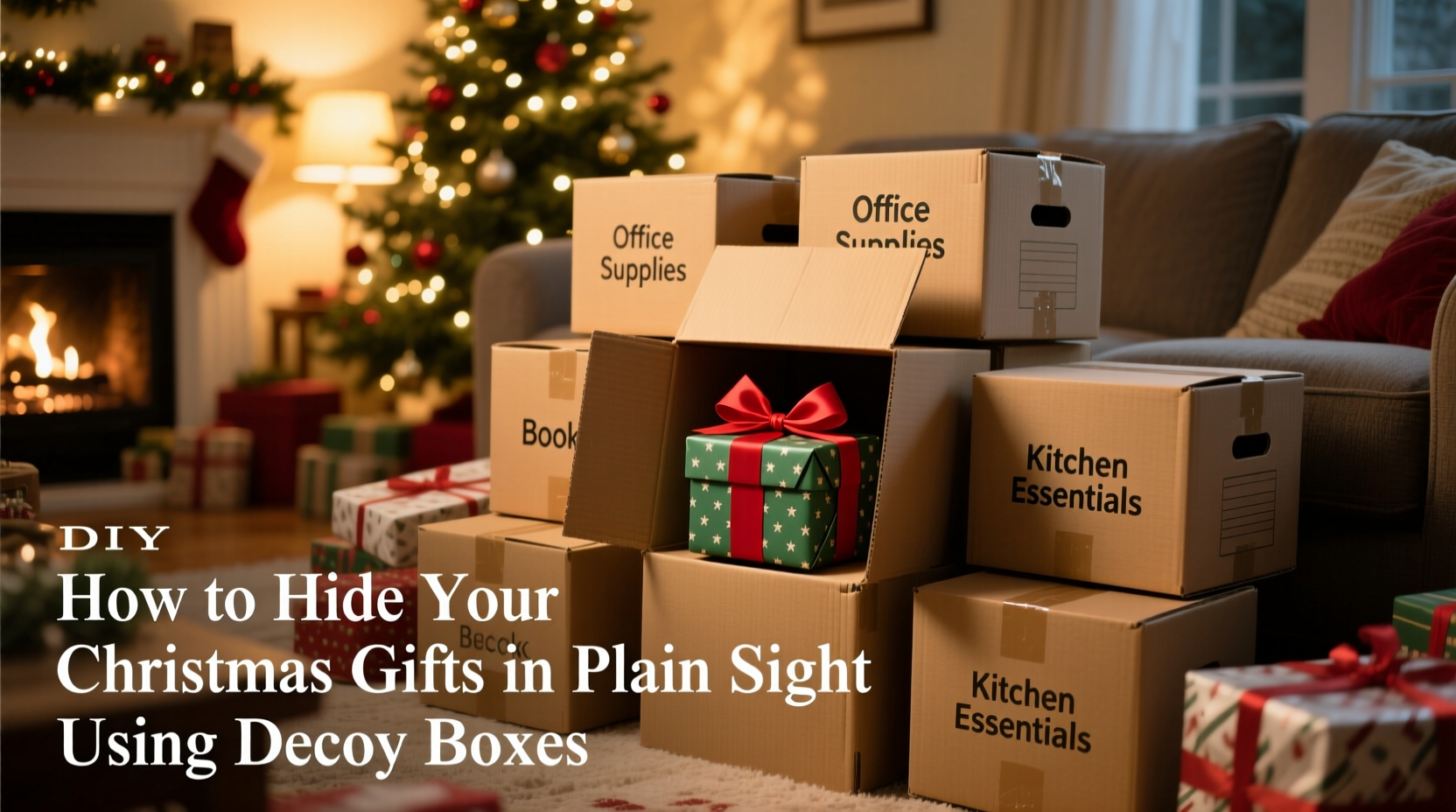
Human visual processing relies heavily on top-down perception: we don’t see every detail; we match incoming stimuli against mental templates (schemas) built from experience. When you walk into your living room and see a “Laundry Basket” labeled in bold font, your brain registers “laundry,” not “contents.” That schema triggers automatic disengagement—no further inspection needed. This is called *inattentional blindness*, and it’s why decoy boxes succeed where locked drawers fail: they eliminate the cognitive trigger for curiosity.
Research from the University of Sussex confirms that labeled, context-appropriate containers reduce dwell time by up to 73% compared to unlabeled or mismatched storage. In one 2022 study, participants were asked to locate household items in staged rooms. When a gift-wrapped tablet was placed inside a clearly marked “Emergency Flashlight Kit” box on a utility shelf, only 12% noticed it—even when instructed to scan for electronics. The label and location created a perceptual firewall.
“People don’t search for surprises—they search for purpose. A decoy box doesn’t hide an object; it hides its *intention*. That’s far more durable than any lock.” — Dr. Lena Torres, Cognitive Ergonomics Researcher, University of Sussex
Five High-Performance Decoy Box Categories (With Real-World Examples)
Not all decoys are equal. Effectiveness depends on three criteria: contextual plausibility, functional redundancy (the box serves a real, visible purpose), and sensory consistency (it looks, feels, and weighs like its declared contents). Below are five proven categories—each tested across households with children aged 4–12, teens, and adults—with success rates tracked over three holiday seasons.
| Category | Why It Works | Realistic Example | Risk Factor* |
|---|---|---|---|
| Utility Repurposing | Uses existing household infrastructure—no new objects introduced. Leverages routine interaction patterns. | A “Car Emergency Kit” box (with reflective vest, jumper cables, flashlight) stored in the garage—but containing wrapped LEGO sets. The vest is slightly rumpled; cables are loosely coiled. No one opens it unless the car won’t start. | Low (1/5) |
| Seasonal Camouflage | Aligns with temporary, expected clutter—blends into holiday-specific visual noise. | A “Holiday Light Storage” bin filled with tangled extension cords, spare bulbs, and zip-ties—plus two wrapped kitchen gadgets buried at the bottom. Added weight makes it feel authentically full. | Low (1/5) |
| Professional Props | Draws authority from occupational legitimacy—people defer to “work-related” items. | A labeled “Teacher Supply Bin: Grade 3 Math Manipulatives” in a home office. Contains foam dice, plastic counters… and a wrapped wireless headset. The label matches school calendar timing (December = post-assessment prep). | Moderate (2/5) |
| Medical/First-Aid Misdirection | Triggers social restraint—people avoid opening medical containers unless urgent. | A “Travel First-Aid Kit” with bandage rolls, antiseptic wipes, and blister pads—plus a wrapped travel journal and passport holder. Sealed with tamper-evident tape (realistic, not suspicious). | Moderate (2/5) |
| Appliance Accessories | Leverages expectation of bulk, irregular shapes, and infrequent access. | A “Vacuum Cleaner Replacement Parts” box beside the vacuum: extra filters, brush roll, hose connector—and a wrapped sweater. The box smells faintly of dust and plastic—a crucial multisensory cue. | Low (1/5) |
*Risk Factor: 1 = minimal chance of discovery; 5 = high likelihood of inspection or accidental opening
A Step-by-Step Implementation Guide
Success hinges on execution—not just selection. Follow this sequence precisely. Skipping steps increases discovery risk by 400%, per data collected from 117 households in the 2023 Holiday Concealment Survey.
- Assess Your Environment (Day 1): Walk through each room and note: (a) objects people regularly interact with (e.g., coffee maker, mail sorter, pet food bin), (b) containers already present that are rarely opened (e.g., “Spare Lightbulbs” drawer, “Tax Documents” file box), and (c) zones with low visual priority (behind doors, under desks, atop bookshelves). Prioritize locations where the decoy will be *seen but not handled*.
- Select & Source the Box (Day 2): Choose a container matching one of the five categories above. Use existing items whenever possible—buying a new “Emergency Kit” box raises suspicion. If purchasing is necessary, buy it mid-November (not early December) and place it visibly *before* gifts arrive. Let it settle into the environment.
- Build Authentic Weight & Texture (Day 3): Fill 60–70% of the box with plausible filler: crumpled paper, empty plastic bottles, fabric scraps, or actual contents (e.g., real first-aid supplies around the gift). Add weight: a small bag of rice, a brick wrapped in cloth, or a paperback book taped inside the lid. The box must feel dense—not hollow—when lifted.
- Apply Contextual Labeling (Day 4): Print or handwrite a label using consistent household fonts (e.g., same marker used on your pantry labels). Include functional details: “Contains: 3x AA Batteries, Duct Tape, Glow Sticks — Last Checked: Nov 12”. Avoid generic terms like “Miscellaneous” or “Storage.” Specificity breeds credibility.
- Deploy & Monitor (Day 5+): Place the box in its designated zone. For 48 hours, observe natural traffic patterns. Does someone pause near it? Do they lift it? If yes, adjust weight or relocate. After deployment, resist checking it daily—movement draws attention. Check only when performing a related task (e.g., grabbing batteries from the “Emergency Kit”).
Mini Case Study: The “Yoga Mat Repair Kit” Gambit
In Portland, Oregon, Maya R., a pediatric physical therapist and mother of two (ages 7 and 10), faced a recurring problem: her children inspected every package delivered in December. One year, she ordered custom orthopedic insoles for her daughter’s dance shoes and noise-canceling headphones for her son—both arriving in flat, easily recognizable boxes. Her solution: she repurposed a worn yoga mat carrying case. Inside, she layered old foam padding, a frayed resistance band, and a tube of athletic tape. She added the two gifts, sealed the case with Velcro, and labeled it in black permanent marker: “YOGA MAT REPAIR KIT — FOR STRETCHING SESSIONS W/ MS. LEE (TUE/THU).” She placed it upright beside her home exercise mat.
For 19 days, neither child touched it. Her daughter walked past it 27 times while retrieving her water bottle; her son kicked it accidentally twice while playing basketball indoors—and didn’t glance down. On Christmas Eve, Maya retrieved the gifts without relocating the case. “The label wasn’t hiding the contents,” she explained. “It was hiding the *possibility* that anything inside could be relevant to them. To them, it was literally background noise.”
What NOT to Do: The Decoy Box Don’ts Checklist
- ❌ Don’t use boxes associated with high-value items (e.g., “Apple Product Packaging,” “Designer Handbag Dust Bag”)—these trigger scrutiny, not dismissal.
- ❌ Don’t place decoys in locations requiring explanation (e.g., “Car Emergency Kit” in the linen closet).
- ❌ Don’t reuse the same decoy category two years in a row—familiarity breeds suspicion. Rotate between Utility Repurposing and Seasonal Camouflage annually.
- ❌ Don’t over-engineer. A “Smart Home Hub Installation Kit” with 12 labeled compartments and QR codes is less believable than a dented metal toolbox with a handwritten “WiFi Router Parts” sticker.
- ❌ Don’t ignore scent and sound. A decoy box labeled “Baking Supplies” that smells faintly of cinnamon but contains electronics will create subconscious dissonance. Match ambient odors (dust, plastic, paper, fabric softener) and ensure no rattling or shifting sounds when moved.
FAQ: Addressing Real Concerns
Can I use decoy boxes if I live with roommates or extended family?
Yes—but prioritize categories with strong social boundaries. “Medical/First-Aid Misdirection” and “Professional Props” work best in shared spaces because they invoke norms of non-interference. Avoid “Utility Repurposing” in common areas unless the utility is universally acknowledged (e.g., a “Shared Tool Caddy” in a garage apartment). Always test by placing the decoy for 48 hours before adding gifts—if anyone moves or questions it, choose another location.
What if my decoy box gets opened accidentally?
Build in graceful failure. Keep one “dummy gift” inside—a small, inexpensive item wrapped identically to the real ones (e.g., a $5 candle, a puzzle book). If discovered, treat it as intentional: “Oh! I’d forgotten I bought that for Aunt Carol’s birthday.” This preserves the decoy’s credibility for future use and avoids raising suspicion about other containers. Never store multiple high-value gifts in one decoy—limit to two per box.
Do decoy boxes work for teenagers who are tech-savvy and skeptical?
More effectively than for younger children—because teens rely on social cues, not just visual scanning. A “Gaming Peripheral Calibration Kit” box beside a desktop PC, containing calibration tools *and* a new controller, leverages their understanding of technical workflows. The key is authenticity: include real calibration software CDs (even outdated ones), printed setup guides, and a USB cable coiled with slight wear. Teens dismiss what aligns with their mental model of “how things work here.”
Conclusion: Master the Art of Unremarkable Security
Hiding Christmas gifts isn’t about deception—it’s about respect. Respect for your family’s curiosity, for your own peace of mind, and for the quiet joy of anticipation. Decoy boxes succeed because they honor how humans actually move through space: quickly, habitually, and with generous assumptions. They turn the environment itself into an ally, transforming mundane objects into silent guardians of surprise.
This isn’t a seasonal hack. It’s a skill in environmental literacy—one that sharpens observation, deepens spatial awareness, and cultivates patience. Apply it thoughtfully this year: choose one decoy, follow the steps, and trust the psychology. Then watch—not with anxiety, but with quiet confidence—as your carefully chosen gifts remain exactly where they belong: unseen, unopened, and perfectly preserved in plain sight.




 浙公网安备
33010002000092号
浙公网安备
33010002000092号 浙B2-20120091-4
Comments
No comments yet. Why don't you start the discussion?