
Distinguishing between moissanite and diamond rings is more than just a matter of curiosity—it can affect value, durability, and long-term satisfaction. While both gemstones dazzle in their own right, they differ significantly in composition, brilliance, and cost. With synthetic moissanite becoming increasingly popular as an affordable alternative to natural diamonds, knowing how to tell them apart is essential for buyers, collectors, and even jewelry owners reviewing inherited pieces. This guide walks through scientifically grounded, practical techniques anyone can use—no lab equipment required—to confidently identify which stone they’re dealing with.
Understanding the Basics: Moissanite vs. Diamond
Diamonds are naturally occurring carbon crystals formed deep within the Earth under extreme pressure and heat. They rank 10 on the Mohs scale of hardness, making them the hardest known natural material. Moissanite, on the other hand, is primarily lab-created silicon carbide. Though first discovered in meteorites, nearly all moissanite available today is synthetically produced. It ranks 9.25 on the Mohs scale—still extremely durable—but differs optically and chemically from diamond.
Because moissanite is engineered to mimic diamond, it shares many visual traits: clarity, sparkle, and colorlessness (in higher grades). However, subtle but detectable differences exist in how light interacts with each stone, their weight, thermal conductivity, and internal characteristics.
“Moissanite has double refraction, which means you can often see doubling of facet lines under magnification—a dead giveaway.” — Dr. Lena Peterson, Gemologist at the International Gemological Institute
Key Visual Differences You Can Spot at Home
You don’t need professional tools to start narrowing down whether a ring features moissanite or diamond. Several observable clues can point toward one or the other.
Fire and Brilliance
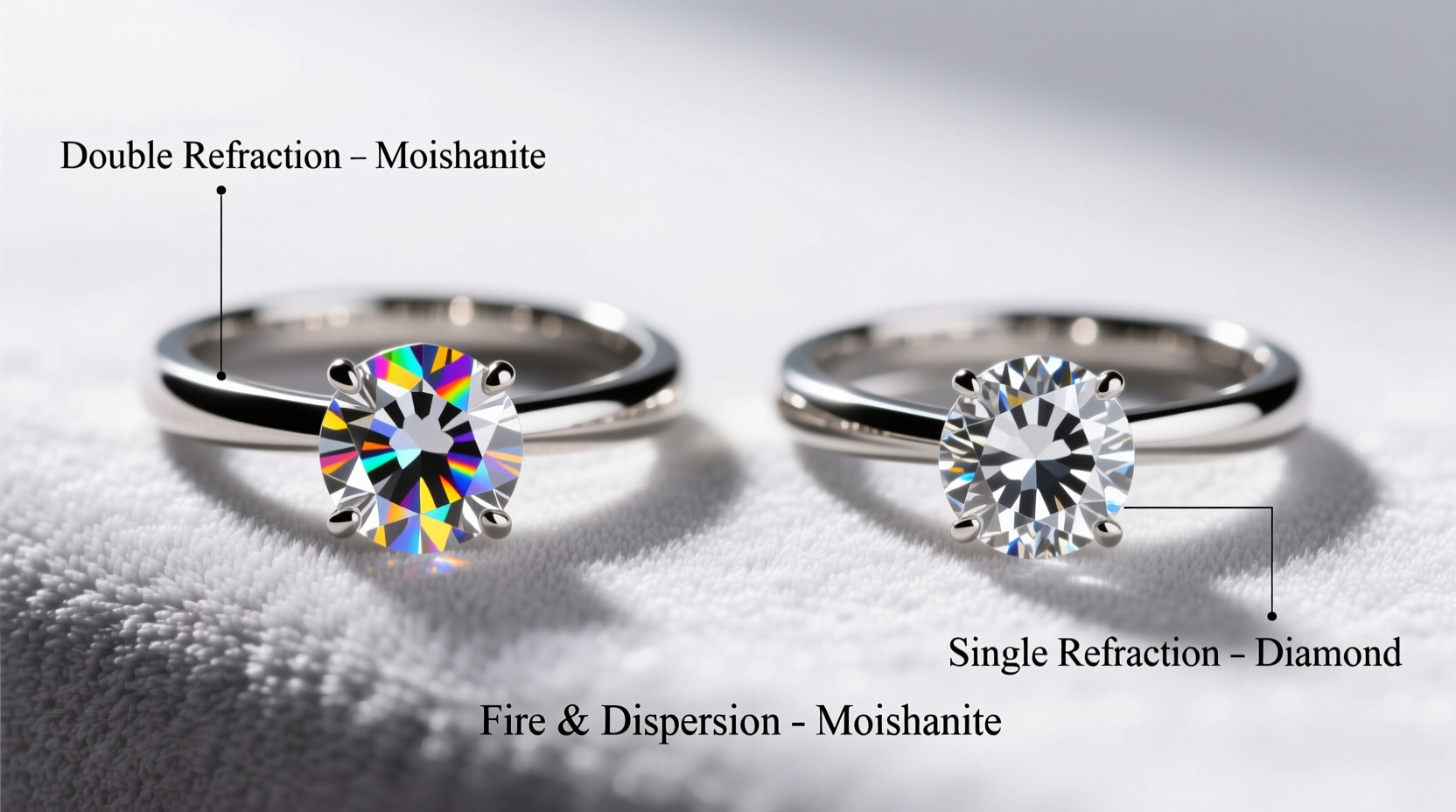
Moissanite disperses light more strongly than diamond, resulting in what’s often described as “disco-ball” flashes of colored light. This high dispersion creates vibrant rainbow sparkles, especially under fluorescent or LED lighting. Diamonds exhibit more white light return (brilliance) and subtler fire. If the ring seems to throw off intense rainbow hues in normal indoor lighting, moissanite is likely.
Double Refraction
One of moissanite’s defining optical properties is birefringence, meaning light splits into two rays when passing through the crystal. This causes facet edges to appear doubled when viewed through a loupe or magnifying glass. To test this, focus on the crown facets or girdle line of the stone. In a diamond, lines will be sharp and single; in moissanite, they may look blurred or duplicated.
Weight and Density
Moissanite is lighter than diamond for the same size. A 6.5mm round moissanite weighs approximately 0.88 carats, while a diamond of the same diameter is about 1.0 carat. If you have a known diamond of similar dimensions, comparing the heft in hand might reveal that the suspect stone feels slightly lighter—an indication of moissanite.
Practical Testing Methods Without Special Tools
While gemological labs use advanced spectrometers and microscopes, several low-tech tests can help differentiate the two stones—though none should replace professional appraisal for certainty.
1. The Fog Test
Breathe onto the stone to fog its surface. A diamond disperses heat almost instantly, so the fog should clear in less than a second. Moissanite also clears quickly but may retain fog slightly longer due to lower thermal conductivity. Note: This test is not foolproof, especially with dirty stones or cold environments.
2. The Scratch Test (Not Recommended)
Do not attempt to scratch the stone or any surface with it. Despite moissanite’s high hardness, this test risks damaging the setting or violating ethical testing standards. Rely on non-destructive methods instead.
3. The Newspaper Test (Limited Usefulness)
Place the stone table-down over printed text. Due to its high refractive index, neither diamond nor moissanite typically allows you to read letters clearly through the pavilion. This test works better for detecting glass imitations, not distinguishing between these two gems.
Using Simple Tools for More Accurate Identification
For greater confidence, inexpensive tools can significantly improve accuracy.
Jeweler’s Loupe (10x Magnification)
Inspect the stone closely for doubling of facet junctions. Rotate the stone slowly and observe how internal reflections behave. Moissanite often shows more pronounced color zoning—subtle green, yellow, or gray tints under certain angles—especially in larger stones or lower-quality grades.
Thermal Conductivity Tester
This handheld device measures how quickly a stone conducts heat. Diamonds are excellent thermal conductors; most moissanite testers are calibrated to distinguish between the two. However, some advanced moissanite stones can trigger false positives on older models. Always verify results with additional observations.
Refractometer (Professional Use)
A refractometer measures a stone’s refractive index. Diamond reads around 2.42, while moissanite ranges from 2.65 to 2.69. This is a definitive test, but refractometers require expertise and direct contact with the stone, making them impractical for set jewelry.
“Even experienced jewelers can misidentify moissanite if they rely solely on visual inspection. Always combine multiple tests.” — Rafael Mendez, Certified Gemologist, GIA Alumni
Comparison Table: Diamond vs. Moissanite at a Glance
| Feature | Diamond | Moissanite |
|---|---|---|
| Composition | Carbon (C) | Silicon Carbide (SiC) |
| Hardness (Mohs) | 10 | 9.25 |
| Refractive Index | 2.42 | 2.65–2.69 |
| Dispersion (Fire) | 0.044 | 0.104 |
| Double Refraction | No | Yes |
| Typical Price (1ct equivalent) | $4,000–$8,000+ | $300–$600 |
Real-World Example: Identifying an Inherited Ring
Sarah inherited a vintage-style solitaire ring from her grandmother, believing it to be a diamond. When she took it to a local jeweler for insurance appraisal, she was told it was moissanite. Confused—since the ring predated widespread moissanite use—she sought a second opinion. Using a 10x loupe, a gemologist observed distinct doubling of facet lines near the girdle. Further testing with a dual thermal/conductivity probe confirmed the stone was indeed modern moissanite, likely replaced during a past repair. This case highlights how assumptions based on age or style can be misleading—and why objective testing matters.
Frequently Asked Questions
Can moissanite pass a diamond tester?
Older diamond testers that measure only thermal conductivity may not distinguish moissanite from diamond, leading to false positives. Modern multi-function testers that also assess electrical conductivity can accurately differentiate the two.
Is moissanite considered \"fake\"?
No. Moissanite is a genuine gemstone in its own right, though lab-created. It is not a diamond imitation in the deceptive sense, but rather a distinct alternative valued for its brilliance and affordability.
Does moissanite lose its sparkle over time?
No. Like diamond, moissanite retains its brilliance permanently. However, dirt, oils, and residue can dull its appearance temporarily. Regular cleaning restores full luster.
Final Checklist: How to Confirm Moissanite vs. Diamond
- Observe the stone under various lighting conditions for excessive rainbow fire.
- Use a jeweler’s loupe to check for double refraction along facet edges.
- Perform the fog test and compare heat dispersion speed.
- Weigh the stone or compare its heft to a known diamond of similar size.
- Use a professional-grade dual probe tester (thermal + electrical conductivity).
- Consult a certified gemologist for conclusive identification.
Conclusion: Confidence Starts with Clarity
Whether you're purchasing an engagement ring, evaluating inherited jewelry, or simply curious about what’s on your finger, understanding the differences between moissanite and diamond empowers informed decisions. These stones may look alike at a glance, but their stories, science, and signatures are distinct. By applying simple observation techniques and leveraging accessible tools, you can move beyond guesswork and gain real insight into your gemstone’s identity.




 浙公网安备
33010002000092号
浙公网安备
33010002000092号 浙B2-20120091-4
Comments
No comments yet. Why don't you start the discussion?