
Distinguishing moissanite from diamond has become increasingly important in both the retail and resale jewelry markets. While visually similar, these two gemstones differ significantly in composition, value, and thermal conductivity. Diamond testers—commonly used by jewelers and consumers alike—are designed primarily to detect thermal or electrical properties unique to diamonds. However, many modern testers struggle with moissanite due to its high thermal conductivity, which can mimic that of a diamond. Understanding how to interpret results correctly and apply best practices when testing various types of jewelry, including chains and mounted stones, is essential for accuracy.
Understanding How Diamond Testers Work
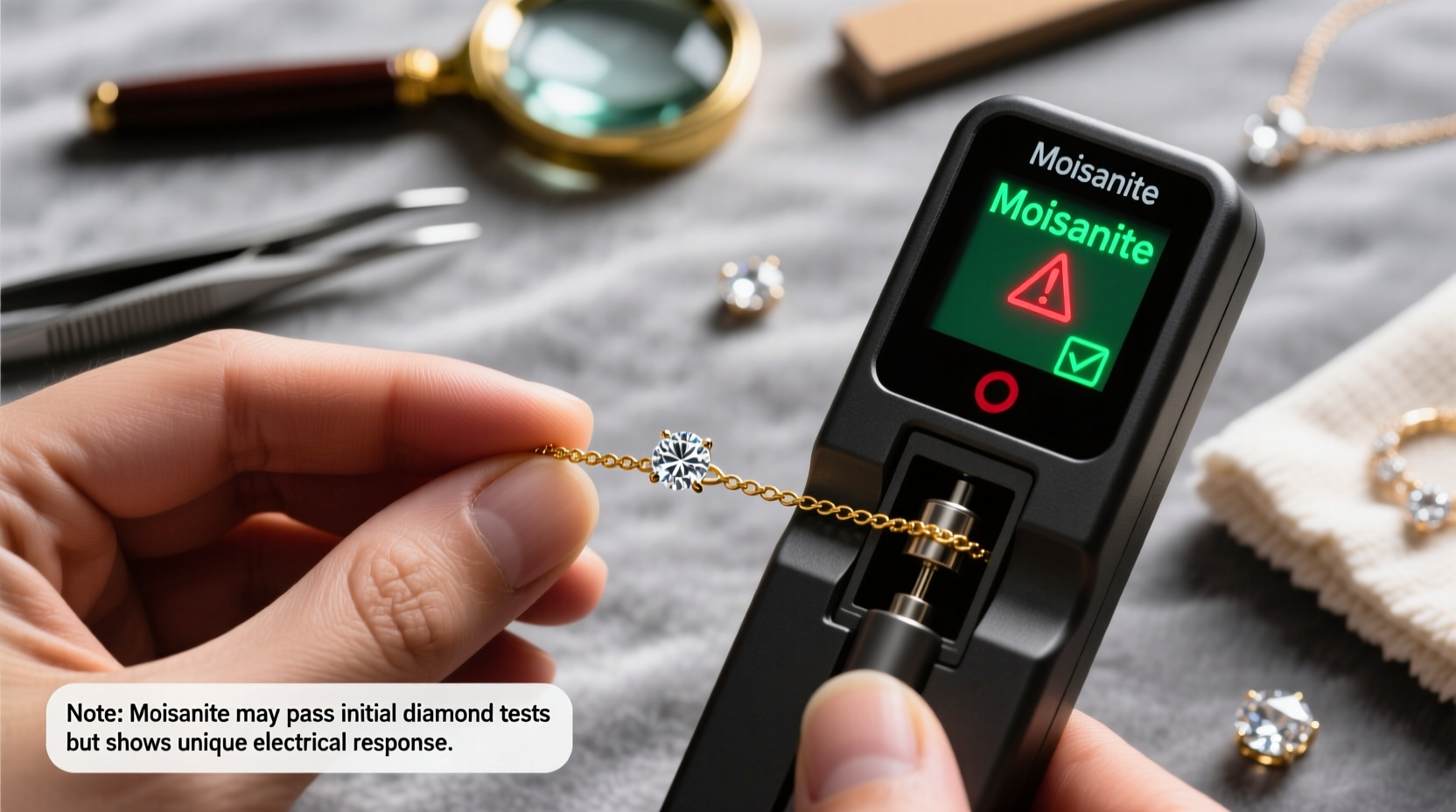
Diamond testers fall into two main categories: thermal conductivity testers and electrical conductivity testers. Thermal testers measure how quickly heat dissipates through a stone. Diamonds conduct heat exceptionally well, so they return a “diamond” reading almost instantly. Moissanite also conducts heat efficiently, which often causes thermal testers to misidentify it as a diamond.
Electrical conductivity testers, on the other hand, detect whether a stone allows electricity to pass through it. Unlike diamond (which is typically an electrical insulator), moissanite is a semiconductor. This key difference allows dual-mode testers—those that measure both thermal and electrical conductivity—to more accurately distinguish between the two.
Step-by-Step Guide to Testing Moissanite vs. Diamond
Accurate identification requires not only the right tool but also proper technique. Follow this step-by-step process to minimize errors when testing loose or mounted stones, as well as jewelry like pendants and chains.
- Calibrate the Tester: Turn on the device and allow it to stabilize. Most testers have a calibration setting or require a test on a known diamond or simulated stone before use.
- Clean the Stone: Wipe the surface with a soft, lint-free cloth. Oils, dirt, or residue can interfere with conductivity readings.
- Position the Probe Correctly: Place the tip perpendicular to the crown of the stone. Avoid metal settings, prongs, or chain links, as these can distort the reading.
- Hold Steady for 2–3 Seconds: Maintain contact without moving the probe. Fluctuating signals may indicate moissanite.
- Observe Both Readings (if dual-mode): If the tester indicates “diamond” thermally but “not diamond” electrically, the stone is likely moissanite.
- Re-Test Multiple Facets: Especially in larger stones, test several points to rule out inconsistencies.
Special Considerations When Testing Chains and Mounted Jewelry
Testing jewelry with embedded stones or delicate components like gold or silver chains introduces additional challenges. Metal settings can conduct heat and electricity, leading to false positives if the probe touches them instead of the gemstone.
For chains set with small stones (such as pavé or micro-set pieces), isolate each stone carefully. Use magnification to ensure the probe contacts only the top facet. If the chain itself is being tested—for authenticity or material verification—a different approach is needed.
To verify if a chain is made of real gold or platinum, use a separate metal tester or perform acid tests. Never rely solely on a diamond tester for metal assessment.
| Test Scenario | Recommended Tool | Common Pitfall |
|---|---|---|
| Loose gemstone (suspected moissanite) | Dual-mode diamond tester | Misreading due to dirty surface |
| Ring with center stone | Thermal + electrical tester | Probe touching prong instead of stone |
| Pendant with small side stones | High-precision probe tester | Inability to isolate tiny gems |
| Gold chain (no stones) | Metal verifier or acid test kit | Using diamond tester incorrectly on metal |
Expert Insight: Why Dual Testing Matters
“Over 70% of moissanite stones sold today will register as ‘diamond’ on basic thermal testers. Only when electrical conductivity is factored in can professionals achieve near 100% accuracy.” — Dr. Alan Reed, Gemological Instrumentation Specialist, International Gem Society
This quote underscores a critical point: relying on outdated or single-function testers risks misidentification. As moissanite becomes more prevalent—especially in engagement rings and vintage-style reproductions—the need for precise tools grows stronger.
Tips for Accurate and Reliable Results
Even experienced jewelers can make mistakes if they rush the testing process. The following tips help improve consistency and reduce errors across different types of jewelry.
- Avoid testing immediately after handling the stone; body heat can skew thermal results.
- Use a jeweler’s loupe to confirm the presence of double refraction—a hallmark of moissanite visible under magnification.
- If uncertain, cross-verify with a professional lab report or refractometer analysis.
- Be cautious with lab-grown diamonds; they test identical to natural diamonds but carry different market values.
Real Example: A Common Misidentification Case
A customer brought a vintage-style halo ring to a local pawn shop, believing it contained a one-carat diamond. The clerk used a standard thermal tester, which beeped positively for “diamond.” Satisfied, the shop offered a moderate buy price. Later, a certified gemologist retested the piece using a dual-mode device. The thermal result was positive, but the electrical reading flagged the center stone as moissanite.
Further inspection revealed slight double refraction around the girdle under 10x magnification—confirming the initial misdiagnosis. The shop avoided a financial loss by consulting an expert, highlighting the importance of advanced tools and trained evaluation.
Checklist: How to Confidently Identify Moissanite
Use this checklist every time you test a stone or jewelry item to ensure thoroughness and precision:
- ☑ Verify the tester is fully charged and calibrated
- ☑ Clean the stone and setting with a soft cloth
- ☑ Confirm the tester has both thermal and electrical modes
- ☑ Isolate the gemstone from metal components during testing
- ☑ Take multiple readings from different facets
- ☑ Check for fluctuating tones or mixed signals (diamond vs. moissanite)
- ☑ Examine under magnification for double refraction lines
- ☑ Document findings for future reference or resale valuation
Frequently Asked Questions
Can a diamond tester tell the difference between moissanite and diamond?
Basic thermal testers cannot reliably distinguish between moissanite and diamond because both conduct heat similarly. However, dual-mode testers that measure electrical conductivity can detect the difference, as moissanite is electrically conductive while most diamonds are not.
Why does my diamond tester say my moissanite is a diamond?
This happens because traditional testers rely on thermal conductivity, which moissanite mimics very closely. Without an electrical conductivity check, the device lacks the data needed to differentiate the two materials.
Is moissanite considered fake or inferior?
No. Moissanite is a legitimate gemstone with its own unique properties, including higher brilliance and fire than diamond. It’s ethically sourced, durable (9.25 on the Mohs scale), and valued for affordability and sustainability. It’s not “fake”—it’s simply different.
Final Thoughts: Confidence Through Knowledge and Tools
Identifying moissanite on a diamond tester isn’t just about owning the right device—it’s about understanding its limitations and applying correct methodology. Whether you're a jeweler, collector, buyer, or seller, accurate testing protects your investments and builds trust. By combining dual-mode technology, careful technique, and visual verification, you can confidently assess any gemstone or piece of jewelry.




 浙公网安备
33010002000092号
浙公网安备
33010002000092号 浙B2-20120091-4
Comments
No comments yet. Why don't you start the discussion?