
Selecting the perfect Apple Watch strap isn’t just about style—it’s about fit, function, and long-term comfort. With multiple Apple Watch models, sizes, and proprietary connector systems over the years, choosing a compatible band can be confusing. Many users have learned the hard way that not all straps work with all watches, even if they look similar. Understanding the nuances of compatibility ensures you get both aesthetic satisfaction and reliable performance from your wearable.
Apple has maintained a consistent lug-based attachment system since the first-generation Apple Watch, but subtle differences in case size, band width, and regional variations can still trip up even experienced buyers. This guide breaks down everything you need to know—from measuring your current band to decoding product labels—so you can confidently select a strap that fits perfectly and lasts.
Understanding Apple Watch Sizing and Band Widths
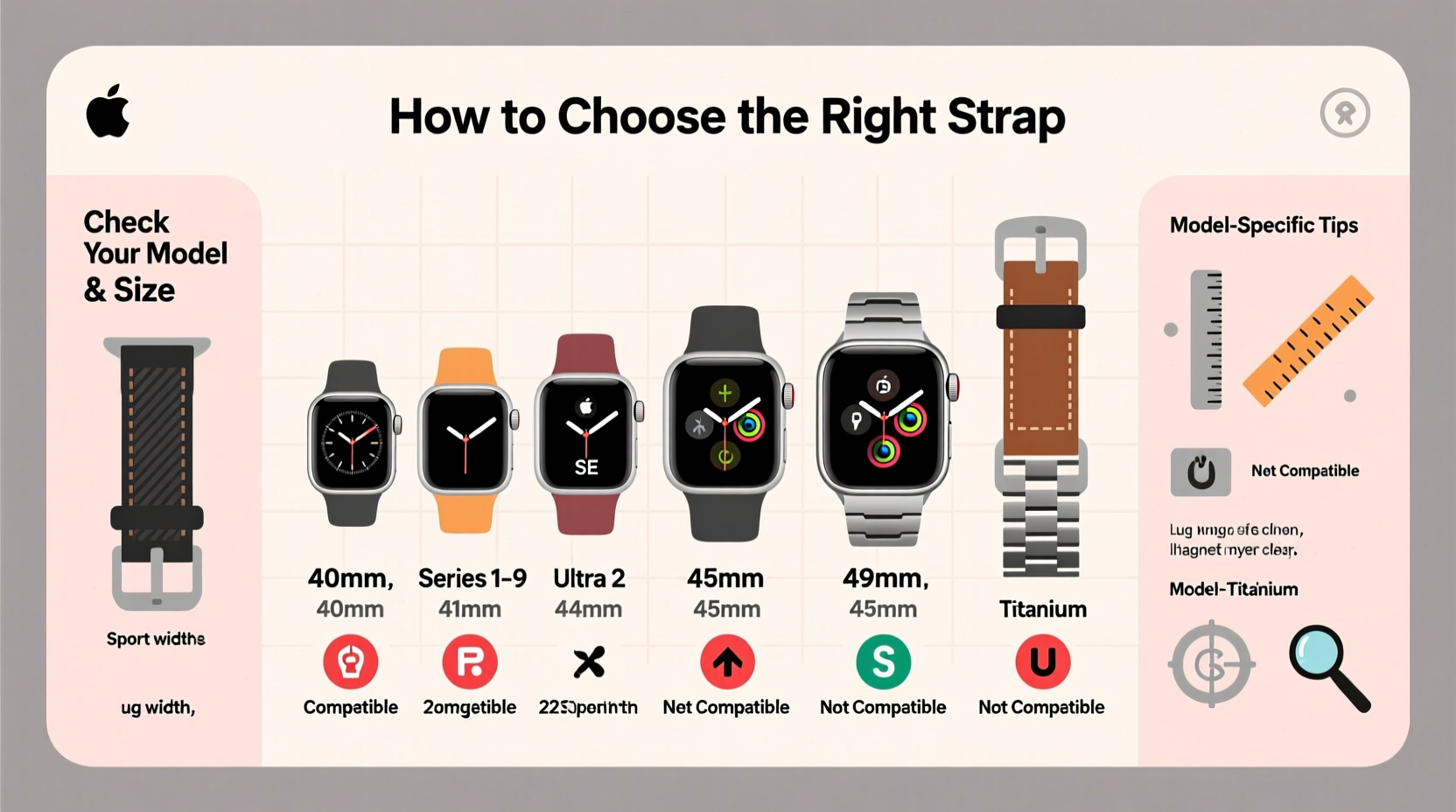
The most critical factor in strap compatibility is your Apple Watch’s case size. Apple uses two primary measurements: 38/40/41mm and 42/44/45/49mm. While newer models use millimeter increments (e.g., 41mm or 45mm), bands are typically labeled as “small” (38–41mm) or “large” (42–49mm). It's essential to match the band width to your watch case.
Here’s a breakdown of case sizes and corresponding band widths:
| Apple Watch Model | Case Size (mm) | Band Width Required |
|---|---|---|
| Apple Watch Series 1–9, SE (1st & 2nd gen), Ultra (1 & 2) | 38, 40, 41 | 20mm (for 38/40), 21mm (for 41) |
| Apple Watch Series 1–9, SE (1st & 2nd gen) | 42, 44, 45 | 22mm (for 42/44), 23mm (for 45) |
| Apple Watch Ultra, Ultra 2 | 49 | 27mm (exclusive to Ultra series) |
Note that while 38mm and 40mm watches both use 20mm bands, and 42mm and 44mm use 22mm bands, the 41mm and 45mm models introduced narrower lugs requiring slightly wider bands: 21mm and 23mm respectively. The Apple Watch Ultra line takes this further with a unique 27mm lug design, meaning its bands are not interchangeable with any other model.
Connector Types and Physical Compatibility
All Apple Watch bands use a spring-loaded pin mechanism that slides into the watch’s lugs. The system is standardized across generations, meaning a 20mm band designed for a 38mm Series 1 will physically attach to a 40mm Series 7—provided the width matches. However, fit and finish may vary due to design differences in curvature and lug shape.
Apple categorizes bands by series compatibility, but the real determinant is physical dimensions. For example:
- Nylon Sport Bands: Available in pairs (e.g., 38/40mm and 42/44mm) and now updated for 41mm and 45mm.
- Leather and Milanese Loops: Sold in specific widths and often tailored to certain models for optimal drape and closure.
- Link Bracelets: Model-specific due to integrated mechanisms and size adjustments.
Third-party manufacturers often produce bands labeled for “all Series,” but verify whether they offer separate sizing options. A one-size-fits-all claim usually means adjustable ends, not universal lug compatibility.
“Even though Apple maintains backward compatibility in its lug system, precision matters. A 23mm band won’t fit a 22mm lug gap—and forcing it can damage the housing.” — David Lin, Wearable Tech Analyst at GadgetInsight
Step-by-Step Guide to Finding Your Perfect Strap
Follow this process to ensure you purchase the correct strap every time:
- Determine your Apple Watch model and size. Go to Settings > General > About and note the model number and case size.
- Check your current band’s width. Flip your watch over and look for the imprint on the back of the band near the connectors (e.g., “20mm” or “23mm”).
- Decide on material and use case. Are you looking for sport, formal, or everyday wear? Materials like fluoroelastomer suit workouts, while leather elevates office attire.
- Verify compatibility on retailer sites. Look for dropdown menus specifying model and size. Avoid listings without clear sizing options.
- Consider clasp type. Buckles, loops, magnetic closures, and deployant clasps affect security and ease of use.
- Purchase from reputable brands. Stick to Apple-certified accessories or well-reviewed third parties like Nomad, Belkin, or Satechi.
Compatibility Checklist Before Buying
✅ Strap Compatibility Checklist
- Know your Apple Watch model and case size
- Confirm the required band width (20mm, 21mm, 22mm, etc.)
- Ensure the band is explicitly listed for your model
- Check if the material suits your lifestyle (sweat-resistant, hypoallergenic, etc.)
- Verify return policy in case of fit issues
- Avoid “universal” bands without size variants
- For Apple Watch Ultra, only use 27mm bands
Real-World Example: Choosing a Strap for Daily Commuting
Sophia owns an Apple Watch Series 8 (45mm) and uses it daily for fitness tracking, commute navigation, and receiving work messages. Her old nylon band frayed after six months of heavy use. She wanted something durable yet professional-looking for her hybrid work schedule.
After checking her watch settings, she confirmed her model was 45mm. She researched bands labeled specifically for 45mm watches with 23mm connectors. She shortlisted a stainless steel link bracelet and a recycled ocean-plastic sport band. The metal option looked sleek but felt heavy during runs. The sport band offered breathability and sweat resistance, plus an extra loop for her wrist shape. She chose the latter, appreciating its eco-friendly materials and secure pin-and-tuck closure.
Her experience highlights the importance of balancing compatibility with personal usage patterns. Even a technically compatible band might not serve your needs if the weight, texture, or closure doesn’t align with your routine.
Frequently Asked Questions
Can I use an Apple Watch SE band on a Series 9?
Yes, provided both watches share the same case size and band width. A 40mm SE uses 20mm bands, which are compatible with a 41mm Series 9 if the band is labeled for that size. Always confirm the exact width before purchasing.
Are Apple Watch Ultra bands interchangeable with other models?
No. The Ultra and Ultra 2 have a unique 49mm case with 27mm lugs, making their bands incompatible with all other Apple Watch models. Conversely, no other band will securely fit the Ultra series.
Do third-party bands affect my Apple Watch warranty?
No. Using non-Apple bands does not void your warranty unless the band causes physical damage. However, poorly made connectors could scratch the lugs or fail unexpectedly, so quality matters.
Final Tips for Long-Term Satisfaction
Once you’ve identified the correct size and style, maintain your straps properly. Clean silicone bands weekly with mild soap and water. Store leather bands flat and away from sunlight to prevent cracking. Replace worn pins or clasps promptly to avoid losing your watch.
Remember, your Apple Watch strap is more than an accessory—it’s part of your daily interface with technology. A well-chosen band enhances comfort, reflects your personality, and withstands your lifestyle. Take the time to measure, research, and invest wisely.




 浙公网安备
33010002000092号
浙公网安备
33010002000092号 浙B2-20120091-4
Comments
No comments yet. Why don't you start the discussion?