
Knowing your car’s exact model, trim level, engine type, and production year is essential for maintenance, repairs, insurance, and resale. While the Vehicle Identification Number (VIN) is the most accurate source, not everyone has immediate access to it—or knows how to decode it. Fortunately, there are several practical, accessible methods to determine your vehicle's identity without depending solely on the VIN. From decoding badging and design cues to leveraging owner resources and digital tools, this guide walks you through proven techniques that anyone can use.
1. Decode Exterior Badges and Design Features
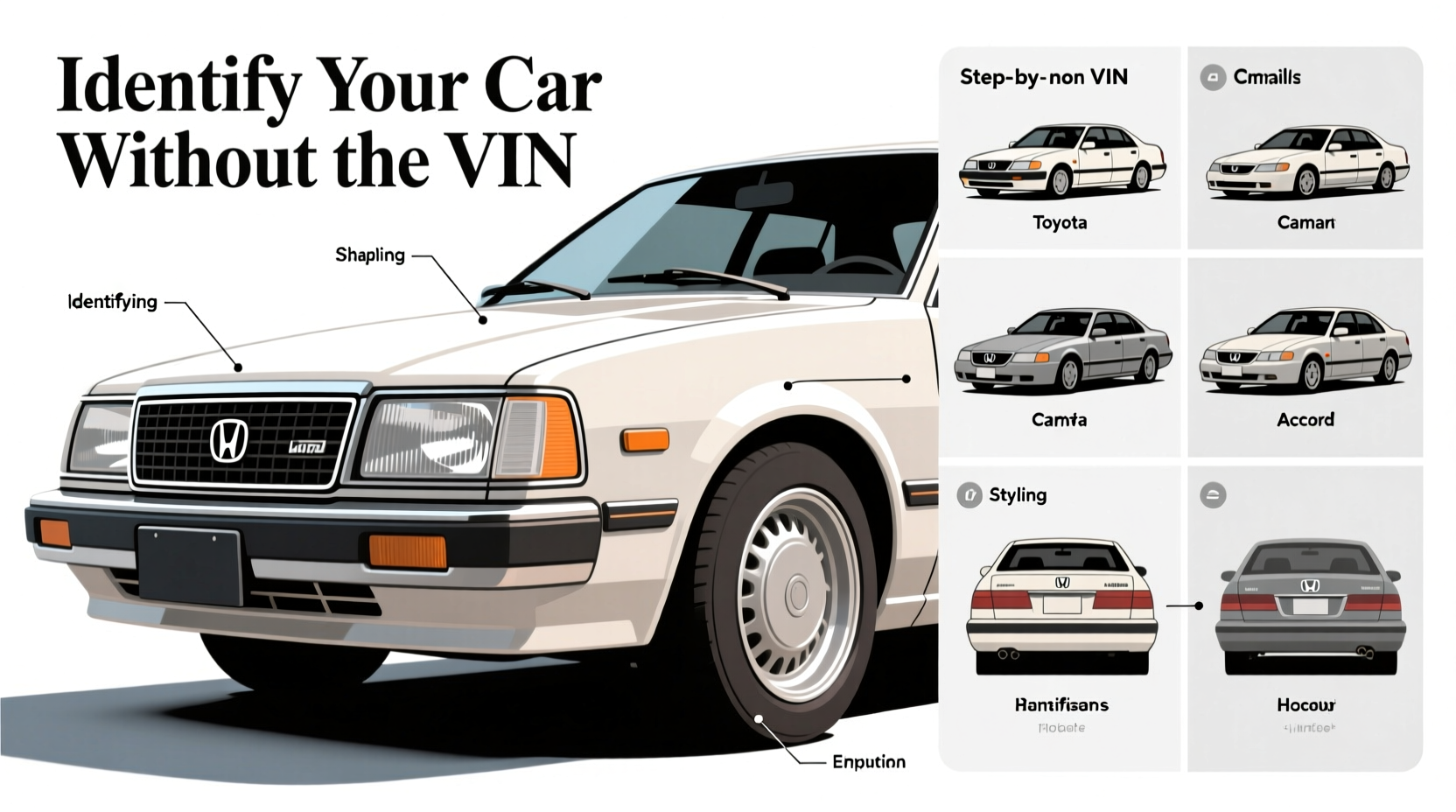
Manufacturers often place identifying clues in plain sight. The most obvious starting point is the badge or emblem on the rear of the vehicle. These typically display the make, model, and sometimes the trim or engine type. For example, a “328i” on a BMW trunk indicates a 3 Series with a specific engine configuration, while “SEL” on an Audi A6 suggests a higher trim level.
Beyond badges, body lines, grille designs, headlight shapes, and wheel styles vary significantly between trims and model years. A Honda Civic Si, for instance, features a sportier front bumper, dual exhaust, and unique alloy wheels compared to the base model. Familiarizing yourself with these differences can help narrow down your vehicle’s exact variant.
2. Use the Owner’s Manual and Registration Documents
The owner’s manual is one of the most overlooked yet comprehensive sources of vehicle information. It usually lists the full model designation, engine specifications, recommended fluids, and even factory options. Look at the cover or the first few pages—many manuals include the model name, generation (e.g., “X5 E70”), and production years covered.
Likewise, your vehicle registration card and title document contain key details such as the make, model, model year, and sometimes the body type (e.g., SUV, sedan). While they may not list trim levels like “Limited” or “Platinum,” they confirm core identifiers. Insurance documents also often describe the vehicle in detail, including engine size and drivetrain.
“Owners often don’t realize their registration includes the exact model nomenclature used by DMV systems—cross-referencing this with brochures from the same year can reveal trim-specific features.” — David Lin, Automotive Records Specialist
3. Examine Internal Labels and Placards
Inside your car, several factory labels provide detailed specifications. Open the driver’s side door and check the door jamb sticker. This placard typically includes:
- Vehicle identification number (VIN)
- Manufacturer name and country of origin
- Model designation
- Trim level
- Engine code
- Transmission type
- Tire pressure recommendations
- Gross vehicle weight rating (GVWR)
This label is standardized across most manufacturers and is one of the most reliable non-VIN sources for confirming your car’s exact configuration. Similarly, the fuel filler door often displays engine displacement (e.g., “2.0L”) and fuel type, which helps differentiate between engine variants.
4. Leverage Online Tools and Community Resources
When physical inspection isn’t enough, digital tools can bridge the gap. Websites like CarComplaints.com, Edmunds.com, and AutoDataDirect allow users to search by make, model, and year, then compare photos and specs to match their vehicle. Many forums—such as Reddit’s r/MechanicAdvice or brand-specific communities like Toyota Nation—welcome photo-based identification requests.
You can also use reverse image search engines. Upload a clear photo of your car’s front or side profile to Google Images or TinEye. If the image matches existing catalog entries, you’ll likely find listings with correct model names and years.
| Method | What It Reveals | Limitations |
|---|---|---|
| Exterior Badges | Model, trim, engine type | Badges can be removed or faked |
| Owner’s Manual | Generation, engine, options | May cover multiple trims |
| Door Jamb Sticker | Precise trim, engine code, GVWR | Can fade or be damaged |
| Registration Docs | Make, model, year, body type | Lacks trim/engine detail |
| Online Forums | Community-driven ID support | Requires user engagement |
5. Step-by-Step Guide to Identifying Your Car Without the VIN
If you’re starting from scratch, follow this logical sequence to determine your vehicle’s identity:
- Observe the front and rear badges. Note any alphanumeric codes (e.g., “GTX,” “250d,” “Hybrid LE”).
- Photograph key design elements: grille, headlights, taillights, wheels, and side profile.
- Check internal labels: inspect the driver’s door jamb sticker and fuel cap for engine and model info.
- Review paperwork: pull out the owner’s manual, registration, or insurance card for listed specifications.
- Search online databases: enter the make and approximate year into Edmunds or Kelley Blue Book and browse matching models.
- Post in automotive forums: upload photos to a relevant community with a request for identification.
- Cross-reference findings: ensure consistency across all sources before finalizing the model and trim.
Mini Case Study: Identifying a Modified Honda Accord
Mark inherited his grandfather’s 2007 Honda Accord but found no documentation. The rear badge was missing, and the wheels were aftermarket. He began by checking the door jamb sticker, which listed the model as “CM5” and engine as “K24Z3”—a clue pointing to a 2.4L four-cylinder. Comparing the front grille and headlight shape to online images, he matched it to the 2008–2012 Accord sedan. Since his car had fog lights and leather seats but no navigation, he concluded it was a “SE” trim. Forum members confirmed the ID after he uploaded interior and exterior photos. Mark later used this information to order correct replacement parts and schedule appropriate maintenance.
Common Mistakes to Avoid
- Assuming all models look identical: Facelifts mid-generation can alter bumpers, lights, and grilles—check year-specific differences.
- Ignoring engine codes: Two cars may share a model name but have different performance or reliability based on engine type.
- Relying only on dealership records: Service centers may mislabel vehicles if prior owners made modifications.
- Overlooking regional variations: A European-spec Golf GTI may differ from a U.S. version in power output and features.
Frequently Asked Questions
Can I identify my car model using only the license plate?
No, license plates do not encode model information. They are issued by state or regional authorities and lack technical data about the vehicle. However, some online lookup services tied to registration databases may return basic details if legally permitted.
What if my car has no badges?
No problem. Focus on design cues: headlight shape, grille pattern, tail lamp design, and body proportions. Enthusiast websites often maintain “badgeless identification” guides. You can also use the door sticker or registration documents to retrieve the model name directly.
How do I know if my car is a special edition or performance trim?
Special editions often come with unique colors, badging, or numbered plaques inside the cabin. Performance trims typically feature larger brakes, dual exhausts, sport suspension, and aerodynamic body kits. Cross-check your vehicle’s features against factory brochure specs from the same year.
Final Checklist: Confirm Your Car’s Identity
- ☐ Check exterior badges and lettering
- Note any model or engine designations.
- ☐ Inspect the driver’s door jamb sticker
- Look for model code, engine type, and trim.
- ☐ Review owner’s manual and registration
- Confirm make, model, and year.
- ☐ Compare photos with online galleries
- Use manufacturer or enthusiast sites.
- ☐ Ask for help in car forums
- Upload clear photos for community input.
Conclusion
Identifying your car’s model and specifications doesn’t require decoding a VIN or visiting a dealership. With careful observation, access to basic documents, and smart use of online resources, you can confidently determine your vehicle’s exact identity. Whether you're buying parts, troubleshooting issues, or simply satisfying curiosity, these methods empower you with accurate, actionable knowledge. The next time you’re unsure about your car’s trim or engine, trust your eyes, use the tools at hand, and engage the passionate communities ready to help.




 浙公网安备
33010002000092号
浙公网安备
33010002000092号 浙B2-20120091-4
Comments
No comments yet. Why don't you start the discussion?