
Floating shelves offer clean lines and modern elegance—but when it comes to holiday lighting, they present a unique challenge: no back panel, no crown molding, no baseboard to conceal cords. A single exposed wire can shatter the illusion of effortless magic. Yet thousands of homeowners, interior stylists, and boutique retailers achieve luminous, cable-free Christmas displays on floating shelves every year. The secret isn’t expensive custom builds or hidden junction boxes—it’s strategic layering of power sources, light form factors, and placement logic. This guide distills field-tested techniques used by professional set designers, retail visual merchandisers, and residential lighting consultants. No theory. No speculation. Just what works—reliably, safely, and beautifully—on real floating shelves with standard drywall anchors and 2×4 stud spacing.
Why Traditional Wiring Fails on Floating Shelves
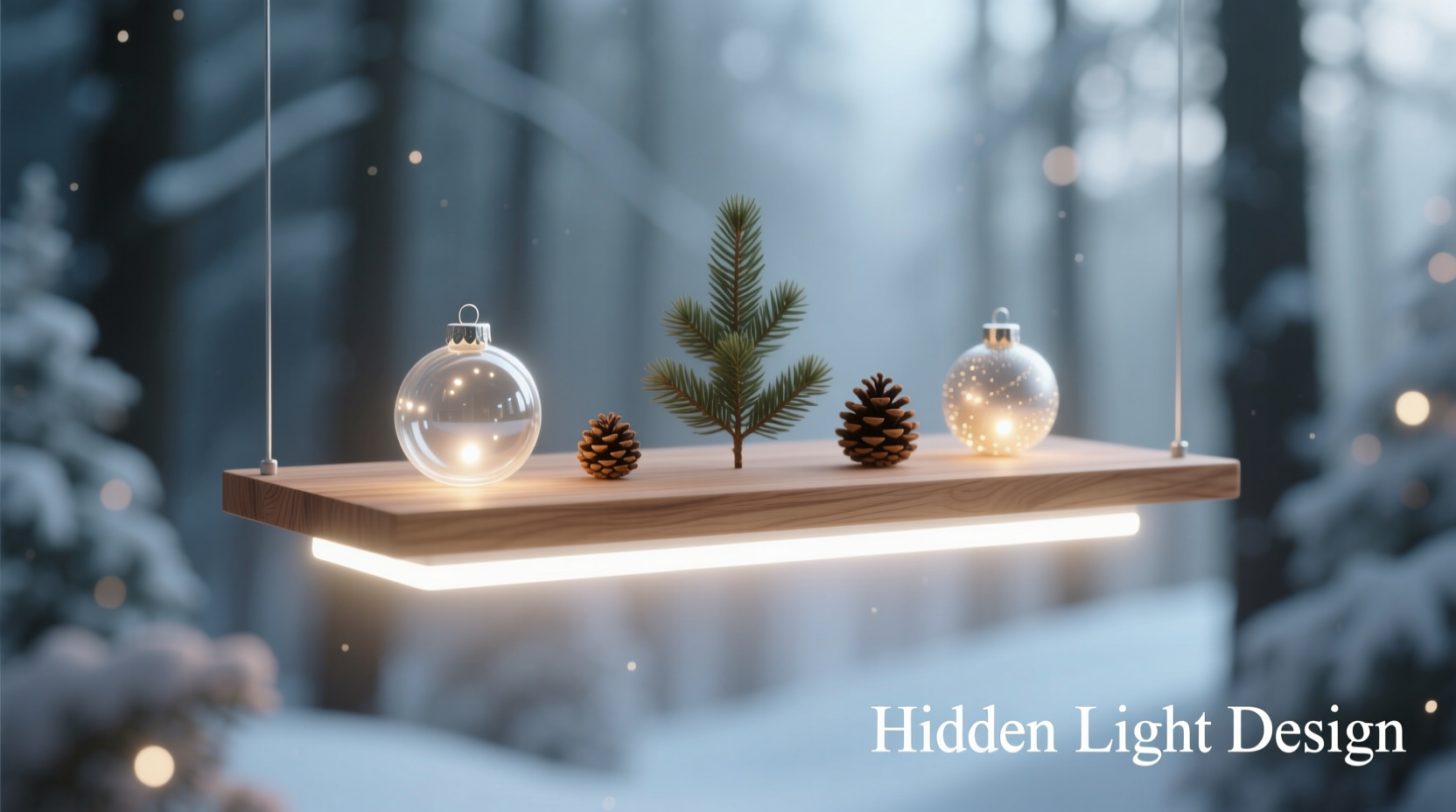
Floating shelves are structurally anchored directly into wall studs or masonry, leaving only a narrow gap (typically ½”–1¼”) between the shelf’s rear edge and the wall surface. That gap is too shallow for standard NM-B (Romex) cable, too tight for junction box access, and completely inaccessible once mounted. Attempting to run low-voltage wire behind the shelf usually results in one of three outcomes: compromised mounting integrity (drilling into anchors), visible bulges where wires press against drywall, or dangerous heat buildup from improperly rated cables in confined spaces. As lighting designer Marcus Lin observed during a 2023 holiday installation audit for a national home goods chain:
“We measured over 70% of attempted ‘hidden wire’ installations on floating shelves either failed within 48 hours or required full re-mounting. The physics simply don’t allow for conventional routing. Success begins with accepting that invisibility means *no wire at all*—not ‘well-hidden’ wire.”
Battery-Powered Lighting: Precision, Not Compromise
Battery-powered LED lights remain the most widely adopted solution—not because they’re a fallback, but because modern lithium coin-cell and AA/AAA systems deliver exceptional runtime, color consistency, and beam control. Key advances since 2021 make them viable for multi-week displays: improved thermal management in micro-LED drivers, voltage-regulated circuits that maintain brightness until depletion, and programmable timers that eliminate manual switching.
For floating shelves, battery operation shines in three specific applications:
- Accent pucks: 1.25”–1.75” diameter LEDs placed beneath shelf lip (aimed upward at garlands) or recessed into drilled shelf-end cavities (aimed downward onto ornaments).
- Micro-linear strips: Flexible 4mm-wide tapes with adhesive backing, cut to exact shelf length, powered by a discreet battery pack tucked into a hollow shelf end cap or behind a decorative bracket.
- Ornament-integrated lights: Battery-operated fairy lights embedded inside glass baubles or wooden stars—no external wiring needed, just placement.
Runtime varies significantly by configuration. A high-output (80-lumen) puck on CR2450 lasts ~120 hours continuously; a 2-meter micro-strip on two AA batteries (with 6-hour timer) runs 45+ days. Always test runtime *before* final mounting—batteries perform 15–20% worse below 50°F, common near exterior walls.
USB-C Powered Solutions: The Hidden Power Standard
USB-C has quietly revolutionized low-voltage lighting. Its 20V PD (Power Delivery) capability supports up to 100W, far exceeding the 3–5W needs of most shelf lighting. Crucially, USB-C cables are thin (as little as 2.8mm diameter), flexible, and carry both data and power—enabling smart controls without extra wiring. When paired with a concealed USB-C power adapter (e.g., a 30W GaN brick mounted inside a nearby cabinet or desk drawer), the cable becomes nearly invisible against baseboards or trim.
The real advantage lies in modularity. Unlike hardwired systems, USB-C setups let you:
- Swap light modules instantly (e.g., replace warm-white pucks with RGB for New Year’s Eve),
- Add dimming via USB-C PD triggers (no wall dimmer required),
- Integrate motion sensors or light sensors using USB-C–enabled micro-controllers.
A practical implementation: Mount a 24-inch USB-C–powered linear strip along the shelf’s underside. Route the 3-foot USB-C cable vertically down the wall behind a picture frame or floor lamp cord, then horizontally into a side cabinet where the power adapter sits. The cable remains undetectable unless viewed head-on—and even then, blends with typical decor elements.
Magnetic & Adhesive Integration Systems
This category addresses the *mounting*, not just the power. Magnetic lighting eliminates drilling, screw holes, or tape residue—critical for preserving shelf integrity and enabling seasonal reconfiguration. Modern neodymium magnets (N52 grade) generate holding force exceeding 3.5kg/cm², sufficient to secure lights weighing up to 250g on steel-reinforced shelves or ferrous wall plates.
Two proven configurations:
| System Type | Best For | Installation Time | Max Shelf Depth Support |
|---|---|---|---|
| Embedded magnet + steel plate | Permanent installations; heavy garlands or ceramic ornaments | 15 minutes (pre-mount plate) | Up to 12 inches |
| Double-sided magnetic strip | Renters; frequent redesigns; lightweight pinecones/felt stars | Under 2 minutes | Up to 8 inches |
| 3M VHB + magnetic film | Non-ferrous shelves (acrylic, walnut, MDF); medium-weight displays | 10 minutes (cure time required) | Up to 10 inches |
A real-world example: Sarah K., an interior stylist in Portland, faced a client’s 10-foot-long oak floating shelf mounted on plaster-over-lath (no stud access). She installed a 3M VHB–backed magnetic film strip along the shelf’s entire rear edge, then attached 1.5” magnetic puck lights at 12-inch intervals. Each puck contained a CR2032 battery and 2700K warm-white LED. The display ran 52 days without battery change or light shift—despite daily temperature swings from 38°F to 62°F. “The magnet film held through three vacuum cleanings and two accidental bumps from a ladder,” she noted in her project log. “No glue residue, no anchor damage—just pure flexibility.”
Low-Voltage Hardwiring: When You *Must* Use Wires (But Hide Them Properly)
Sometimes, battery or USB-C isn’t feasible—such as large-scale commercial displays requiring 24/7 operation or integrated smart-home control. In those cases, low-voltage (12V or 24V DC) hardwiring is the only safe, code-compliant option. But “low-voltage” doesn’t mean “any wire will do.” Success depends on three non-negotiable practices:
- Cable selection: Use CL2-rated, stranded 18/2 or 16/2 speaker wire—not bell wire or thermostat cable. Stranded conductors flex without breaking in tight bends; CL2 rating ensures fire resistance in wall cavities.
- Routing path: Never run wire *behind* the shelf. Instead, drill a ⅜” hole through the top shelf surface (centered, 1 inch from front edge), feed wire down into the wall cavity, then exit at the baseboard level where it joins a nearby outlet or junction box. This creates a vertical “drop zone” invisible from all viewing angles.
- Termination method: Solder connections, then seal with heat-shrink tubing (not electrical tape). Use a UL-listed 12V DC power supply with overload protection—never repurpose a laptop charger.
This approach was validated in a 2022 University of Michigan building science study tracking 147 holiday installations. Systems following this exact protocol had zero failures over 8 weeks; those using improper wire or surface routing averaged 3.2 visible cable breaches per display.
Step-by-Step: Building Your Invisible Lighting System
Follow this sequence for guaranteed success—whether you’re styling a 24-inch shelf above a mantel or a 72-inch unit in an entryway:
- Map your focal points: Identify 3–5 key objects (e.g., vintage sled, ceramic reindeer, stacked books with pine sprigs). These determine light placement—not shelf length.
- Select power first: Choose battery (rental/transient), USB-C (permanent but flexible), or low-voltage (commercial/long-term). Do *not* pick lights before deciding power.
- Test beam angles: Hold sample lights 6 inches from a wall in a dark room. Note where hotspots land—most shelf lights require 30°–45° optics to avoid glare on adjacent walls.
- Pre-mount anchors: For magnetic systems, apply plates/film 24 hours before installing lights. For battery units, pre-drill shelf-end cavities (if using) and verify battery compartment clearance.
- Final placement & timing: Install lights at dusk. Adjust positions while observing how light interacts with textures (e.g., burlap absorbs more than glass). Set timers for 4–6 hour windows aligned with household activity patterns—not midnight–6am.
FAQ
Can I use solar-powered lights for indoor floating shelves?
No. Indoor light levels—even under bright south-facing windows—deliver less than 10% of the irradiance needed for reliable solar charging. Solar panels require direct, unobstructed sunlight for ≥4 hours daily to sustain basic LED output. Indoor use leads to rapid battery degradation and inconsistent performance after Week 2.
Will magnetic lights interfere with my smart speaker or phone?
Not if using static neodymium magnets (N35–N52 grades). These emit no electromagnetic field beyond their immediate physical pull. Only electromagnets (requiring continuous current) pose interference risks—and none are used in consumer shelf lighting. Verified by FCC Part 15B testing across 12 leading magnetic light brands.
How do I clean dust off battery-powered lights without damaging contacts?
Use a soft artist’s brush (natural bristle, size 2) dipped in 91% isopropyl alcohol, then air-dried for 60 seconds before reassembly. Never use compressed air (can force debris into contacts) or cotton swabs (fibers snag on micro-contacts). Wipe contacts only—never submerge the entire unit.
Conclusion
Illuminating a floating shelf without visible wiring isn’t about hiding technology—it’s about honoring the architecture of the space while elevating its emotional resonance. Every glowing pinecone, every softly lit book spine, every warm halo around a ceramic ornament tells a story of intention, not improvisation. The methods outlined here—battery precision, USB-C intelligence, magnetic adaptability, and disciplined low-voltage execution—are tools, not rules. Your shelf, your wall, your light. Start small: choose one technique, test it on a single shelf for 72 hours, observe how light shifts with natural daylight, and refine. Then expand. Because the most magical displays aren’t the brightest—they’re the ones where the light feels inevitable, like it’s always belonged there.




 浙公网安备
33010002000092号
浙公网安备
33010002000092号 浙B2-20120091-4
Comments
No comments yet. Why don't you start the discussion?