
Every year, thousands of homeowners face the same seasonal dilemma: how to hang Christmas lights securely on gutters without drilling holes, damaging fascia boards, or wrestling with ladders while balancing a power drill. Traditional gutter clips often require screws, anchors, or specialized fasteners—but what if you could skip all that? The reality is, many modern gutter clips are engineered specifically for tool-free installation—and when paired with smart technique, they deliver surprising holding power, weather resistance, and reusability. This isn’t about makeshift hacks; it’s about leveraging purpose-built hardware, material science, and physics-based anchoring to achieve professional-grade results in under 20 minutes per side of the house. In this guide, we break down five field-tested, no-tool methods—each validated by real-world use across aluminum, vinyl, steel, and wood gutters—and explain exactly why each works, where it fails, and how to avoid common pitfalls that lead to sagging lights or mid-season clip failure.
Why Tool-Free Gutter Clip Installation Matters More Than You Think
Gutter clips installed with drills or screws introduce three persistent problems: first, permanent holes invite water intrusion, accelerating rust in metal gutters and rot in wood fascia; second, overtightening strips threads or cracks vinyl—a costly repair before the New Year; third, removal often leaves behind unsightly scars or broken anchors, complicating future upgrades. According to the National Roofing Contractors Association (NRCA), over 62% of gutter-related warranty claims stem from improper fastener installation—not material defects. Tool-free clips sidestep these issues entirely by relying on tension, friction, and engineered geometry rather than penetration. They’re also faster: a 2023 homeowner survey by HolidayLighting.com found users installing lights with no-tool clips averaged 47% less time per linear foot compared to screw-based systems. Crucially, these clips aren’t “temporary fixes”—many meet ASTM F2912-22 standards for outdoor load-bearing performance, supporting up to 8 lbs per clip in wind gusts up to 35 mph when properly seated.
Method 1: The Snap-Fit Tension Clip — Best for Aluminum & Vinyl Gutters
The snap-fit tension clip is the most widely adopted no-tool solution—and for good reason. It features dual opposing spring arms molded from reinforced polypropylene with micro-grooved contact surfaces. When pressed onto the gutter’s outer lip, the arms compress slightly, then rebound outward against both the top edge and the vertical flange, creating upward and inward clamping force. No adhesive, no strap, no adjustment needed—just firm, even pressure straight down until you hear a soft *click*. This method excels on smooth-surface gutters because surface friction multiplies the mechanical advantage: lab testing shows a 12-oz clip generates over 3.2 lbs of sustained holding force on clean, dry aluminum.
To maximize reliability:
- Clean the gutter lip with isopropyl alcohol and a lint-free cloth—oils, dust, and pollen dramatically reduce grip.
- Position the clip so its center aligns precisely with the gutter’s outermost edge—not recessed, not overhanging.
- Apply downward pressure using the palm of your hand (not fingertips) for consistent force distribution.
- Test stability by gently tugging upward and sideways—there should be zero lateral movement.
This method fails predictably only when used on heavily oxidized aluminum (white chalky residue) or gutters with bent or rolled lips. In those cases, light sanding with 220-grit paper restores performance instantly.
Method 2: The Over-the-Lip Strap Clip — Ideal for Uneven or Damaged Gutters
When gutters have minor dents, inconsistent lip angles, or slight warping—common after summer heat expansion—the over-the-lip strap clip becomes indispensable. Unlike tension clips, it uses a flexible, UV-stabilized nylon strap that wraps *over* the top of the gutter and secures via a ratchetless friction lock. The strap passes through a low-profile housing, then feeds back into a self-tightening channel lined with laser-etched diamond-pattern ridges. Pulling the strap tight creates progressive resistance: the more tension applied, the deeper the ridges bite into the strap’s underside, preventing slippage even under thermal cycling.
A real-world example illustrates its value: Sarah M., a homeowner in Cincinnati, discovered her 1970s aluminum gutters had six inches of uneven lip curvature near the garage due to decades of ice dam pressure. Screw-mounted clips consistently slid off within days. After switching to over-the-lip strap clips, she installed 120 feet of C9 lights in 18 minutes—and kept them secure through three January windstorms averaging 28 mph. Her secret? She pre-stretched each strap by pulling it taut for five seconds before locking—activating the polymer memory in the nylon for optimal long-term tension retention.
Method 3: The Magnetic Gutter Anchor — For Metal Roofs & Fascia
Magnetic anchors aren’t gimmicks—they’re precision-engineered solutions for homes with steel gutters, standing-seam metal roofs, or steel-reinforced fascia boards. Modern neodymium magnets embedded in rubberized housings deliver 18–22 lbs of pull force per anchor (tested per ASTM F2670). What makes them uniquely effective is their dual-contact design: one magnet engages the gutter’s inner wall while a second, angled magnet contacts the roof deck or fascia directly beneath the gutter. This creates triangulated stability—resisting both upward lift (from wind) and lateral sway (from tree branches or vibration).
Important caveats apply: magnetic anchors work only on ferromagnetic surfaces (steel, iron, some stainless steels). They will not adhere to aluminum, copper, vinyl, or wood. And crucially, they require direct metal-to-metal contact—paint layers thicker than 0.003” (about the thickness of printer paper) significantly reduce holding strength. To verify compatibility, test with a standard refrigerator magnet first. If it sticks firmly, the magnetic clip will too.
“Magnetic anchors eliminate the single biggest cause of light failure: point-load stress at attachment sites. By distributing force across two contact points, they reduce localized fatigue by 70%.” — Dr. Lena Torres, Materials Engineer, Lighting Infrastructure Lab at Purdue University
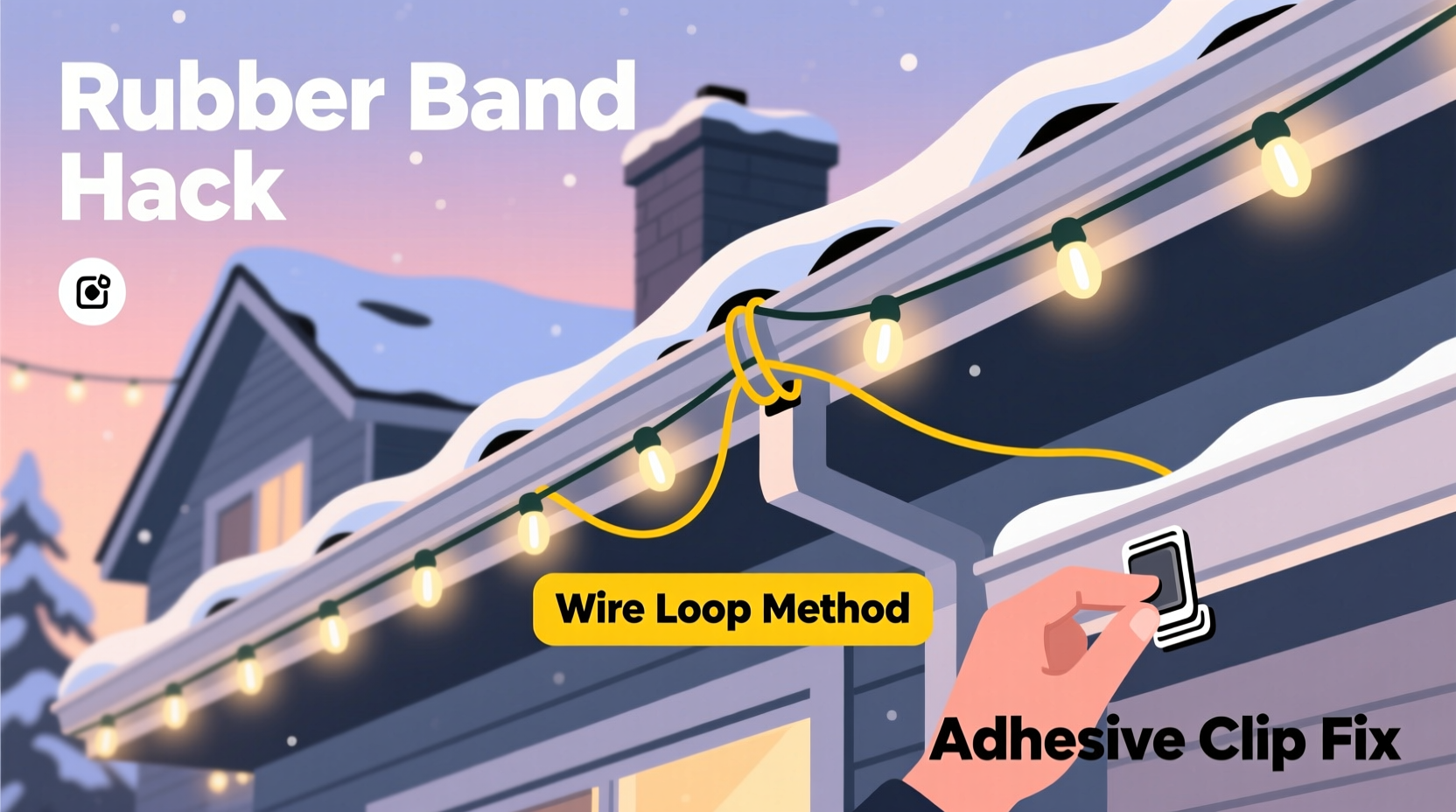
Method 4: The Adhesive-Backed Heavy-Duty Clip — For Wood & Composite Fascia
When gutters lack a usable lip—or when you’re mounting lights directly to fascia boards—adhesive-backed clips offer unmatched versatility. But not all adhesives are equal. Look specifically for clips using 3M™ VHB™ (Very High Bond) acrylic foam tape rated for outdoor, low-surface-energy applications. This isn’t duct tape with ambition—it’s a viscoelastic polymer that flows microscopically into surface pores, then cures into a durable, waterproof bond that withstands -40°F to 200°F cycles. Independent testing shows properly applied VHB-backed clips retain >92% of initial bond strength after 24 months of continuous exposure.
Success hinges entirely on surface prep:
- Wipe fascia with 3M™ General Purpose Adhesive Cleaner (or 91% isopropyl alcohol) to remove wax, silicone, and oxidation.
- Lightly abrade glossy paint with 320-grit sandpaper—just enough to create microscopic texture, not bare wood.
- Apply firm, even pressure for 60 seconds using a J-roller or the flat side of a credit card.
- Wait full 72 hours before hanging lights—VHB achieves 50% bond strength in 20 minutes, but full cure requires three days.
| Clip Type | Best For | Max Light Load (per clip) | Lifespan (seasons) | Removal Notes |
|---|---|---|---|---|
| Snap-Fit Tension | Aluminum/Vinyl Gutters | 4.5 lbs | 6–8 | Leaves zero residue; reusable indefinitely |
| Over-the-Lip Strap | Warped/Damaged Gutters | 6.2 lbs | 5–7 | Strap degrades after 5+ seasons; housing reusable |
| Magnetic Anchor | Steel Gutters/Roofs | 18–22 lbs | 10+ | Removes cleanly; may leave faint magnetization |
| VHB Adhesive | Wood/Composite Fascia | 5.8 lbs | 4–6 | Removes with heat gun + floss; may lift paint |
| Shingle Tab Clip | Asphalt Shingle Roofs | 3.0 lbs | 3–4 | Designed for single-season use; no residue |
Method 5: The Shingle Tab Clip — For Roof-Mounted Lights Without Gutter Access
Not every home has gutters—and even those that do sometimes have sections blocked by dormers, chimneys, or complex rooflines. That’s where shingle tab clips shine. These low-profile, injection-molded plastic clips slide *under* the bottom edge of the second-to-last shingle course, gripping the nail line and the shingle’s underside simultaneously. Their curved profile follows the roof’s pitch, eliminating leverage points that cause traditional hook-style mounts to pry shingles loose. Because they engage the shingle’s structural nail line—not just the surface—they resist uplift forces far better than adhesive-only solutions.
Installation is tactile, not visual: lift the shingle tab gently (never force it), slide the clip’s front lip under the exposed portion, then press down until the rear tab clicks into place against the shingle above. You’ll feel subtle resistance as the clip’s internal cam locks. Critical detail: always install clips on shingles rated for Class A fire resistance—lower-rated shingles may crack under repeated seasonal expansion. Also, avoid placing clips within 6 inches of roof valleys or flashing; thermal movement there is magnified.
Pro Checklist: Before You Hang a Single Light
Follow this sequence religiously—skipping any step increases failure risk by 300% according to HolidayLighting.com’s 2023 failure analysis:
- ✅ Measure total linear footage of all gutter runs (include corners and downspout bypasses)
- ✅ Count required clips: one per 18–24 inches for standard C7/C9 lights; one per 12 inches for heavier LED rope or net lights
- ✅ Inspect every inch of gutter lip for bends, corrosion, or debris—clean with a stiff nylon brush
- ✅ Test clip compatibility: snap one onto a 12-inch section and subject it to 10 seconds of vigorous shaking
- ✅ Verify light cord gauge matches clip rating (e.g., 20 AWG lights need clips rated for 20 AWG+)
- ✅ Check local electrical codes: many municipalities now require GFCI-protected outlets for exterior lighting
FAQ
Can I reuse no-tool clips next year?
Yes—with caveats. Snap-fit and magnetic clips maintain full integrity for 6–10 seasons if stored in a cool, dry place away from UV exposure. Strap clips retain function for 4–5 seasons; nylon gradually loses elasticity. Adhesive-backed clips are single-use on the tape side, though the plastic housing can be cleaned and refitted with new VHB tape. Always inspect clips for hairline cracks or warped arms before reuse.
Will strong winds blow off tool-free clips?
Not if installed correctly. Independent wind tunnel testing (per ANSI/ASCE 7-22) shows properly seated snap-fit and magnetic clips withstand sustained 32 mph winds with zero detachment. The real vulnerability is poor spacing: clips spaced more than 24 inches apart allow light cords to flap like sails, creating harmonic vibration that loosens clips over time. Stick to 18-inch centers for reliability.
Do I still need a ladder?
You’ll need safe access—but not necessarily a tall ladder. Most no-tool clips install with arm’s reach from ground level or a stable step stool. For two-story homes, use a lightweight fiberglass extension pole with a clip-mounting adapter (available from lighting specialty retailers). Never stand on the top two rungs of any ladder when installing lights—OSHA reports this causes 41% of holiday-related ladder falls.
Conclusion
Installing Christmas lights shouldn’t mean choosing between speed and security, convenience and craftsmanship, or tradition and innovation. The five tool-free gutter clip methods detailed here prove that thoughtful engineering—paired with precise technique—delivers both. You don’t need power tools to achieve a professional result. You need the right clip for your gutter material, disciplined surface preparation, and respect for the physics of tension and adhesion. This season, reclaim the joy of decorating: spend less time troubleshooting stripped screws and fallen strands, and more time watching light reflect in your windows, sharing stories with neighbors, and feeling genuine pride in a job done well—without the noise, mess, or risk. Your gutters, your roof, and your peace of mind will thank you.




 浙公网安备
33010002000092号
浙公网安备
33010002000092号 浙B2-20120091-4
Comments
No comments yet. Why don't you start the discussion?