
Christmas trees are more than decorations—they’re sensory anchors of the season. The scent of pine needles, the warmth of lights, the rustle of tinsel: these cues trigger deep emotional resonance. Yet many overlook one powerful layer—intentional fragrance. Aromatherapy diffusers, when thoughtfully integrated, can deepen that experience: evoking forest walks with cedarwood, calming holiday stress with lavender, or uplifting gatherings with sweet orange. But doing so safely—especially around live or dried trees, electrical wiring, and open flames—is non-negotiable. This isn’t about adding a “nice smell” as an afterthought. It’s about designing a cohesive, health-conscious, and fire-resilient sensory environment where scent supports, rather than compromises, the integrity of your holiday centerpiece.
Why Scent Matters—And Why Tree Safety Must Come First
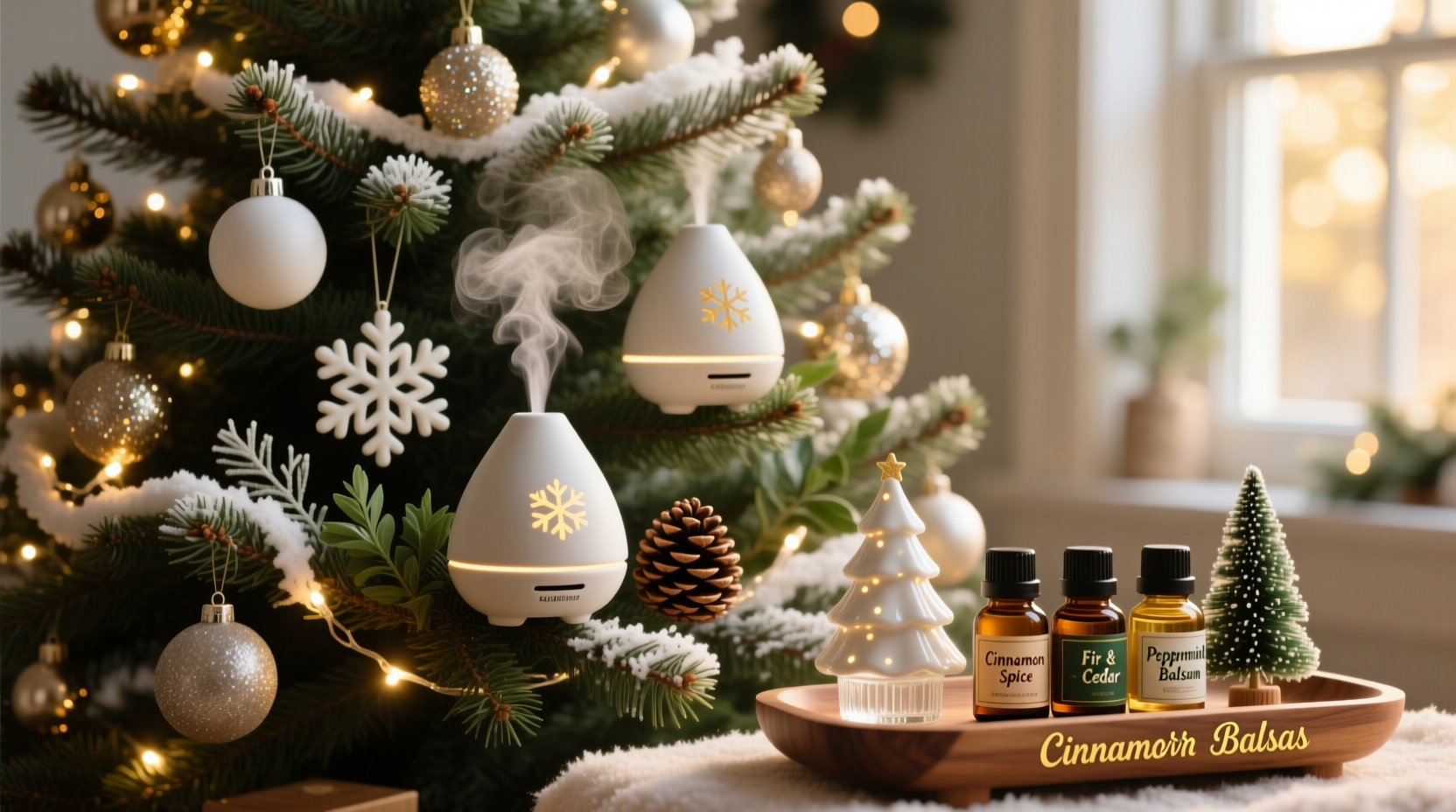
Research in environmental psychology confirms that ambient scent significantly influences mood, memory recall, and perceived time—making it especially potent during emotionally charged periods like the holidays. A 2023 study published in the Journal of Environmental Psychology found participants exposed to seasonal scents (balsam fir, cinnamon, vanilla) reported 32% higher levels of festive engagement and 27% lower self-reported stress during December activities. Yet those benefits vanish if safety is sidelined. Real-world data from the National Fire Protection Association shows that between 2018–2022, Christmas trees were involved in an average of 150 home fires annually—nearly half caused by electrical distribution or lighting failures, and another 16% linked to proximity of heat sources. Diffusers generate moisture, heat (in some models), and sometimes require proximity to outlets—factors that demand deliberate planning, not improvisation.
“Adding scent near a tree isn’t decorative—it’s a functional design decision. You’re introducing humidity, electricity, and volatile organic compounds into a high-risk microenvironment. Every placement must answer: ‘Does this increase ignition risk, accelerate needle desiccation, or interfere with airflow?’” — Dr. Lena Torres, Environmental Health Specialist, NFPA Fire Safety Advisory Council
Choosing the Right Diffuser: Type, Placement, and Compatibility
Not all diffusers work equally well—or safely—near Christmas trees. Ultrasonic models are generally safest for proximity use; they operate cool, produce fine mist, and don’t rely on heat or open flames. Avoid reed diffusers (volatile oils can drip onto branches or lights), candle-based warmers (open flame + dry pine = unacceptable risk), and nebulizing diffusers (high-concentration oil output may irritate airways or coat delicate needles).
Placement strategy hinges on airflow—not aesthetics. Trees create natural convection currents: warm air rises up the trunk, cools near the ceiling, then descends along walls. To maximize scent dispersion while minimizing localized saturation, position diffusers at floor level, 2–3 feet from the tree’s base, angled slightly upward—not aimed directly at branches. For larger rooms (over 300 sq ft), use two diffusers: one near the tree’s base and a second across the room, opposite the main seating area. This creates balanced olfactory coverage without overloading the immediate tree zone.
Safety-Centric Integration: A 5-Step Timeline
Integrating scent should follow a deliberate sequence—beginning before the tree arrives and concluding only after decor removal. Rushing any step increases risk.
- Pre-Tree Assessment (3–5 days before setup): Inspect all electrical outlets near intended diffuser locations. Verify GFCI protection. Test circuit load: unplug non-essential devices to ensure headroom for both tree lights and diffuser.
- Tree Selection & Hydration (Day of setup): Choose a fresh-cut tree with flexible, green needles and sticky sap. Immediately cut ½ inch off the base and submerge in water. Maintain water level above the cut at all times—dehydration accelerates flammability exponentially.
- Lighting & Wiring First (Before any scent): Install lights *before* ornaments or diffusers. Use only UL-listed LED lights (cooler operation, lower wattage). Secure all cords with cord clips—not tape or staples—to prevent fraying or overheating.
- Diffuser Positioning & Testing (After lights, before ornaments): Place diffuser per airflow guidelines above. Fill with distilled water (mineral buildup clogs ultrasonic plates) and 3–5 drops of pure essential oil. Run for 15 minutes. Monitor for unusual sounds, excessive mist pooling, or warmth near cords or tree base.
- Ongoing Monitoring (Daily): Check water level twice daily. Wipe exterior condensation from the diffuser housing. Inspect tree base for standing water overflow or dampness spreading toward electrical components.
Essential Oil Selection: What Works—and What to Avoid
Not all essential oils complement trees—or indoor air quality. Some oxidize rapidly, creating airborne irritants; others contain high levels of monoterpenes (like limonene in citrus oils), which react with ozone to form formaldehyde—a known respiratory irritant. Prioritize stability, low volatility, and synergy with pine resin notes.
| Oil | Best For | Why It’s Safe & Effective | Avoid If |
|---|---|---|---|
| Balsam Fir | Authentic forest depth | Naturally matches tree chemistry; low evaporation rate; antimicrobial properties help inhibit mold in humid environments | You have pets—some conifer oils may cause mild GI upset if ingested |
| Frankincense | Calming, ceremonial warmth | Low volatility; resinous base note lingers without overwhelming; minimal interaction with ambient ozone | You use oxygen therapy in the home (consult physician first) |
| Blue Tansy | Stress relief & air purification | Contains chamazulene, which neutralizes airborne particulates; gentle aroma doesn’t compete with pine | You’re pregnant (use only under clinical aromatherapy guidance) |
| Lavender (Bulgarian) | Evening relaxation | High linalool content provides consistent diffusion; proven sleep-supportive effect without sedative drowsiness | You have young children under age 3 (dilute further or avoid nighttime use) |
| Citrus Oils (e.g., Sweet Orange) | Bright daytime energy | Uplifting—but highly reactive | You run HVAC continuously or have high indoor ozone (e.g., near laser printers) |
Crucially: never blend more than three oils. Complex blends increase chemical interactions and unpredictability in humid, warm environments. And always use 100% pure, GC/MS-tested oils—adulterated versions often contain synthetic solvents that degrade plastic diffuser parts and emit VOCs when aerosolized.
Real-World Application: The Henderson Family’s Safer Scent Shift
The Hendersons in Portland, Oregon, had used a reed diffuser nestled in their artificial tree’s branches for five years—until last December, when their smoke alarm triggered mid-morning. Investigation revealed no fire, but significant moisture accumulation around the tree’s internal wiring conduit. “The reeds were dripping oil onto the plastic housing,” says father Mark Henderson. “It wasn’t flammable, but it softened the insulation over time. Our electrician said it was a short-circuit waiting to happen.” They switched to a dual-ultrasonic setup: one diffuser on a ceramic tray beside the tree stand (filled with balsam fir and frankincense), and a second across the living room (lavender only, timed to activate at 7 p.m.). They added a smart hygrometer to monitor humidity near the tree base—keeping it between 40–55%, ideal for both needle retention and diffuser efficiency. “We didn’t lose the feeling—we gained peace of mind,” Mark notes. “And our kids say the tree smells ‘like real woods now,’ not ‘like a store.’”
What NOT to Do: The Critical Don’ts List
- Don’t use diffusers with built-in timers that auto-restart overnight—unattended operation near trees violates NFPA 101 Life Safety Code Section 18.7.5.
- Don’t place diffusers on wooden surfaces directly beneath the tree—condensation seeps into grain, warping finishes and promoting mold.
- Don’t refill diffusers with tap water—minerals corrode ultrasonic plates and create white dust residue on ornaments and branches.
- Don’t diffuse oils containing eugenol (e.g., clove bud, cinnamon leaf) near trees—eugenol accelerates oxidation of pine resins, increasing flammability.
- Don’t assume “natural” means “safe”—many plant-derived oils (e.g., wintergreen, birch) contain methyl salicylate, which is toxic in vaporized concentrations.
FAQ: Addressing Common Concerns
Can I use my diffuser with a real tree if it’s already drying out?
No. Once a tree begins shedding needles or its cut base turns dark and dry, relative humidity around it drops sharply—increasing electrostatic charge and making mist droplets more likely to cling to and weigh down brittle branches. Wait until you’ve replaced the tree or switch to a non-mist method like passive wood-ring diffusers placed away from the trunk.
Will diffuser mist harm my tree’s needles or lights?
Mist itself won’t damage healthy needles—but prolonged saturation will. Pine needles absorb moisture readily; oversaturation encourages fungal growth and weakens cell walls. As for lights: water + electricity is always risky. Even “splash-proof” LED lights aren’t rated for direct mist exposure. That’s why floor-level, angled placement—not overhead or inside the canopy—is essential.
How do I clean my diffuser after holiday use?
Immediately after final use: empty remaining water, wipe interior with a soft cloth dampened with white vinegar (1:1 vinegar/water), then rinse thoroughly with distilled water. Let air-dry completely before storage. Vinegar dissolves mineral deposits and oil residue without damaging ultrasonic plates. Never use bleach or abrasive cleaners.
Conclusion: Breathe Deeper, Celebrate Safer
Your Christmas tree is a living symbol—not just of tradition, but of care, intention, and shared presence. Integrating aromatherapy isn’t about luxury or novelty; it’s about honoring how profoundly scent shapes our experience of belonging, calm, and joy. But that richness only endures when grounded in vigilance: in choosing the right tool, respecting physics and biology, and placing safety ahead of convenience. You don’t need elaborate setups or expensive oils to succeed. You need awareness, consistency, and the quiet confidence that comes from knowing your home breathes easily—and safely—through the season. Start small this year: pick one ultrasonic diffuser, one stable oil, and commit to the five-step timeline. Observe how the scent settles—not as an overlay, but as an extension of the tree’s own quiet presence. Then share what you learn. Because the most meaningful traditions aren’t inherited—they’re refined, together, with attention and respect.




 浙公网安备
33010002000092号
浙公网安备
33010002000092号 浙B2-20120091-4
Comments
No comments yet. Why don't you start the discussion?