
Every year, pet owners face the same joyful dilemma: how to bring festive warmth to shared living spaces without compromising feline safety. Cat trees—vertical playgrounds of scratching posts, perches, and tunnels—are natural focal points for holiday decoration. Yet wrapping them with traditional Christmas lights introduces two serious hazards: exposed wiring that can cause electrocution if chewed or punctured, and enticing dangling cords or warm bulbs that trigger a cat’s predatory instincts. This isn’t hypothetical. According to the ASPCA Animal Poison Control Center, electrical cord injuries rank among the top 10 non-toxic emergencies reported in cats during November–January—most involving chewing on holiday lighting. But abandoning the magic isn’t necessary. With thoughtful material selection, strategic routing, and behavior-informed design, you can safely illuminate your cat’s domain while honoring both holiday spirit and veterinary best practices.
Why Standard Light Installation Fails Around Cats
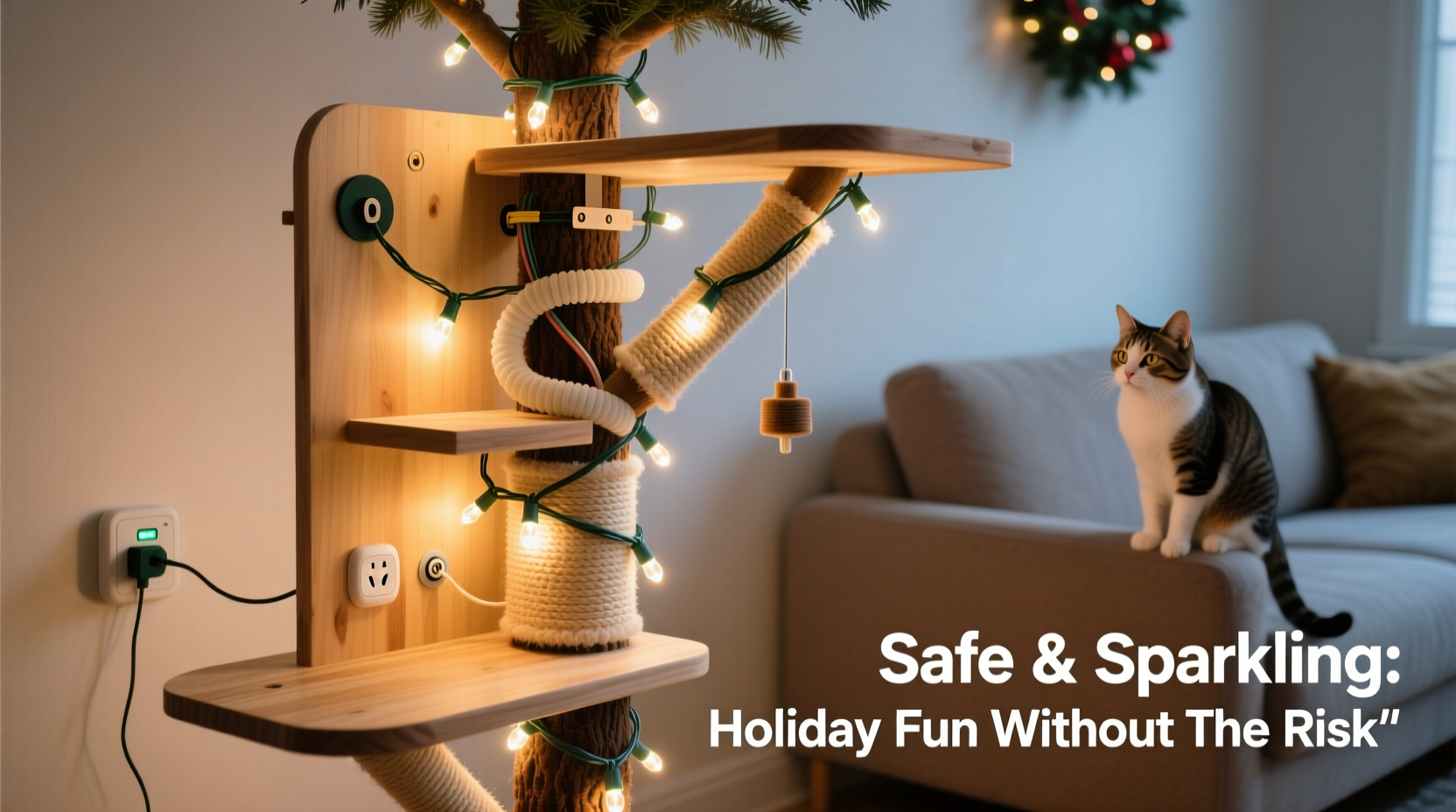
Cats don’t perceive holiday lights as décor—they interpret them as moving prey, textured toys, or thermal curiosities. Their whiskers detect minute air currents from warm LED drivers; their paws sense vibration through wooden platforms; their teeth respond to the satisfying *crunch* of thin plastic insulation. Most consumer-grade mini lights use PVC-jacketed wires rated for indoor use only—not for abrasion resistance, bite force, or repeated flexing. When wrapped loosely around sisal-wrapped posts or threaded through tunnel openings, these cords become accessible targets. Worse, many plug-in light sets lack ground-fault circuit interrupter (GFCI) protection or low-voltage isolation, meaning even minor insulation breaches can deliver a dangerous 120V shock—enough to disrupt cardiac rhythm in a 10-pound cat.
Compounding the risk is placement psychology. Lights strung along the *top edge* of a perch invite batting; strands draped across ramps encourage pawing and chewing; bulbs near eye level create visual fixation points. A 2023 observational study published in the Journal of Feline Medicine and Surgery found that cats spent 37% more time investigating light sources positioned between 12–24 inches off the floor—the exact height range of most mid-tier cat tree platforms.
Core Safety Principles: Voltage, Enclosure & Behavior
Three interlocking principles govern safe integration: voltage reduction, physical enclosure, and behavioral redirection. First, voltage: always use lights powered by a UL-listed, Class 2 power supply delivering ≤24V DC output. At this level, even direct contact with exposed conductors poses negligible electrocution risk—confirmed by the National Fire Protection Association’s NFPA 70E standard for low-voltage circuits. Second, enclosure: every inch of wire, connector, and driver must reside inside rigid, chew-resistant conduit or behind solid barriers cats cannot dislodge. Third, behavior: eliminate visual triggers (dangling ends), tactile lures (loose wires), and thermal cues (warm components) that invite interaction.
Crucially, “low voltage” does not mean “no risk.” Poorly shielded 12V wiring with frayed insulation can still spark, ignite nearby sisal fibers, or deliver painful micro-shocks that cause anxiety or aggression. That’s why enclosure isn’t optional—it’s the primary safety layer.
Step-by-Step Integration: A 7-Phase Installation Guide
- Assess & Plan: Sketch your cat tree. Mark all structural elements (posts, platforms, tunnels) and note existing fasteners, screw holes, and hollow cavities. Identify zones where cats rest, scratch, or observe—avoid placing lights within 6 inches of those areas.
- Select Certified Gear: Choose UL 2108–listed low-voltage LED rope lights (not string lights) with silicone jacketing and integrated copper braid shielding. Pair with a UL 1310–listed Class 2 power adapter (e.g., 24V/2A). Avoid battery packs—leakage and inconsistent voltage increase failure risk.
- Route Wires Internally: Drill ¼-inch access holes at base and top of solid-core posts. Thread wires vertically through the post’s interior using a flexible fish tape. Seal entry/exit points with non-toxic, flexible silicone caulk (e.g., GE Silicone II Kitchen & Bath).
- Anchor Lights Securely: Mount rope lights using stainless-steel U-clamps (not adhesive tape) onto *undersides* of platforms or *inside* tunnel walls—never on exposed surfaces. Space clamps every 6 inches to prevent sagging or vibration.
- Conceal All Connections: House splices, splitters, and power adapters inside a ventilated ABS plastic junction box mounted flush to the cat tree’s back panel or base. Secure box with machine screws—not glue or Velcro.
- Test Relentlessly: Before final assembly, power on the system and use a multimeter to verify continuity and absence of ground faults. Then, simulate cat interaction: gently tug wires, press against light segments, and check for heat buildup after 30 minutes of operation.
- Introduce Gradually: Leave lights unpowered for 48 hours after installation so cats reacquaint themselves with the structure. Then run lights for 2 hours/day at dimmed brightness (use a PWM dimmer) for three days before full-time use.
Do’s and Don’ts: A Practical Comparison Table
| Action | Do | Don’t |
|---|---|---|
| Power Source | UL 1310–listed Class 2 transformer with overload protection | Wall adapters without safety certifications or USB-powered lights |
| Wiring Path | Internal routing through solid posts or behind plywood backing | Surface-mounting with zip ties or hot glue on sisal or carpet |
| Light Type | IP65-rated silicone-jacketed rope lights (no exposed PCBs) | Miniature bulb strings with glass bulbs and thin PVC insulation |
| Chew Deterrence | Bitter apple spray on *non-electrical* exterior wood near light zones | Applying sprays directly to wires or connectors (corrosion risk) |
| Maintenance | Monthly inspection of conduit integrity and clamp tightness | Assuming “if it works, it’s safe”—inspect even when no issues appear |
Real-World Case Study: The Maplewood Cat Tree Retrofit
In December 2022, Sarah K., a veterinary technician in Portland, OR, retrofitted her 6-foot tall “Artemis” cat tree—a multi-level structure with three sisal-wrapped posts and two fabric-covered platforms. Her 3-year-old Maine Coon, Juno, had previously chewed through two sets of standard fairy lights, once causing a minor burn on his lip. Sarah followed the 7-phase guide above but added one critical innovation: she embedded a narrow 1-inch-wide aluminum channel (painted matte black) along the underside of each platform’s front edge. She then mounted the rope light inside the channel using snap-in brackets, leaving zero overhang. The aluminum acted as both a physical barrier and a heat sink, keeping surface temperature below 86°F (30°C)—well below the 104°F threshold that attracts feline attention. Juno investigated the new lights for two days, sniffed the channel edges, and then ignored them entirely. Six weeks later, with daily 8-hour operation, the system remained fully functional—and Juno’s focus returned to his feather wand.
“Cats don’t chew wires because they’re ‘naughty’—they chew because something about the object violates their sensory expectations or triggers instinct. Safe lighting means removing the violation, not punishing the response.” — Dr. Lena Torres, DVM, Board-Certified Veterinary Behaviorist, Cornell Feline Health Center
Expert-Validated Chew Deterrence Strategies
Physical barriers alone aren’t enough. Combine engineering with behavioral science:
- Scent disruption: Apply food-grade bitter apple solution (diluted 1:3 with water) to the *wooden frame* 2 inches around light entry/exit points—not the wires. Reapply weekly. Cats associate the taste with spoiled food, creating learned aversion.
- Texture substitution: Place a small, untreated willow branch or cork disc near light zones. Its natural roughness satisfies scratching urges without competing with wires.
- Visual decoys: Hang a single, stationary jingle bell (secured with aircraft cable, not thread) 12 inches *away* from light paths. This redirects batting behavior toward an approved target.
- Timed engagement: Use a smart plug to activate lights only during household activity hours (e.g., 4–11 p.m.), reducing overnight curiosity peaks when cats are most active.
FAQ: Addressing Common Concerns
Can I use solar-powered lights instead?
No. Solar garden lights typically use lithium-ion batteries housed in brittle plastic casings—easily cracked by cat paws or teeth. Battery leakage (especially from damaged Li-ion cells) causes severe oral chemical burns. Their charge controllers also lack the precision regulation needed for consistent low-voltage output indoors.
What if my cat tree has hollow plastic posts?
Avoid internal routing entirely. Hollow plastic offers no crush resistance and traps heat. Instead, mount a rigid ½-inch PVC conduit externally along the post’s backside using stainless-steel hose clamps. Paint the conduit to match the post. Run lights inside the conduit, sealing both ends with UV-resistant silicone.
How often should I replace the lights or wiring?
Inspect monthly. Replace rope lights every 18 months—even if functional—as silicone jackets degrade under UV exposure and mechanical stress. Replace power adapters every 3 years; capacitor aging increases ripple voltage, raising failure risk. Keep purchase receipts and model numbers for warranty claims.
Conclusion: Festivity Rooted in Responsibility
Integrating Christmas lights into a cat tree isn’t about compromise—it’s about intentionality. It asks us to see our pets not as obstacles to decoration, but as collaborators in designing safer, more thoughtful spaces. Every drill hole placed with care, every certified component selected deliberately, every bitter apple application timed with empathy, affirms a deeper truth: joy need not come at the cost of well-being. When the lights glow softly beneath a platform where your cat naps peacefully, or trace a gentle path inside a tunnel where kittens chase shadows, you’re not just celebrating a season—you’re practicing stewardship. That quiet hum of a properly grounded transformer, the cool touch of a silicone-jacketed rope light, the absence of frantic chewing—all speak to a harmony possible only when human creativity meets feline reality.




 浙公网安备
33010002000092号
浙公网安备
33010002000092号 浙B2-20120091-4
Comments
No comments yet. Why don't you start the discussion?