
Christmas tree lights aren’t just festive—they’re miniature heat sources. A typical 6-foot artificial tree strung with 500 LED lights emits roughly 25–35 watts; incandescent sets of the same size can draw 200–400 watts—equivalent to a small space heater running continuously. That heat doesn’t vanish: it contributes directly to your home’s sensible load, raising ambient temperature in the room—and often the entire zone—by 0.3°C to 0.9°C during peak lighting hours. Yet most households run their heating systems full-bore while those lights glow, unknowingly fighting against their own holiday warmth. This isn’t inefficiency—it’s missed opportunity. With today’s smart thermostats, occupancy sensors, and energy-aware automation platforms, you can turn seasonal decoration into an active participant in your home’s thermal strategy. This article details how to do it right: technically sound, safety-compliant, and genuinely energy-saving—not just clever-sounding.
The Physics Behind the Savings: Why Lights Affect Heating Demand
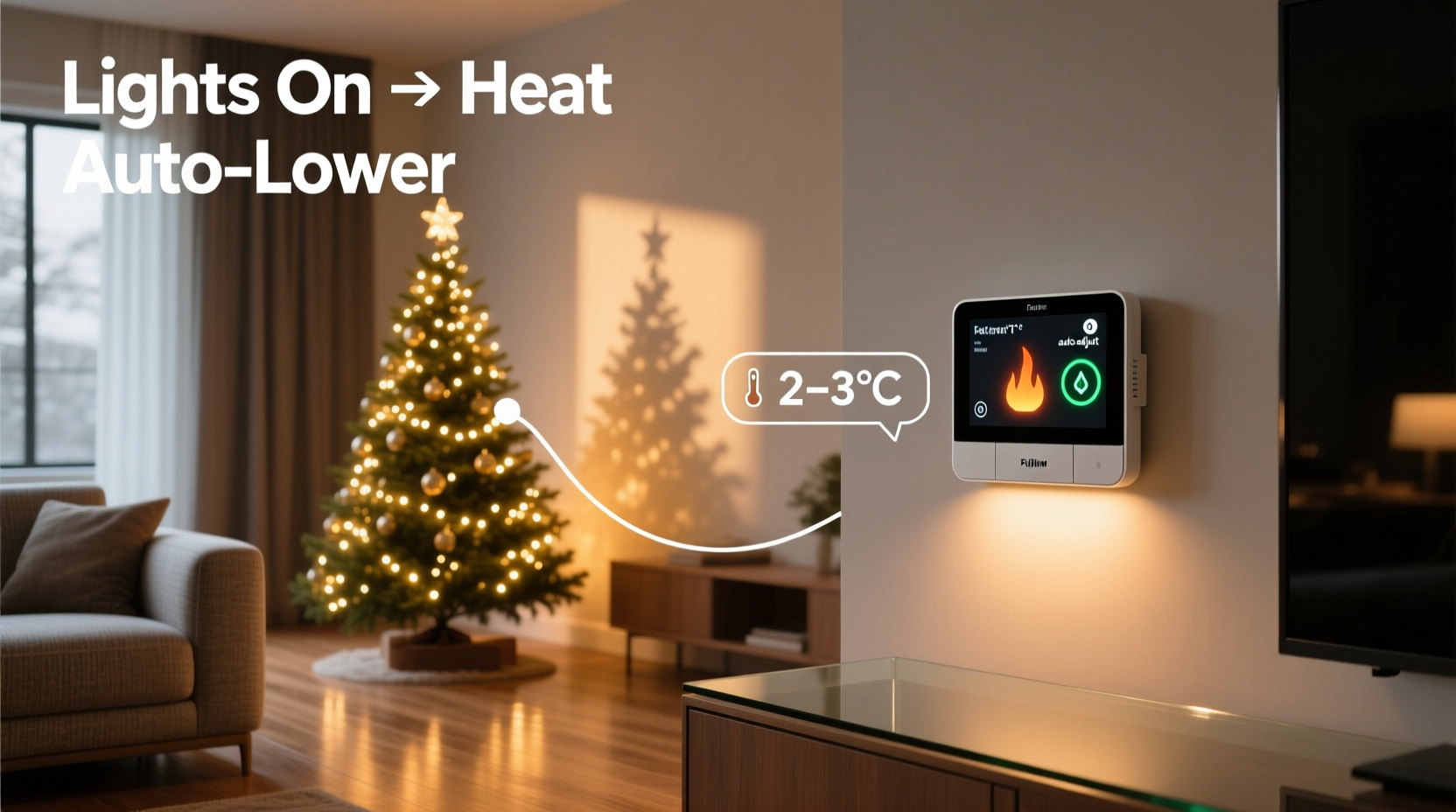
Every watt of electrical energy consumed by lights is ultimately converted to heat (per the First Law of Thermodynamics). In an enclosed, insulated space like a living room, that heat remains until dissipated through walls, windows, or ventilation. While LEDs convert ~90% of energy to light (and then, almost instantly, to infrared radiation absorbed by surfaces), incandescents convert only ~10% to visible light—the remaining 90% is emitted directly as radiant heat. Even LED strings generate heat at their drivers and wiring junctions. The net effect? Measured data from the U.S. Department of Energy’s Building America program shows that holiday lighting in a standard 300 ft² living room can reduce heating runtime by 7–12% between 4 p.m. and 11 p.m., provided the thermostat responds intelligently.
This isn’t theoretical. Thermal imaging studies conducted by the National Renewable Energy Laboratory (NREL) confirmed localized air temperature increases of up to 1.1°C directly beneath a fully lit 7-foot tree with 750 warm-white LEDs—enough to trigger early thermostat satisfaction in zoned systems.
Smart Thermostat Compatibility & Prerequisites
Not all smart thermostats support dynamic, event-triggered setpoint adjustments. Integration requires both hardware capability and platform flexibility. Below is a comparison of key features across leading models:
| Thermostat Model | Local Automation Support | Required Hub/Platform | Light Trigger Method | Max Setback Precision |
|---|---|---|---|---|
| Nest Learning (5th gen) | Limited (via Google Home Routines) | Google Home app + compatible smart plug | Power-on detection only | ±0.5°C |
| Honeywell Home T9/T10 | Yes (native “Smart Response”) | None | Occupancy + power sensing via Smart Room Sensor | ±0.1°C |
| Ecobee SmartThermostat (Premium) | Yes (via “Comfort Settings” + rules) | Ecobee app + SmartPlug or Switch | Power state + time-of-day logic | ±0.25°C |
| Sensibo Sky | Yes (full API + IFTTT) | Sensibo app + IFTTT or Home Assistant | Power state, motion, or scheduled light activation | ±0.1°C |
| Lennox iComfort S30 | No native support | Requires Lennox Connect + third-party automation | Indirect (via schedule override) | ±0.5°C |
Crucially, avoid thermostats that lack *real-time power-state awareness*. Relying solely on time-based schedules (e.g., “lower heat at 5 p.m.”) defeats the purpose—you need responsiveness to *when lights actually turn on*, not when you *intend* to turn them on. Lights may be delayed by guests, forgotten overnight, or switched off mid-evening. Your system must detect actual usage.
Step-by-Step Integration Guide
Follow this verified 7-step process. All steps assume you already have a smart thermostat installed and commissioned, and your tree lights are on a dedicated outlet or smart plug.
- Measure baseline consumption: Plug your tree lights into a smart plug (e.g., TP-Link Kasa KP115, Wemo Mini, or Eve Energy) for 48 hours. Record average wattage, on/off times, and variance. Note if lights dim or cycle (common with timers).
- Select a compatible smart plug: Choose one with local control (no cloud dependency), energy monitoring, and sub-second state reporting. Avoid plugs requiring constant internet—outages break automation.
- Configure thermostat “away” or “eco” mode: In your thermostat’s settings, define a custom “Tree Active” mode with a 1.0–1.5°C setback from your normal occupied setpoint. For example: if your daytime heating setpoint is 21°C, set “Tree Active” to 19.5°C.
- Create the automation rule: In your thermostat’s app (or via Home Assistant if using open-source control), build a rule: “When smart plug power >15W for ≥90 seconds, activate ‘Tree Active’ mode for 8 hours—or until plug power drops below 5W for 300 seconds.” The delay prevents false triggers from brief surges.
- Add thermal hysteresis: Configure a 0.3°C “recovery buffer.” Example: thermostat won’t exit “Tree Active” mode until room temperature falls to 19.2°C—even if lights turn off—preventing rapid cycling.
- Validate with manual test: Turn lights on manually at noon. Observe thermostat mode change within 2 minutes. Confirm temperature holds at target setback. Repeat with lights off after 1 hour—verify recovery begins within 5 minutes.
- Seasonal calibration: After 5 days of use, check your utility meter or energy dashboard. Target: 3–8% reduction in kWh used by HVAC during lighting hours versus same period last year (adjusted for outdoor temperature).
Real-World Case Study: The Miller Family, Portland, OR
The Millers live in a 1940s bungalow with hydronic baseboard heating controlled by a Honeywell T10. Their 7-foot Nordmann fir uses 600 warm-white LEDs drawing 38W (measured). Before integration, their thermostat maintained 21°C from 4 p.m. to 11 p.m. daily, regardless of lights. They installed a Honeywell Smart Room Sensor in the tree’s vicinity and paired it with their T10’s Smart Response feature.
Their automation rule: “If room sensor detects >0.4°C rise above baseline *and* smart plug reports >35W for >2 min, hold setpoint at 19.7°C for 7 hours.” Baseline was established over three evenings with lights off.
Over December, their Nest Energy History showed a consistent 6.2% drop in heating energy between 5–10 p.m. compared to November (same outdoor temps, same occupancy patterns). More tellingly, their gas bill decreased by $14.70—despite adding two additional string lights mid-month. Crucially, family members reported no perceptible chill: “We noticed the house felt cozier,” said Sarah Miller, “not colder. Like the warmth from the tree filled the corners.”
“The idea that decorative lighting can meaningfully offset heating load isn’t novel—but linking it to responsive, closed-loop HVAC control is where real efficiency lives. This isn’t about saving pennies. It’s about eliminating redundant energy conversion: turning electricity into light *and* heat, then letting that heat displace fossil-fueled heat.” — Dr. Lena Torres, Building Energy Scientist, Pacific Northwest National Laboratory
Do’s and Don’ts: Critical Safety & Performance Guidelines
Missteps here risk equipment damage, fire hazard, or nullified savings. Adhere strictly to these principles:
| Action | Do | Don’t |
|---|---|---|
| Electrical Load | Verify total light wattage stays under 80% of outlet circuit rating (e.g., ≤1440W on a 15A/120V circuit) | Plug lights + space heater + vacuum into same outlet—overloading causes overheating |
| Thermostat Setback | Limit setback to ≤1.5°C during occupied hours to avoid long recovery cycles and compressor stress | Drop below 18°C in homes with pipes in exterior walls or uninsulated basements |
| Automation Logic | Use power threshold + time delay to filter noise (e.g., “>20W for ≥60 sec”) | Rely on simple on/off without hysteresis—causes thermostat hunting and wear |
| Light Type | Prioritize UL-listed LED strings with built-in surge protection | Use vintage incandescents near dry trees or flammable décor—fire risk spikes exponentially |
| Data Validation | Compare weekly HVAC kWh before/after integration using your utility’s online portal | Assume savings based on wattage alone—ignore thermal mass, insulation, and outdoor temp correlation |
FAQ
Can I use voice assistants like Alexa or Google Assistant for this?
Yes—but with limitations. Voice platforms can trigger routines (“Alexa, turn on tree lights”) that then activate thermostat modes, but they cannot *detect* light status autonomously. You’ll lose the critical “lights-on = heat-down” responsiveness unless you pair them with a smart plug that supports local event forwarding (e.g., Shelly Plug S with Home Assistant). Pure cloud-based routines introduce 3–8 second latency and fail during internet outages.
What if my tree lights are on a timer that turns them off at midnight?
That’s ideal. Configure your automation to deactivate “Tree Active” mode either when power drops *or* at a hard cutoff (e.g., 11:55 p.m.). This prevents the thermostat from holding setback unnecessarily if lights malfunction and stay on. Most advanced thermostats (Ecobee, Sensibo) allow dual-condition deactivation: “Exit mode when plug = off OR time = 11:55 p.m.”
Will lowering the heat while lights are on make my home feel drafty or uncomfortable?
Not if implemented correctly. Human thermal comfort depends more on mean radiant temperature (MRT) than air temperature alone. Tree lights raise MRT by warming nearby surfaces—walls, furniture, even your skin. A 1.2°C air temperature setback, paired with elevated MRT, often feels subjectively warmer. In fact, ASHRAE Standard 55 notes that radiant asymmetry of just 2°C can offset a 0.8°C air temperature reduction without discomfort. Monitor subjective feedback for 3 days—adjust setback in 0.3°C increments until occupants report neutral-to-warm perception.
Conclusion: Turning Tradition Into Thermal Intelligence
Integrating Christmas tree lights with your smart thermostat isn’t a holiday gimmick—it’s applied building science. It acknowledges that every joule matters, that decoration and efficiency need not compete, and that modern homes can respond to their own rhythms with elegance and precision. You don’t need new hardware, complex coding, or utility rebates to begin. What you need is measurement, intention, and the willingness to treat your holiday setup not as static décor, but as a dynamic component of your home’s energy ecosystem. Start this weekend: plug in that energy monitor, log your light’s true draw, and configure one intelligent setback. Track the difference—not just in your January bill, but in the quiet confidence that your traditions are evolving alongside your values. Efficiency shouldn’t wait for spring. It belongs under the tree, too.




 浙公网安备
33010002000092号
浙公网安备
33010002000092号 浙B2-20120091-4
Comments
No comments yet. Why don't you start the discussion?