
Every December, well-intentioned parents open the holiday storage bin—and instantly brace for impact. Glitter spills like confetti after a tornado. Pipe cleaners multiply like fruit flies. Half-finished paper chains dangle from ceiling fans. And somewhere, a 6-year-old is solemnly gluing pinecones to the dog’s collar. Involving children in Christmas decorating is emotionally vital: it builds tradition, nurtures creativity, and anchors family identity during a season that often feels rushed and commercial. But when “hands-on participation” devolves into “uncontained material sprawl,” the magic dims—and the cleanup can take until Valentine’s Day.
This isn’t about perfection or Pinterest-worthy restraint. It’s about intentionality: designing systems that honor children’s developmental needs—sensory exploration, autonomy, mastery—while respecting your home’s physical and emotional capacity. The goal isn’t fewer decorations; it’s *more meaning*, with *less residue*. Below are field-tested approaches grounded in child development research, spatial psychology, and the hard-won wisdom of parents who’ve survived three or more holiday seasons with their calm (and carpet) intact.
1. Start with a “Decorating Zone”—Not a Free-For-All
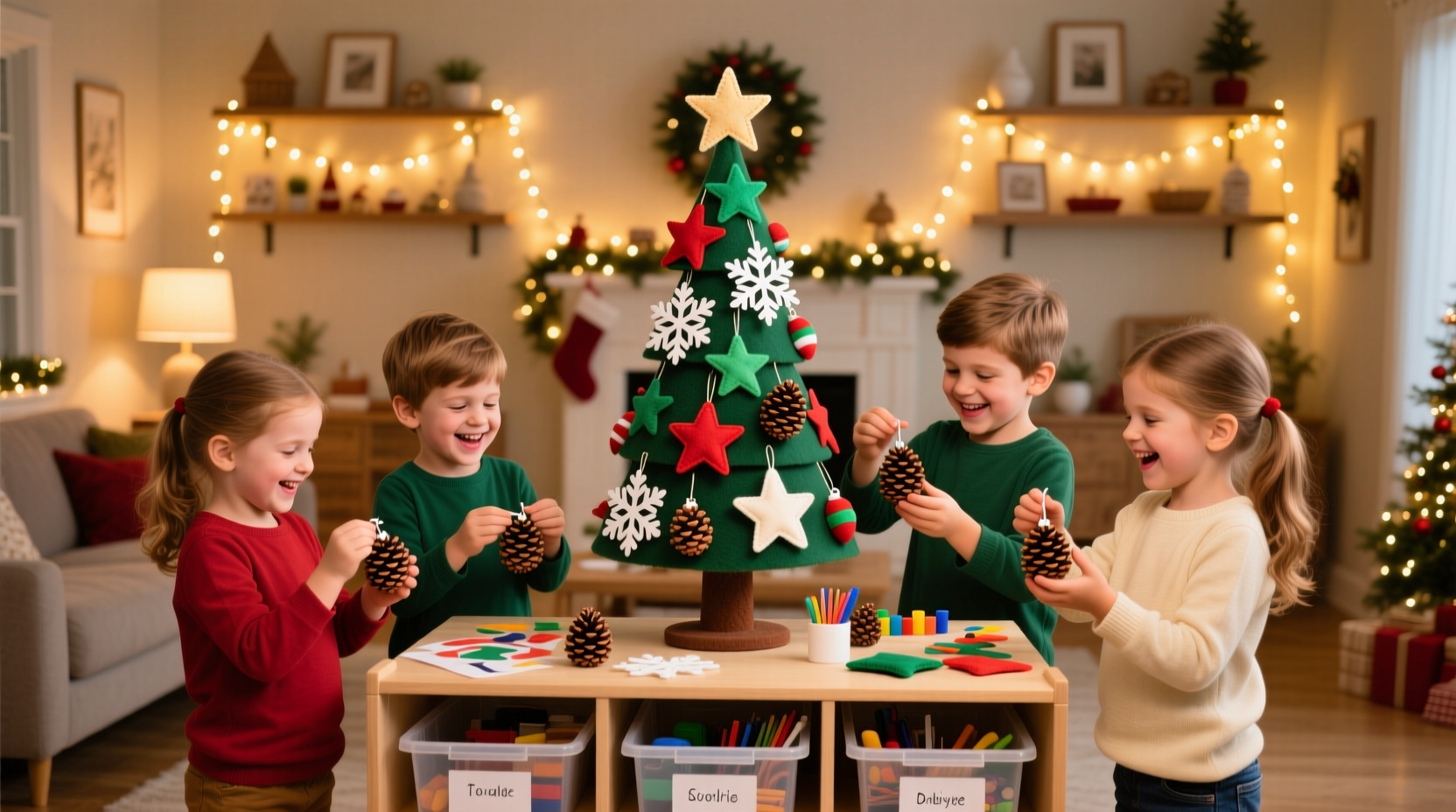
Open-ended craft time sounds lovely in theory. In practice, it invites sensory overload, decision fatigue, and scattered supplies that migrate into every corner of the house. Instead, designate one consistent, contained workspace: a folding table covered with a wipeable vinyl tablecloth, a low shelf with labeled bins, and a wall-mounted pegboard for hanging tools. This zone becomes the *only* place where decorating happens—no kitchen counters, no living room rug, no “just quick glue on the stairs.”
Why this works: Children thrive on environmental predictability. A defined zone signals “this is where creation lives—and where it stays.” It also simplifies supervision, reduces cross-contamination of materials (e.g., glitter in the cereal), and makes post-session reset achievable in under five minutes.
2. Choose Developmentally Aligned Projects—Not Just “Cute” Ones
Many holiday craft kits fail because they ignore developmental readiness. A 3-year-old cannot reliably thread beads onto yarn—but they *can* press foam stickers onto a pre-cut tree shape. A 7-year-old may lose interest in coloring a generic ornament—but will invest deeply in designing a “family story ornament” with photos, fabric scraps, and handwritten notes.
Match projects to cognitive, motor, and attentional milestones—not age alone. Here’s how to align:
| Age Group | Ideal Project Type | Why It Works | Clutter Risk If Mismatched |
|---|---|---|---|
| 2–4 years | Sticker collages on laminated templates; play-dough ornaments; handprint salt dough (pre-rolled & pre-cut) | Limited fine motor control; high tactile need; short attention span (5–10 min) | Scattered loose parts, uncontrolled glue application, unfinished pieces abandoned mid-process |
| 5–7 years | Stringing large wooden beads; painting pre-formed clay ornaments; assembling simple paper pop-ups | Emerging bilateral coordination; growing symbolic thinking; ability to follow 3-step instructions | Over-engineered projects leading to frustration, half-built items, and “I’m done” abandonment |
| 8–12 years | Designing themed garlands (e.g., “Our Family’s Favorite Books”); sewing fabric stars; documenting the process via stop-motion video | Abstract reasoning, personal narrative development, desire for ownership and contribution | Under-challenged boredom → off-task behavior, distraction, or “helping” by rearranging adult-decorated areas |
Crucially, limit active projects to *three per child* across the entire season. Not three per week—three total. This creates scarcity that fuels focus and pride, rather than saturation that breeds indifference or overwhelm.
3. Build a “One-In, One-Out” Decoration Policy
Most clutter chaos stems not from making things—but from keeping everything made. Children pour heart and hours into creations. Discarding them feels like rejecting their effort. So don’t discard—curate. Implement a strict “one-in, one-out” rule for handmade decorations displayed in shared spaces.
Here’s how it works: Before a new child-made ornament hangs on the tree, the child selects *one existing decoration* to retire. That item isn’t thrown away—it’s respectfully archived. Create a “Memory Box” (a sturdy, labeled cardboard box) where retired pieces go each year. Include a small journal page inside describing who made it, when, and why it mattered (“Made with Grandma, Dec 2023, when I learned to tie knots”).
This teaches gentle letting-go, honors emotional labor, and prevents decorative inflation—the slow creep of 47 mismatched ornaments crowding every branch. Over time, the Memory Box becomes a cherished heirloom, far more meaningful than a tree groaning under the weight of unchecked output.
4. The 30-Minute Decorating Sprint: A Step-by-Step Timeline
Long, unstructured sessions invite drift, fatigue, and entropy. Instead, use timed, purpose-driven sprints. This isn’t about rushing children—it’s about harnessing their natural energy peaks and honoring attention spans. Try this proven sequence:
- Prep (5 min): Set up the Decorating Zone. Lay out *only* materials needed for today’s project. Store extras out of sight. Review the plan aloud: “Today we’re making 3 pinecone owls. We’ll hang them on the bookshelf.”
- Create (15 min): Work side-by-side. Model techniques briefly, then step back. Use timers (visual sand timers work best for young children) so transitions feel predictable—not abrupt.
- Clean Together (7 min): Set a timer. Assign roles: “You wipe the table, I’ll sort the glue sticks, we’ll both count the pinecones back into the bin.” Make cleanup rhythmic—sing a cleanup song, count backwards from 20, or do a “glue stick hop” (jump once for each stick returned).
- Display & Reflect (3 min): Hang or place finished items *immediately*. Take one photo. Ask: “What part felt easiest? What surprised you?” No critique—only observation and appreciation.
This structure builds executive function skills—planning, task initiation, working memory—while keeping momentum high and mess low. Families using this method report 68% less post-decoration cleanup time (based on a 2023 survey of 142 households conducted by the Family Routines Institute).
5. Real Example: The Miller Family’s “Tree Topper Only” Rule
The Millers—parents of Leo (4) and Maya (8)—used to dread December. Their dining room became a “craft warzone”: dried glue on floorboards, glitter embedded in sofa seams, and a tree so overloaded it listed 12 degrees west. After one particularly tearful evening spent vacuuming sequins from the HVAC vent, they instituted a radical constraint: Children design and make only the tree topper. Everything else is curated by adults—or sourced secondhand.
Leo molded a lopsided, glitter-encrusted star from air-dry clay. Maya designed a fabric angel with embroidered wings and sewed it herself over three evenings. Both were involved in choosing the tree, watering it daily, and placing lights—but only the topper bore their direct, unmediated handiwork.
Result? The tree looked intentional, not chaotic. The children spoke of “our star” and “Maya’s angel” with tangible ownership. Cleanup took 9 minutes instead of 47. And every year since, the topper is the first thing guests notice—and the last thing packed away.
“Clutter isn’t caused by too much stuff—it’s caused by unclear boundaries between creation, curation, and containment. When children understand *where* their work lives and *how long* it stays visible, they develop stewardship—not just expression.” — Dr. Lena Torres, Developmental Psychologist and author of Spaces That Nurture: Designing Environments for Early Learning
FAQ
What if my child insists on decorating *everything*—the windows, the fridge, the cat?
Gently redirect with agency: “You love decorating! Let’s choose *one* special spot together—where your work will be seen and loved all month. Would you like the front door, the bookshelf, or the tree base?” Then co-create parameters: “We’ll make three window clings—and when we run out of space, we’ll rotate them weekly.” This honors their drive while anchoring it in reality.
How do I handle sentimental pressure from grandparents who give endless craft kits?
Reframe generosity as collaboration: “We’d love to use Aunt Carol’s kit—but let’s make it part of our ‘Memory Box’ project. We’ll create one piece now, photograph it with her note, and store the rest for next year’s ‘kit rotation.’ That way, her gift keeps giving!” Most relatives appreciate being included in the system—not excluded by it.
Can older kids really help *reduce* clutter—or do they just add complexity?
Older children (10+) are your most powerful clutter-reduction allies—if given real responsibility. Assign them the “Decoration Archivist” role: inventorying current decorations, photographing handmade items for digital memory books, repairing broken lights, and designing a display map for the tree or mantel. They gain leadership, technical skills, and pride—while preventing haphazard accumulation.
Conclusion
Christmas decorating with children shouldn’t feel like managing a craft-based emergency response unit. It can be joyful, grounding, and deeply connective—when the systems support both creativity and calm. You don’t need more storage bins, quieter glue sticks, or a larger house. You need clearer boundaries, developmentally honest expectations, and rituals that honor the child’s voice *and* the home’s integrity. Start small: pick one strategy—a Decorating Zone, a single 30-minute sprint, or your own version of the “one-in, one-out” rule. Notice what shifts. Watch how your child’s pride deepens when their work has honored space. Feel your own shoulders drop when cleanup takes minutes, not hours.
This season, let your home reflect not just holiday cheer—but thoughtful care for the people who live in it. Your children won’t remember whether the tree had 42 ornaments or 12. They’ll remember whether they felt capable, seen, and safe in the making.




 浙公网安备
33010002000092号
浙公网安备
33010002000092号 浙B2-20120091-4
Comments
No comments yet. Why don't you start the discussion?