
Every year, families face the same quiet tension: the desire to make holiday decorating a shared, meaningful experience with children—and the dread of hearing that unmistakable *tink* of shattered glass or ceramic. Fragile ornaments aren’t just expensive; they’re often heirlooms, sentimental tokens, or handmade treasures that carry stories older than the kids hanging them. Yet excluding children from this ritual risks making them passive observers rather than invested participants in family traditions. The solution isn’t “wait until they’re older” or “just let them handle the cheap ones.” It’s about intentional design—of space, materials, roles, and expectations—that honors both developmental readiness and emotional significance. This article draws on child development research, occupational therapy insights, and real-world experience from educators, professional decorators, and parents who’ve transformed ornament-hanging from a high-stakes operation into a calm, creative, and deeply connective practice.
1. Redefine “Fragile”: A Developmental Lens
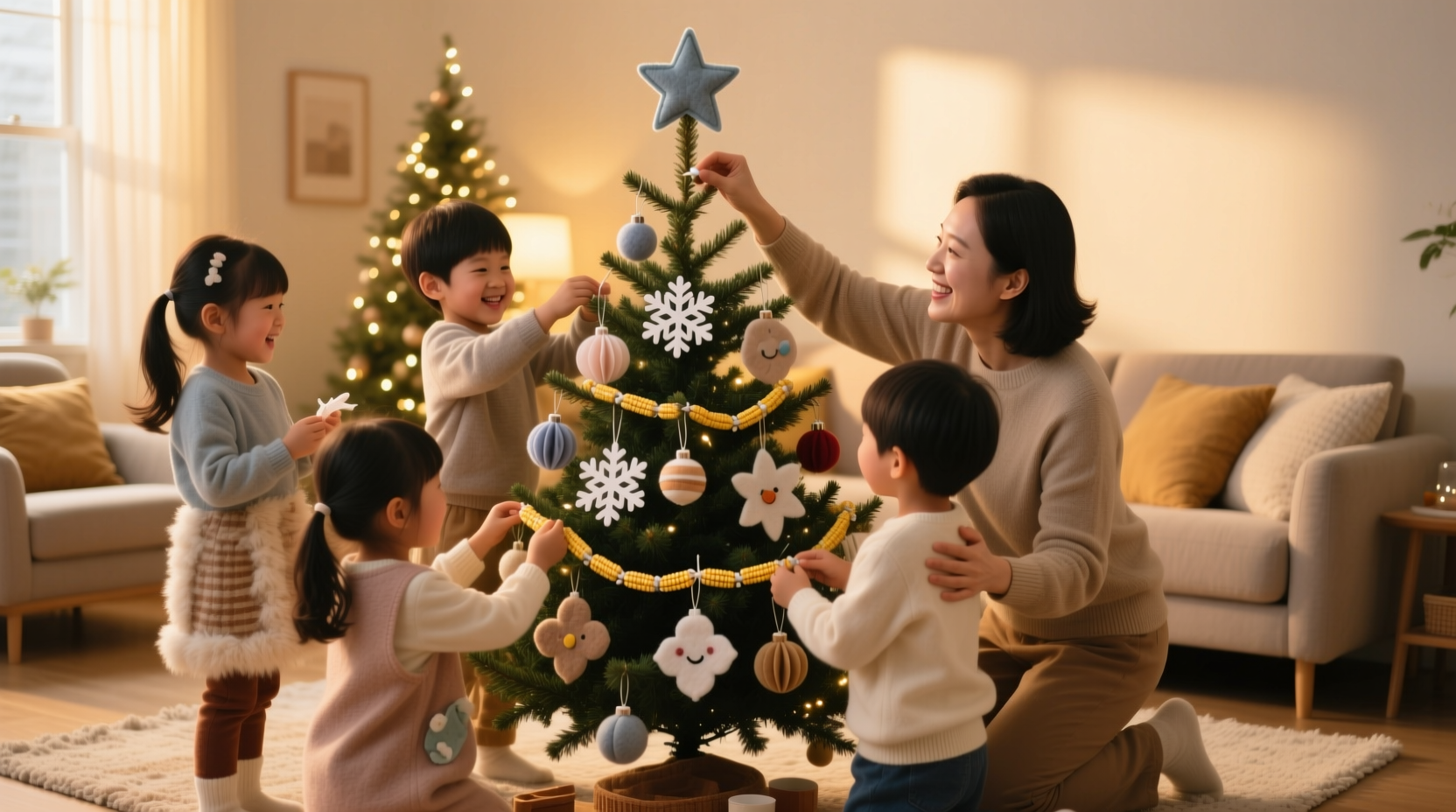
Before selecting ornaments—or assigning tasks—consider what “fragile” means through a child’s physical and cognitive lens. A 4-year-old lacks fully developed fine motor control and impulse regulation; their grip strength is still maturing, and their ability to anticipate consequences (e.g., “if I swing this ornament, it might hit the tree branch and crack”) emerges gradually between ages 5 and 7. According to Dr. Sarah Lin, pediatric occupational therapist and author of Playful Foundations: Building Motor Skills Through Everyday Routines, “Children don’t break ornaments because they’re careless—they break them because their nervous systems haven’t yet wired the sequence: see → plan → adjust grip → move slowly → monitor feedback. That wiring happens through repetition with appropriate scaffolding—not through admonishment.”
This reframing shifts the focus from blame to setup. Instead of asking, “How do I stop my child from dropping it?” ask, “What support does their developing brain and body need to succeed?” That support includes weight, texture, size, and visual cues—all elements you can intentionally choose.
2. The Three-Zone Tree Strategy
Divide your tree (or mantel, wreath, or display) into three vertically stacked zones—each with distinct ornament types, accessibility rules, and adult roles. This structure eliminates ambiguity, reduces decision fatigue for children, and creates natural boundaries that feel fair—not punitive.
| Zone | Height Range | Ornament Criteria | Child Role | Adult Role |
|---|---|---|---|---|
| Base Zone | 0–24 inches from floor | Sturdy, washable, non-breakable: wood, thick felt, silicone, fabric, large plastic | Full autonomy: choose, hang, rearrange freely | Supervise only for safety (e.g., tripping hazards); no corrections unless safety-related |
| Middle Zone | 24–48 inches | Mixed: 70% durable ornaments + 30% fragile pieces placed *only* on lower, sturdier branches with wide spacing | Choose from pre-selected options; hang with adult hand-over-hand guidance (adult places hand over child’s hand, guiding motion) | Pre-place fragile ornaments on stable branches; provide verbal prompts (“Let’s lift together,” “Feel how light it is?”); never take back control mid-motion |
| Crown Zone | 48+ inches | Fragile heirlooms, blown glass, delicate ceramics, vintage pieces | Observation & storytelling only: “Tell me about Grandma’s angel,” “Which color shines brightest up there?” | Hang independently; narrate process aloud (“I’m using two hands and holding it close to my body”) |
This zoning system respects hierarchy without shame. Children understand that higher doesn’t mean “better”—it means “more protected,” just like how museums display rare artifacts behind glass. They learn stewardship, not exclusion.
3. Build a Kid-Safe Ornament Toolkit
Replace the notion of “kid ornaments” with “collaborative ornaments”—pieces designed for shared creation and lasting use. These aren’t throwaways; they’re investments in memory-making. Below are five proven categories, ranked by durability and engagement potential:
- Clay & Air-Dry Sculptures: Use oven-bake or air-dry clay (non-toxic, certified ASTM D-4236). Kids imprint handprints, press leaves, roll beads, or carve initials. Once cured, seal with water-based polyurethane. These become annual touchpoints: “Remember when you made this at age six? Look how your thumbprint fits perfectly.”
- Felt & Fabric Appliqués: Pre-cut shapes (stars, trees, animals) with fusible webbing or fabric glue sticks. Children arrange and press onto stiffened felt backings. No needles, no hot glue guns—just tactile precision and color theory in action.
- Natural Element Ornaments: Pinecones dipped in white glue then rolled in coarse sea salt (sparkles like snow), cinnamon sticks wired into stars, or dried orange slices strung with jute. Biodegradable, aromatic, and inherently forgiving—slight cracks add character, not catastrophe.
- Recycled Material Constructions: Cardboard tubes cut into rings and painted, bottle caps flattened and hammered into discs, scrap fabric braided into tassels. Teaches sustainability while building spatial reasoning.
- Photo & Memory Tokens: Small laminated photos sealed inside clear acrylic ornaments (sold as “photo insert” styles) or printed directly onto shatterproof plastic baubles. Emotionally resonant and physically resilient.
Crucially, involve children in *making* these ornaments months before December. A September craft session builds anticipation, reinforces motor skills, and creates ownership long before the tree goes up.
4. The “Five-Minute Hang” Protocol: A Step-by-Step Routine
Spontaneous ornament-hanging invites chaos. A predictable, timed routine builds confidence, reduces overwhelm, and makes fragility management automatic. Follow this sequence every time:
- Prepare the Space (2 min): Clear floor space around the tree. Lay down a soft rug or folded blanket to cushion accidental drops. Place a small basket of Base Zone ornaments and a second basket of Middle Zone options within easy reach—but keep Crown Zone ornaments visibly stored elsewhere (e.g., in a labeled box on a high shelf).
- Select & Name (1 min): Child chooses one ornament. Adult names its material (“This is smooth ceramic”), weight (“It feels light like a feather”), and special feature (“See the gold rim? Let’s keep that facing out”). Naming builds observational language and respect.
- Position & Pause (30 sec): Adult helps child stand at the correct zone height (use a stable step stool if needed). Child holds ornament at chest level. Adult says, “Hold it here for three breaths”—modeling slow inhale/exhale. This pause activates the prefrontal cortex, dampening impulsive motion.
- Guide & Glide (1 min): Adult places hands gently over child’s hands. Together, they lift the ornament *slowly*, align the hook, and slide it onto the branch—no twisting, no jerking. Emphasize “gliding,” not “pushing.”
- Reflect & Rotate (30 sec): Child steps back. Adult asks, “What do you love about where it landed?” Then rotates responsibility: “Next time, you’ll choose which branch we try first.” Consistency here builds agency, not dependence.
This protocol takes under five minutes but yields outsized returns: reduced anxiety, heightened focus, and repeated neural reinforcement of careful movement.
5. Real-World Adaptation: The Martinez Family Case Study
The Martinez family of Portland, Oregon, faced recurring holiday stress. Their 5-year-old Leo loved decorating but had broken seven ornaments in two years—including a hand-blown glass dove gifted by his late great-aunt. Rather than banishing him from the tree, they redesigned their approach using the principles above.
First, they created a “Leo’s Lower Branch” section—a dedicated 20-inch band wrapped in soft velvet ribbon at eye level, anchored with extra-thick wire branches. They filled it exclusively with ornaments Leo helped make: salt-glazed pinecones, fabric reindeer with embroidered eyes, and clay stars imprinted with his fingerprints. For Middle Zone participation, they introduced “ornament passports”—small cards with photos of each fragile piece, its story, and a photo of the exact branch where it lived. Leo “checked in” each ornament by matching the card to the branch, reinforcing spatial memory and reverence.
Within one season, Leo began saying, “That one’s Aunt Rosa’s. We hang it *here*—not too high.” His mother, Elena, notes, “He didn’t just stop breaking things. He started *protecting* them. That shift—from ‘I broke it’ to ‘I kept it safe’—changed everything.”
“Children don’t learn care through warnings. They learn it through repeated, supported experiences of being trusted with something precious—and succeeding.” — Dr. Amara Patel, Early Childhood Education Researcher, University of Washington
FAQ
What if my child insists on handling a fragile ornament?
Validate the feeling first: “You really want to hold that shiny one—yes, it’s beautiful.” Then offer agency within safety: “Let’s hold it together, right here on this towel, and look closely at the colors. When you’re ready, you can choose where *your* ornament goes on the lower branch.” This honors desire while anchoring choice in capability.
Are there truly unbreakable alternatives that still feel special?
Absolutely. Look for ornaments made from borosilicate glass (used in labware—shatter-resistant), high-impact acrylic with matte finishes (reduces glare and slipperiness), or hand-thrown stoneware glazed with food-safe, chip-resistant finishes. Many artisan makers now label pieces as “child-collaborative” with intentional weight distribution and rounded edges.
How do I explain why some ornaments stay in the box?
Use concrete, non-moral language: “Some ornaments are like museum paintings—they’re very old or very delicate, so we keep them safe in their special home until we’re ready to admire them together. You get to help us decide *when* to bring them out next year.” This frames protection as shared responsibility, not restriction.
Conclusion
Involving children in holiday decorating isn’t about achieving picture-perfect symmetry or preserving ornaments in pristine condition. It’s about cultivating presence—yours and theirs—in a season often defined by hurry and expectation. Every time you kneel beside your child to guide their hands over a fragile bauble, every time you pause to breathe before lifting, every time you celebrate the lopsided clay star they pressed with fierce concentration—you’re doing far more than hanging decorations. You’re modeling patience, honoring developmental truth, and weaving belonging into tradition, one deliberate, gentle motion at a time.
Start small this year. Choose one strategy—the Three-Zone Tree, the Five-Minute Hang, or a single batch of handmade ornaments—and commit to it without compromise. Notice what shifts: the steadiness in your child’s hands, the curiosity in their questions, the quiet pride when they point to “their branch” and say, “I did that.” Those moments are the real heirlooms—the ones no glass can shatter.




 浙公网安备
33010002000092号
浙公网安备
33010002000092号 浙B2-20120091-4
Comments
No comments yet. Why don't you start the discussion?