
Decorating for the holidays is more than a seasonal chore—it’s a ritual of connection, creativity, and shared memory-making. Yet for many families, the excitement of including children quickly collides with reality: the delicate glass ornament shatters on the hardwood, the garland tangles around the cat’s tail, and someone trips over an extension cord snaking across the living room floor. The result? A retreat into “adult-only zones,” diminished participation, and missed opportunities for building confidence, fine motor skills, and joyful ownership of family traditions.
This isn’t about lowering expectations or sacrificing aesthetics. It’s about rethinking *how* we invite children in—not as passive observers or supervised assistants, but as capable, trusted contributors. Drawing on early childhood education principles, occupational therapy insights, and real-world experience from families who’ve transformed their decorating process, this guide outlines a thoughtful, layered approach that prioritizes safety *and* agency. You’ll learn how to assign meaningful roles based on developmental readiness, redesign your space for co-creation, and turn potential hazards into teachable moments—without compromising beauty, function, or peace of mind.
1. Redefine “Involvement” by Age and Ability
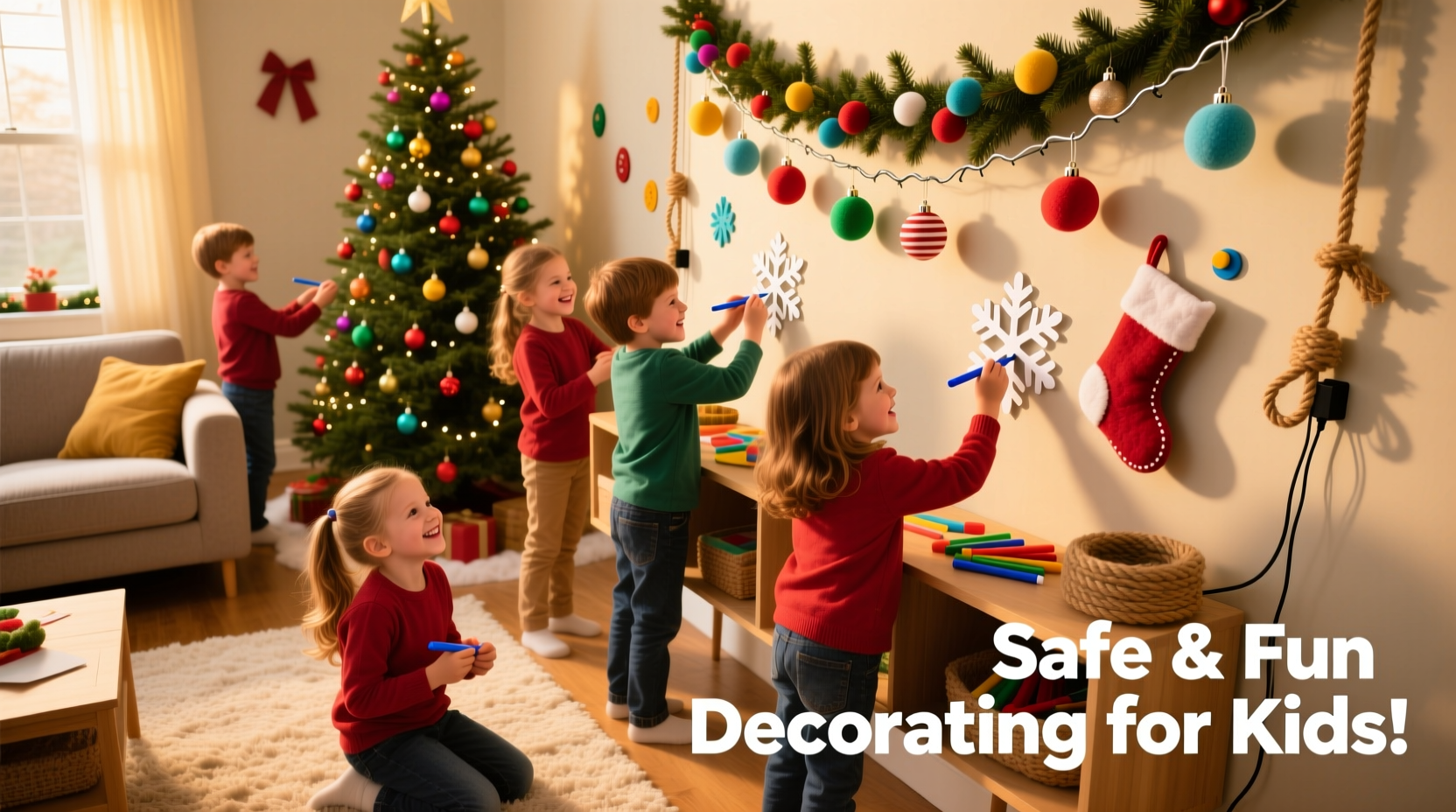
Children aren’t miniature adults—and their capacity for safe, satisfying participation shifts dramatically between ages 3 and 12. Rather than asking, “Can they hang ornaments?” ask, “What part of the *process* can they own?” Developmental psychologist Dr. Lena Torres, author of Playful Spaces, Purposeful Rituals, emphasizes that “authentic involvement isn’t measured by proximity to fragile objects—it’s measured by decision-making power, repetition with mastery, and visible contribution to the final environment.”
Here’s how to align tasks with developmental strengths:
| Age Range | Strengths & Readiness | Safe, Meaningful Roles | Risk-Aware Adjustments |
|---|---|---|---|
| 3–5 years | Strong imitation drive; developing hand-eye coordination; limited impulse control; fascinated by texture and color | Sorting ornaments by color/size; placing soft fabric or felt ornaments on low branches; stringing large wooden beads onto yarn garlands; applying reusable stickers to windows or doors | Ornaments must be unbreakable (fabric, wood, foam); all cords kept out of reach or secured under rugs; no step stools—use only ground-level trees or wall-mounted frames |
| 6–8 years | Improved fine motor control; beginning understanding of cause/effect; eager to follow multi-step instructions; developing spatial awareness | Designing and hanging paper chains; assembling simple LED light strands (battery-operated only); arranging themed decor trays (e.g., pinecones + cinnamon sticks); labeling handmade ornaments with names/dates | Use only UL-listed, low-voltage battery lights (no plug-in strings); supervise wire management; introduce cord-tidying as a game (“Let’s give the cord a cozy home!”) |
| 9–12 years | Capable of independent problem-solving; understands electrical safety basics; enjoys leadership roles; seeks responsibility and recognition | Mapping light placement on a sketch of the room; testing and troubleshooting battery lights; creating custom signage or photo displays; managing a “safety checklist” before guests arrive (e.g., checking cord anchors, verifying outlet load limits) | Require formal briefing on outlet safety (max 3 devices per outlet); co-sign off on ladder use (only with adult spotter); assign them as “cord captains” with velcro straps and labeled bins |
2. Design the Environment for Shared Ownership—Not Just Supervision
Most decoration-related accidents don’t stem from children’s actions alone—they emerge from environments designed for adult convenience, not collaborative creation. When wires snake across walkways, when the tree stand is unstable, or when fragile items dominate eye-level shelves, we’re setting up a constant tension between curiosity and caution. Instead, adopt an environmental design mindset: proactively structure the space so safety and participation coexist.
Start with three foundational adjustments:
- Anchor everything—literally. Use museum-grade putty, removable adhesive hooks, or heavy-duty Velcro strips to secure garlands, wreaths, and light bases. Test stability *before* adding children’s input—not after.
- Create dedicated “child-accessible zones.” Reserve one shelf, a section of mantel, or a corner of the window for decorations managed entirely by kids—complete with their own storage bin, step stool (if age-appropriate), and visual checklist. This builds autonomy while containing variables.
- Decouple lighting from risk. Eliminate plug-in extension cords in high-traffic areas. Instead, deploy clusters of battery-powered LED candles, fairy lights in mason jars, or solar-charged string lights mounted on stable surfaces (e.g., bookshelves, picture ledges). Charge batteries fully *before* decorating begins—and label each set with its charge date.
A 2023 study published in the Journal of Environmental Psychology found that households using designated child zones saw a 72% reduction in decoration-related incidents—and reported significantly higher levels of child engagement and sustained attention during the process.
3. The Step-by-Step Safety-First Decorating Timeline
Timing matters as much as task assignment. Rushing through setup invites shortcuts that compromise safety. Follow this 5-day timeline to build momentum, reinforce habits, and embed safety checks naturally:
- Day 1: Prep & Plan Together
Review photos of past decorations. Ask: “What made you proud last year?” “What felt tricky?” Sort supplies into “Kid Zone,” “Adult Zone,” and “Team Zone.” Label bins with icons (not just words) for pre-readers. Charge all batteries. Inspect cords for fraying. - Day 2: Anchor & Arrange
Adults install all wall hooks, secure furniture (e.g., lock TV stands), and mount stable bases for trees or displays. Kids assist by handing tools, choosing hook colors, or placing non-slip pads under trays. No ornaments or lights yet. - Day 3: Light Up Safely
Kids test battery lights, arrange them in jars or along shelves, and practice wrapping cords neatly using velcro straps. Adults verify outlet loads and hide any necessary plug-in cords behind furniture or in cord covers. Document placements on a simple sketch. - Day 4: Decorate with Intention
Using pre-sorted ornaments and materials, kids decorate their zones first. Then, with adult support, add coordinated elements to shared spaces (e.g., “You choose the red ornaments—we’ll hang them together on the lower third”). Pause every 20 minutes for a “safety sweep”: checking cord anchors, clearing walkways, and resetting cluttered surfaces. - Day 5: Celebrate & Sustain
Host a “grand reveal” walk-through. Kids narrate their contributions. Complete a joint photo journal page. Review the “Safety Sweep” checklist as a family—and store it visibly for weekly refreshers.
4. Real Example: The Miller Family’s “No-Shatter” Shift
The Millers—a family with two children, ages 5 and 8—used to dread December. Their 7-foot Fraser fir stood on a wobbly stand, draped in heirloom glass balls and intertwined plug-in lights. Each year brought at least one shattered ornament, two tripped adults, and mounting resentment from the kids, who were repeatedly told, “Just wait until you’re older.”
After a particularly stressful weekend—when their son knocked over the tree trying to reach a high branch—the Millers consulted a local occupational therapist specializing in sensory-friendly home environments. They implemented three key changes:
- They replaced their tree with a sturdy, weighted metal-frame artificial tree designed for low-profile anchoring (no stand wobble).
- They curated a “kid-safe ornament kit”: hand-painted wooden stars, wool-felt snowflakes, and silicone “icicles” that bend but don’t break—all stored in a low, open basket.
- They installed battery-powered micro-LEDs on individual branches *before* adding ornaments, eliminating the need to weave lights through dense foliage later.
“The biggest shift wasn’t the gear—it was letting our daughter lead the ‘light check,’” says parent Maya Miller. “She’d go branch by branch, pressing the on/off switch and telling us, ‘This one’s sleepy—needs new batteries.’ She felt like an engineer, not a liability.” That year, zero ornaments broke. Zero trips occurred. And both children asked, unprompted, to help “winterize” the porch lights the following November.
5. Essential Safety Checklist & FAQ
Before you begin decorating, run through this concise, actionable checklist—designed to be completed *with* kids, not just by adults:
☐ All battery-powered lights tested and charged
☐ Cords secured with velcro, clips, or covered with cord sleeves
☐ Furniture anchored; no wobbly stands or shelves within reach
☐ “Kid Zone” clearly marked with accessible storage and step stool (if used)
☐ Fragile items placed above 48 inches—or removed entirely from common areas
☐ First-aid kit and fire extinguisher checked and within adult reach
☐ Emergency exit paths completely clear (no garlands, rugs, or furniture blocking)
☐ Each child assigned one “safety role” (e.g., Cord Captain, Light Tester, Sweeper)
Frequently Asked Questions
What if my child insists on hanging the “real” ornaments?
Honor the desire—and redirect the skill. Say: “Those are special because Grandma made them. Let’s make *our own* version together—using clay, salt dough, or even recycled cardboard. We’ll hang yours *and* ours, and tell everyone which ones we created.” This validates their emotional connection while building ownership of safer alternatives.
Are battery lights truly safer than plug-in ones?
Yes—when used correctly. Battery-operated LEDs generate negligible heat, eliminate shock risk, and remove the need for extension cords in walkways. However, avoid cheap, non-UL-certified units with exposed wiring or poor battery compartment seals. Stick to reputable brands (like Luminara or Twinkly) and replace batteries *before* they’re depleted—leaking alkaline batteries pose a chemical hazard.
How do I explain electrical safety without scaring my child?
Focus on observable cause-and-effect, not abstract danger. Try: “Wires get tired when too many things pull from them—like when you try to carry five books at once. When wires get tired, they can spark, and sparks can hurt people or things. So we give them breaks—by using batteries or spreading plugs out.” Pair this with a hands-on demo: let them feel how warm a phone charger gets after 10 minutes versus a battery light (which stays cool).
“The goal isn’t to eliminate risk—it’s to make risk visible, manageable, and shared. When children understand *why* a rule exists, they become partners in safety, not just subjects of it.” — Dr. Arjun Patel, Pediatric Occupational Therapist and Founder of SafeSpaces Learning Lab
Conclusion
Involving kids in holiday decorating isn’t about achieving perfection—it’s about cultivating presence. It’s the 6-year-old’s focused concentration while threading beads, the pride in a lopsided paper chain displayed beside your favorite vintage tinsel, the quiet moment when a child notices a cord near the door and quietly loops it behind the sofa. These aren’t compromises. They’re the very substance of meaningful tradition.
You don’t need flawless execution to create lasting joy. You need intentionality, respect for developmental realities, and the willingness to adapt your environment—not just your expectations. Start small: pick one zone, one light source, one ornament type. Involve your children in the planning, not just the doing. Watch how their confidence grows when their ideas shape the space—and how your own stress eases when safety is built in, not bolted on.
This season, let your decorations reflect not just what looks beautiful—but what feels deeply, authentically shared. Your children won’t remember whether every bulb matched. But they’ll remember whether they felt trusted, capable, and utterly welcome in the making of it all.




 浙公网安备
33010002000092号
浙公网安备
33010002000092号 浙B2-20120091-4
Comments
No comments yet. Why don't you start the discussion?