
Decorating with toddlers is rarely about achieving Pinterest-perfect symmetry—it’s about shared laughter, sensory discovery, and the quiet pride in a child’s “I did it!” moment. Yet many caregivers hesitate, remembering last year’s glitter explosion, the ceramic snowman that met its end mid-handoff, or the frantic scramble after a toddler liberated an entire box of fragile glass baubles. The truth is: breakage isn’t inevitable. With intentional setup, age-aligned tasks, and a shift from “decorating *for* them” to “decorating *with* them,” toddlers can become genuine collaborators—not just bystanders or hazards. This isn’t about lowering expectations; it’s about raising scaffolding. What follows is a field-tested framework grounded in early childhood development principles, occupational therapy insights, and real home environments—not theoretical ideals.
Why Involving Toddlers Matters (Beyond the Obvious)
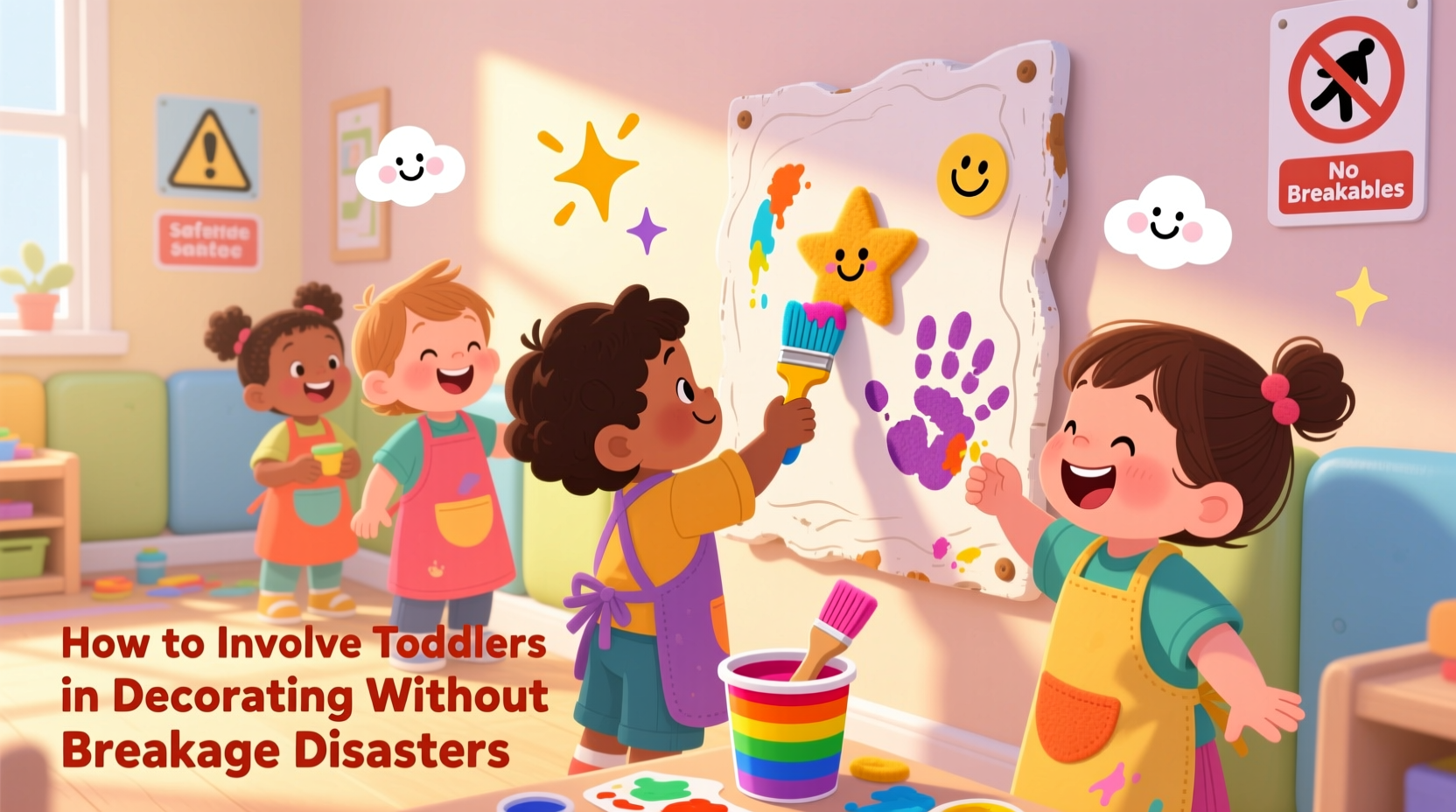
Participation in decorating does far more than fill time before naptime. It supports foundational developmental domains: fine motor skills (peeling stickers, threading large beads), executive function (following simple sequences like “first glue, then press”), emotional regulation (practicing patience while waiting for glue to dry), and identity formation (“This is *my* tree—I chose the red star”). Research from the Erikson Institute confirms that meaningful contribution to family routines strengthens a child’s sense of agency and belonging—critical predictors of long-term resilience. When toddlers help hang paper chains or arrange felt animals on a felt board, they’re not just playing; they’re practicing decision-making, spatial reasoning, and collaborative problem-solving. Crucially, this work builds intrinsic motivation: children who help create their environment are more likely to respect its boundaries—and less likely to impulsively dismantle it later.
Five Non-Negotiable Safety & Setup Principles
Prevention begins before the first craft supply leaves the shelf. These five principles form the bedrock of any toddler-inclusive decorating session:
- Designate a “Yes Space” for Decorating: Clear one low table or floor area where *only* approved, safe materials live. Remove nearby breakables, cords, or unstable furniture. Use painter’s tape to mark boundaries visually—even 2-year-olds respond to clear spatial cues.
- Pre-Portion & Pre-Prepare: Never hand a toddler a full glue bottle or open glitter jar. Instead, place dots of washable glue on a paper plate, pre-cut ribbon into 6-inch lengths, or fill egg cartons with individual pom-poms. This eliminates spills, overuse, and impulsive grabbing.
- Choose Materials by Developmental Fit—Not Just Age Label: A 24-month-old may still mouth objects, so avoid anything smaller than 1.25 inches in diameter. Prioritize texture over fragility: thick cardboard, sturdy felt, wood slices, and air-dry clay over glass, thin plastic, or ceramic.
- Anchor Everything: Secure posters, garlands, or mobiles with removable adhesive putty (like Blu Tack) instead of tape or nails. For wall decorations, use static-cling vinyl or reusable sticker sheets—no permanent residue, no holes, no risk of falling frames.
- Have a “Reset Ritual”: End every session with a 2-minute cleanup song (“Clean-up, clean-up, everybody do your share!”). Let your toddler place items back in labeled bins (picture labels help pre-readers). This teaches ownership and makes future sessions faster and calmer.
Age-Appropriate Tasks: Matching Activity to Ability (18–36 Months)
Toddler development isn’t linear—but motor, cognitive, and attention capacities follow predictable patterns. The table below outlines realistic, joyful contributions by approximate age band. Note: Always observe your child’s current readiness—not just their birthday.
| Age Range | Physical & Cognitive Capacity | Safe, Meaningful Decorating Tasks | Materials to Avoid |
|---|---|---|---|
| 18–24 months | Grasps with thumb-and-finger (pincer), follows 1-step directions, explores with mouth, short attention span (3–5 mins) | Sticking pre-cut foam shapes onto a laminated poster; placing large wooden beads onto a shoelace; pressing play-dough “ornaments” onto a cardboard tree; arranging fabric scraps on a felt board | Glue sticks (too hard to control), small buttons, loose glitter, string longer than 12 inches, anything with sharp edges |
| 24–30 months | Begins to imitate actions, stacks 8+ blocks, uses 2–3 word phrases, tolerates 5–8 minute tasks | Threading large pasta rings onto yarn; gluing pre-cut paper strips onto a wreath base; stamping with potato or foam stamps; choosing colors for a mural and applying paint with a roller | Scissors (even safety ones), liquid glue bottles, candles, tinsel, glass beads, hot glue guns |
| 30–36 months | Can copy a circle, uses 3–5 word sentences, follows 2-step directions, shows preference and initiative | Designing a paper chain with color choices; painting wooden ornaments with watercolors; arranging natural items (pinecones, acorns, smooth stones) in a tray; helping hang lightweight garlands using command hooks at toddler height | Fragile ceramics, mercury-containing thermometers (in vintage decor), battery-operated lights with accessible compartments, unsecured heavy objects |
A Real Example: The “No-Break” Holiday Tree Project
Last December, Maya—a preschool teacher and mother of two—wanted her 2.5-year-old Leo to help decorate their family tree. Her past attempts had ended in tears: once when he pulled down a branch loaded with glass balls, another when he tried to “taste” the tinsel. This year, she redesigned the experience entirely. She cleared the living room rug, set up a low table with a 3-foot artificial tree (lightweight, plastic branches), and prepared three stations: (1) a tray of wooden ornaments painted with non-toxic acrylics, each with a looped yarn hanger; (2) a basket of oversized, soft fabric stars and moons stuffed with polyester fiberfill; and (3) a paper plate with glue dots and a stack of die-cut felt leaves. Leo chose which station to start at—no pressure, no timeline. He spent 7 minutes carefully pressing leaves onto the tree’s trunk (a tactile, controlled motion), then moved to hanging wooden ornaments with help only for the final loop-over-the-branch step. His 4-year-old sister joined in, narrating his choices (“Leo picked the blue star!”). No breakage occurred. More importantly, Leo pointed to the tree for days afterward saying, “Mine. I stick. I hang.” That ownership—born from autonomy, safety, and competence—was the real decoration.
“Toddlers don’t need ‘help’ to participate—they need *access*. Access means materials they can manipulate independently, spaces they can navigate safely, and tasks where success is built into the design—not dependent on adult correction.” — Dr. Lena Torres, Pediatric Occupational Therapist and author of Small Hands, Big World
Step-by-Step: Building a Toddler-Safe Garland in Under 15 Minutes
This hands-on project demonstrates how structure transforms potential chaos into calm collaboration. Follow these steps precisely—each serves a developmental purpose:
- Gather & Prep (3 mins): Collect 12–15 large wooden beads (1.5” diameter), one 36-inch length of jute twine (pre-knotted at both ends), and a shallow tray. Place everything within easy reach on a wipeable surface.
- Model & Invite (1 min): Sit beside your toddler. Thread one bead onto the twine slowly, saying, “Watch: slide… slide… done!” Then hold out the twine and say, “Your turn to slide?” Wait 5 seconds—don’t rush the response.
- Scaffold, Don’t Take Over (5 mins): If they grasp the bead but struggle to align it, gently guide their wrist—not their fingers. Say, “Hold the string tight. Now push the bead *up*.” Celebrate effort: “You pushed! It’s moving!” Not just completion.
- Pause & Reflect (2 mins): After 5 beads, stop. Ask, “What color is this one?” or “How many did we do?” Count together, touching each bead. This embeds math and language without drilling.
- Finish & Display (4 mins): Tie the ends together loosely. Let your toddler choose where to hang it—on a door handle, a low hook, or draped over a bookshelf edge. Take a photo together beside it. Later, refer to it: “Remember when you made the red-and-blue garland?”
What to Do When (Not If) Something Breaks
Despite precautions, accidents happen. How you respond matters more than the incident itself. Reacting with anger or shame teaches avoidance—not care. Instead, treat breakage as data:
- Stay Calm & Name the Feeling: “Oh—the cup fell. That surprised me!” Naming your own emotion models regulation. Then gently name theirs: “You looked startled.”
- Involve Them in the Response: Hand them a dustpan and brush (child-sized) or a damp cloth. Say, “Let’s clean this up together.” This reinforces responsibility without blame.
- Reframe, Don’t Punish: Instead of “You broke it—no more decorating,” try “That material wasn’t strong enough for little hands. Next time, let’s try the wooden cups.” This separates behavior from identity.
- Review the Setup: Afterward, ask yourself: Was the item within reach? Was it secured? Did I offer alternatives before they reached for it? Adjust—not restrict.
FAQ: Real Questions from Real Caregivers
“My toddler just wants to throw or smash decorations—how do I redirect that energy?”
Smashing and throwing are valid sensory-motor needs—not misbehavior. Offer structured alternatives *before* frustration builds: a designated “smash bag” filled with bubble wrap, crumpled paper, or soft foam blocks; a “throw zone” (a taped square on the floor) where they can toss bean bags at a target; or heavy-work activities like rolling play-dough “ornaments” with a rolling pin. Often, the impulse fades when the underlying need (proprioceptive input, big emotions) is met proactively.
“We rent and can’t put holes in walls—what are safe, renter-friendly decorating options?”
Static-cling vinyl decals, reusable sticker sheets, washi tape (removes cleanly from most painted walls), magnetic boards hung with removable hooks, and fabric-based solutions (like a clip-string banner with mini clothespins) are all landlord-approved. For trees or centerpieces, use weighted bases (a sand-filled planter pot wrapped in burlap) instead of wall-mounting. Always test adhesives on a small, inconspicuous area first.
“What if my toddler loses interest after 90 seconds?”
That’s neurotypical toddler attention. Don’t force continuation. Instead, honor the exit: “You’re all done sticking! Let’s wash hands and read a book.” Then, later, invite re-engagement casually: “The stars are still on the table if you want to add more.” Often, a short break resets focus—and returning voluntarily builds intrinsic motivation far more than prolonged pressure.
Conclusion: Decorate With, Not Around
“Without breakage disasters” isn’t about creating a sterile, toddler-proof museum. It’s about designing environments where curiosity is honored, motor skills are supported, and mistakes become moments of connection—not correction. Every time you hand a toddler a chunky wooden bead instead of a glass ornament, every time you kneel to their eye level to co-create rather than direct, every time you celebrate the lopsided paper chain as art—you’re building more than holiday cheer. You’re nurturing confidence, respect for shared space, and the quiet understanding that their hands belong in this world, shaping it with care and joy. Start with one small, safe project this week. Notice what your toddler chooses, how they hold the materials, where their attention lingers. Then build from there—not toward perfection, but toward partnership. Because the most beautiful decoration isn’t on the tree or the wall. It’s the steady, growing light of competence in your child’s eyes.




 浙公网安备
33010002000092号
浙公网安备
33010002000092号 浙B2-20120091-4
Comments
No comments yet. Why don't you start the discussion?