
In an age of information overload, clarity in thought and action is more valuable than ever. The \"W concepts\"—a framework often referenced in philosophy, strategic thinking, and behavioral psychology—offer a structured way to assess situations, make decisions, and cultivate deeper understanding. While the term may seem abstract at first, its principles are grounded in practical reasoning. This guide breaks down how to recognize, interpret, and apply W concepts effectively in everyday life.
Understanding the Core W Framework
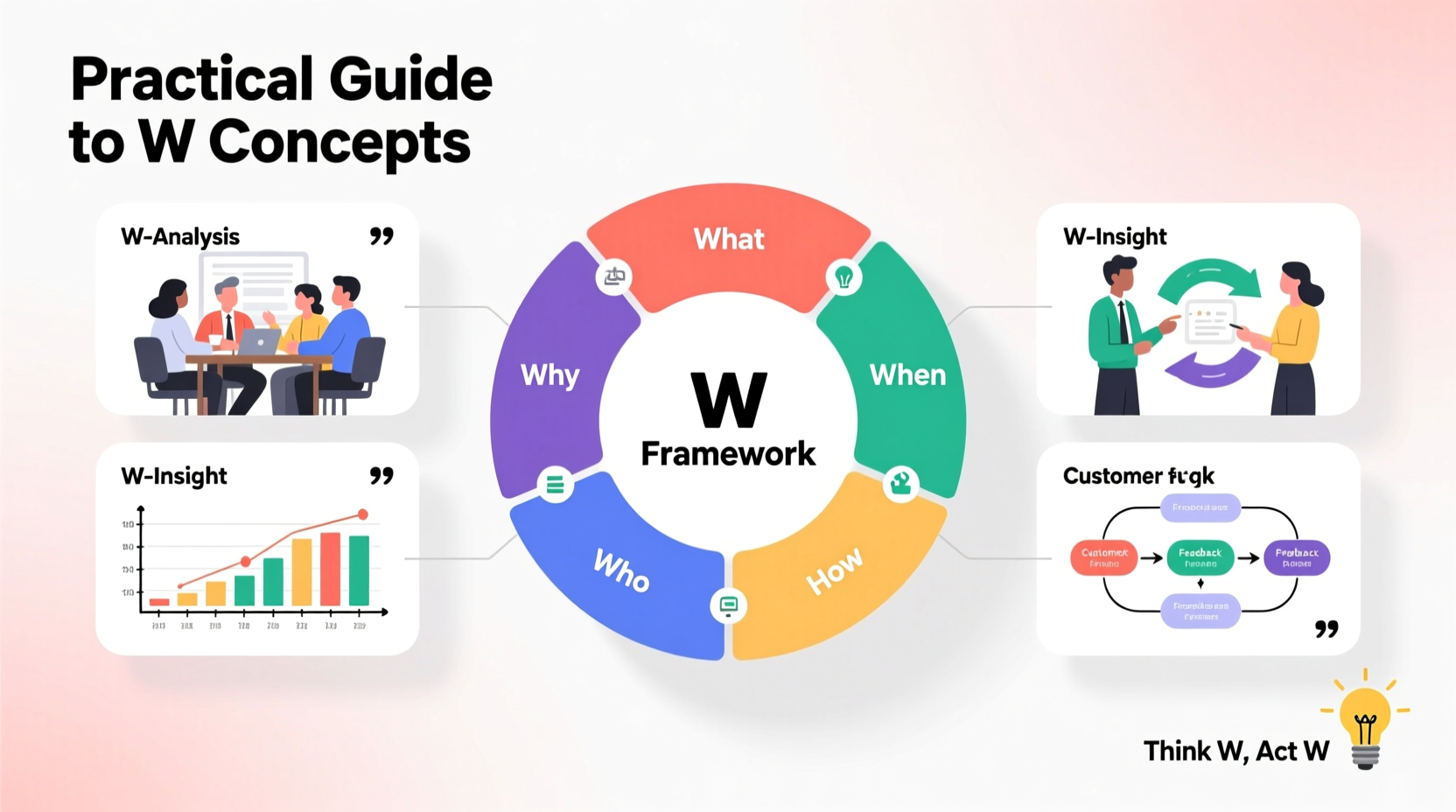
The W concepts typically refer to five foundational questions: Who, What, When, Where, and Why. These aren’t just journalistic prompts—they form a cognitive scaffold for dissecting problems, evaluating choices, and building knowledge. Each “W” acts as a lens through which you can examine any situation with precision.
- Who? Identifies stakeholders, influencers, or actors involved.
- What? Clarifies the nature of the event, object, or idea.
- When? Establishes timing, sequence, or urgency.
- Where? Locates the context geographically, socially, or organizationally.
- Why? Explores purpose, motivation, or underlying cause.
Mastery of these elements allows for sharper analysis and reduces the risk of misjudgment. Unlike surface-level thinking, the W framework encourages depth and intentionality.
Step-by-Step Guide to Applying W Concepts
Applying the W framework isn't reserved for academics or strategists. It's a tool accessible to anyone seeking clearer insight. Follow this six-step process to integrate it into your daily thinking.
- Identify the Situation: Define what you're dealing with—a conflict, opportunity, problem, or goal.
- Ask Each W Question: Write each one down and respond honestly, using available facts.
- Validate Your Answers: Cross-check assumptions. Are your responses based on evidence or emotion?
- Prioritize the Most Influential W: Often, \"Why?\" reveals root causes, while \"Who?\" uncovers power dynamics.
- Map Interconnections: See how answers influence one another. For example, knowing *when* something happened might change your understanding of *why*.
- Act Based on Insights: Use your clarified perspective to make informed decisions or communicate more effectively.
This method works whether you're resolving a team disagreement, planning a career move, or evaluating news sources. The structure prevents reactive thinking and promotes deliberate response.
Common Pitfalls and How to Avoid Them
Even with a strong framework, cognitive biases and time pressure can distort application. Below are frequent errors and how to correct them.
| Pitfall | Consequence | Solution |
|---|---|---|
| Skipping \"Why?\" | Superficial fixes instead of solving root issues | Use the \"5 Whys\" technique to drill deeper |
| Assuming \"Who\" is obvious | Missing hidden influencers or beneficiaries | List all parties, including indirect ones |
| Treating \"When\" as irrelevant | Poor timing or missed windows of opportunity | Create a timeline of key events |
| Overlooking \"Where\" | Contextual blind spots (e.g., cultural norms) | Consider physical, digital, and social environments |
“Most people answer the question they wish had been asked, not the one that was.” — Daniel Kahneman, Nobel Laureate in Behavioral Economics
Real-World Example: Resolving a Workplace Conflict
Consider a scenario where two team members clash during a product launch meeting. Tensions rise, and progress stalls. Instead of mediating emotionally, a manager applies the W framework:
- Who? The lead developer and marketing director are directly involved. Indirectly, the client and end-users are affected.
- What? Disagreement over feature prioritization—functionality vs. user appeal.
- When? The conflict emerged after the second sprint review, suggesting accumulated frustration.
- Where? In a high-pressure virtual meeting with stakeholders observing.
- Why? The developer feels design changes undermine technical stability; the marketer fears bland features won’t attract users.
With this clarity, the manager schedules a private follow-up, reframing the discussion around shared goals. By addressing the \"Why,\" both parties realize their concerns serve the same objective: a successful launch. A compromise is reached with phased feature deployment.
This case shows how the W model transforms emotional friction into collaborative problem-solving.
Checklist: Mastering W-Based Thinking
Use this checklist to ensure consistent and effective use of W concepts:
- ☑ Start with a clear statement of the issue or decision
- ☑ Write out answers to all five W questions
- ☑ Challenge assumptions behind each answer
- ☑ Identify which W carries the most weight in this context
- ☑ Look for missing pieces—what don’t you know yet?
- ☑ Revisit your W analysis after new information emerges
- ☑ Share your W breakdown when explaining decisions to others
Regular use of this checklist strengthens analytical discipline and builds trust in your judgment.
Frequently Asked Questions
Is the W framework only useful for problem-solving?
No. While it excels in troubleshooting, it’s equally powerful for planning, learning, and communication. For instance, when studying a historical event, asking the five Ws helps organize complex narratives into digestible insights.
What if I can’t answer one of the Ws?
Uncertainty is normal. If you can’t answer \"Who?\" or \"Why?\", treat it as a research gap. Note it explicitly and seek information. The value lies not only in having answers but in identifying what needs further exploration.
Can the W model be used in personal development?
Absolutely. Reflecting on your habits with W questions leads to self-awareness. Ask: *What* habit am I trying to change? *Why* did I adopt it? *When* does it usually occur? This introspective use fosters meaningful growth.
Conclusion: Turn Inquiry Into Action
The W concepts are more than a mnemonic device—they are a mindset. They teach us to pause before reacting, to question before concluding, and to understand before acting. In a world that rewards speed, choosing depth is a quiet act of courage. Whether you're navigating a career crossroads, improving relationships, or consuming media, grounding yourself in the W framework brings clarity, confidence, and control.




 浙公网安备
33010002000092号
浙公网安备
33010002000092号 浙B2-20120091-4
Comments
No comments yet. Why don't you start the discussion?