
Choosing between \"which\" and \"what\" may seem like a minor detail, but using the wrong one can make your writing sound awkward or unclear. Both are interrogative pronouns used to ask questions, yet they serve different grammatical roles and imply different levels of specificity. Understanding when to use \"which\" versus \"what\" improves clarity, enhances professionalism, and strengthens communication—whether you're writing an email, crafting a report, or speaking in a meeting.
The confusion often arises because both words can introduce questions about choices. However, their underlying logic differs: \"what\" is open-ended, while \"which\" implies selection from defined options. Getting this distinction right helps listeners and readers follow your meaning without hesitation.
Understanding the Core Difference
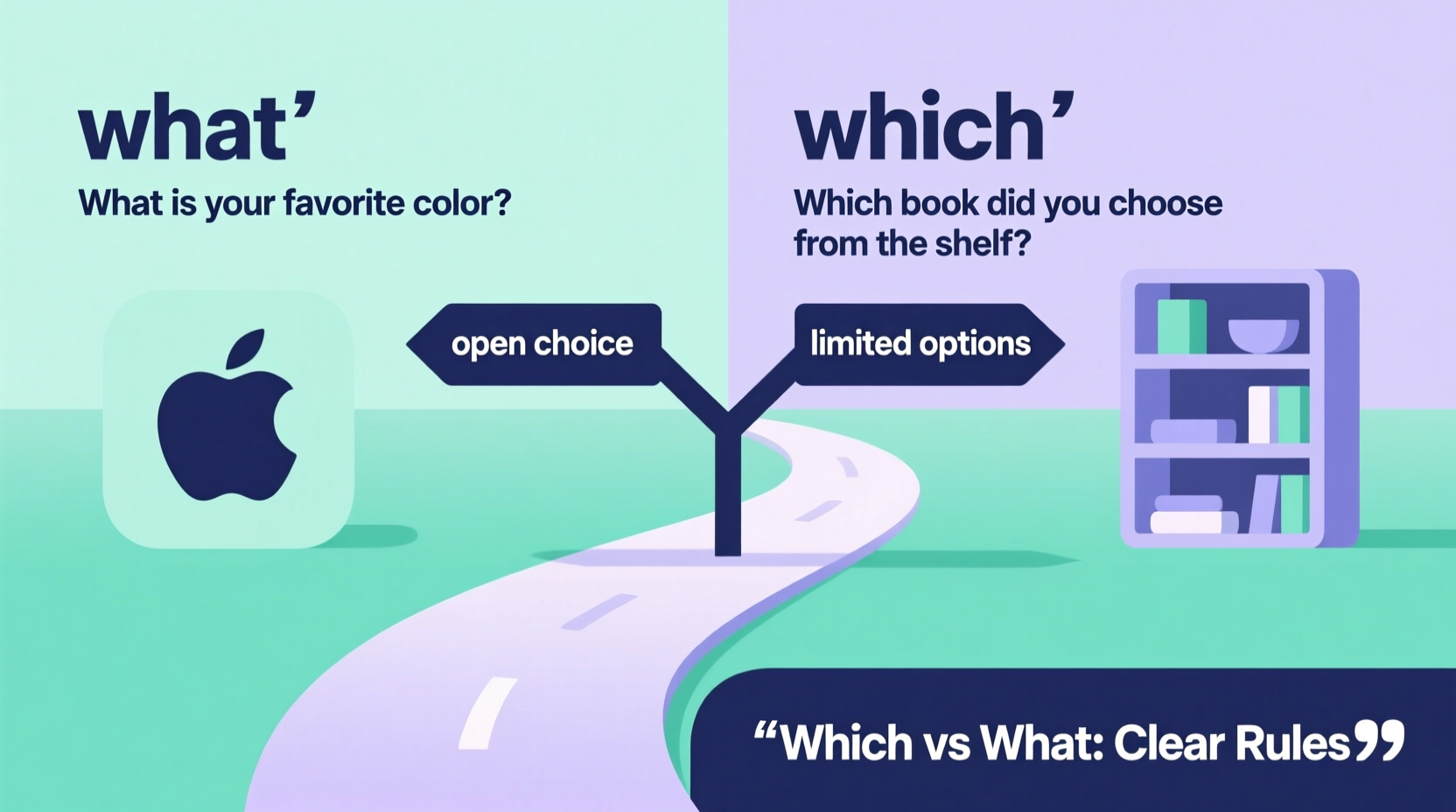
At its foundation, the choice between \"which\" and \"what\" depends on whether the options being considered are limited or unlimited.
- Use \"what\" when the range of possible answers is broad, unknown, or unrestricted.
- Use \"which\" when there is a finite set of choices, even if that set isn’t explicitly listed.
For example:
\"What kind of music do you like?\" — This assumes an infinite variety of genres exist.
\"Which kind of music do you prefer: jazz, rock, or classical?\" — Here, the listener must choose from three named options.
In practice, \"what\" invites exploration; \"which\" narrows focus. Recognizing this subtle but powerful difference allows for more precise language use.
When to Use \"What\": Open-Ended Questions
\"What\" introduces questions where the speaker doesn’t assume prior knowledge of available choices. It’s ideal for gathering information in unstructured contexts.
Examples include:
- What time does the train leave?
- What did you have for breakfast?
- What subject should I study to improve my writing?
These questions don’t presuppose a list. The answer could come from anywhere within a vast domain. Even if practical limits exist (e.g., only certain subjects are offered), the speaker isn't implying any specific shortlist.
Common Mistakes with \"What\"
A frequent error occurs when people use \"what\" in situations where context clearly defines the options. For instance:
- ❌ \"What flavor ice cream do you want?\" (when standing in front of a menu with six listed flavors)
- ✅ \"Which flavor ice cream do you want?\"
Because the choices are visible and limited, \"which\" is more accurate and natural.
When to Use \"Which\": Selecting From Known Options
\"Which\" functions best when the pool of choices is constrained—either by context, prior mention, or shared understanding.
Consider these examples:
- Which book should we read next for the club?
- You’ve passed the test—now which prize would you like: a certificate or a gift card?
- There are two routes to the airport. Which one is faster?
In each case, the number of plausible answers is small and identifiable. Using \"which\" signals that the decision is among known alternatives.
| Question | Correct Word | Reason |
|---|---|---|
| ___ movie are you watching tonight? | Which | Implies choice from recent releases or streaming options (limited set). |
| ___ is your favorite color? | What | No predefined list; answer can be any color. |
| ___ do you want to eat for dinner? | What | Open-ended unless dining at a restaurant with a menu. |
| ___ of these shirts fits better? | Which | Refers to specific items already presented. |
Subtle Context Clues Matter
Sometimes, the same sentence changes meaning based on context. Compare:
- \"What car did you buy?\" — Could mean any car ever made.
- \"Which car did you buy?\" — Suggests the person was choosing among several models recently viewed.
The second version implies a decision-making process involving comparison. That nuance makes \"which\" more informative than \"what\" in evaluative or comparative settings.
Expert Insight: Why Precision Matters
“Using ‘which’ instead of ‘what’ when appropriate shows linguistic awareness. It tells the listener you’re thinking in terms of structured decisions—not just random possibilities.” — Dr. Laura Simmons, Linguistics Professor at Oxford
According to research in applied linguistics, native speakers intuitively prefer \"which\" in constrained-choice scenarios, even if they can't explain why. Non-native speakers who master this distinction are perceived as more fluent and articulate.
Step-by-Step Guide to Choosing Correctly
Follow this five-step process whenever you're unsure whether to use \"which\" or \"what\":
- Identify the intent: Are you asking for general information or a preference? <
- Determine option scope: Is the answer drawn from a large/unlimited pool or a small/defined one?
- Check context: Were options previously mentioned or implied?
- Test substitution: Replace the word with “from this list” (for \"which\") or “in general” (for \"what”). See which fits better.
- Rephrase if needed: If neither feels right, consider restructuring the sentence entirely.
Mini Case Study: Business Meeting Communication
Sarah, a project manager, sent out a follow-up email after a team discussion:
❌ “Let me know what tasks you’d like to take on.”
Her team responded slowly, some asking for clarification on available assignments. A week later, she revised her approach:
✅ “Here are the remaining tasks: drafting the client proposal, updating the budget sheet, or coordinating vendor calls. Please let me know which one you’d like to handle.”
Responses came within hours. By switching from \"what\" to \"which,\" Sarah framed the request as a choice from a clear list, reducing ambiguity and cognitive load.
Checklist: Use This Before Sending Written Messages
Before finalizing emails, messages, or documents, review your use of \"which\" and \"what\" with this checklist:
- ☐ Does the audience know the available options?
- ☐ Am I referring to a specific subset of items, people, or ideas?
- ☐ Would adding “of these” after the question still make sense?
- ☐ Is the question meant to narrow down choices rather than explore possibilities?
- ☐ Have I used \"what\" only when the field of answers is truly open-ended?
If most answers are “yes” to the first four and “no” to the last, \"which\" is probably the better fit.
FAQ
Can \"which\" be used without listing options explicitly?
Yes. \"Which\" can refer to implied sets. For example, “Which way to the exit?” works even without naming directions because the physical layout provides context. As long as the options are naturally limited, \"which\" remains appropriate.
Is it ever correct to use \"what\" when options are limited?
Occasionally, especially in casual speech. Saying “What movie are we watching?” at home with Netflix open is common and acceptable. However, in formal writing or precise communication, \"which\" is preferred when constraints exist.
Do grammar rules differ between American and British English?
No significant difference exists. Both varieties treat \"which\" as indicating selection from a closed set and \"what\" for open-ended inquiries. Stylistic preferences may vary slightly, but the core rule holds across dialects.
Conclusion: Choose With Confidence
Mastering the difference between \"which\" and \"what\" isn’t about rigid grammar rules—it’s about matching your language to your intent. Use \"what\" to invite discovery and \"which\" to guide decisions. With practice, the right choice becomes instinctive, sharpening your expression and boosting credibility.




 浙公网安备
33010002000092号
浙公网安备
33010002000092号 浙B2-20120091-4
Comments
No comments yet. Why don't you start the discussion?