
Fragile ornaments—whether hand-blown glass baubles, antique porcelain figures, or delicate ceramic sculptures—are often heirlooms passed down through generations. Their value lies not only in sentiment but also in craftsmanship and rarity. Yet, their fragility makes proper handling essential. Traditional paper labels degrade over time, peel off, or detract from visual appeal. A modern solution is emerging: discreet QR codes that provide instant access to detailed care instructions without marring the item’s appearance.
This method bridges preservation and practicality, allowing collectors, museums, artisans, and families to safeguard delicate items while ensuring anyone who handles them knows exactly how to do so safely. From holiday decorations to museum artifacts, embedding digital care guidance into physical objects enhances longevity and reduces human error.
The Problem with Conventional Labeling
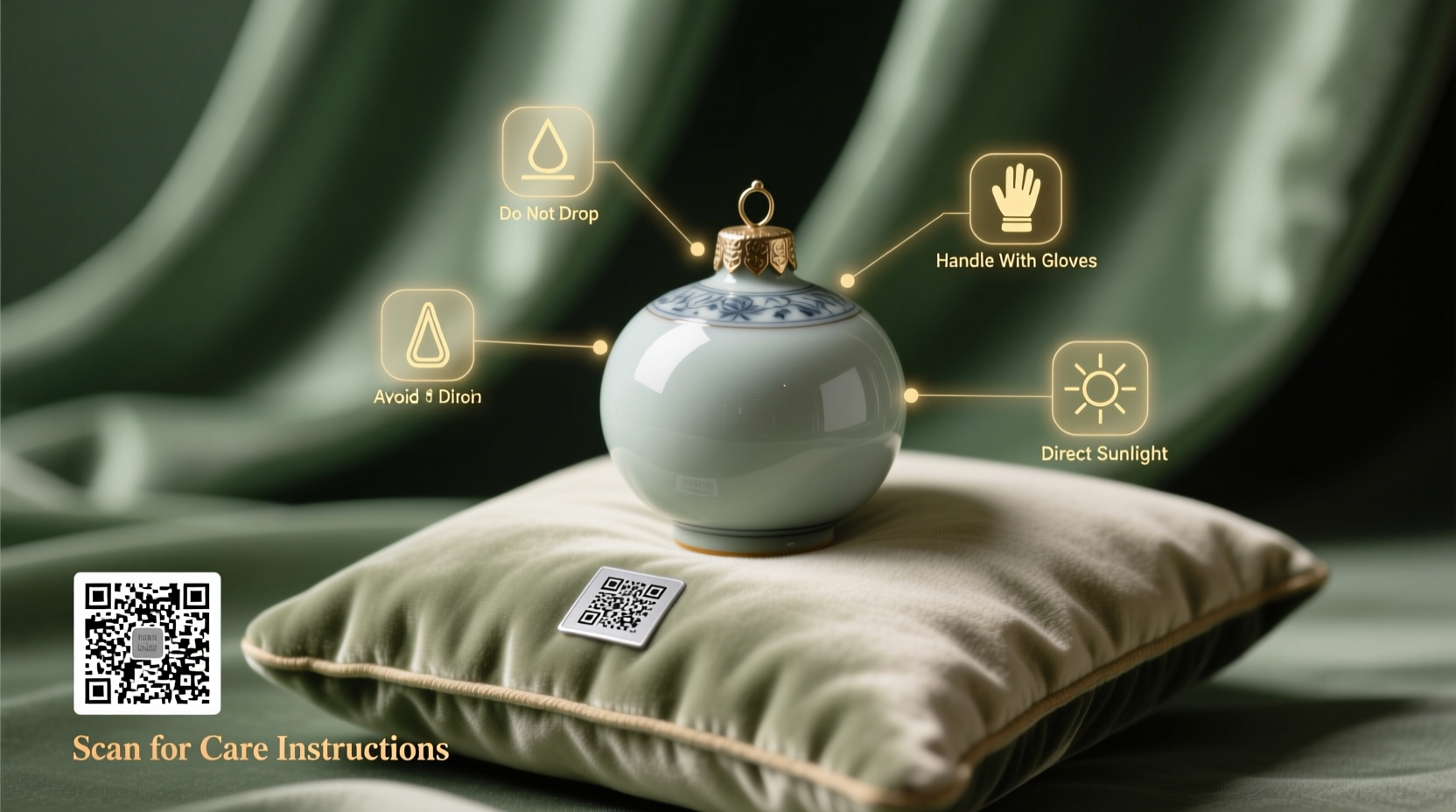
Most people rely on sticky tags, handwritten notes, or storage box labels to convey care details. These methods are inconsistent at best and destructive at worst. Adhesives can leave residue, especially on porous surfaces like unglazed ceramics. Ink may bleed or fade. Paper deteriorates in humidity or temperature shifts common in attics and basements where many ornaments are stored.
Beyond material degradation, traditional labeling fails when context is lost. An ornament removed from its original box or gifted to a new owner often loses its accompanying care sheet. This increases the risk of improper cleaning, accidental drops, or exposure to damaging environments.
“Over 60% of damage to collectible ornaments occurs during handling due to lack of clear, accessible care information.” — Dr. Lillian Cho, Conservator at the National Decorative Arts Institute
Digital labeling via QR codes addresses these issues by embedding durable, invisible guidance directly onto or near the object—without altering its aesthetic integrity.
Why QR Codes Work for Fragile Ornaments
QR (Quick Response) codes are two-dimensional barcodes readable by smartphones and tablets. When scanned, they redirect users to web pages, documents, or multimedia content. For fragile ornaments, this means:
- Instructions remain legible indefinitely.
- No physical wear on the code itself if properly placed.
- Content can be updated remotely (e.g., improved cleaning techniques).
- Multiple languages or video tutorials can be included.
- Codes can be nearly invisible when printed small or embedded subtly.
Unlike RFID tags or NFC chips, which require specialized hardware, QR codes use existing technology—everyone with a smartphone can scan them. They’re also low-cost, easy to generate, and scalable across collections of any size.
Step-by-Step Guide to Implementing Discreet QR Labels
Applying QR codes to fragile ornaments requires precision and planning. Follow this sequence to ensure durability, discretion, and functionality.
- Digitize Care Instructions
Create a dedicated webpage or PDF with comprehensive care guidelines. Include:- Cleaning methods (safe cleaners, tools, frequency)
- Handling precautions (gloves recommended? Two hands?)
- Storage conditions (ideal temperature, humidity, light exposure)
- Display recommendations (indoor/outdoor, shelf stability)
- Contact info for restoration services (optional)
- Generate the QR Code
Use a reliable QR generator such as QRCode Monkey, GoQR, or Bitly. Choose static or dynamic:- Static: Free, permanent, but cannot be edited after printing.
- Dynamic: Allows future edits to the destination URL; ideal for evolving care standards.
- Design for Discretion
Print the QR code at 8–12 mm square for most ornaments. At this size, it's scannable by modern phones but visually unobtrusive. Consider grayscale printing to blend with neutral bases. - Select Attachment Method
Choose based on ornament material and structure:- Adhesive backing: Use archival-safe, acid-free tape or micro-mount dots for non-porous surfaces.
- String tag: Attach a tiny card with the QR code to an existing loop or hanger.
- Base integration: Print directly on the display base or stand.
- Invisible ink: Experimental, but UV-reactive QR codes exist—require special lighting to scan.
- Test Before Finalizing
Scan the code from multiple angles and distances using different devices. Ensure readability under typical indoor lighting. Confirm the linked page loads quickly and displays correctly on mobile screens. - Apply with Precision
Place the label where it won’t interfere with viewing or handling—typically the underside, back, or base. Avoid high-touch areas prone to abrasion.
Best Practices for Long-Term Success
To maximize effectiveness and prevent future complications, adhere to these principles:
- Prioritize reversibility: Never glue directly onto valuable antiques. Use removable mounts that preserve authenticity.
- Backup your data: Host care instructions on a stable platform (e.g., password-protected cloud folder or personal website). Avoid free hosting sites that may shut down.
- Update regularly: Reassess care advice annually. New conservation research may change best practices.
- Train family members: Show younger generations how to scan and interpret the codes—especially important for inherited collections.
| Ornament Type | Recommended QR Placement | Risk to Avoid |
|---|---|---|
| Blown Glass Bauble | Inside cap or hanger loop | External adhesive weakening seal |
| Porcelain Figurine | Underside of base | Scratching glazed surface during application |
| Wooden Nativity Piece | Attached cotton tag | Moisture absorption from direct adhesion |
| Hand-Painted Ornament | Separate archival card in storage box | UV fading of printed code |
Real Example: Preserving a Family Heirloom Collection
The Reynolds family owns a set of 12 handcrafted Christmas ornaments dating back to the 1940s, each representing a significant life event. Stored in a cedar chest for decades, they were passed from mother to daughter with verbal care tips—but over time, details were forgotten. One year, a well-meaning nephew cleaned a silver-accented ball with a commercial polish, stripping its finish.
Determined to prevent further loss, granddaughter Maya implemented a QR system. She created a private webpage hosted on a family domain, detailing each ornament’s origin, materials, and specific care needs. She printed miniature QR cards on archival paper, attached them with silk thread to each ornament’s ribbon, and laminated them with transparent heatless film.
She also made a short video demonstrating safe dusting techniques and embedded it on the page. Now, every family member—from grandparents to teenagers—can scan a code and instantly access accurate, consistent guidance. The collection has remained undamaged for three holiday seasons since implementation.
Checklist: Implement Your Own QR Care System
Use this checklist to ensure no step is missed when setting up your ornament labeling system:
- ☐ Inventory all ornaments needing labels
- ☐ Write detailed digital care instructions for each (or group)
- ☐ Choose hosting method (personal website, Google Drive, Dropbox, etc.)
- ☐ Generate QR codes using a trusted tool
- ☐ Test scanability across multiple devices
- ☐ Select attachment method based on material sensitivity
- ☐ Print codes at optimal size (8–12 mm) in high contrast
- ☐ Apply labels to designated discreet locations
- ☐ Share access instructions with key handlers (family, staff, curators)
- ☐ Schedule annual review of content and code functionality
Common Pitfalls and How to Avoid Them
Even well-intentioned efforts can fail if critical details are overlooked. Here are frequent missteps and their solutions:
- Pitfall: Using generic URLs that expose private data.
Solution: Password-protect sensitive pages or use unguessable URLs (e.g., avoid “/grandma-christmas-care”). - Pitfall: Placing codes where they’re easily rubbed off.
Solution: Position on protected surfaces and use tamper-resistant mounting. - Pitfall: Assuming everyone knows how to scan a QR code.
Solution: Add a tiny icon next to the code (e.g., a phone symbol with a wave) as a visual cue. - Pitfall: Relying solely on digital records with no backup.
Solution: Keep a printed master list in a fireproof safe or share it with a trusted relative.
FAQ
Can QR codes withstand long-term storage conditions?
Yes, if properly protected. Printed on archival paper and laminated or sealed in plastic sleeves, QR codes can last decades. Avoid direct sunlight and high humidity. For extreme environments, consider engraving codes onto metal tags instead.
What if someone doesn’t have a smartphone?
Maintain a secondary reference—such as a printed booklet or labeled USB drive—stored alongside the ornaments. Alternatively, register the collection with a museum or historical society that can assist with access.
Is there a risk of hacking or phishing with QR codes?
Only if malicious links are used. Always generate codes from reputable sources and avoid third-party generators that inject ads or track users. Use HTTPS-secured websites for hosting care pages to ensure safety.
Looking Ahead: The Future of Smart Preservation
As digital integration becomes seamless in everyday life, the line between physical keepsakes and digital stewardship will continue to blur. Some innovators are experimenting with nano-engraved QR codes visible only under magnification, while others embed augmented reality experiences that show restoration history when scanning an ornament.
For now, simple, discreet QR labeling offers a powerful leap forward in preventive care. It empowers owners to protect what matters most—not just from breakage, but from ignorance. As more collectors, artisans, and institutions adopt this practice, we move toward a culture where heritage objects come with built-in wisdom.
“Preservation isn’t just about climate control and gloves—it’s about knowledge transfer. QR codes are the bridge between generations.” — Rafael Mendez, Director of Digital Heritage Initiatives, Global Museum Alliance
Final Thoughts and Call to Action
Your ornaments carry stories, memories, and artistry that deserve protection. By adopting discreet QR codes linked to care instructions, you give them a voice—one that says, “Handle me gently,” “Clean me this way,” and “I matter.”
This isn’t just a tech upgrade; it’s a commitment to mindful curation. Whether you’re organizing a personal holiday collection or managing a public exhibit, take the first step today. Digitize one ornament’s care guide. Print its code. Attach it thoughtfully. Test it. Share it.




 浙公网安备
33010002000092号
浙公网安备
33010002000092号 浙B2-20120091-4
Comments
No comments yet. Why don't you start the discussion?