
Every holiday season, millions of families pull down dusty storage bins filled with ornaments collected over decades. The ritual often begins with excitement but quickly turns into frustration: “Where is the snowman from 2007?” or “I know we have a reindeer in one of these boxes—why does it take 20 minutes to find it?” When ornaments are stored and labeled only by year, locating specific pieces becomes a scavenger hunt across time rather than a joyful part of decorating.
The solution isn’t better memory—it’s smarter organization. By shifting from chronological labeling (by year) to thematic labeling (by subject or style), you transform your ornament storage into an intuitive system. Instead of asking, “Which year did we get the gingerbread man?” you simply reach for the “Foods & Treats” box. No guessing, no sifting. Just clarity and ease.
This approach aligns with how humans naturally recall information—not by dates, but by associations. We remember the cookie-decorating ornament because it’s part of our baking tradition, not because it was purchased on December 15, 2014. Organizing by theme leverages that cognitive advantage, making decoration faster, less stressful, and more enjoyable.
Why Year-Based Labeling Fails During Holiday Prep
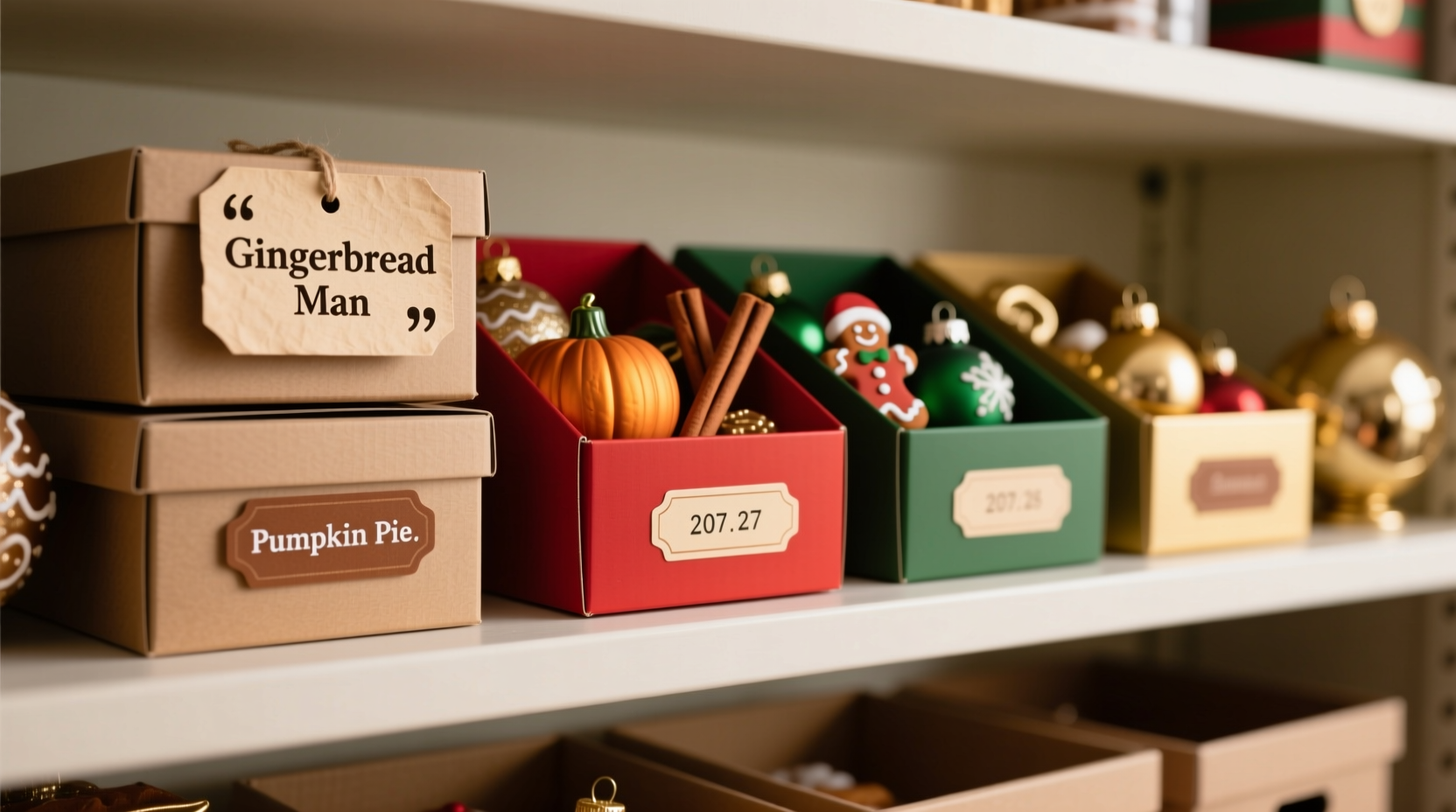
Labeling ornament boxes by year might seem logical at first glance—after all, many collectors want to preserve sentimental timelines. But when it comes to practical use during the busy holiday season, this method breaks down quickly.
Consider a typical scenario: You’re setting up the tree and decide you want to feature all the animal-themed ornaments this year. Rather than opening just one or two clearly marked containers, you now need to open every single box from 2003 to last Christmas, checking each one individually. The same happens if you're helping a child find their favorite character or planning a themed tree like “Winter Wonderland” or “Vintage Hollywood.”
Year-based systems assume you’ll remember both the acquisition date and which box corresponds to it—an unrealistic expectation under seasonal stress. Even digital photos of past trees rarely include metadata like “Box 2016 – Left Branch, Top Right.”
Designing a Thematic System That Works
To build an effective thematic labeling system, start by auditing your collection. Empty all ornament boxes into a clean, well-lit space. As you sort, group items into broad categories based on visual and conceptual themes. These should be intuitive enough that any family member—or guest—can understand them without explanation.
Common and useful themes include:
- Animals & Wildlife – bears, deer, birds, woodland creatures
- Foods & Treats – gingerbread men, candy canes, cookies, fruit
- Nativity & Religious Symbols – angels, shepherds, stars, nativity scenes
- Vehicles – sleighs, trains, cars, airplanes
- Characters – Santa, elves, Frosty, Rudolph, pop culture figures
- Nature – snowflakes, pinecones, trees, icicles
- Ornament Style – vintage glass, hand-blown, handmade, felt, ceramic
- Color Themes – gold & white, red & green, silver & blue (useful for coordinated trees)
Some ornaments may fit multiple categories. A porcelain Santa holding a candy cane could belong in both \"Characters\" and \"Foods & Treats.\" In such cases, place it in the category used most frequently or where it makes the most visual sense. Consistency matters more than perfection.
“Organization is not about rigid rules—it’s about creating systems that serve your behavior. Most people decorate by mood or story, not by timeline.” — Sarah Linwood, Home Organization Consultant
Step-by-Step Guide to Reorganize Your Ornament Storage
Switching from year-based to theme-based labeling takes a few focused hours, but the payoff lasts for years. Follow this sequence for best results:
- Gather supplies: Clear bins with lids, masking tape, permanent markers, index cards, labels (optional), inventory notebook or spreadsheet.
- Empty all boxes: Lay out every ornament on tables or clean floors. Handle gently and inspect for damage.
- Create sorting zones: Use large sheets of paper or fabric to mark areas for each theme. Start broad, then refine as needed.
- Sort ornaments: Place each piece into the most appropriate category. Involve family members to capture shared memories and perspectives.
- Adjust categories: Merge or split themes based on volume. For example, if “Handmade Ornaments” has 40 items, consider subcategories like “Kids’ School Crafts” and “Family Heirlooms.”
- Pack by theme: Place sorted ornaments into clear bins. Use tissue paper or dividers to prevent breakage.
- Label clearly: On the outside of each bin, write the theme in bold letters. Add a short descriptor if helpful (e.g., “Foods & Treats – Gingerbread, Candy Canes, Cookies”).
- Create a master list: Document each box’s contents digitally or in a notebook. Include themes, notable pieces, and year acquired for sentimental tracking.
- Store strategically: Keep frequently used boxes accessible. Rotate seasonal displays by swapping out one or two themed boxes each year.
- Review annually: After each holiday, assess what worked and adjust categories or labels as your collection evolves.
Real Example: The Thompson Family Tree Transformation
The Thompsons of Minneapolis had accumulated 17 ornament boxes over 25 years. Each was labeled with a year, from “1998 – First Christmas” to “2023 – Disney Trip.” Every November, the process of decorating involved opening at least 10 boxes to find the right mix of colors and styles. Their daughter, Lily, often cried when her favorite penguin ornament couldn’t be found until mid-December.
In January 2024, they decided to reorganize. Over a weekend, they emptied every bin and grouped ornaments into six main themes: Animals, Foods & Treats, Vintage Glass, Santa & Elves, Nativity, and Kids’ Handmade. They packed each into new clear bins, labeled them boldly, and created a simple Google Sheet listing key items in each.
Last December, when Lily asked for her penguin, her mom said, “Let’s check the Animals box,” and found it in seconds. The entire tree was decorated in under an hour, with intentional placement of themes on different branches. “It felt creative again,” said Mr. Thompson, “not like a chore.”
Do’s and Don’ts of Thematic Ornament Labeling
| Do | Don’t |
|---|---|
| Use clear, descriptive names – e.g., “Woodland Creatures” instead of “Nature 2” | Use vague labels like “Misc” or “Other” |
| Limit the number of boxes – aim for 5–8 core themes to avoid fragmentation | Create overly specific categories like “Red Balls from 2005–2010” |
| Involve the family in naming themes—this increases buy-in and consistency | Name boxes using inside jokes or acronyms only you understand |
| Update labels annually as your collection grows or changes | Set it and forget it—systems decay without maintenance |
| Use durable labels – laminate or use waterproof stickers | Rely solely on marker-written labels that fade over time |
Checklist: Transition from Year-Based to Theme-Based Storage
- ☐ Gather all ornament storage containers in one room
- ☐ Prepare sorting materials (towels, paper, labels, pens)
- ☐ Define 5–8 primary themes based on your collection
- ☐ Sort all ornaments into designated theme zones
- ☐ Adjust themes as needed—merge, rename, or split
- ☐ Pack each theme into its own clearly marked bin
- ☐ Create a master inventory list with themes and highlights
- ☐ Store boxes in an accessible, climate-stable location
- ☐ Test the system next holiday season and refine
Frequently Asked Questions
What if I have sentimental ornaments tied to specific years?
You can maintain sentimentality without sacrificing usability. Keep a small “Memory Box” or attach a note inside the thematic bin indicating when a particular ornament was acquired. For example, inside the “Kids’ Handmade” box, a tag might read: “Star ornament – Emma, age 5, 2018.” This preserves meaning while keeping the external system functional.
Can I combine theme and year labeling?
Yes, but prioritize theme on the outside. Use secondary labeling for year. For instance: “Foods & Treats (Includes items from 2004–2023)” or include the year range on a side panel. The primary identifier should always answer “what’s inside?” not “when?”
How do I handle very large collections?
If you have dozens of boxes, introduce sub-themes under broader categories. For example:
- Animals
- Forest Animals
- Arctic Animals
- Farm Animals
Use hierarchical labeling: “Animals → Arctic → Penguins, Polar Bears.” Maintain a table of contents on the storage shelf or in your digital inventory.
Conclusion: Decorate with Intention, Not Confusion
Switching from year-based to theme-based ornament labeling isn’t just about convenience—it’s about reclaiming the joy of the season. When you can find the gingerbread man in seconds, you spend less time searching and more time celebrating. The holidays are fleeting; your traditions should feel meaningful, not mechanical.
A well-labeled, thoughtfully organized system pays dividends every single year. It empowers children to participate, reduces holiday stress, and makes rotating displays or trying new tree themes effortless. More importantly, it shifts the focus from preservation of the past to creation of the present.




 浙公网安备
33010002000092号
浙公网安备
33010002000092号 浙B2-20120091-4
Comments
No comments yet. Why don't you start the discussion?