
Lighting transforms a Christmas tree from a decorated object into a living centerpiece—a focal point that breathes warmth, rhythm, and quiet reverence into your space. Yet most people stop at stringing one set of lights and calling it done. The result? A flat, overexposed silhouette—or worse, a tangled, uneven glow that competes with the ornaments rather than complementing them. True holiday illumination is architectural: it relies on intentional layering—ambient light to establish mood and spatial context, and accent light to sculpt form, highlight detail, and guide the eye. This isn’t about adding more bulbs; it’s about assigning purpose to each source. Done well, layered lighting makes your tree feel grounded in the room, not suspended in isolation—and invites lingering, not glancing.
Understanding the Two Core Layers: Ambient vs. Accent
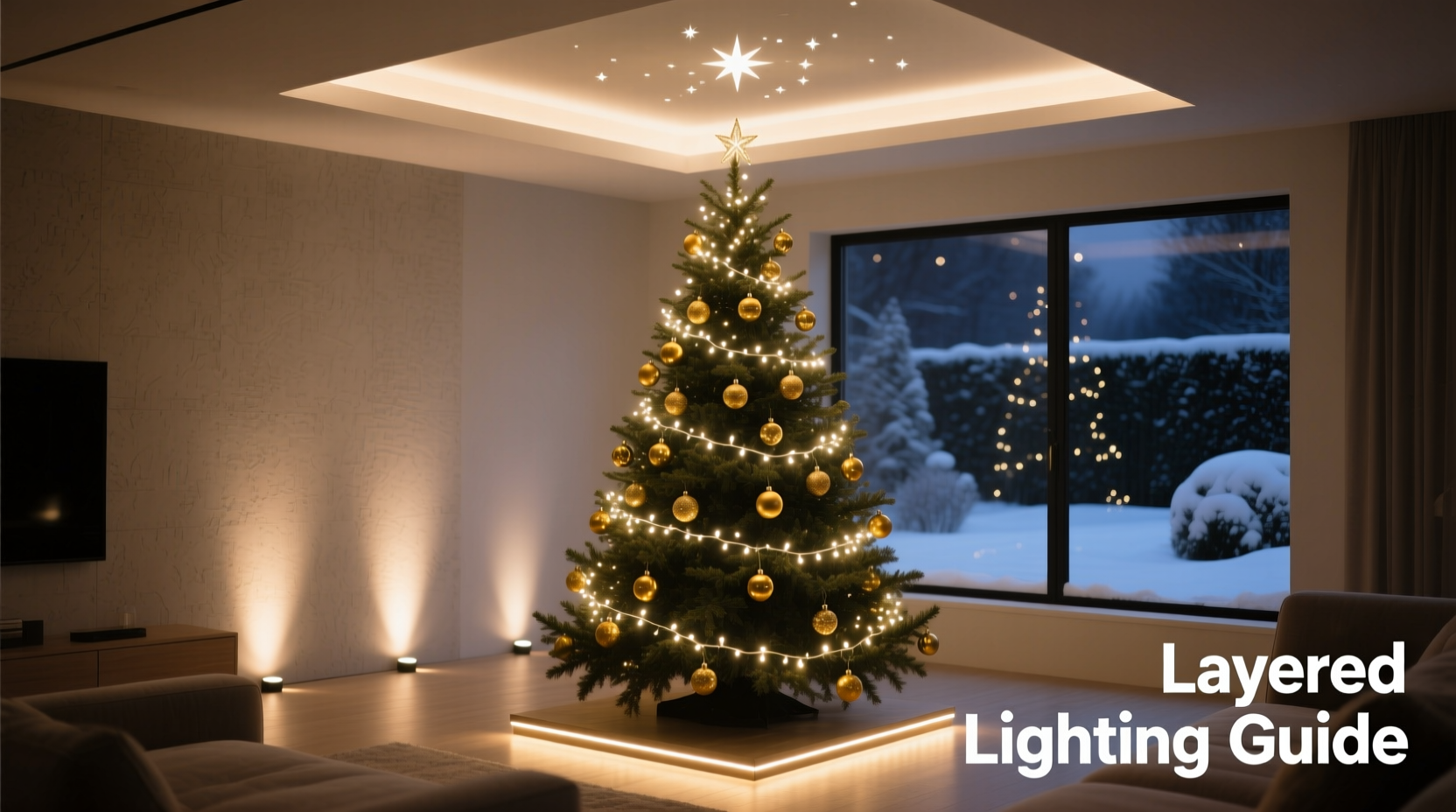
Ambient lighting provides the foundational, even wash of light that defines the room’s overall brightness and tonal temperature. It’s the “air” your tree exists in—the soft, indirect glow that prevents shadows from swallowing corners and allows guests to move comfortably without squinting or tripping. Ambient light doesn’t spotlight; it envelops. Think of recessed ceiling fixtures on dimmers, wall sconces angled upward toward ceilings, or floor lamps with opaque, wide-brimmed shades casting diffused light downward and outward.
Accent lighting, by contrast, is directional and intentional. Its job is to draw attention—to emphasize texture (like the velvet nap of a ribbon), reveal dimension (the curve of a glass ornament’s surface), or create focal hierarchy (making the star or angel shimmer while the lower branches recede softly). Accent sources include track heads, adjustable picture lights, LED puck lights mounted discreetly on shelves or mantels, and even battery-operated micro-spotlights clipped to branch tips.
The critical insight is this: ambient light sets the emotional baseline—calm, festive, cozy—while accent light adds narrative. One without the other feels incomplete. Too much ambient drowns detail; too much accent creates visual noise and fatigue. Balance emerges not from equal wattage, but from calibrated contrast ratios and thoughtful placement.
The 5-Step Layering Process (With Timing & Technique)
Layering isn’t theoretical—it’s procedural. Follow this sequence precisely, testing after each step. Skipping or reordering steps leads to overcorrection and imbalance.
- Step 1: Establish ambient foundation (Day 1, morning)
Turn on only your primary ambient sources—ceiling fixtures, wall sconces, or floor lamps—set to 30–40% brightness. Observe how light falls across walls, furniture, and the floor around the tree stand. Adjust lamp shades or fixture angles to eliminate harsh pools or dark voids. Goal: even, shadow-minimized illumination at eye level throughout the seating zone. - Step 2: Install core tree lights (Day 1, afternoon)
Use warm-white (2700K–3000K) incandescent or high-CRI LED mini-lights. Wind them evenly from trunk to tip, spacing bulbs 4–6 inches apart. Start at the base, spiral upward, then weave back down to fill gaps. Prioritize density on the *inner* branches—this creates internal glow, not just outline. Avoid wrapping only the outer perimeter; that flattens the tree. - Step 3: Add directional accent (Day 2, early evening)
Position two to three adjustable accent sources: one aimed at the tree’s upper third (to lift the topper), one centered on the mid-section (to highlight ornaments), and one low and wide (to illuminate the skirt and base). Use narrow-beam (15°–25°) LEDs. Test beam spread: it should cover the target zone without spilling onto adjacent walls or artwork. - Step 4: Refine ambient contrast (Day 2, late evening)
Dim ambient sources by 15–20%. Then increase accent intensity just enough to restore visual hierarchy—your topper should now read as brightest, ornaments as secondary, and background as softest. This subtle shift creates depth perception. - Step 5: Final calibration (Day 3, daytime)
View the tree in natural daylight. If ornaments look washed out or metallics lack sparkle, add one or two micro-spotlights (under 3W, 12V) clipped to sturdy inner branches, aimed *across* (not at) reflective surfaces. This catches highlights on curvature—not flat reflection.
What Works (and What Doesn’t): Lighting Source Comparison
Not all lights serve the same function. Choosing the wrong type for a layer sabotages the entire effect. This table clarifies purpose, ideal placement, and common pitfalls.
| Light Type | Best For | Ideal Placement | Avoid Using For |
|---|---|---|---|
| Warm-white LED mini-lights (2700K, CRI >90) | Core tree ambient layer | Wound through inner/outer branches, densest at trunk | Accent work—too diffuse, lacks directionality |
| Narrow-beam track heads (25°, 3000K) | Primary accent layer | Mounted on ceiling joists or wall brackets, 3–5 ft from tree, aimed slightly downward | Ambient fill—creates harsh hotspots and glare |
| Uplighting floor lamps (with linen shades) | Room-level ambient | Placed 4–6 ft behind or beside tree, shade tilted to bounce light off ceiling | Direct tree illumination—causes top-heavy brightness and unbalanced shadows |
| Battery-powered micro-spots (1–2W, 12V) | Fine-tuned accent | Clipped to inner branches, aimed across ornament surfaces | Whole-tree coverage—insufficient output, creates scattered points of light |
| Cool-white string lights (4000K+) | None—avoid entirely | N/A | All layers—disrupts warmth, makes greenery look sickly, fatigues eyes |
Real-World Example: The Urban Apartment Tree in a North-Facing Living Room
Sarah, a graphic designer in Chicago, struggled with her 6.5-foot Nordmann fir in a compact, north-facing living room. Her previous setup—a single strand of cool-white lights and an overhead recessed fixture—left the tree looking like a lonely, overexposed prop against gray walls. Shadows pooled heavily behind the sofa, and ornaments vanished in low light.
She followed the 5-step process: First, she installed two adjustable wall sconces (3000K, 350-lumen) angled upward at 45° to wash light onto the ceiling, creating soft ambient bounce. Second, she rewound her tree with 300 warm-white, high-CRI mini-lights—spending 45 minutes ensuring inner density. Third, she added a single 7W track head (25° beam) mounted on the ceiling, positioned 4 feet left of center and aimed at the tree’s crown. Fourth, she dimmed the sconces to 35% and boosted the track head to 70%—revealing dimension without glare. Finally, she clipped two micro-spots to inner branches near the midsection, aiming them laterally across her hand-blown glass ornaments.
The result? A tree that felt “anchored” in the room—not floating. Guests commented on how “restful” the space felt, how ornaments “caught the light differently from every angle,” and how the warm glow made the gray walls feel rich, not cold. Most importantly, Sarah could sit on her sofa at 9 p.m. and read without switching on a task lamp.
“Good tree lighting isn’t about brightness—it’s about luminance contrast and spectral harmony. A 3000K ambient base with precise 3000K accent sources creates visual coherence. Introduce cooler tones, and the brain registers dissonance before it registers ‘Christmas.’” — Rafael Torres, Lighting Designer & Principal, Lumina Studio Chicago
Essential Checklist: Before You Plug In
- ✅ All ambient sources are dimmable and tested independently
- ✅ Core tree lights are warm-white (2700K–3000K), high-CRI (>90), and wound with inner density prioritized
- ✅ Accent sources are narrow-beam (≤25°), adjustable, and positioned at least 3 feet from the tree
- ✅ No accent beam directly hits reflective surfaces (mirrors, glass tabletops, TV screens)
- ✅ All cords are secured with painter’s tape or cord clips—not staples or nails—to prevent damage and fire risk
- ✅ GFCI-protected outlets are used for all plug-in sources
- ✅ Timer settings align: ambient lights turn on 30 minutes before sunset; accent lights activate 15 minutes later for gradual layering
FAQ
Can I use smart lights for layering—or do they complicate things?
Smart lights excel for ambient control—especially those with tunable white (2200K–6500K) and scheduling—but avoid using them for accent work unless they offer precise beam control and independent dimming per fixture. Most smart bulbs flood light; they don’t focus it. Reserve smart systems for ambient sources and use dedicated directional fixtures for accent.
My tree is artificial and looks plasticky under lights. How do I fix that?
Plastic foliage reflects light poorly, causing glare and flatness. First, replace cool-white lights with warm-white, high-CRI LEDs—they render green tones naturally. Second, add ambient uplighting from floor lamps to soften edges. Third, use micro-spots aimed *across* branch clusters (not at them) to catch subtle texture in the PVC needles. Avoid direct frontal lighting—it exaggerates artificiality.
How many accent lights do I really need for a standard 7-foot tree?
Three is optimal: one focused on the upper third (crown/treetop), one on the visual “heart” (midsection, 3–4 feet up), and one wide-angle source illuminating the base and skirt. More than three introduces competing focal points and visual clutter. Quality—not quantity—drives impact.
Conclusion: Light With Intention, Not Habit
Layering ambient and accent lighting around your Christmas tree is less about decoration and more about curation—of space, of mood, of memory. It asks you to slow down, observe how light behaves in your specific room, and make deliberate choices instead of defaulting to tradition or convenience. When ambient light wraps the room in quiet warmth and accent light traces the delicate architecture of pine and ornament, your tree stops being seasonal decor and becomes a sanctuary within your home. It’s the difference between seeing a tree and feeling its presence—the hush it inspires, the way it draws people in, the way its glow lingers in your peripheral vision long after you’ve walked away.
This year, resist the impulse to “just get it done.” Take the time to map your ambient canvas. Choose accent sources with care. Calibrate deliberately. Let the light breathe, recede, and highlight—not shout. Your tree deserves that respect. And your home—your family, your quiet moments, your shared laughter—deserves the depth only intentional light can provide.




 浙公网安备
33010002000092号
浙公网安备
33010002000092号 浙B2-20120091-4
Comments
No comments yet. Why don't you start the discussion?