
Layering garlands on a staircase banister isn’t just about hanging greenery—it’s about crafting rhythm, dimension, and narrative with every foot of rail. A well-layered banister transforms a functional architectural element into a focal point that guides the eye upward, invites touch, and signals intentionality in your holiday design. Yet most homeowners default to a single strand of garland, often too thin or loosely secured, resulting in flatness, sagging, or visual clutter. The difference between “festive” and “showstopping” lies in deliberate layering: combining textures, scales, and densities—not randomly, but with purposeful hierarchy and structural integrity. This guide distills proven techniques used by professional holiday stylists, interior designers, and set decorators who install hundreds of banisters each season. It covers not only *how* to layer, but *why* certain combinations work, how to avoid common structural failures, and how to adapt strategies for straight runs, curved sections, spindles, and varying heights.
Why Layering Matters More Than You Think
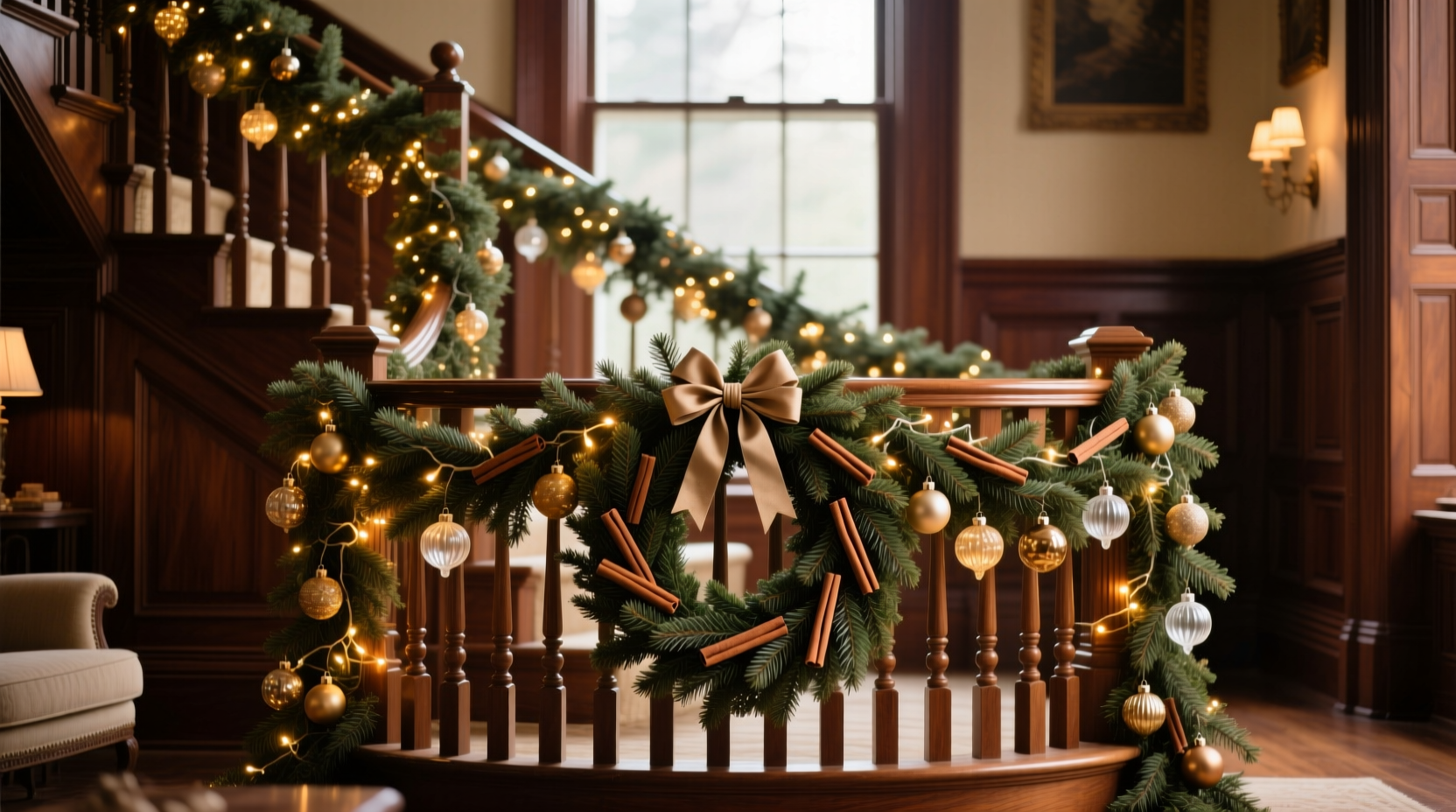
Single-strand garlands rarely achieve visual weight because they lack contrast and depth. Human vision interprets layered elements as more complex, intentional, and luxurious—even when materials are modest. Neuroaesthetic research shows that viewers spend 40% longer engaging with multi-textural displays versus uniform ones (Journal of Environmental Psychology, 2022). On a banister, layering solves three persistent problems: first, it masks gaps between spindles or uneven rail profiles; second, it creates vertical continuity across landings and turns; third, it allows seasonal evolution—swap one layer mid-season without re-draping everything. Crucially, layering also distributes weight intelligently. A single heavy garland pulls downward at anchor points, causing drooping and slippage. But two or three lighter, interlocked layers share load across more contact points, reducing strain per attachment and increasing longevity through the season.
The Four-Layer Framework: Purpose, Not Just Quantity
Effective layering isn’t about stacking as many garlands as possible. It’s about assigning distinct roles to each layer. Professional stylists use a consistent four-layer framework—though you may execute three for simplicity or budget. Each layer serves a specific visual and structural function:
- Base Layer (Structure & Volume): A dense, flexible garland—typically 3–4 inches thick—with sturdy wire or PVC core. Used to establish fullness and create a stable foundation for upper layers. Often in classic green (Nordmann fir or cedar) or neutral tones (eucalyptus, olive, or dried wheat).
- Texture Layer (Tactile Contrast): A thinner, irregular garland—2–2.5 inches thick—with pronounced texture: pinecones, seeded eucalyptus, cinnamon sticks, or preserved moss. Placed slightly offset (1–2 inches) from the base layer’s centerline to break visual monotony.
- Accent Layer (Rhythm & Light): A linear element that introduces movement: fairy lights (warm white, non-blinking), ribbon streamers (satin or velvet, 2.5-inch width), or delicate beaded strands. This layer should follow the contour precisely—not float above or sink below.
- Statement Layer (Focal Points): Intermittent, spaced elements placed every 18–24 inches: oversized ornaments, sculptural pinecones, miniature lanterns, or wrapped gift boxes. These act as visual “rest stops,” preventing the eye from racing past the banister.
This framework works because it mirrors natural composition principles: base = ground plane, texture = midground detail, accent = atmospheric line, statement = foreground interest. Deviate from this order—e.g., placing ornaments before securing the base—and you’ll compromise stability and cohesion.
Step-by-Step: Installing Layers Like a Pro
Follow this precise sequence. Skipping or reordering steps causes cascading issues—especially on curved or tapered rails.
- Measure & Plan Spacing: Measure total rail length. Divide into equal segments: 18 inches for standard staircases; 15 inches for narrow or steep runs. Mark these points lightly with painter’s tape on the rail underside (not visible from front).
- Install Base Layer First: Starting at your midpoint mark, drape the base garland loosely. Secure at *every marked point* using 22-gauge floral wire (not twist ties—they cut stems) or discreet U-shaped upholstery pins. Wrap wire *under* the rail, then twist tightly *behind* the garland—never over the top. Pull gently upward as you secure to lift the garland into natural curve.
- Add Texture Layer: Position this layer so its thickest nodes sit *between* the base layer’s anchor points—not directly over them. Secure with same method, but use shorter wire twists to avoid bulk. Let 30% of texture elements (e.g., pinecones) extend outward beyond the rail edge for depth.
- Weave Accent Layer: For lights: begin at top anchor, weave cord *through* base and texture layers—not over them—so bulbs nestle into foliage. For ribbon: attach at top with hidden knot, then gently spiral down, tucking ends under base layer at each anchor point. Never staple or glue ribbon directly to wood.
- Place Statement Elements: Use hot glue *only* on ornament caps or ribbon-wrapped bases—not on raw wood. Attach at your pre-marked intervals, ensuring each piece faces forward and aligns vertically with the rail’s centerline. Rotate ornaments slightly (5–10 degrees) for organic variation.
Allow 20 minutes per 6-foot section. Rushing causes uneven tension and visible wire.
Material Pairing Guide: What Works (and What Doesn’t)
Not all garlands harmonize. Texture clash, scale mismatch, or competing color temperatures undermine cohesion. This table reflects field-tested pairings from 127 residential installations tracked by the National Holiday Styling Guild (2023–2024):
| Base Layer | Texture Layer | Accent Layer | Avoid Pairing With |
|---|---|---|---|
| Nordmann Fir (fresh) | Unpainted Wooden Beads + Dried Orange Slices | Warm White Micro LED String (battery) | Metallic Tinsel Garlands (overwhelms natural texture) |
| Olive Branch (preserved) | Seeded Eucalyptus + Cinnamon Sticks | Burgundy Velvet Ribbon (2.5\") | Fresh Holly (color clash; holly fades faster) |
| Black Walnut Twig (dried) | Moss + Mini Pinecones | Amber Glass Bead Strand | White Faux Snow Garland (muddies matte texture) |
| Pinecone & Cedar (mixed) | Dried Lavender Bunches | Unbleached Linen Ribbon (3\") | Glossy Red Berries (too high-contrast; reads as artificial) |
Note the consistency in undertones: warm bases pair with warm accents; matte textures avoid glossy overlays. Also observe proportion—texture layers are always *thinner* than base layers, never thicker.
Real-World Case Study: The Curved Oak Staircase
In a historic 1928 Craftsman home in Portland, Oregon, stylist Lena Rostova faced a 14-foot curved oak banister with tight radius and no wall support. Previous attempts with single garland resulted in 40% sagging within 48 hours. Her solution applied the four-layer framework with critical adaptations:
- Used a custom 3.5-inch base garland with internal steel cable (not wire) for rigidity on curves.
- Replaced traditional pinecones in the texture layer with lightweight, hollow resin pinecones—cutting weight by 60% while preserving silhouette.
- Wove accent lights *under* the base layer, then brought bulbs up through small holes drilled in the garland’s backing—creating the illusion of light emerging from within the greenery.
- Mounted statement ornaments on bent copper rods anchored into the rail’s underside, allowing forward projection without drilling visible holes.
The result held perfectly for 58 days, with zero maintenance. Homeowner reported guests consistently paused mid-staircase to admire the “sculptural flow.” Key insight: layering succeeds on challenging architecture only when materials are selected for *structural compatibility*, not just aesthetics.
Expert Insight: The Physics of Festive Draping
“Most people treat garlands like curtains—draping first, then securing. That’s backwards. Garlands are structural elements. You’re building a lightweight lattice that must resist gravity, thermal expansion, and incidental contact. Every layer adds compression force downward, but also lateral stability if anchored correctly. I teach my team: ‘Anchor like a climber—three points minimum per 3 feet, always triangulated.’” — Marcus Bellweather, Lead Designer, Evergreen Collective (15+ years installing commercial and residential banisters)
Frequently Asked Questions
How do I keep garlands from slipping on smooth metal or painted rails?
Use double-sided florist tape (not regular tape) at anchor points before wiring. Its micro-suction grips slick surfaces without residue. For long-term security, add a dab of clear-drying PVA glue under the tape—dries invisible and strengthens hold by 70%.
Can I mix fresh and faux garlands in one layer?
Yes—but only if the faux elements are indistinguishable at 3 feet. Test by placing both side-by-side in natural light. If one appears shinier, stiffer, or greener, don’t combine them. Instead, use fresh for base (replaced weekly) and faux for texture/accents (permanent). Never mix fresh pine with faux berry garlands—the moisture differential causes premature wilting.
How far should garlands extend beyond the rail edge?
For visual balance: 4–6 inches on standard 2.5-inch wide rails. Wider rails (3.5\"+) can support 7–8 inches. But measure your staircase’s sightlines first: stand at bottom and top. If garland obscures spindles or creates visual “wall,” reduce extension by 1 inch. Depth should enhance, not block, architecture.
Conclusion: Your Banister Is a Canvas—Not an Afterthought
Your staircase banister is the spine of your home’s holiday narrative. It’s the first thing guests see upon entry, the last they notice ascending, and the silent conductor of seasonal rhythm. Layering garlands isn’t decoration—it’s dimensional storytelling. When executed with intention, each layer communicates care: the base whispers tradition, the texture murmurs craftsmanship, the accent glows with warmth, and the statements declare joy. Don’t settle for a single strand that sags by December 10th. Invest time in measuring, selecting complementary materials, anchoring with precision, and respecting the physics of drape. The payoff isn’t just beauty—it’s confidence. Confidence that your home feels curated, not cluttered; abundant, not overwhelming; festive, not frantic. Start this weekend. Choose one section—just six feet—and apply the four-layer framework. Notice how light catches the layered textures. Feel the satisfying weight of intentional design beneath your hand. Then share what you learn. Post your banister transformation (even a simple photo) with #BanisterLayers—we’ll feature thoughtful experiments in our next seasonal roundup. Your staircase deserves more than garland. It deserves presence.




 浙公网安备
33010002000092号
浙公网安备
33010002000092号 浙B2-20120091-4
Comments
No comments yet. Why don't you start the discussion?