
Most people hang lights once — then step back, satisfied. But the difference between a “nice” tree and one that stops conversation isn’t more bulbs. It’s intentionality in layering. Depth in holiday lighting isn’t created by brightness; it’s built through strategic placement, varied scale, controlled contrast, and thoughtful sequencing of light sources. When done well, layered lighting transforms static décor into a living, breathing environment — where shadows hold as much meaning as highlights, and warmth feels tactile, not just visual. This isn’t about decoration. It’s about spatial storytelling with light.
The Three-Layer Framework: Foundation, Form, and Flourish
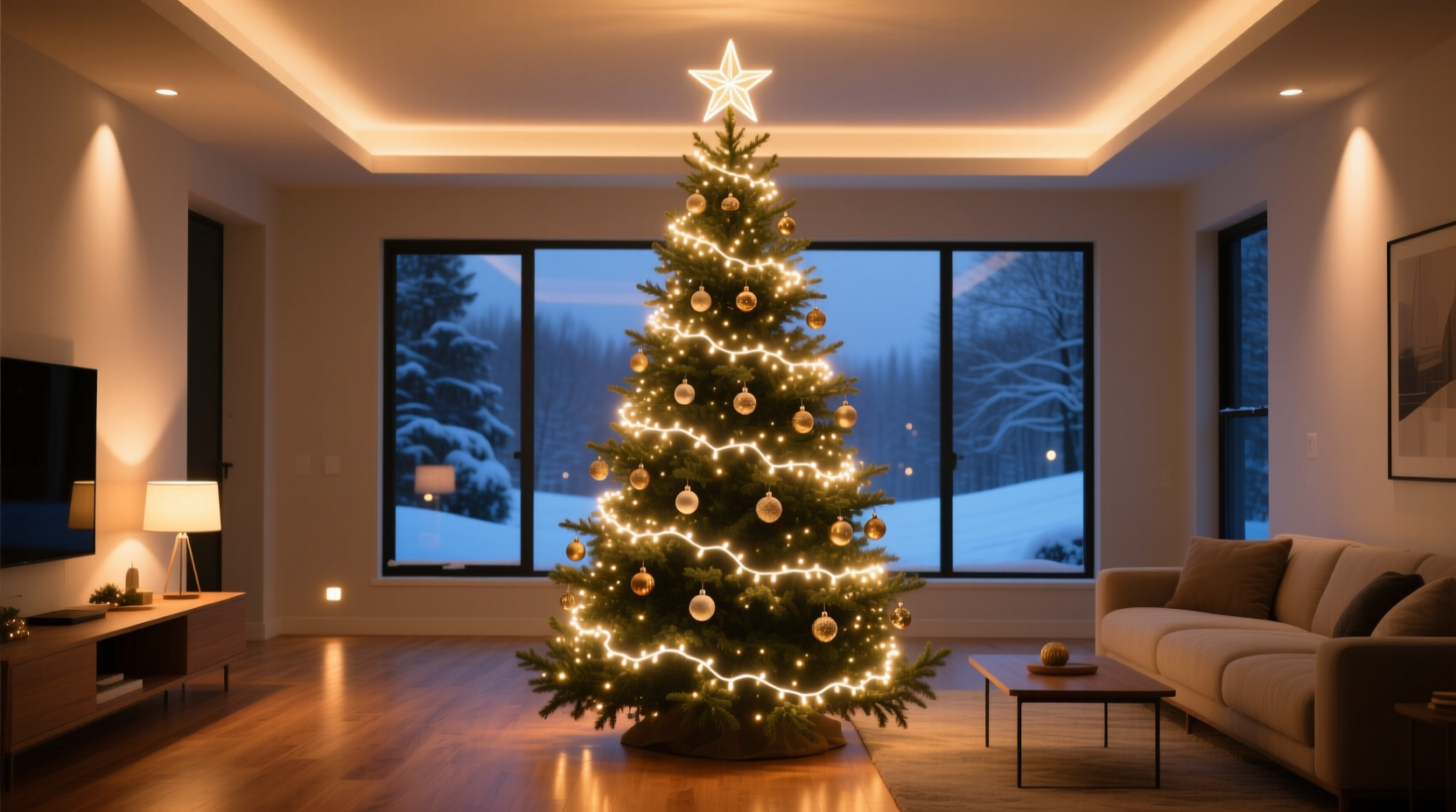
Professional lighting designers use a consistent three-tiered approach — and it applies perfectly indoors during the holidays. Each layer serves a distinct purpose, and skipping or underdeveloping any one weakens the entire effect.
- Foundation Layer: Ambient, low-intensity light that establishes overall mood and eliminates harsh voids. Think warm-white string lights wrapped deep within the tree’s inner branches or recessed LED strips along baseboards and crown molding.
- Form Layer: Mid-level lighting that defines shape, texture, and structure. This includes outlining the tree’s silhouette with a second strand of lights, wrapping garlands, or illuminating architectural features like mantels, bookshelves, or window frames.
- Flourish Layer: Accent lighting that draws attention, adds sparkle, and introduces variation. Think fairy lights draped loosely over branches, battery-operated puck lights nestled in greenery, or small spotlights aimed at ornaments, figurines, or tabletop displays.
Crucially, each layer must operate at a different intensity, color temperature, and rhythm. Foundation should be 20–30% dimmer than form, and flourish should be 15–20% brighter — but never glaring. Warm white (2200K–2700K) dominates foundation and form; flourish can introduce subtle variation (e.g., a single strand of soft amber micro-lights among cool-white foundation strands) — but avoid mixing too many temperatures in one zone.
Tree Lighting: A Step-by-Step Layering Sequence
Forget “starting at the top.” The most effective tree lighting begins from the inside out — and follows a precise physical sequence. Here’s how to execute it flawlessly:
- Prep the trunk and inner core: Wrap a warm-white LED strand tightly around the trunk, starting at the base and spiraling upward every 4–6 inches. Then, take a second identical strand and weave it horizontally through the innermost branches — not on the surface, but deep within the skeleton, following natural branch forks. This creates foundational glow and prevents dark “holes” when viewed from below.
- Add the form outline: Use a slightly brighter (but still warm-white) strand with wider spacing (e.g., 6-inch bulb intervals instead of 4-inch). Begin at the lowest strong branch and wrap outward and upward in a consistent spiral — maintaining even tension and spacing. Do *not* loop back down. Keep this strand visible but not dominant — it should define shape, not compete.
- Integrate garland lighting (if using): If draping ribbon, pine garland, or beaded strands, pre-light them first. Weave a third, ultra-flexible micro-light strand (2mm wire, battery or plug-in) *through* the garland *before* hanging. This ensures even illumination along its length — no dark patches or hot spots.
- Apply the flourish layer: Drape loose, unspooled fairy lights (preferably with memory wire for gentle shaping) over outer branches. Let them fall naturally — don’t force symmetry. Tuck ends deep into foliage so only the lit segments show. For added dimension, place 2–3 small, directional LED puck lights (with adhesive backing) on sturdy interior branches, angled upward toward the tip of the tree.
- Final calibration: Turn off all other room lights. Observe the tree from multiple angles — front, side, and from a low vantage point (crouch down). Adjust any overly bright or dark zones. Dim foundation and form layers by 10–15% if the flourish appears washed out.
Room-Wide Layering: Beyond the Tree
A beautifully lit tree feels isolated without complementary room lighting. True depth emerges when light flows cohesively across surfaces, planes, and vertical zones. Treat your room like a stage set — with foreground, midground, and background lighting.
| Zone | Lighting Technique | Purpose & Pro Tips |
|---|---|---|
| Baseboard & Floor Level | Low-profile LED strip lights (warm white, 2700K) mounted flush under furniture, along stair treads, or behind sofa bases | Creates grounding ambient light; eliminates “floating” effect. Use dimmable strips and keep brightness at 15–20% max — this is pure foundation. |
| Mid-Wall & Furniture Height | Uplights behind plants or tall vases; battery-operated picture lights on wall art; cordless puck lights under open shelves | Defines vertical rhythm and draws eye upward. Avoid aiming lights directly at walls — angle slightly to graze texture (e.g., brick, wood paneling). |
| Ceiling & Upper Walls | Recessed LED downlights (dimmable, 2700K) focused on key areas; discreet LED rope lights tucked into crown molding; pendant lights with frosted glass shades | Provides functional illumination while reinforcing height. Use no more than 3–4 focal points — e.g., over dining table, reading chair, and entryway console. |
| Window Areas | Sheer curtain rods with integrated LED strips; battery-powered mini-lights woven into sheer fabric; small framed LED panels placed *behind* curtains | Creates soft, diffused glow that reads from outside — enhances curb appeal and adds depth to window framing. Never use bare bulbs visible through glass. |
Consistency matters more than quantity. A single well-placed uplight behind a fiddle-leaf fig delivers more perceived depth than ten mismatched lamps scattered across a room. Prioritize quality of light — smooth dimming, uniform color, and minimal glare — over sheer number of fixtures.
Real-World Example: The Compact Apartment Transformation
Sarah, a graphic designer in Portland, lives in a 650-square-foot studio with low ceilings and no fireplace. Her first holiday season there, she hung one 100-bulb strand on her 6-foot tree and plugged in two novelty lamps. The result? A bright, flat, visually exhausting space — especially at night. “It felt like a dentist’s office,” she recalls.
The following year, she applied layering principles with tight constraints. She started with a 24-inch-wide, 48-inch-tall artificial tree (smaller scale allowed deeper interior access). She used three strands: a 200-bulb warm-white foundation strand woven deep inside; a 150-bulb form strand with wider spacing; and 3 meters of flexible micro-fairy lights for flourish. In the room, she installed 1-meter LED strips under her floating desk, behind her bookshelf, and along the base of her Murphy bed frame. She added two adjustable brass uplights — one behind a potted olive tree, another behind a tall floor mirror — both aimed to graze adjacent walls. Finally, she strung 2 meters of battery-powered lights behind sheer linen curtains beside her only window.
The change was immediate. “The space didn’t get bigger — but it felt taller, calmer, and infinitely more intentional,” Sarah says. “People commented on the ‘coziness,’ not the size. I realized depth isn’t about square footage — it’s about how light moves *through* space.”
“Layering isn’t decorative excess — it’s optical architecture. Each layer manipulates perception: foundation anchors, form organizes, flourish invites. Skip one, and the brain struggles to resolve the space.” — Marcus Bell, Lighting Designer, Illumina Studio (12+ years specializing in residential holiday lighting)
Essential Do’s and Don’ts for Lasting Impact
Even with perfect technique, execution pitfalls can undermine months of planning. These are non-negotiable distinctions between amateur and expert results.
- DO use dimmers on *every* hardwired lighting circuit — including tree plugs if using a smart power strip. Layering collapses without dynamic control.
- DO choose LEDs exclusively — not just for energy savings, but for consistent color temperature and near-zero heat output (critical for safety near dry foliage and fabrics).
- DO stagger timing on animated lights. If using twinkling or chasing effects, run only *one* strand per zone — and offset its cycle by 3–5 seconds from others. Synchronized blinking kills depth perception.
- DON’T mix bulb types on the same tree layer (e.g., C6 and G12 bulbs). Varying sizes and diffusion break visual continuity — even if color and wattage match.
- DON’T overload outlets or daisy-chain more than three strands. Voltage drop causes dimming at the end of chains and increases fire risk — especially with older home wiring.
- DON’T rely solely on “warm white” labels. Check the Kelvin (K) rating on packaging. Many “warm white” strings read 3000K+ — too cool for foundation. Aim for 2200K–2700K for true candlelight warmth.
FAQ: Practical Questions Answered
How many lights do I really need for a 7-foot tree?
Forget outdated “100 lights per foot” rules. Modern LEDs are brighter and more efficient. For layered depth: 300–400 bulbs for foundation (deep interior), 200–250 for form (outline), and 100–150 for flourish (surface accents). Total: 600–800 bulbs — not 700 alone. Quality trumps quantity.
Can I layer lights on an artificial tree with built-in lighting?
Yes — but carefully. First, test the built-in lights at their lowest dim setting. If they’re already at 70% brightness or emit cool white light (3500K+), treat them as your foundation layer and add warmer, dimmable form and flourish layers *over* them. Never cover built-in lights with thick garlands — heat buildup risks melting wiring.
What’s the safest way to light high ceilings or stair railings?
Use battery-operated, UL-listed lights with adhesive backing or magnetic mounts — no ladders required. For stair railings, opt for flexible LED rope lights with silicone jackets (non-slip, weather-resistant) secured with removable mounting clips every 12 inches. Always verify battery life exceeds your display period by 25% — and label each unit with its replacement date.
Conclusion: Light With Intention, Not Habit
Layering Christmas lighting isn’t about accumulating more gear. It’s about slowing down — observing how light falls across a branch, how shadow pools beneath a shelf, how warmth radiates differently from a strand buried deep versus one draped loosely on top. It’s the difference between decorating and designing. When you commit to foundation, form, and flourish — when you dim, stagger, and calibrate — you stop illuminating objects and start shaping atmosphere. You invite people not just to look, but to linger. To feel grounded, yet lifted. To sense the quiet magic of intention made visible.
Your home doesn’t need to be magazine-perfect. It needs to feel authentically, warmly, deeply *yours* — and that starts with how light moves through it. So this season, skip the rush. Unplug one strand. Step back. Ask: Where does the eye rest? Where does it travel? Where does it pause? Then light accordingly.




 浙公网安备
33010002000092号
浙公网安备
33010002000092号 浙B2-20120091-4
Comments
No comments yet. Why don't you start the discussion?