
Flat, one-dimensional lighting is the most common reason holiday displays feel underwhelming—even when using premium bulbs and abundant strands. Depth isn’t achieved by adding more lights; it’s created through intentional layering: strategic placement, thoughtful contrast, and purposeful variation in scale, color temperature, and intensity. Professional designers and award-winning home decorators don’t rely on “more is better.” They build luminous architecture—using light as a sculptural medium. This guide distills field-tested techniques used by commercial installers and elite residential stylists into actionable, tool-free methods anyone can apply. Whether you’re dressing a 7-foot Fraser fir or a 16-inch grapevine wreath, these principles transform illumination from decoration into dimension.
Why Layering Creates Perceived Depth (Not Just Brightness)
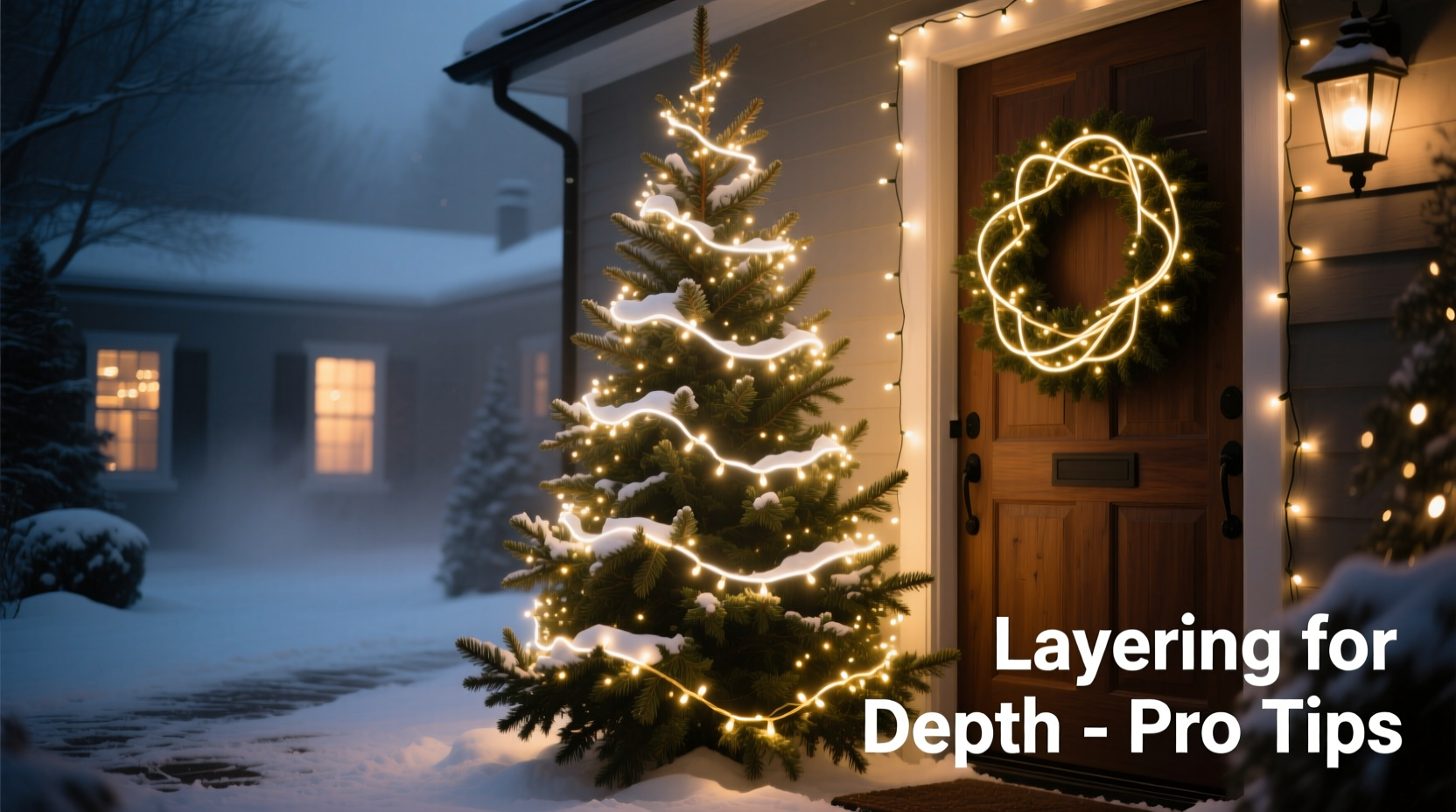
Human vision interprets depth through cues: relative size, overlapping elements, atmospheric perspective (subtle shifts in color and contrast), and light falloff. A single strand of lights wraps around branches but fails to differentiate foreground from background—everything reads at the same visual plane. Layering introduces hierarchy: warm white lights recede slightly, cool whites advance; micro-LEDs suggest delicate texture close up, while larger C7/C9 bulbs anchor focal points farther out; tightly wound inner strands glow softly behind looser outer wraps, creating natural occlusion. The result isn’t just “more light”—it’s spatial storytelling.
This principle holds across scales. On a tree, layered lighting mimics how sunlight filters through real evergreens: dappled at the surface, gently diffused within the canopy, with subtle highlights along outer tips. On a wreath, layers replicate the dimensional quality of hand-tied greenery—where inner sprigs nestle beneath outer bows and ribbons, each catching light differently.
The Three-Layer Framework: Core, Mid, and Accent
Professional installers universally follow a three-tiered approach—not as rigid rules, but as a functional scaffold. Each layer serves a distinct spatial role and must be installed in sequence, from innermost to outermost.
- Core Layer (Foundation): Thin, flexible micro-LED or incandescent mini-lights wrapped *deep inside* the tree or wreath structure. These provide ambient fill, illuminating inner branches without glare. Use warm white (2200K–2700K) for natural depth perception.
- Mid Layer (Structure): Standard LED mini-lights or rope lights placed along primary branch lines and wreath frames. This defines shape and volume. Slightly cooler (2700K–3000K) than the core layer creates gentle forward push.
- Accent Layer (Surface & Detail): Larger bulbs (C6, C7, or battery-operated fairy lights), icicle strings, or programmable pixel lights applied to tips, contours, and decorative elements. This layer adds sparkle, rhythm, and focal interest—drawing the eye outward and upward.
Crucially, each layer should use *different bulb types or spacing*. Never layer identical strands—they’ll visually merge and cancel depth. For example: 100-count warm micro-LEDs (core), 70-count medium-warm mini-lights (mid), and 50-count vintage-style C6 bulbs (accent).
Step-by-Step Tree Layering Protocol
Follow this sequence precisely—deviating disrupts the optical stacking effect. Total time: 45–75 minutes for a standard 7-foot tree.
- Prep the tree: Fluff branches from the bottom up. Ensure inner branches are accessible—not compressed. Trim any obstructive lower limbs if needed.
- Install the Core Layer: Starting at the trunk base, gently weave a warm-white micro-LED strand *between* inner branches—not over them. Work upward in spirals, keeping strands loose enough to avoid pulling branches inward. Use no clips; let gravity and natural tension hold them. Target 100–150 bulbs for a 7-ft tree.
- Add the Mid Layer: Begin again at the base, but now wrap a second strand *over* the outer surface of primary branches. Maintain consistent spacing: 4–6 inches between bulbs on horizontal limbs, 8–10 inches on vertical trunks. Follow the natural “S-curve” of each branch—not straight lines. This defines silhouette.
- Apply the Accent Layer: Now add visual punctuation. Place larger bulbs only on branch *tips*, not mid-length. Drape icicle strings vertically from top-tier branches downward—not horizontally. For a modern look, use programmable lights only on the top third of the tree to create a “glowing crown” effect.
- Final Refinement: Step back 6 feet. Turn off room lights. Observe where light pools (too dense) or vanishes (gaps). Gently adjust only the accent layer—never re-wrap core or mid. Add 3–5 battery-powered puck lights nestled deep in the trunk base for grounded warmth.
Wreath-Specific Layering: Precision Over Volume
A wreath’s compact form demands surgical layering. Unlike trees, there’s no “back”—every angle is visible. Depth here is created through radial stratification and textural contrast.
| Layer | Placement Technique | Recommended Bulb Type | Quantity (16\" Wreath) |
|---|---|---|---|
| Core | Woven *through* the grapevine or wire frame, following its inner contour | Warm white micro-LEDs (2mm) | 70–90 bulbs |
| Mid | Wrapped tightly around the *outer edge* of the wreath body, hiding wire | Medium-warm mini-lights (5mm) | 60–80 bulbs |
| Accent | Hand-placed: 3–5 larger bulbs at cardinal points (top, bottom, left, right); tiny fairy lights clustered at bow centers | C6 vintage bulbs or battery fairy lights | 4–6 bulbs + 1–2 fairy clusters |
Key nuance: The core layer must be *invisible* when viewed head-on—it’s felt, not seen. Its job is to cast soft shadow behind the mid layer, making the wreath appear thicker. The mid layer defines the circle’s crisp edge. The accent layer breaks symmetry and adds human-scale detail. Avoid wrapping strands around the *back* of wreaths—this wastes energy and creates glare on walls.
Real-World Case Study: The “Frosted Pine” Wreath Transformation
In December 2023, interior stylist Maya R. redesigned her client’s entryway wreath after two seasons of flat, unremarkable results. The original used a single 100-bulb warm-white strand wrapped haphazardly—resulting in bright hotspots and dark voids. Maya applied the three-layer method:
- Core: She wove 80 micro-LEDs through the inner vine ring using a bent paperclip as a needle—taking 12 minutes to ensure even distribution.
- Mid: She hand-wrapped 72 mini-lights around the front face, securing each loop with floral wire hidden beneath pine sprigs.
- Accent: She placed four frosted-glass C6 bulbs at 12, 3, 6, and 9 o’clock positions, then tucked two clusters of copper-wire fairy lights beneath a velvet bow.
The result? Visitors consistently described the wreath as “3D,” “like looking into a snow globe,” and “so rich I wanted to touch it.” Notably, total bulb count decreased by 15%—yet perceived brightness increased. The client reported doubling the number of compliments—and no longer needing supplemental wall sconces.
“Depth in lighting isn’t about wattage—it’s about choreography. Every bulb must have a relationship with the ones before and after it in space and time.” — Daniel Torres, Lighting Designer, Holiday Illuminations Co. (12+ years commercial installation)
Essential Do’s and Don’ts for Lasting Dimension
Mistakes in layering compound quickly. These field-validated guidelines prevent common pitfalls:
- Do test all strands *before* installation. Replace flickering or dim bulbs immediately—gaps break layer continuity.
- Do use separate outlets or power strips for each layer when possible. This allows independent dimming and troubleshooting.
- Don’t mix color temperatures within the same layer—e.g., warm and cool white mini-lights on the mid layer will vibrate and flatten.
- Don’t overload extension cords. Layering increases total load; calculate watts (Volts × Amps) and stay below 80% capacity.
- Do secure strands with plastic-coated floral wire or twist ties—not staples or nails. Branches shift; rigid fasteners snap wires.
- Don’t layer lights over heavy ornaments first. Hang ornaments *after* lighting is complete—ornaments interact with light layers and can block intended effects.
FAQ: Layering Questions Answered
Can I layer lights on an artificial tree with built-in lighting?
Yes—but with critical adjustments. Disable or cover built-in lights entirely. Built-in strands are typically mid-layer density and fixed placement, leaving no room for core fill or custom accents. Treat the tree as a blank structural canvas: add your own core layer deep in the branches, then build mid and accent layers as usual. Never run external strands over active built-in wiring.
How many total lights do I need for proper layering?
Forget “100 lights per foot.” Layering requires proportional allocation: 40% core, 40% mid, 20% accent. For a 7-ft tree: ~300 core bulbs, ~300 mid bulbs, ~150 accent bulbs. For a 16\" wreath: ~80 core, ~80 mid, ~40 accent. Quality matters more than quantity—150 well-placed warm micro-LEDs outperform 500 cheap, inconsistent bulbs.
What’s the best way to store layered strands for next year?
Never wrap layered strands together. Store each layer separately on labeled, flat cardboard reels (cut from shipping boxes) or in compartmentalized storage bins. Wind core strands loosely—tight coiling stresses micro-LED wires. Keep accent bulbs in padded dividers. Note the layer type and color temperature on each container. This preserves integrity and eliminates re-testing next season.
Conclusion: Light With Intention, Not Just Abundance
Layering Christmas lighting is fundamentally an act of attention—to the geometry of a branch, the weight of a wreath frame, the way warmth recedes and coolness advances in human perception. It asks you to slow down, observe, and place each element not for coverage, but for conversation: How does this bulb speak to the one behind it? What does this cluster reveal about the form beneath? When done well, layered lighting doesn’t shout “holiday!”—it whispers “presence,” inviting pause and quiet awe. You don’t need specialty tools, advanced wiring knowledge, or a decorator’s budget. You need only this framework, a few thoughtfully chosen strands, and the willingness to see light not as decoration, but as dimension.
Start small this season: choose one wreath or the lower third of your tree. Apply the core-mid-accent sequence. Observe the difference in shadow, glow, and presence. Then expand—not with more bulbs, but with deeper intention.




 浙公网安备
33010002000092号
浙公网安备
33010002000092号 浙B2-20120091-4
Comments
No comments yet. Why don't you start the discussion?