
As the holiday season approaches, homes come alive with warm glows, festive scents, and elaborately decorated trees and mantles. But behind every dazzling display lies a hidden risk: electrical overload. Too many strings of lights, motorized garlands, and plug-in ornaments can push household circuits beyond their limits, leading to tripped breakers—or worse, fire hazards. The good news is that with proper planning and smart layering techniques, you can create a breathtaking holiday atmosphere while keeping your home safe.
The key isn’t just in choosing beautiful decorations—it’s in understanding how electricity flows through your home and how much each outlet and circuit can handle. This guide walks you through practical strategies for layering Christmas lights and garlands safely, including load calculations, circuit management, and real-world examples from seasoned decorators.
Understand Your Electrical System’s Limits
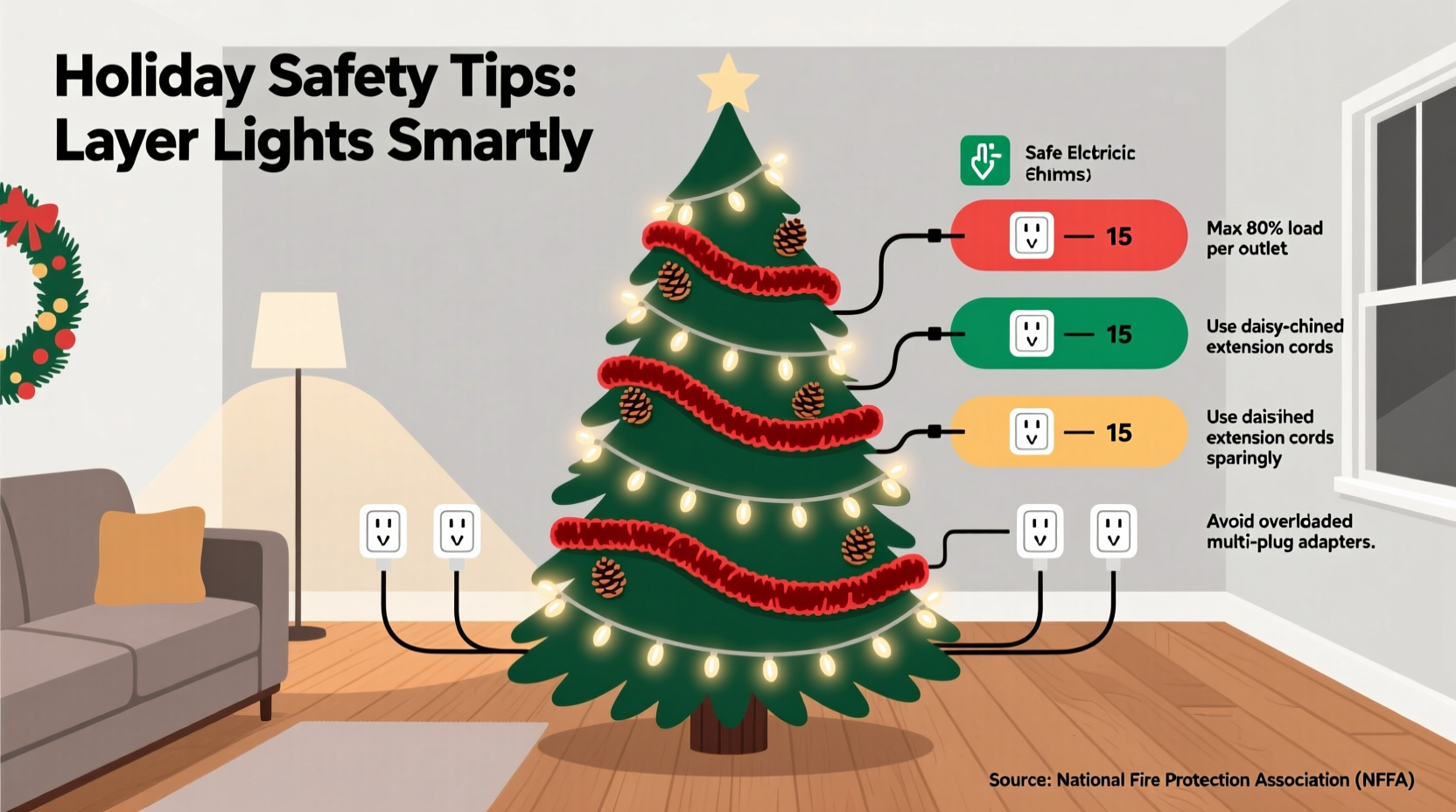
Before plugging in even a single strand of lights, it’s essential to understand the basics of your home’s electrical system. Most standard residential circuits in North America are rated for 15 or 20 amps at 120 volts. That means a 15-amp circuit can handle up to 1,800 watts (15 x 120), and a 20-amp circuit supports 2,400 watts. However, electrical codes recommend using only 80% of a circuit’s capacity for continuous loads—those running for three hours or more, which includes holiday lighting. This brings the safe limit down to 1,440 watts for a 15-amp circuit and 1,920 watts for a 20-amp circuit.
Each string of lights consumes a certain number of watts. Traditional incandescent mini-lights can use 40–50 watts per 100-light strand, while LED versions typically use only 4–7 watts for the same length. Garlands with built-in lights or rotating mechanisms may draw additional power. When layering multiple strands and decorative pieces, these numbers add up quickly.
Calculate Total Load Before You Decorate
Layering lights and garlands becomes dangerous when you exceed outlet or circuit capacity without realizing it. A common mistake is assuming that because multiple devices are plugged into different outlets, they’re on separate circuits. In reality, one wall outlet often shares a circuit with several others in the same room or nearby areas.
To avoid overloading, start by mapping out which outlets are on the same circuit. You can do this by turning off one breaker at a time and testing which outlets lose power. Label them accordingly. Once you know your circuit layout, calculate the total wattage of all devices you plan to connect to each circuit.
“Holiday lighting is one of the most frequent causes of overloaded circuits in December. A little math before decorating prevents big problems later.” — James Lark, Licensed Electrician and Home Safety Consultant
For example, if you're decorating a living room with eight strands of incandescent mini-lights (50 watts each), two illuminated garlands (35 watts each), and a motorized snow globe (20 watts), your total load would be:
- Lights: 8 × 50 = 400 watts
- Garlands: 2 × 35 = 70 watts
- Snow globe: 20 watts
- Total: 490 watts
This load falls well within the 1,440-watt safe limit of a 15-amp circuit. But if you added four more strands of traditional lights and a heated figurine, you could easily surpass the threshold. Switching to LED lights dramatically reduces the load. The same eight strands in LED format might consume only 5 watts each—just 40 watts total instead of 400.
Smart Layering Techniques for Maximum Impact, Minimum Risk
Layering doesn’t mean piling on as many lights as possible. It means creating depth, dimension, and visual interest through strategic placement and power-efficient choices. Here are proven methods to achieve a richly decorated space without pushing circuits to the edge.
Use LED Lights Whenever Possible
LEDs consume up to 90% less energy than incandescent bulbs and generate far less heat, reducing both electrical strain and fire risk. They also last significantly longer—often 25,000 to 50,000 hours—making them ideal for annual reuse. While the upfront cost may be higher, the long-term savings in energy and replacement costs are substantial.
Distribute Load Across Multiple Circuits
Never daisy-chain too many devices on a single outlet or power strip. Instead, spread your decorations across multiple circuits. For instance, place tree lights on one circuit, mantle garlands on another, and outdoor lights on a dedicated exterior circuit. This not only prevents overloads but also ensures that if one circuit trips, your entire display doesn’t go dark.
Use High-Quality Power Distribution Tools
Invest in heavy-duty, UL-listed extension cords and power strips with built-in surge protection and individual switches. Avoid “octopus” setups where multiple strips are plugged into one another. Instead, use a single high-capacity strip connected directly to the wall outlet, and limit the number of devices per strip based on its rating.
| Light Type | Avg. Watts per 100 Lights | Max Strands Safe to Daisy Chain | Heat Output |
|---|---|---|---|
| Incandescent Mini-Lights | 40–50W | 3–4 | High |
| LED Mini-Lights | 4–7W | Up to 25* | Low |
| Bulb-Type C7/C9 (Incandescent) | 5–10W per bulb | 2–3 strands | Moderate to High |
| Bulb-Type C7/C9 (LED) | 0.5–1W per bulb | Up to 50* | Negligible |
*Based on typical 210-watt maximum for light strings; always verify manufacturer specifications.
Incorporate Timers and Smart Plugs
Automating your display reduces runtime and overall energy consumption. Set timers to turn lights on at dusk and off at bedtime (e.g., 6 PM to 11 PM). Smart plugs allow remote control via smartphone and can provide real-time energy monitoring, alerting you to abnormal draws.
Step-by-Step Guide to Safe Holiday Lighting Setup
Follow this timeline to decorate efficiently and safely, minimizing electrical risks while maximizing visual appeal.
- Week 1: Audit and Plan
Walk through your home and identify all intended decoration zones. Note available outlets and test which breaker controls each. Sketch a simple map of circuits. - Week 2: Inventory and Upgrade
Gather all lights and garlands. Replace frayed wires, broken sockets, or outdated incandescent strands with LED alternatives. Discard any damaged items. - Week 3: Calculate Loads
Add up the wattage of all planned devices per circuit. Ensure totals stay below 80% of circuit capacity. Adjust plans as needed—swap in LEDs or redistribute items. - Week 4: Install with Distribution in Mind
Plug devices into different circuits. Use labeled power strips to keep track. Avoid running cords under rugs or across high-traffic areas. - Final Touch: Test and Automate
Turn everything on simultaneously and monitor for flickering, buzzing, or tripped breakers. Program timers or smart plugs for daily operation.
Real Example: The Overloaded Living Room Display
Sarah from Portland decided to go all-out for her family’s first Christmas in a new house. She strung six 100-light incandescent strands around the mantle, wrapped the staircase railing with two illuminated pine garlands, and added a lit nativity scene. All were plugged into power strips connected to a single living room outlet.
On opening night, she turned everything on—and immediately tripped the breaker. After resetting it twice with the same result, she called an electrician. He explained that her combined load was nearly 600 watts, exceeding the safe capacity once other devices (TV, lamps) were factored in. By replacing the incandescent strands with LEDs and moving the nativity to a kitchen outlet on a different circuit, she restored full function without risk.
Her revised setup used only 90 watts for lighting, stayed within safe limits, and looked just as festive—proving that brightness isn’t measured in watts, but in warmth and thoughtfulness.
Essential Safety Checklist
- ✅ Identify all circuits used for holiday decor
- ✅ Replace incandescent lights with LEDs where possible
- ✅ Check all cords for damage before use
- ✅ Use UL-listed extension cords and power strips
- ✅ Never exceed 80% of circuit capacity
- ✅ Avoid daisy-chaining more than three light strands (unless labeled safe)
- ✅ Install GFCI protection for outdoor outlets
- ✅ Use timers or smart plugs to limit runtime
- ✅ Keep decorations away from heat sources and flammable materials
- ✅ Turn off all lights when leaving home or sleeping
Frequently Asked Questions
Can I use indoor lights outside?
No. Indoor-rated lights are not designed to withstand moisture, temperature changes, or UV exposure. Using them outdoors creates shock and fire hazards. Always use lights labeled for outdoor use if placing them outside, even under eaves or covered porches.
How many strings of lights can I connect together?
It depends on the type. Most incandescent mini-lights are rated to connect 3–4 strands end-to-end. LEDs often allow 20 or more, but always check the manufacturer’s label. Exceeding the “maximum connectable” number can overheat wires and void warranties.
Is it safe to leave Christmas lights on overnight?
While modern LED lights generate minimal heat and are safer than older types, experts still recommend turning off all holiday lights when you’re asleep or away from home. Use timers to automate shutdowns and reduce risk.
Conclusion: Decorate Boldly, But Decorate Safely
The magic of the holidays comes from connection, tradition, and beauty—not from how many watts you burn. By understanding your home’s electrical limits and making informed choices about lighting and garland placement, you can create a stunning, layered display that’s as safe as it is spectacular. Prioritize LED technology, distribute loads wisely, and never underestimate the value of a simple timer.
Your family’s safety is the most important ornament on the tree. With careful planning, you can enjoy years of joyful, worry-free celebrations. Start your electrical audit today, and make this the year your holiday decor shines—responsibly.




 浙公网安备
33010002000092号
浙公网安备
33010002000092号 浙B2-20120091-4
Comments
No comments yet. Why don't you start the discussion?