
Most people hang Christmas lights once—and wonder why their tree looks flat, sparse in the middle, or overly bright at the tips. The secret isn’t more bulbs or brighter wattage. It’s *layering*: a deliberate, three-dimensional technique used by professional decorators to create luminous depth, visual rhythm, and that coveted “glowing from within” effect. When done right, layered lighting transforms a static evergreen into a dynamic centerpiece—where every branch seems to breathe light, and shadows recede without disappearing entirely. This isn’t about covering branches; it’s about sculpting with illumination.
The Science Behind Sparkle: Why Layering Works
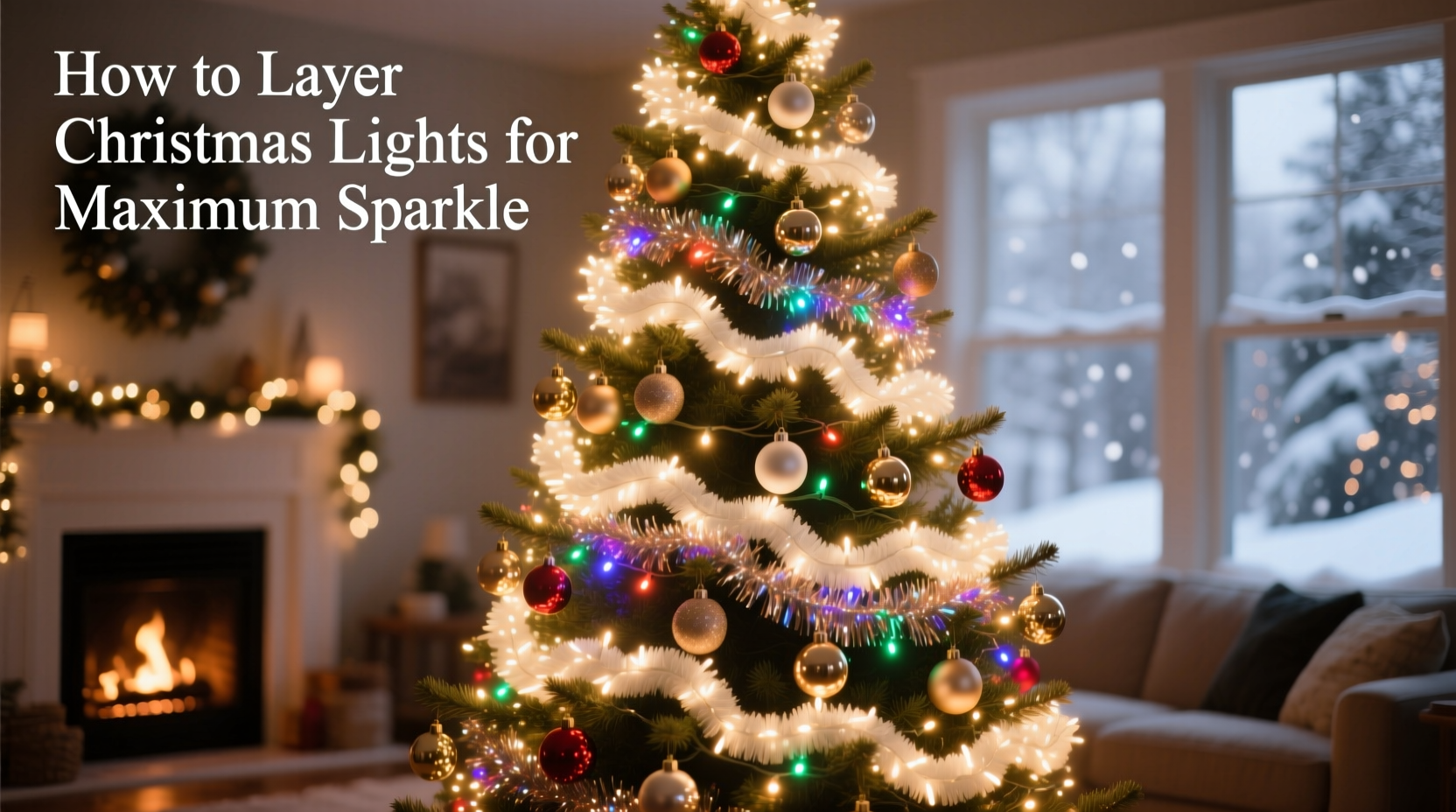
Human vision perceives brightness not in absolute terms, but relative to contrast and context. A single strand of lights viewed against dark foliage creates high-contrast “hot spots”—bright bulbs floating in voids. Layering introduces graduated luminance: inner strands glow softly through needles, mid-layer strands define structure, and outer strands catch ambient reflections. This mimics natural light diffusion—like sunlight filtering through layered forest canopy. Studies in environmental psychology show viewers consistently rate multi-layered lit trees as “more festive,” “warmer,” and “more inviting” than uniformly lit ones—even when total bulb count is identical.
Crucially, layering also solves the “backside problem.” Trees are three-dimensional objects, yet most people light only the front-facing 60–70% of the surface. Without intentional interior and rear placement, the back half remains visually hollow—especially noticeable when the tree stands away from a wall or in open space. Professional installers treat the tree like a volume, not a silhouette.
Pre-Lighting Prep: Tools, Strand Selection & Tree Readiness
Before touching a single bulb, prepare deliberately. Rushing this phase guarantees frustration and compromised results.
Strand selection matters:
- Warm white (2200K–2700K) delivers classic, cozy sparkle—ideal for traditional trees. Avoid cool white unless intentionally going for modern/minimalist.
- LED mini lights (2.5–3.5mm bulbs) offer superior energy efficiency, cooler operation, and tighter spacing—critical for dense layering without overheating.
- Use multiple strand lengths: 100-light strands (approx. 25 ft) for interior and mid-layers; 50-light strands (12.5 ft) for precision work on tips and contours.
- Avoid C7/C9 bulbs for layering: Their size and spacing prevent seamless integration across depths. Save them for outdoor framing or top accents.
Tree readiness checklist:
- Fluff branches outward and upward—not just sideways—to open interior volume.
- Trim any broken or inward-growing branches that obstruct access to the trunk and core.
- Secure the tree stand firmly; a wobbling base disrupts consistent spacing.
- Have two step stools: one stable base stool and one lightweight “reach” stool for upper tiers.
The Three-Layer Method: A Step-by-Step Guide
This proven sequence builds luminosity from the inside out. Never skip layers or reverse the order—it disrupts optical balance.
Layer 1: The Core Glow (Interior Illumination)
Start at the trunk. Wrap strands horizontally around the central stem, beginning at the lowest sturdy branch junction (about 12–18 inches above the stand). Space wraps 6–8 inches apart vertically. Tuck each loop *deep* into the interior—behind the first tier of branches—so light filters forward, not outward. Use gentle clips or twist-ties (not staples or nails) to secure near the trunk. This layer should be subtle: you shouldn’t see bulbs, only soft, even radiance through the foliage.
Layer 2: The Structural Frame (Mid-Canopy Definition)
Now work outward. Starting at the same low point, spiral a new strand upward at a 45-degree angle, weaving it *over and under* major branch junctions—not along branch tips. This creates diagonal rhythm and prevents “stripey” vertical lines. Keep tension light; bulbs should nestle naturally into branch forks, not pull foliage taut. For a 7-foot tree, use 3–4 strands here, staggering start points so spirals don’t align. This layer defines the tree’s silhouette and adds directional interest.
Layer 3: The Surface Sparkle (Outer Contour & Tip Emphasis)
Final layer focuses on texture and highlight. Use shorter 50-light strands. Begin at the bottom and work upward, placing bulbs *on the outermost 1–2 inches of branch tips*, following natural branch curves—not straight lines. Vary density: cluster 2–3 bulbs on prominent tips (especially front-facing), space 4–6 inches apart on thinner branches. Skip every third or fourth tip on dense sections to avoid glare. This layer catches ambient light and creates micro-reflections—the “twinkle” your eye registers as sparkle.
| Layer | Placement Depth | Bulb Visibility | Primary Visual Role |
|---|---|---|---|
| Core Glow | Within 6 inches of trunk | Not visible—only soft glow | Creates volumetric warmth; eliminates dark voids |
| Structural Frame | Middle third of branch length | Partially visible; nestled in forks | Defines shape and adds dimensional rhythm |
| Surface Sparkle | Outer 1–2 inches of tips | Fully visible; intentional highlights | Delivers perceived brightness and textural twinkle |
Pro Techniques for Real-World Success
Even with correct layering, execution details make or break the result.
Branch-by-branch anchoring: Instead of draping long strands loosely, anchor each section before moving on. After placing 3–4 feet of strand, gently tuck ends under nearby branch bark or use clear floral wire (0.3mm thickness) for invisible holds. This prevents sagging and keeps layers distinct.
The “Back Half Rule”: For every 3 bulbs placed on the front, place 2 on the sides and 1 on the back. Stand behind the tree periodically and adjust—don’t assume symmetry. Use a mirror if space is tight.
Power management: Daisychaining too many strands risks voltage drop, dimming inner layers. Check manufacturer specs: most LED mini lights allow 40–60 strands per circuit. Use separate outlets or UL-listed power strips with built-in surge protection and individual switches—so you can test layers independently.
“Amateur lighting treats the tree as a surface. Professional lighting treats it as architecture. You’re not decorating branches—you’re illuminating volume.” — Marcus Bellweather, Lead Designer, Evergreen Lumina Studios (12+ years lighting Rockefeller Center, White House, and Nordstrom flagship trees)
Mini Case Study: The Overwhelmed Hostess & Her 7-Foot Noble Fir
Sarah, a graphic designer in Portland, spent three Decembers frustrated with her family’s 7-foot Noble Fir. “It always looked like a string of lights stuck to a green pole,” she says. “The center was black, the top blinding, and the back? Just… missing.” In year four, she followed the three-layer method strictly—using warm-white 2.5mm LEDs, pre-fluffing for 45 minutes, and dedicating two full hours to lighting (not rushing). She started with 2 core-glow strands, added 4 structural spirals (each starting 12 inches higher than the last), then finished with 6 short sparkle strands. Her husband filmed time-lapses: the transformation wasn’t in brightness, but in *presence*. “People kept walking around it, saying ‘How did you get it to look so… alive?’” Sarah now hosts an annual “Light Layering Night” for neighbors—her signature move? Turning off all room lights and letting guests experience the tree’s self-contained glow.
Common Pitfalls & How to Avoid Them
- Pitfall: “Bulb stuffing” the tips. Overloading ends flattens dimension. Solution: Follow the 1-bulb-per-3-inch rule on fine branches; use clusters only on thick, horizontal limbs.
- Pitfall: Ignoring the trunk-to-tip transition. Abrupt shifts between layers cause visual breaks. Solution: Let core-glow strands gently emerge near branch bases; let structural strands fade into tip placements—not stop abruptly.
- Pitfall: Using mismatched color temperatures. Mixing warm white (2700K) and daylight (5000K) strands creates jarring contrast. Solution: Buy all strands from the same batch/manufacturer—even if purchasing weeks apart.
- Pitfall: Hanging lights before ornaments. Ornaments block light paths and add weight that pulls strands down. Solution: Lights go on *first*, then ornaments, then garlands (which diffuse rather than block).
FAQ
How many lights do I really need for layering?
Forget the outdated “100 lights per foot” rule. For layered effect on a standard 7-foot tree: 300–400 lights for Core Glow (3–4 strands), 500–600 for Structural Frame (5–6 strands), and 300–400 for Surface Sparkle (6–8 short strands). Total: 1,100–1,400 lights. Density—not quantity—is what creates richness.
Can I layer lights on an artificial tree with hinged branches?
Yes—but adapt the method. Hinged trees often have denser outer foliage and sparser interiors. Prioritize Core Glow *between* hinge joints (where gaps exist), and use flexible, thin-gauge wire to thread strands through pre-drilled branch holes if available. Avoid forcing strands into stiff PVC branches—they’ll snap.
What if my tree has uneven density—thin on one side?
Compensate optically, not literally. Place slightly more Surface Sparkle bulbs on sparse areas to draw attention, but keep Core Glow consistent. Then, position the tree so the thinner side faces a wall or corner—letting the fuller side face primary viewing angles. Layering enhances, but doesn’t replace, smart placement.
Conclusion: Light Is Your First Ornament
Your Christmas tree’s emotional impact begins long before the first ornament touches a branch. It begins with light—not as mere utility, but as the foundational layer of atmosphere, memory, and shared warmth. Layering lights isn’t extra work; it’s the single most impactful decision you’ll make in your holiday setup. It turns obligation into artistry, routine into ritual. That soft halo behind the ornaments? That gentle pulse visible through the living room doorway? That’s the reward of treating light as dimension, not decoration. Don’t settle for illumination. Aim for resonance.




 浙公网安备
33010002000092号
浙公网安备
33010002000092号 浙B2-20120091-4
Comments
No comments yet. Why don't you start the discussion?