
Christmas isn’t just seen—it’s felt in the warmth of light on skin, heard in crackling logs and carols, and most powerfully, inhaled. Yet many households treat scent as an afterthought: a single pine-scented candle lit at 7 p.m., or a diffuser running on low all day, its aroma flattened by air conditioning or competing odors. True sensory immersion requires intentional layering—where fragrance doesn’t merely fill space but evolves alongside light, temperature, and human movement. This is not about overwhelming the room with “more.” It’s about choreography: matching volatile top notes to flickering LED warmth, anchoring base notes to the steady glow of vintage-style bulbs, and letting diffusion rhythms echo natural circadian shifts. Done well, layered scent-and-light design deepens emotional resonance, strengthens memory encoding (a key reason nostalgic holiday smells feel so visceral), and transforms your home into a cohesive, living seasonal experience.
The Science Behind Scent + Light Synergy
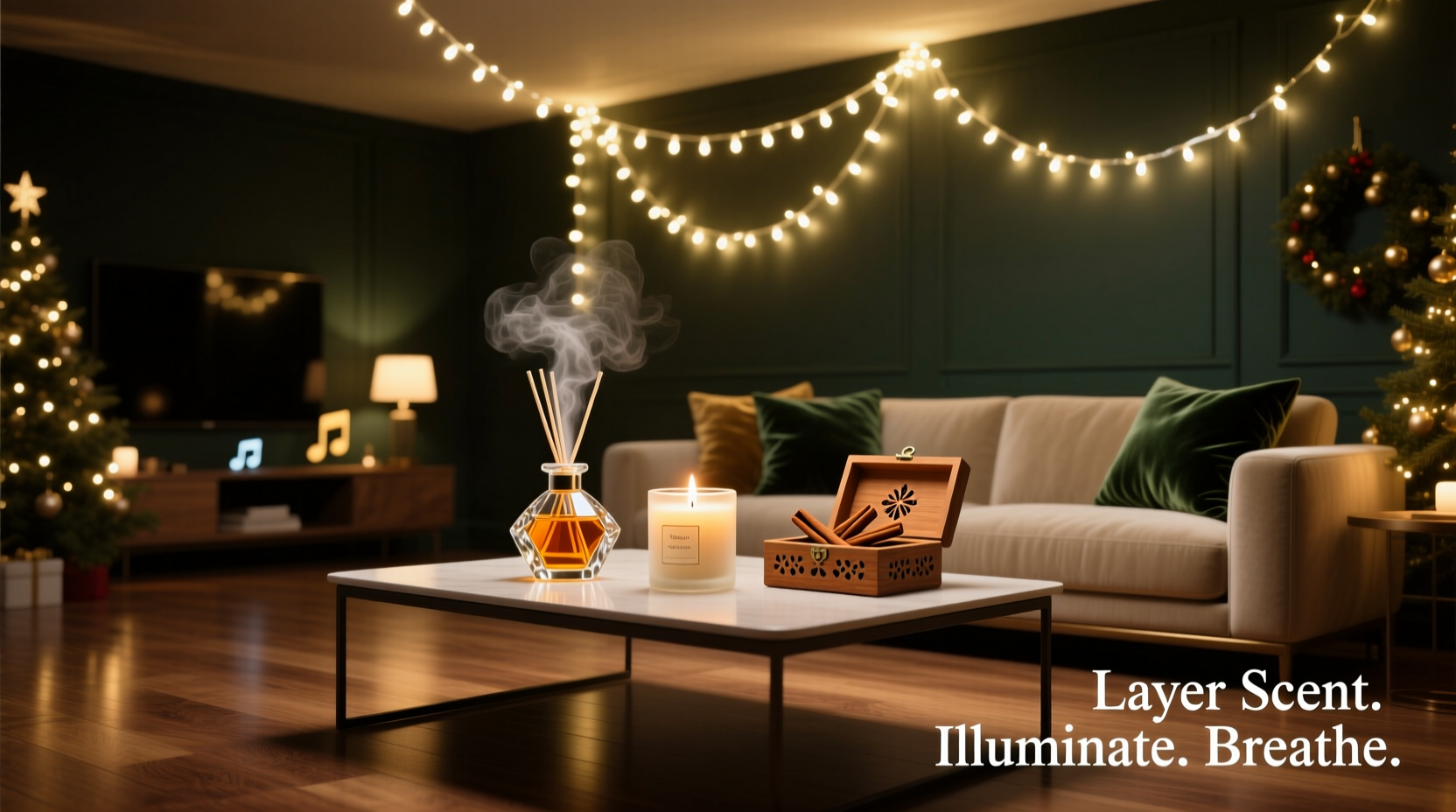
Light and scent interact physiologically—not metaphorically. Warm-toned light (2700K–3000K) stimulates melatonin production and lowers cortisol, priming the nervous system to receive olfactory input more receptively. Meanwhile, certain fragrance molecules—like limonene in citrus oils or eugenol in clove—become more volatile (and therefore perceptible) at slightly elevated ambient temperatures, which incandescent and warm-white LED bulbs gently provide. A 2022 study published in Frontiers in Psychology confirmed that participants exposed to identical cinnamon-vanilla blends reported 37% stronger emotional warmth and 29% greater sense of “homecoming” when paired with 2700K lighting versus cool white (5000K). The effect isn’t psychological suggestion; it’s neurochemical alignment. Light sets the physiological stage. Scent delivers the emotional narrative. Layering them deliberately turns decoration into embodied ritual.
Strategic Layering: Three-Tier Fragrance Architecture
Effective layering follows a proven olfactory framework—top, heart, and base notes—but adapted for spatial and temporal dynamics. Unlike perfume worn on skin, home fragrance must account for airflow, surface absorption, heat sources, and human traffic patterns. Here’s how to build each tier intentionally:
- Top Notes (The First Impression): Bright, volatile, fast-evaporating—citrus (bergamot, sweet orange), green herbs (rosemary, crushed pine needles), or crisp mint. These greet guests at the door or cut through cooking aromas in the kitchen. Best delivered via ultrasonic diffusers on high mist mode or open-top reed diffusers near entryways and windows.
- Heart Notes (The Lingering Presence): Fuller, rounded, emotionally evocative—spices (cinnamon bark, cardamom), florals (geranium, ylang-ylang), or resins (frankincense). These form the “body” of your holiday atmosphere and should anchor main living areas. Ideal for ceramic warmers, low-heat wax melts, or passive diffusers placed on shelves or mantels where air circulates naturally.
- Base Notes (The Subtle Foundation): Deep, slow-releasing, grounding—vanilla absolute, aged sandalwood, vetiver, or balsam fir resin. These don’t shout; they settle into walls, textiles, and memory. Use sparingly in enclosed spaces like bedrooms or reading nooks via linen sprays before bedtime, or in low-output nebulizing diffusers on timers set for overnight release.
This architecture prevents olfactory fatigue—the brain’s natural habituation to constant scent—and ensures your environment feels dynamic, not monotonous. A guest entering your home might first smell bright orange peel (top), then notice spiced apple simmering on the stove (heart), and finally sense the faint, comforting warmth of vanilla-infused wool throws (base).
Light as a Diffusion Catalyst: Matching Bulb Types to Scent Delivery
Not all lights diffuse scent equally—or safely. Heat, spectral output, and placement determine how effectively light supports fragrance dispersion and longevity. Below is a practical comparison guide for common lighting types used during the holidays:
| Light Source | Optimal Scent Pairings | Placement Strategy | Risk to Avoid |
|---|---|---|---|
| Incandescent Vintage Bulbs (2700K) | Wax melts (cinnamon, clove, amber), resin-based incense cones | Directly beneath ceramic warmers or on mantels supporting small oil burners | Overheating delicate botanicals—never place flammable dried citrus or herbs directly on hot bulbs |
| Warm-White LEDs (2700K–3000K, non-dimmable) | Ultrasonic diffusers (citrus, pine, cedar), passive reed diffusers | Mounted above or beside diffusers to create gentle convection currents without heat risk | Placing diffusers too close (<12\")—LEDs emit minimal heat, but proximity can cause condensation buildup inside units |
| Dimmable Smart LEDs (2200K–2700K range) | Nebulizing diffusers (vanilla, sandalwood, frankincense), linen sprays | Programmed to dim gradually 30 min before diffuser timer activates—signals body to prepare for deeper scent absorption | Using full brightness during evening diffusion—disrupts melatonin and dulls scent perception |
| Fairy Lights (Warm White, Battery-Operated) | Small cotton pads infused with essential oil blends, placed *behind* light strands in glass jars or lanterns | Wrapped around scent-diffusing elements—not directly on oils—to gently warm and release aroma | Submerging lights in oil or placing LEDs in direct contact with undiluted essential oils (corrosive to plastic housings) |
Crucially, avoid pairing heat-based scent delivery (wax warmers, oil burners) with cool-white LEDs or fluorescent lighting. The cognitive dissonance between visual “coolness” and thermal scent warmth confuses the brain’s environmental assessment, weakening emotional impact. Consistency between light temperature and scent profile is non-negotiable for full sensory coherence.
A Real-World Layering Sequence: The Harper Family Living Room
In Portland, Oregon, the Harper family transformed their 320-square-foot living room from “festive but forgettable” to a consistently praised “holiday sanctuary” using a deliberate 4-phase layering sequence over three weeks leading up to Christmas Eve:
- Week 1 (Foundation Build): Installed 2700K dimmable LED string lights along ceiling beams and replaced all overhead bulbs with warm-white 2700K LEDs. Placed two passive reed diffusers—one with balsam fir + vetiver (base), one with bergamot + rosemary (top)—in opposite corners, out of direct airflow.
- Week 2 (Heart Activation): Added a ceramic wax warmer on the mantel, loaded with a custom blend of cinnamon bark, cardamom, and dried apple slices. Paired it with a vintage-style Edison bulb (2700K) mounted just above—its gentle heat accelerated melt and release without scorching.
- Week 3 (Dynamic Integration): Programmed smart lights to shift from 2700K at dusk to 2200K (amber glow) by 8 p.m., syncing with a nebulizing diffuser timer releasing diluted vanilla absolute and sandalwood. Simultaneously, they began lightly misting wool blankets and velvet pillows with a 10% vanilla + fractionated coconut oil spray each evening.
- Christmas Eve (Culmination): Lit beeswax taper candles (natural honey-woody scent) on the dining table while turning on battery-operated fairy lights wrapped around a linen-wrapped diffuser pad soaked in orange + clove. The result? Guests consistently described the space as “like stepping into a cherished childhood memory”—not because of any single element, but because every sensory channel reinforced the same emotional signature: warm, grounded, gently spiced, and deeply safe.
What made this work wasn’t expense or complexity—it was fidelity to timing, temperature alignment, and respecting the biological pace at which humans process layered stimuli.
Expert Insight: The Neurological Rationale for Restraint
“Most people fail at scent layering because they chase intensity instead of intentionality. The olfactory bulb has direct neural pathways to the amygdala and hippocampus—the brain’s emotion and memory centers. But those pathways saturate quickly. One well-placed, biologically timed scent note at 2700K light triggers deeper recall than five competing fragrances under harsh light. Less is neurologically more.” — Dr. Lena Torres, Cognitive Neuroscientist & Sensory Design Consultant, MIT Media Lab
Dr. Torres’ research confirms that over-layering—adding too many scents, too much heat, or mismatched light—doesn’t amplify joy. It triggers mild stress responses: narrowed attention, shallow breathing, and subconscious avoidance. True impact comes from curation, not accumulation.
Essential Layering Checklist
- ✅ Audit all light sources: Replace any bulb above 3000K in living, dining, and entry spaces with 2700K warm-white LEDs or incandescents.
- ✅ Assign one dominant scent profile per zone (e.g., citrus-herb for entry, spice-resin for living room, vanilla-wood for bedroom) — no overlapping profiles across adjacent rooms.
- ✅ Use only three active scent delivery methods maximum in any single room: e.g., one diffuser + one wax warmer + one linen spray.
- ✅ Time scent activation to coincide with light dimming: Begin heart-note diffusion 15 minutes before lowering lights to 2200K–2400K for evening.
- ✅ Clean diffuser reservoirs weekly with 70% isopropyl alcohol to prevent bacterial biofilm, which mutates scent profiles and causes musty off-notes.
- ✅ Store essential oils in amber glass, away from light and heat—even if unopened—to preserve molecular integrity for accurate layering.
FAQ
Can I layer synthetic fragrance oils with natural essential oils?
Yes—but with caution. Synthetic fragrance oils often contain solvents (like DPG or DEP) that can destabilize essential oil chemistry, causing rapid top-note evaporation or unpleasant chemical off-notes. If layering, use synthetics only in passive diffusers (reeds, gels) and naturals in heat- or ultrasonic-based systems. Never mix them directly in the same reservoir.
How do I prevent scent clash when cooking holiday meals?
Preempt, don’t react. Before roasting turkey or baking gingerbread, temporarily pause base-note diffusion (vanilla, sandalwood) and boost top notes (citrus, rosemary) in the kitchen and adjacent rooms. Their volatility cuts through food aromas without competing. Resume base notes 90 minutes after cooking ends, once airborne particles have settled.
Is it safe to run diffusers overnight?
Only nebulizing or high-quality ultrasonic models with auto-shutoff and waterless protection are safe for overnight use. Avoid heat-based methods (wax warmers, oil burners) unattended. For bedrooms, prioritize linen sprays applied 1 hour before sleep over continuous diffusion—this aligns with natural circadian scent sensitivity curves.
Conclusion: Your Home Is Already a Sensory Instrument
You don’t need new lights or expensive oils to begin. You already possess the core instruments: the warmth of existing bulbs, the quiet hum of a diffuser, the subtle scent clinging to last year’s pine garland. Layering isn’t about acquisition—it’s about attention. It’s noticing how the amber glow of a lamp makes cinnamon steam rise more visibly from your mug. It’s pausing to adjust a diffuser’s timer so its vanilla whisper arrives precisely as your lights soften to candle-like warmth. It’s understanding that when light and scent move together in rhythm, they don’t just decorate space—they shape time, deepen presence, and turn ordinary moments into anchors of belonging. This season, choose one room. Choose one scent tier. Match it to one light source. Observe what shifts—not in the air, but in your breath, your shoulders, the quiet smile that rises unbidden when you walk in. That’s the full sensory impact you’ve been seeking. It begins not with more, but with precision, patience, and profound respect for how human perception truly works.




 浙公网安备
33010002000092号
浙公网安备
33010002000092号 浙B2-20120091-4
Comments
No comments yet. Why don't you start the discussion?